
Pulp Fiction, 1878 · page 4 of 16
Beadle's Half Dime Library No. 52 — page 4: what you’re looking at
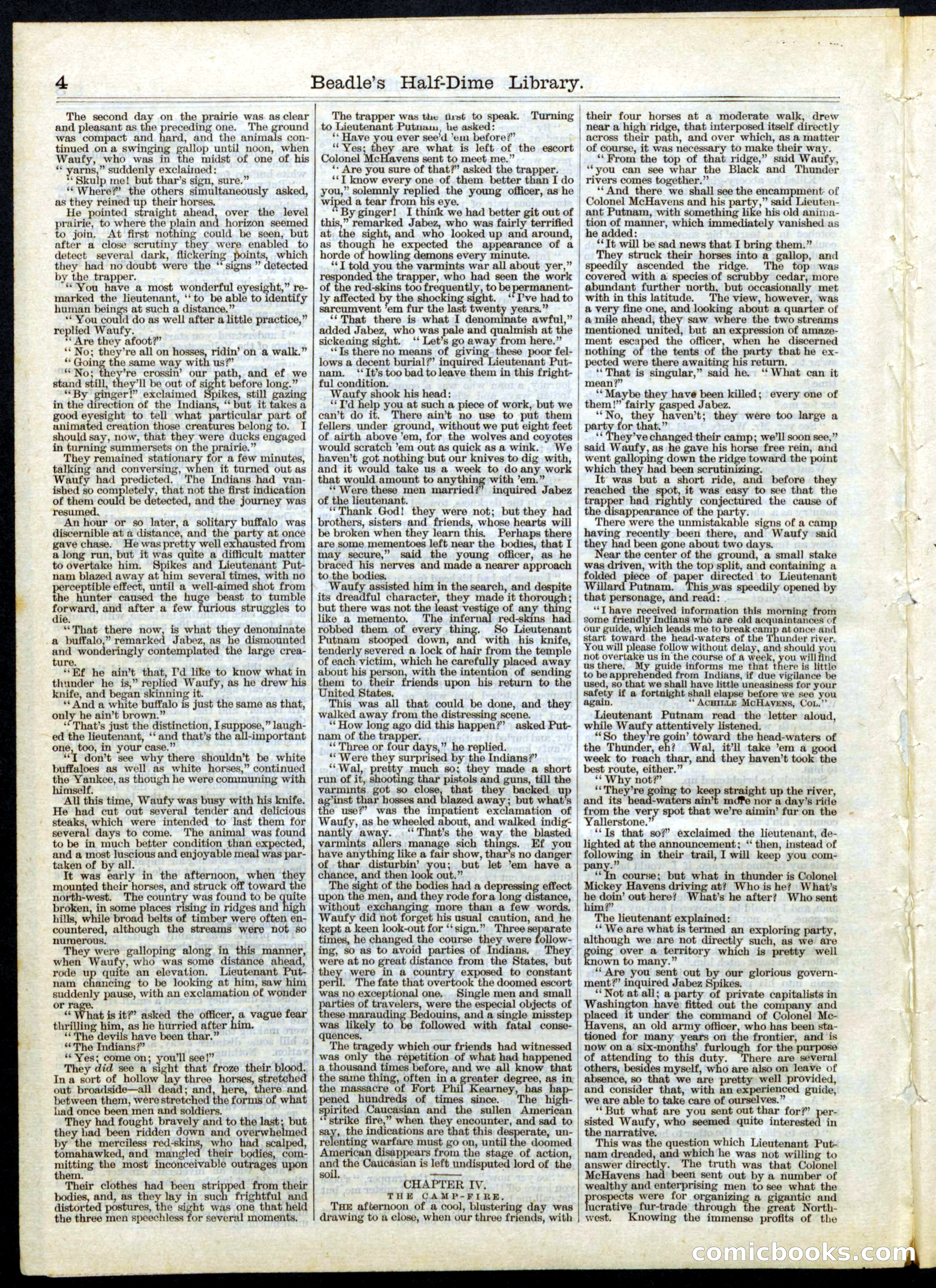
A restored page from Pulp Fiction, 1878. Page through the whole issue in the reader above.
📄 Transcribed text from this page (OCR, searchable)
Machine-transcribed from the original scan — historical spelling and the odd misread are preserved.
4 Beadle’s Half-Dime Library. _ —— — —E -_ - — ——— The second day on the prairie was as clear and pleasant as the preceding one. The ground was compact and hard, and the animals con- tinued ona swinging gallop until noon, when Waufy, who was in the midst of one of his ** varns,” rae sn exclaimed : ‘Skulp me! but thar’s sign, sure.” ‘Where?’ the others simultaneously asked, as they reined up their horses. He pointed straight ahead, over the level prairie, to where the plain and horizon seemed to join. At first nothing could be seen, but after a close scrutiny they were enabled to detect several dark, flickering points, which they had no doubt were the “signs ” detected by the trapper. “You have a most wonderful eyesight,” re- marked the lieutenant, ‘‘ to be able to identify human beings at such a distance.” ‘** You could do as well after a little practice,” replied Waufy. ‘Are they afoot?” ‘** No; they’re all on ho ridin’ on a walk.” ** Going the same way with us?” ** No; they’re crossin’ our path, and ef we stand still, they’ll be out of sight before long.” “By ginger!” exclaimed Spikes, still gazing in the direction of the Indians, “ but it takes a good eyesight to tell what particular part of animated creation those creatures belong to. I should say, now, that they were ducks engaged in turning summersets on the prairie.” They remained stationary for a few minutes, talking and conversing, when it turned out as Waufy had predicted. The Indians had van- ished so completely, that not the first indication of them could be detected, and the journey was resumed, An hour or so later, a solitary buffalo was discernible at a distance, and the party at once gave chase. He was pretty well exhausted from a long run, but it was quite a difficult matter to overtake him. Spikes and Lieutenant Put- nam blazed away at him several times, with no perceptible effect, until a well-aimed shot from the hunter caused the huge beast to tumble forward, and after a few furious struggles to é. “That there now, is what they denominate a buffalo,” remarked J abez, as he dismounted and wonderingly contemplated the large crea- ture. “Ef he ain’t that, ’d like to know what in thunder he is,” replied Waufy, as he drew his knife, and be skinning it. ** And a white buffalo is just the same as that, only he ain’t brown.” ‘‘That’s just the distinction, Isup ed the lieutenant, ‘‘ and that’s the one, too, in your case.” “T don’t see why there shouldn’t be white buffaloes as well as white horses,” continued the Yankee, as though he were communing with himself. All this time, Waufy was busy with his knife. He had cut out several tender and delicious steaks, which were intended to last them for several days to come. The animal was found to be in much better condition than expected, and a most luscious and enjoyable meal was par- taken of by all. It was early in the afternoon, when they mounted their horses, and struck off toward the north-west. The country was found to be quite ata gw some places rising in ridges aud high hills, w broad belts of timber were often en- countered, although the streams were not so wa pene callopiiigl "dais ey were oping along in manner, when Wauty. who was some distance ahead, rode up quite an elevation. Lieutenant Put- nam chancing to be looking at him, saw him suddenly pause, with an exclamation of wonder e,” laugh- -lnportant or ‘“‘ What is it?’ asked the officer, a vague fear thrilling him, as he hurried after him. ‘The devils have been thar.” “The Indians?” ** Yes; come on; you'll see!” They did see a sight that froze their blood. Ina sort of hollow lay three horses, stretched out broadside—all dead; and, here, there and between them, were stretched the forms of what had once been men and soldiers. They had fought bravely and to the last; but they had been ridden down and overwhelmed by the merciless red-skins, who had_ scalped, tomahawked, and mangled their bodies, com- mitting the most inconceivable outrages upon them. A Their clothes had been stripped from their bodies, and, as they lay in such frightful and distor postures, the sight was one that held the three men speechless for several moments. —— The trapper was the tirst to speak. Turning to Lieutenant Putnam, be asked: ‘* Have you ever see’d ’em before?” s° ¥ 86 ard are what is left of the escort | of course, it was necessary to make their way. v Colonel Mc ens sent to meet me.” ‘* Are you sure of that?” asked the trapper. ‘*] know every one of them better than I do you,” solemnly replied the young officer, as he wiped a tear from his eye. | «6 _ Colonel McHavens and his par SE their four horses at a moderate walk, drew near a high ridge, that interposed itself directly across their path, and over which, as a matter ‘‘From the top of that ridge,” said Waufy, rivers comes together.” you can see whar the Black and Thunder ‘*And there we shall see the encampment. of ae Lieuten- By ginger! I think we had better git out of ant Putnam, with something like his old anima- tion of manner, which immediately vanished as this,” remarked Jabez, who was fairly terrified at the sight, and who looked up and around, as though he expected the appearance of a horde of howling demons every minute. **IT told you the varmints war all about yer,” responded the trapper, who had seen the work of the red-skins too ie 2 apni to be permanent- ly affected by the shocking sight. ‘‘ I’ve had to sarcumvent ‘em fur the last twenty years.” ‘That there is what I denominate awful,” added Jabez, who was pale and qualmish at the sickening sight. ‘* Let’s go away from here.” ‘*Ts there no means of giving these r fel- lows a decent burial?’ inquired Lieutenant Put- nam. ‘‘It’s too bad toleave them in this fright- ful condition. Waufy shook his head: “Td help you at such a piece of work, but we can’t do it. There ain’t no use to put them fellers under ground, without we put eight feet | arcs Neaiesnaehile m1 ‘‘ They’ve changed their camp; we’ll soon see,” of airth above ’em, for the wolves and coyotes would scratch ’em out as quick asa wink. We haven’t got nothing but our knives to dig with, and it would take us a week to do any work that would amount to anything with ’em.” ‘* Were these men married?’ inquired Jabez of the lieutenant. “Thank God! they were not; but they had brothers, sisters and friends, whose hearts will be broken when they learn this. Perhaps there are some mementoes left near the bodies, that I may secure,” said the young officer, as he braced his nerves and made a nearer approach to the bodies, Waufy assisted him in the search, and despite its dreadful character, they made it thorough; but there was not the least wesige of any thin like a memento. The infernal red-skins had robbed them of every thi Putnam stooped down, an with his knife, So Lieutenant | tenderly severed a lock of hair from the temple | of each victim, which he carefully away about his person, with the intention of sending them to their friends upon his return to the United States. This was all that could be done, and they walked away from the distressing scene. ‘* How long ago did this happen?’ asked Put- nam of the trapper. ‘‘ Three or four days,” he replied. ‘** Were they surprised by the Indians?’ ‘Wal, pretty much so; they made a short run of it, shooting thar pistols and guns, till the varmints got so close, that they backed u ag’inst thar bosses and blazed away; but what’s the use?’ was the impatient exclamation of | Waufy, as he wheeled about, and walked indig< | nantly away. ‘‘That’s the way the blasted varmints allers manage sich things. Ef you have anything like a fair show, thar’s no danger of thar disturbin’ you; but let ’em have a chance, and then look out.” The sight of the bodies had a depressing effect upon the men, and they rode fora long distance, without e ing more than a few words. Waufy did not forget his usual caution, and he kept a keen look-out for ‘‘sign.” Three separate times, he changed the course they were follow- ing, so as to avoid parties of Indians, They were at no great distance from the States, but they were in a country exposed to constant peril. The fate that overtook the doomed escort was no exceptional one, Single men and small ead of travelers, were the especial objects of hese marauding Bedouins, and a single misstep was likely to followed with fatal conse- quences. The tragedy which our friends had witnessed was only the repetition of what had happened a tnonsane egg Scere ns and me oe know aoe e same thing, often in a r degree, as in the massacre of Fort Phil Kearney, has ha pened hundreds of times since. The fie irited Caucasian and the sullen American ‘strike fire,” when they encounter, and sad to mf the indications are that this d rate, un- relenting warfare must go on, until the doomed American disappears from the stage of action, and the Caucasian is left undisputed lord of the soil, CHAPTER IV. THE CAMP-FIRE. Tae afternoon of a cool, blustering day was drawing to a close, when our three friends, with he added: ** Tt will be sad news that I bring them.” They struck their horses into a gallop, and dil covered ascended the ridge. The top was with a species of scrubby cedar, more abundant further north, but occasionally met with in this latitude. The view, however, was a very fine one, and looking about a quarter of a mile ahead, they saw where the two streams mentioned uni ment esca nothing o pected were there awaitin ‘That is singular,” said he. mean?” the officer, w but an ee of amaze- en he discerned the tents of the party that he ex- his return. ‘What can it ‘* Maybe they have been killed; every one of them!” fairly — Jabez. ‘*No, they haven’t; they were too large a for that.” said Waufy, as he gave his horse free rein, and went galloping down the ridge toward the point which they had been scru tinizing. It was but a short ride, and before they reached the spot, it was easy to see that the hg er had rightly conjectured the cause of e appearance of the part There were the unmistakable signs of a camp having recently been there, and Waufy said the had been gone about two days. ear the center of the ground, a small stake was driven, with the top split, and containing a folded piece of pa Will Putnam. that personage, and read: r directed to Lieutenant is was speedily opened by ‘*T have reeeived information this morning from some friendly Indians who are old acquaintances of atonce and , under river. You will please follow without delay, and should you not overtake us in the course of a week, you will find our guide, which leads me to break cam start toward the head-waters of the ' us there. My tide informs me that there is little to be apprehended from Indians, if due vigilance be used, so that we shall have little uneasiness for your safety if a fortnight yy elapse before we see you again. CHILLE McHavens, Cou.’’ Lieutenant Putnam read the letter aloud, while Wauty attentively listened. “So they’re oin’ toward the head-waters of the Thunder, eh? Wal, it’ll take ’em a good week to reach thar, and they haven’t took the best route, either.” ** Why not?” ‘*They’re to keep straight up the river and its hactlies ant aadPerdir: oy day’s ride from the very spot that we’re aimin’ fur on the Yallerstone. ‘‘Is that so?’ exclaimed the lieutenant, de- lighted at the announcement; ‘ then, instead of fo lowing in their trail, I will keep you com- pany.” pF 4 course; but what in thunder is Colonel Mickey Havens driving at? Who is he? What's Who sent 4 he doin’ out here? What's he after? him?” The lieutenant explained: ‘* We are what is although we are not directly rmed an exploring party, such, as we are going over a territory which is pretty well own to many.” ‘*Are you sent out by our glorious govern- ment?’ inquired Jabez Spikes. ‘Not at all; a pa Washington have fi of private capitalists in out the company and laced it under the command of Colonel Mc- vens, an old army officer, who has been sta- tioned for many now on a six-months’ furlo of attendin others, besides myself, w ears on the es a and is or the purpose to this duty. ere are several ho are also on leave of absence, so that we are pretty well provided, and consider that, with an experienced guide, we are able to take care of ourselves.” “But what are you sent out thar for?” pe sisted Waufy, who seemed quite inter the narrative. r- in This was the question which Lieutenant Put- nam dreaded, and which answer directly. McHavens | he was not willing to The truth was that Colonel been sent out by a number of wealthy and enterprising men to see what the were for o i tic and rospects rganizing a gigan fucrative fur-trade through the great North- west. “Eomic 3001 Knowing the immense profits of the <S