
Pulp Fiction, 1887 · page 2 of 16
Beadle's Half Dime Library No. 518 — page 2: what you’re looking at
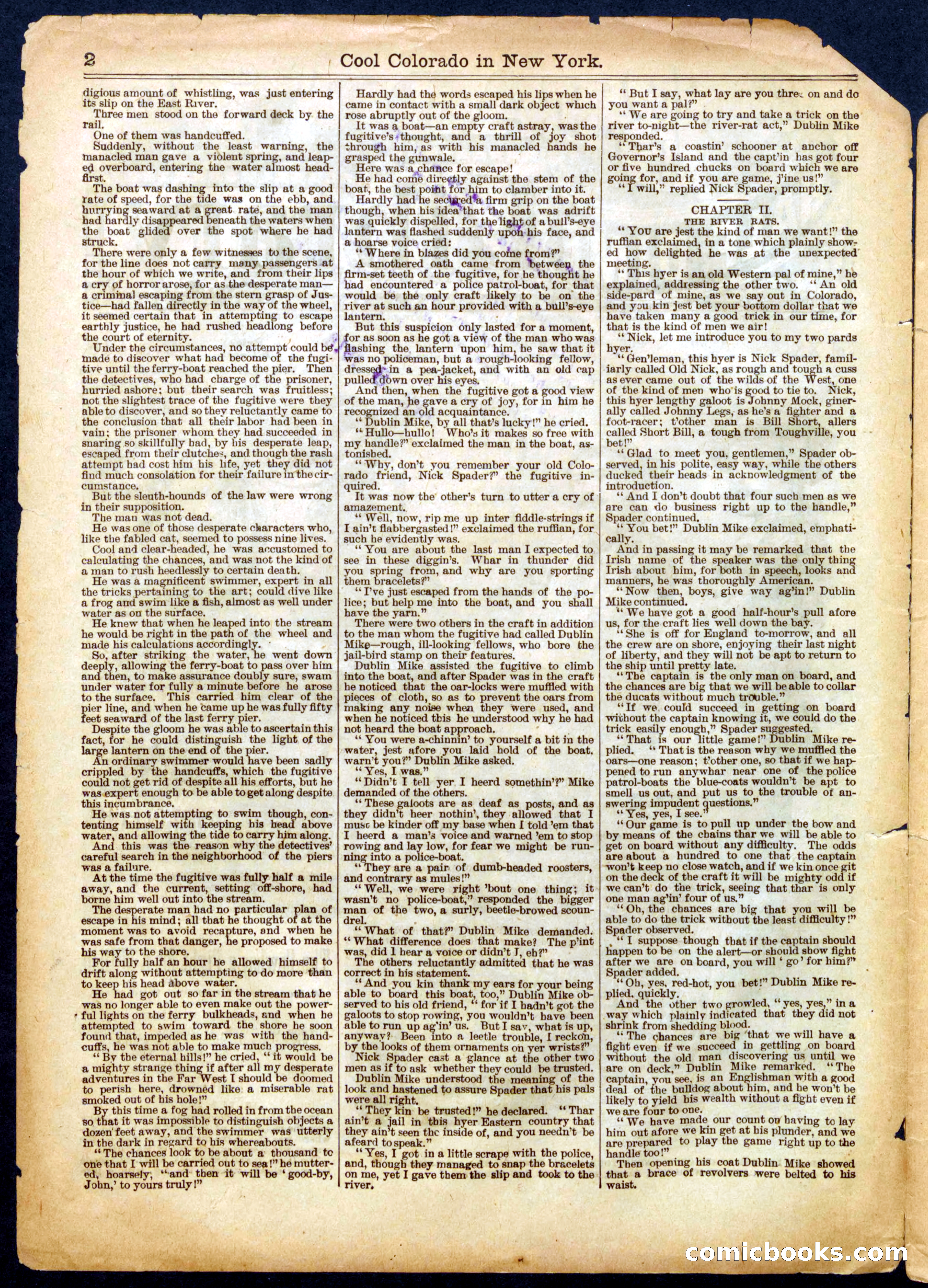
A restored page from Pulp Fiction, 1887. Page through the whole issue in the reader above.
📄 Transcribed text from this page (OCR, searchable)
Machine-transcribed from the original scan — historical spelling and the odd misread are preserved.
2 | - Cool Colorado in New York. digious amount of whistling, was just entering its slip on the East River. als men stood on the forward deck by. the rail. One of them was handcuffed. Suddenly, without the least warning, the manacled man gave a vidlent spring, and leap- ed overboard, entering the water almost head- st. The boat was dashing into the slip at a good rate of speed, for the tide was on the ebb, and hurrying seaward at a — rate, and the man had hardly disappeared beneath the waters when the boat glided over the spot where he had struck, There were only a few witnesses to the scene, for the line does not carry many passengers at the hour of which we write, and from their lips a cry of horror arose, for as the desperate man— a criminal] escaping from the stern grasp of Jus- tice—had fallen directly in the way of the wheel, it seemed certain that in attempting to escape earthly justice, he had rushed headlong before the court of eternity. Under the circumstances, no attempt could bé made to discover what had become of the fugi- tive until the ferry-boat reached the pier. Then the detectives, who had charge of the prisoner, hurried ashore; but their search was fruitless; not the slightest trace of the fugitive were they able to discover, and so they reluctantly came to the conclusion that all their labor had been in vain; the prisoner whom they had succeeded in snaring so skillfully bad, by bis desperate leap, escaped from their clutches, and though the rash attempt had cost him his hfe, yet they did not find much consolation for their failure in the cir- cumstance, But the sleuth-hounds of the Jaw were wrong in their supposition. The man was not dead. He was one of those desperate characters who, like the fabled cat, seemed to possess nine lives. Cool and clear-headed, he was accustomed to calculating the chances, and was not the kind of a man to rush heedlessly to certain death. He was a magnificent swimmer, expert in all the tricks pertaining to the art; could dive like a frog and swim like a fish, almost as well under water as ou the surface. He knew that when he leaped into the stream he would be right in the path of the wheel and made his ngieniatione gpm So, after striking the water, he went down deeply, allowing the ferry-boat to pass over him a shen, to make assurance doubly sure, swam under water for fully a minute before he arose to the surface. This carried him clear of the ier line, and when he came up he was fully fifty eet seaward of the last ferry pier. Despite the gloom he was able to ascertain this fact, for he could distinguish the light of the large lantern on the end of the pier. n ordinary swimmer would have been sadly crippled by the handcuffs, which the fugitive could not get rid of despite all his efforts, but he was.expert enough to be able toget along despite this incumbrance. He was not attempting to swim though, con- tenting himself with keeping his bh above water, and allowing the tide to carry him along. And this was the reason why the detectives’ careful search in the neighborhood of the piers was a failure. At the time the fugitive was fully half a mile away, and the current, setting off-shore, had borne him well out into the stream. The desperate man had no particular plan of escape in his mind; all that he thought of at the moment was to avoid gp te and when he was safe from that danger, he proposed to make his way to the shore. For fully balf an hour he allowed himself to drift along without attempting to do more than to keep his head above water. He had got out so far in the stream that he was no longer able to even make out the power- ful lights on the ferry bulkheads, and when he attempted to swim toward the shore he soon found that, impeded as he was with the hand- cuffs, he was not able to make much progress, ‘* By the eternal bills!” he cried, “‘ it would be a mighty strange thing if after all my desperate adventures in the Far West I should be doomed to perish here, drowned like a miserable rat smoked out of bis hole!” By this time a fog had rolled in from the ocean so that it was impossible to distinguish objects a dozen feet away, and the swimmer was utterly in the dark in regard to his whereabouts. ‘‘The chances look to be about a thousand te Hardly had the words escaped his lips when he came in contact with a small dark object which rose abruptly out of the gloom. 7 It was a boat—an empty craft astray, was the fugitive’s:thought, and a thrill of joy shot shrough him, as with his manacled hands he grasped the gunwale, Here was a_chance for escape! He had come direetly against the stem of the boat, the best poiht for him to clamber into it. Hardly had he secured 2 firm grip on the boat though, when his idea’that the boat was adrift was quickly dispelled, for the light of a bull’s-eye lantern was flashed suddenly upoh-his face, and a hoarse voice cried: . of ‘Where in blazes did you come from?” A smothered oath came from tween the firm-set teeth of the fugitive, for he thought he had encountered a police patrol-boat, for that would be the only craft likely to be on the river at such an hour provided with a bull’s-eye lantern. : But this suspicion only lasted for a moment, | for as soon as he got a view of the man who was ‘flashing the lantern upon him, he saw that it was no policeman, but a rough-looking fellow, dressed in a pea-jacket, and with an old cap pulled down over his eyes. And then, when the fugitive got a good view of the man, he gave a cry of joy, for in him he recognized an old acquaintance. ‘* Dublin Mike, by all that’s lucky!” he cried. **Hullo—hullo! Who's it makes so free with my handle?” exclaimed the man in the boat, as- tonished. ‘Why, don’t you remember your old Colo- rado friend, Nick Spader?” the fugitive in- quired. It was now the’ other’s turn to utter a cry of amazement, ‘** Well, now, rip me up inter fiddle-strings if I ain’t flabbergasted!” exclaimed the ruffian, for such he evidently was. ‘You are about the last man I expected to see in these diggin’s. Whar in thunder did you spring from, and why are you sporting them bracelets?” ‘*T’ve just escaped from the hands of the po- lice; but help me into the boat, and you shall have the yarn.” There were two others in the craft in addition to the man whom the fugitive had called Dublin Mike—rough, ill-looking fellows, who bore the jail-bird stamp on their features. Dublin Mike assisted the fugitive to climb into the boat, and after Spader was in the craft he noticed that the oar-locks were muffled with pieces of cloth, so as to prevent the oars from making any noise when they were used, and when he noticed this he understood why he had not heard the boat approach. ‘* You were a-chinnin’ to yourself a bit in the water, jest afore you laid hold of the boat, warn’t you?” Dublin Mike asked. ‘Yes, I was.” **Didn’t I tell yer I heerd somethin’?” Mike demanded of the others. ‘** These galoots are as deaf as posts, and as they didn’t heer nothin’, they allowed that I musc be kinder off my base when [ told ’em that I heerd a man’s voice and warned ’em to stop rowing and lay low, for fear we might be run- ‘g-oe a police-boat. ‘* They are a pair of dumb-headed roosters, and contrary as mules!” ‘“ Well, we were right ’bout one thing; it wasn’t no police-boat,” responded the bigger — of the two, a surly, beetle-browed scoun- rel. ‘What of that?’ Dublin Mike demanded. ‘* What difference does that make? The p’int was, did 1 hear a voice or didn’t J, eh?” The others reluctantly admitted that he was correct in his statement. ‘*And you kin thank my ears for your being able to board this boat, too,” Dublin Mike ob- served to his old friend, “‘ for if I hadn’t got the galoots to stop rowing, you wouldn’t have been able to run up ag‘in’ us. ButI sav, what is up, anyway? Been into a leetle trouble, [ reckon, by the looks of them ornaments on yer wrists?” Nick Spader cast a glance at the other two men as if to ask whether they could be trusted. Dublin Mike understood the meaning of the look and hastened to assure Spader that his pals were all right. ‘* They kin be trusted!” he declared. ‘* Thar ain’t a jail in this hyer Eastern country that they ain’t seen the inside of, and you needn’t be afeard tospeak.” ‘Yes, I got in a little scrape with the police, one that I will be carried out to sea!” he mutter- | and, though they managed to snap the bracelets ed, hoarsely, ‘““and then it will be ‘ good-by Jobn,’ to yours truly!” : on me, yet I gave them the slip and took to the river, eo —.. ee Cee eeee;8§ OO aa —— ** But I say, what lay are you thre: on and do you want a pal?” ‘We are going to try and take a trick on the river to-night—the river-rat act,” Dublin Mike responded, ‘*Thar’s a coastin’ schooner at anchor off Governor’s Island and the capt’in has got four or five hundred chucks on board which we are going for, and if you are game, j’ine us!” **] will,” replied Nick Spader, promptly. CHAPTER II. THE RIVER RATS. “* YOu are jest the kind of man we want!” the ruffian exclaimed, in a tone which plainly show- ed how delighted he was at the unexpected meeting. ‘** This hyer is an old Western pal of mine,” he explained, addressing the other two. ‘ An old side-pard of mine, as we say out in Colorado, and you kin jest bet your bottom dollar that we have taken many a good trick in our time, for that is the kind of men we air! ‘* Nick, let me introduce you to my two pards hyer. ‘** Gen’leman, this hyer is Nick Spader, famil- iarly called Old Nick, as rough and tough a cuss as ever came out of the wilds of the West, one of the kind of men who’is good to tie to. Nick, this hyer lengthy galoot is Johnny Mock, giner- ally called Johnny Legs, as he’s a fighter and a foot-racer; t’other man is Bill Short, allers called Short Bill, a tough from Toughville, you bet!” ‘*Glad to meet you, gentlemen,” Spader ob- served, in his polite, easy way, while the others ducked their heads in acknowledgment of the introduction. ‘* And I don’t doubt that four such men as we are can do business right up to the handle,” Spader continued, "i You bet!” Dublin Mike exclaimed, emphati- cally. And in passing it may be remarked that the Irish name of the speaker was the only thing Irish about him, for both in speech, looks and manners, he was thoroughly American. ‘‘Now then, boys, give way ag’in!” Dublin Mike continued. ‘We have got a good half-hour’s pull afore us, for the craft lies well down the bay. ‘*She is off for England to-morrow, and all the crew are on shore, enjoying their last night of liberty, and they will not be apt to return to the ship until pretty late. ‘“‘The captain is the only man on board, and the chances are big that we will beable to collar the ducats without much trouble.” ‘“‘If we. could succeed in getting on board without the captain knowing it, we could do the trick easily enough,” Spader suggested. ‘*That is our little game!” Dublin Mike re- plied. ‘* Thatis the reason why we muffled the oars—one reason; t’other one, so that if we hap- pened to run anywhar near one of the police patrol-boats the blue-coats wouldn’t be apt to smell us out, and put us to the trouble of an- swering impudent questions.” ** Yes, yes, I see.’ ‘‘Our game is to pull up under the bow and by means of the chains thar we will be able to get on board without any difficulty. The odds are about a hundred to one that the captain won't pun no close watch, and if we kin once git on the deck of the craft it will be mighty odd if we can’t do the trick, seeing that thar is only one man ag’in’ four of us,” “Oh, the chances are big that you will be able to do the trick without the least difficulty !” Spader observed. _ ** 1 suppose though that if the captain should happen to be on the alert—or should show fight after we are on board, you will * go’ for him?” Spader added. ; ‘Oh, yes, red-hot, you bet!” Dublin Mike re- plied, quickly. And the other two growled, “ yes, yes,” ina way which plainly indicated that they did not shrink from shedding blood. ; ** The chances are big ‘that we will have a fight even if we su _in gettling on board without the old man discovering us until we are on deck,” Dublin Mike remarked. ‘ The captain, you see, is an Englishman with a good deal of the bulldog about him, and he won't be likely to yield bis wealth without a fight even if we are four to one. ‘‘ We have made our count on having to lay him out afore we kin get at bis plunder, and we are prepared to play the game right up to the handle too!” — ; Then opening his coat Dublin Mike showed that a brace of revolvers were belted to his waist. ecomicbooks Fiat - :