
Pulp Fiction, 1887 · page 4 of 16
Beadle's Half Dime Library No. 517 — page 4: what you’re looking at
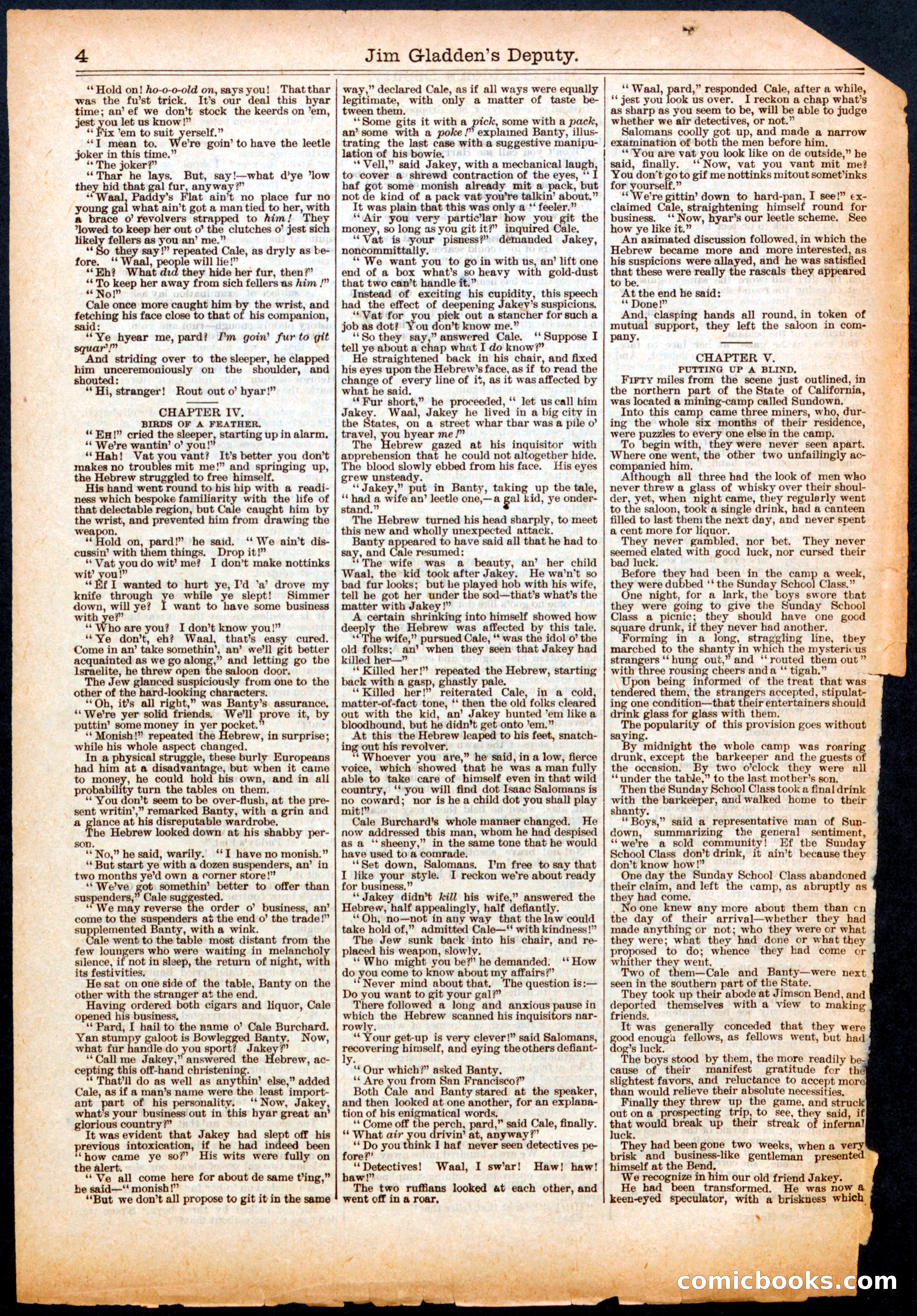
A restored page from Pulp Fiction, 1887. Page through the whole issue in the reader above.
📄 Transcribed text from this page (OCR, searchable)
Machine-transcribed from the original scan — historical spelling and the odd misread are preserved.
Jim Gladden’s __Jim Gladden’s Deputy. TN That thar was the fu’st trick. It’s our deal this byar time; an’ ef we don’t stock the keerds on ’em, ‘* Hold on! ho-o-o0-old on, says you! jest you let us know!” rT ‘em to suit yerself.” ‘“‘T mean to. e’re goin’ to have the leetle joker in this time.” ¥ The joker?” Thar he lays. But, say!—what d’ye ‘low they hid that gal fur, any Ww ay?” **Waal, Paddy's Flat ain't no place fur no young gal what ain’t got a man tied to her, with a brace o’ revolvers strapped to him | l tare a0 9 to keep her out 0 the clutches 0’ jest sic et Bo they as you an’ me.” they say!” repeated Cale, as dryly as be- 7 aal, people will lie!” “Eh? What dt they hide her fur, then?” ‘To keep her away from sich fellers as him !” sé No!” Cale once more caught him by the wrist, and at his face close to that of his companion, sai ~ xe hyear me, pard? J’m goin’ fur to git rp And striding over to the sleeper, he clapped him unceremoniously on the shoulder, and shouted: ‘* Hi, stranger! CHAPTER IV. BIRDS OF A FEATHER. ‘‘ Ex!” cried the sleeper, starting up in alarm, ‘* We're wantin’ o’ you!’ ‘‘Hah! Vat you vant? It’s better you don’t makes no troubles mit me!” and springing up, the Hebrew struggled to free himself. His hand went round to his hip with a readi- ness which bespoke familiarity with the life of that delectable region, but Cale caught him by = wrist, and prevented him from drawing the Hold on, pard!” he said. ‘*‘ We ain’t dis- cussin’ with them things. Drop it!” ‘* Vat you do wit? me? I don’t make nottinks wit? ou!” f Il wanted to hurt ye, I'd ’a’ drove my knife through ye while ye slept! Simmer down, will ye? I want to have some business with e?” ho are you? I don’t know you!” ‘* Ye don’t, eh? Waal, that’s easy cured. Come in an’ take somethin’, an’ we’ll git better acquainted as we go an | » and letting go the lsraelite, he threw open the saloon door. The Jew glanced eeapicionaly from one to the other of the hard-looking characters. ‘*Oh, it’s all right,” was Banty’s assurance, “We're yer solid friends. We'll prove it, by puttin’ some money in yer ket. ‘* Monish!” repeated the Hebrew, in surprise; while his whole aspect changed. In a physical struggle, these burly Europeans had him at a disadvantage, but when it came to money, he could hold his own, and in all probability turn the tables on them. ‘* You don’t seem to be over-flush, at the pre- ~ger writin’,” remarked Banty, with a grin and lance at his disreputable wardrobe, "Phe Hebrew looked down at his shabby per- Rout out o’ hyar!” mete No,” he said, warily. ‘‘ I have no monish, " “But start ye with a dozen suspenders, an’ in two months ye’d own a corner store!” ‘* We've got somethin’ better to offer than sus nders,” Cale suggested. ‘“ We may reverse the order o’ business, an’ come to the su ders at the end o’ the trade!” supplemented Banty, with a wink. ale went to the table most distant from the few loungers who were waiting in melanchol silence, if not in sleep, the return of night, with its festivities. He sat on one side of the table, Banty on the other with the stranger at the end. Having ordered both cigars and liquor, Cale opened his business, ‘* Pard, I hail to the name o’ Cale Burchard. Yan stum y galoot is Bowlegged Banty. Now, what fur handle do you sport? Jakey?” ‘*Call me Jakey,” answered the Hebrew, ac- cepting this off-hand christening. ‘* That’ll do as well as anyt in’ else,” added Cale, as if a man’s name were the least ‘import- ant part of his personality. ‘* Now, Jakey, what's your business out in this hyar great an’ glorious country?” It was evident that Jakey had slept off his previous intoxication, if he had indeed been ‘how came ye so?’ His wits were fully on the alert. “Ve all come here for about de same ving,” he said—‘‘ monish!”’ ‘“‘But we don’t all propose to git it in the same way,” declared Cale, as if all ways were equally legitimate, with only a matter of taste be- tween them. ‘‘Some gits it witha pick, some with a pack, an’some with a poke /” explained Banty, illus- trating the last case with a suggestive manipu- lation of his bowie, ‘* Vell,” said Jakey, with a mechanical laugh to cover a shrewd contraction of the eyes, wy haf got some monish already mit a pack, but not kind of a pack vat you’re talkin’ about.” It was plain that this was only a *‘ feeler.” “Air you very particlar how you git the money, 80 long as you git it?’ inquired Cale. at is your pisness?”’ demanded Jakey, noncommittally. ‘*We want you to goin with us, an’ lift one end of a box what's SO heavy with gold-dust that two can’t handle it.” Instead of exciting his cu idity, this speech had the effect of deepening Jakey’s suspicions, ‘* Vat for you pick out a stancher for such a job as dot? You don’t know me.” ‘‘So they say,” answered Cale. ‘‘ Suppose I tell ye about a chap what I do know?” He straightened back in his chair, and fixed his eyes upon the Hebrew’s face, as if to read the change of every line of it, as it was affected by what he said. “Fur short,” he proceeded, ‘‘ let us call him Jakey. Waal, Jakey he lived in a big city in the § tates, on a street whar thar was a pile 0’ travel, ou hyear me /” ebrew gazed at his inquisitor with Se ehietion that he could not altogether hide, The blood slowly ebbed from his face. His eyes grew unsteady. ‘‘Jakey,” put in Banty, taking up the tale, ‘* had a wife an’ leetle one,—a gal kid, ye onder- stand.” The Hebrew turned his head sharply, to meet this new and wholly unexpected attack. Rew as §, appeared to have said all that he had to y, and ale resumed: M The wife was a beauty, an’ her child Waal, the kid took after Jakey. He wa’n't so bad fur looks; but Le played hob with his wife, tell he got her under the sod—that’s what's the matter with Jakey!” A certain shrinking into himself showed how deeply the Hebrew was affected by this tale. ‘*The wife,” pursued Cale, “* was the idol 0’ the old folks; an’ when they seen that Jakey had killed her—” ‘* Killed her!” repeated the Hebrew, starting back with a gasp, ghastly pale. ‘Killed her!” reiterated Cale, in a cold matter-of-fact tone, * then the old folks cleare out with the kid, an’ Jakey hunted ’em like a bloodhound, but he didn’t get onto ’em.” At this the Hebrew leaped to his feet, snatch- ing out his revolver. ‘* Whoever you are,” he said, in a low, fierce voice, which showed ‘that he was a man fully able to take care of himself even in that wild country, ‘‘-you will find dot Isaac Salomans is no coward ; nor is he a child dot you shall play mit! Cale Burchard’s whole manner changed. He now addressed this man, whom he had despised as a ‘‘sheeny,” in the same tone that he would have used to a comrade. ‘*Set down, Salomans. I like your Style. for business.” ‘““Jakey didn’t kill his wife,” answered the Hebrew, half appealingly, half defiantly. ‘*Oh, no—not in any way that the law could take hold of,” admitted Cale—‘ with kindness!” The Jew sunk back into his chair, and re- placed his weapon, slowly. ‘“Who might you be?” he demanded: ‘‘ How do ) you come to know about my affairs?” Never mind about that. The question is:— Do you want to git your gal?” There followed a long and anxious pause in ito the Hebrew scanned his inquisitors nar- rowly “Your get-up is very clever!” said Salomans, oe himself, and eying the others defiant Mi Our which?” asked Banty. ‘* Are you from San Francisco?” Both Cale and Banty stared at the speaker, and then looked at one “anothar’ for an explana- I’m free to say that I reckon we're about ready tion of his eni tical words. ‘* Come off the une peroly nerd pard,” said Cale, finally. ** What air rivin’ at, anyway?” **Do yout ink lhaf never seen detectives pe- fore?’ Haw! haw! ** Detectives! baw!” The two ruffians looked at each other, and went off in a roar, Waal, I sw’ar! ‘Waal, pard,” fa > Wists rsa Cale de is all wade wramcecualle |. 1Ntcak asd oieeaina Cale, after a while, ** jest you look us over. I reckon a chap what’s as sharp as you seem to be, will be able to judge whether we air detectives, or not.” oy Salomans coolly got up, and made a narrow eu examination of both the men before him. ion ‘You are vat you look like on de outside,” he A said, finally. ‘‘ Now, vat you vant mit "me? You don’t go to gif me nottinks mitout somet’inks for yourself.” ‘< We're gittin’ down to hard-pan, I see!” ex- claimed Cale, straightening himself round for business. “Now, hyar’s our leetle scheme. See how ye like it.” An animated discussion followed,in which the Hebrew became more and more interested,as __ his suspicions were allayed, and he was satisfied = that these were really the rascals they appeared to be. At the end he said: ** Done!” Sqees And, clasping hands all round,in token of ~— mutual support, they left the saloon in com- pany. CHAPTER V. PUTTING UP A BLIND. Firty miles from the scene just outlined, in the northern part of the State of California, , was located a mining-camp called Sundown, oe Into this camp came three miners, who, dur- ing the whole six months of their residence, were puzzles to every one else in the camp. To begin with, they were never seen apart. ~ a Where one went, the other two unfailingly ac- as companied him. i Although all three had the look of men who never threw a glass of whisky over their shoul- der, yet, when night came, en & regulerly went ee, to the saloon, took a single drink, had a canteen filled to last them the next day, and never spent a cent more for liquor. They never gambled, nor bet. They never seemed elated with gocd luck, nor cursed their bad luck. Before they had been in the camp a week, they were dubbed ‘‘ the Sunday Schoo] Class.” One night, for a lark, the boys swore that — they were going to give the Sunday School ~ Class a picnic; they should have one good square drunk, if they never had another. Forming in a long, straggling line, they marched to the shanty in which the mystericus st rs ‘hung out,” and ‘‘ routed them out” ie three rousing cheers anda “ tigah.” ; n being informed of the treat that was | biased them, the strangers accepted, stipulat- in one condition—that their entertainers s ould drink glass for glass with them. The popularity of this provision goes without saying. y midnight the whole camp was roarin drunk, except the barkeeper and the guests o the occasion. By two o’clock they were all - ‘*under the table,” to the last mother’s son, | Then the Sunday School Class took a final drink with the barkeeper, and walked home to their shanty. ‘ Boys,” said a representative man of Sun- down, summarizing the general sentiment, “we're a sold community! Ef the Sunday School Class don’t drink, it ain't because they don’t know how!” One day the Sunday School Class abandoned their claim, and left the vamp, as abruptly as the ey had come. o one knew any more about them than cn the day of their’ arrival—whether they had made anything or not; who they were or w ~ they were; what they’ had done or what proposed to do; whence they had come ea whither they went, Two of them—Cale and Banty—were next seen in the southern part of the State. They took up their abode at Jimson Bend, and deported themselves with a view to making friends. It was generally conceded that they were par enough fellows, as fellows went, but had og’s luck. The boys stood by them, the more readily b cause of their manifest gratitude for thé slightest favors, and reluctance to accept more than would relieve their absolute necessities, Finally they threw up the game, and oe out on a prospecting trip, to see, the ast would break up their streak of inf iNternal luc hs They had been gone two weeks, when a ve " brisk and business-like gentleman presente y ar Sr at ne ae of e recognize in him our a trad ke. ang He had been transformed. He was n¢ ” Se keen-eyed speculator, with a eal 355°) 7% ¥ tist “ a aa ae + Soe -&