
Pulp Fiction, 1887 · page 11 of 16
Beadle's Half Dime Library, No. 514 — page 11: what you’re looking at
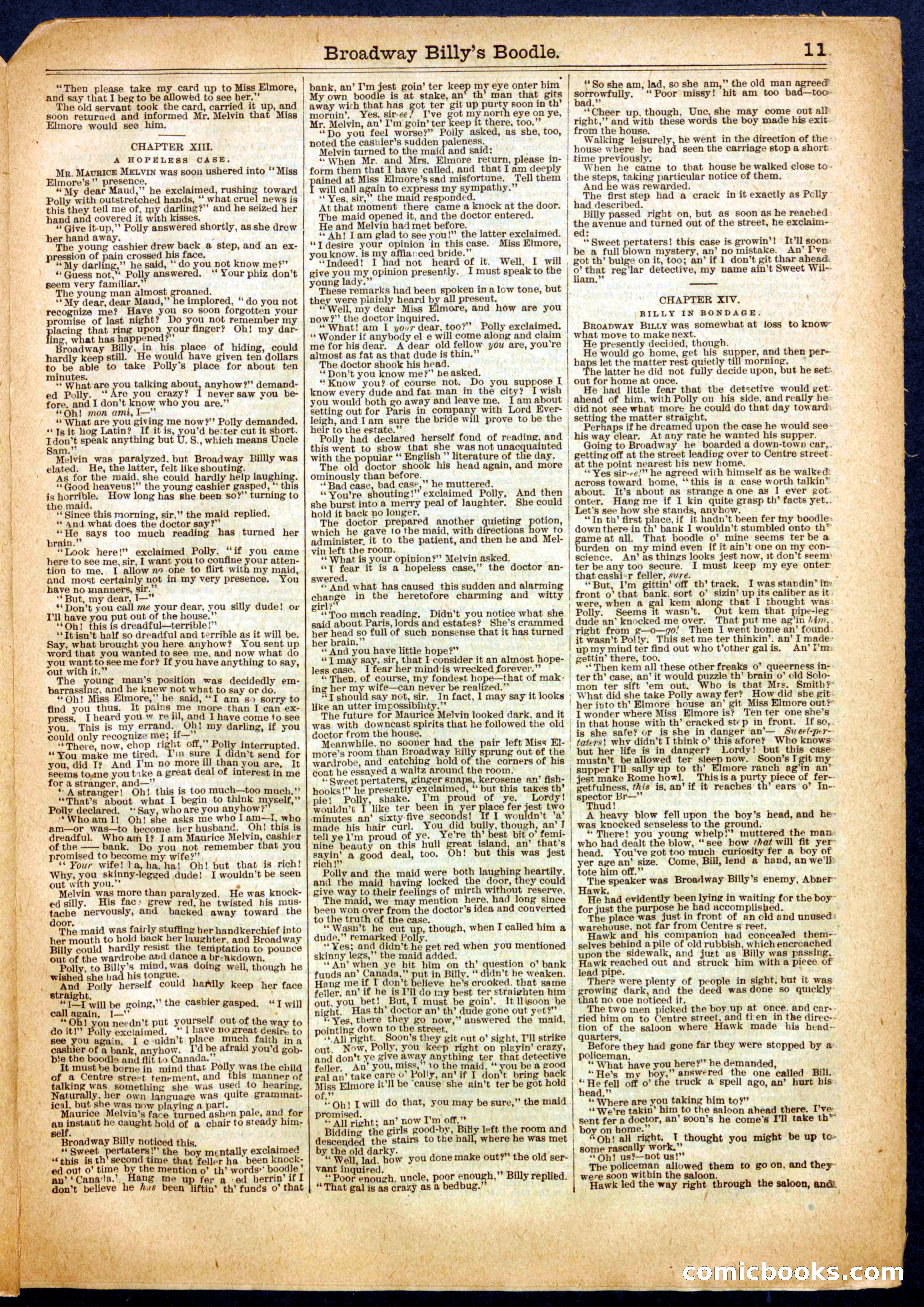
A restored page from Pulp Fiction, 1887. Page through the whole issue in the reader above.
📄 Transcribed text from this page (OCR, searchable)
Machine-transcribed from the original scan — historical spelling and the odd misread are preserved.
re esedin ake [Te ~~ a a a sa “Then please take my card up to Miss Elmore, and say that I beg to be allowed to see her.”’ The old servant took the card, carried it up, and Elmore would see him. CHAPTER XIII. A HOPELESS CASE. Mr. Maurice Metvry was soon ushered into “‘ Miss Elmore’s’”’ presence, “My dear Maud,” he exclaimed, rushing toward Polly with outstretched hands, ‘‘ what cruel news is this they tell me of, my darling?’ and he seized her hand and covered it with kisses, ‘““ Give it-up,’’ Polly answered shortly, as she drew her hand away. | The young cashier drew back a step, and an ex- pression of pain crossed his face, “My darling,” he said, “do you not know me?” “Guess not,”* Polly answered, ‘* Your phiz don’t seem very familiar.’ The young man almost groaned. ‘* My dear, dear Maud,” he implored, “ do you not recognize me? Have you so soon forgotten your promise of last night? Do you not remember my lacing that ring upon your finger? Oh! my dar- ing, what has happened?” Broadway Billy, in his pce of hiding, could hardly keep still. He woulc have given ten dollars to be able to take Polly's place for about ten minutes. ‘* What are you talking about, anyhow?’’ demand- ed Polly. “Are you crazy? never saw you be- fore. and I don’t know who you are,” ‘Oh! mon ami, I—” “What are you giving me now?”’ Polly demanded. ‘‘TIgit hog Latin? If it is, you’d be:ter cut it short. Idon’t speak anything but U.8., which means Uncle Sam.” Melvin was paralyzed. but Broadway Billly was elated. He, the latter, felt like shouting. As for the maid, she could hardly help laughing. ‘*Good heavens!”’ the young cashier gasped, ** this is horrible. How long has she been so?’’ turning to the maid. ‘‘ Since this morning, sir,’’ the maid replied. ‘* and what does the doctor say?” ‘“‘He says too much reading has turned her brain.” ‘*Look here!’”? exclaimed Polly, “if you came here to see me, sir, I want you to confine your atten- tion to me. I allow no one to flirt with my maid, and most certainly not in my very presence. You have no manners, sir.”” ‘But, my dear, I—” ** Don’t you call me your dear, you silly dude! or I'll have you put out of the house.” ‘¢Oh! this is dreadful—terrible!” ‘*It isn’t half so dreadful and terrible as it will be. Say, what brought you here. anyhow? You sent up word that you wanted to see me, and now what do you want to see me for? If you have anything to say, out with it.” The young man’s position was decidedly em- barrassing, and he knew not what to say or do. **Oh! Miss Elmore,” he said, “I am so sorry to find you thus. It pains me more than I can ex- press. I heard you w re iil, and I have come to see you. This is my errand. Oh! my darling, if you could only recognize me; if— “There, now, chop right off,’ Polly interrupted. “You make me tired. I’in sure I didn’t send for you, did I? And Im no more ill than you are, It seems togme you tike a great deal of interest in me for a stranger, and—”’ ‘-A stranger! Oh! this is too much—too much,” “That’s about what I begin to think myself,” Polly declared. * Say, who are you anyhow?’ ‘‘Whoaml! Oh! she asks me who lam—tI, who am—or was—to become her husband. Qh! this is dreadful. Who am I? I am Maurice Melvin, cashier of the —— bank. Do you not remember that you romised to become my wife?” ‘* Your wife! ba, ha, ha! Oh! but that is rich! Why, you skinny-legged dude! I wouldn't be seen out with you.”’ . Melvin was more than paralyzed. He was knock- ed silly. His fac+ grew red, he twisted his mus- tache nervously, and backed away toward the door. ; The maid was fairly stuffing her handkerchief into her mouth to hold back her laughter, and Broadway Billy could hardly resist the teniptation to pounce out of the wardrobe avd dance a br-akdown. Polly, to Billy’s mind, was doing well, though he wished she had his tongue. straight. And Polly herself could hardly keep her face “1-71 will be going,” the cashier gasped, “TI will i" call again. “Oh! you needn’t put yourself out of the way to do it!” Polly exclaimed. “| have no great desire to see yOu again, I c-uldn’t place much faith ina er of a bank, anyhow. I'd be afraid you’d gob- bie the boodis and flit to Canada.” It must be borne in mind that Polly was the child of a Centre street tenement, and this manner of talking was something she was used to hearing, Naturally, her own language was quite grammat- ical, but she was now playing a part. Maurice Melvin’s face turned ashen pale, and for an instant he caught hold of a chair to steady him- self. Broadway Billy noticed this, ‘Sweet pertaters!” the boy mentally exclaimed “this is th second time that feller ha been knock- ed out o’ time 7 the mention o’ th’ words’ boodle’ ay’ ‘ Cana’!a. ang me up fer a ed herrin’ if I don’t believe he Aus been liftin’ th’ funcs o' that | | away wich that has soon returned and informed Mr. Melvin that Miss | minutes an’ sixty-five seconds! | Broadway Billy’s Boodle. bank, an’ I’m jest goin’ ter keep my eye onter bim My own boodile is at stake, an’ th’ man that gits ot ter git up purty soon in th’ mornin’, Yes, sir-ee/ I’ve got my north eye on ye, Mr. Melvin, an’ I’m goin’ ter eon it there, too.” “Do you feel worse?” Polly asked, as she, too, noted the castuier’s sudden paleness, Melvin turned to the maid and said: “When Mr. and Mrs. Elmore return, please in- form them that I have called, and that I am deeply ained at Miss Elmore’s sad misfortune. Tell them will call again to express my sympathy.” ‘Yes, sir,” the maid responded. At that moment there came a knock at the door. The maid opened it, and the doctor entered. He and Melvin had met before. ‘Ah! Iam glad to see you!” the latter exclaimed. ‘“‘T desire your opinion in this case. Miss Elmore, you know. is my affianced bride.” ‘Indeed! I had not heard of it. Well, I will give you my opinion presently. I must speak to the young lady.”’ i These remarks had been spoken in a low tone, but they were plainly heard by all present. ‘“Well, my dear Miss Elmore, and how are you now?’ the doctor inquired. “What! am I your dear, too?” Polly exclaimed. ‘* Wonder if anybody el e will come along and claim me for his dear. A dear old fellow you are, you're almost as fat as that dude is thin.” The doctor shook his head. ‘* Don’t you know me?” be asked. “Know you? of course not. Do you suppose I know every dude and fat man in the city? I wish | you would both go away and leave me. Iam about setting out for Paris in company with Lord Ever- leigh, and Iam sure the bride will prove to be the heir to the estate.”’ Polly had declared herself fond of reading, and this went to show that she was not unacquainted with the popular “‘ English ”’ literature of the day. The old doctor shook his head again, and more ominously than before. ‘Bad case, bad case,’’ he muttered. “You're shouting!’ exclaimed Polly, she burst into a merry peal of Jaughter. hold it back no longer. The doctor prepared another quieting Peres which he gave to the maid, with directions how to administer, it to the patient, and then he and Mel- vin left the room. ‘‘ What is your opinion?” Melvin asked, “T fear it is a hopeless case,’’ the doctor an- swered. * And what has caused this sudden and alarming change in the heretofore charming and witty irl?’ ‘‘Too much reading, Didn't you notice what she said about Paris, lords and estates? her head so full of such nonsense that it has turned her brain.” * And you have little hope?” And then She could **] may say, sir, that I consider it an almost hope- ! less case. I fear her mind‘is wrecked forever.” “ Then. of course, my fondest hope—that of mak: ing her my wife—can never be realized.” **T should say not, sir, like an utter impossibihty.”’ The future for Maurice Melvin looked dark, and it was with downcast spirits that he followed the old doctor from the house, Meanwhile, no sooner had the pair left Miss El- more’s room than Broadway hilly sprung out of the wardrobe, and catching hold of the corners of his coat he essayed a waltz around the room. “ Sweet pertaters, ginger snaps, kerosene an’ fish- hooks!”’ he presently exclaimed, ** but this takes th’ pie! Polly, shake. [’m proud of ye. Lordy! wouldn’t L like ter been in yer place fer jest two f I wouldn’t ‘a’ You did bully, though, an’ J made his hair curl. Ye’re th’ tell ye l’m proud of ye. niné beauty on this sayin’ a good deal, too. rich!”’ Polly and the maid were both laughing heartily, and the maid having locked the door, they could give way to their feelings of mirth without reserve. The maid, we may been won over from the doctor’s idea and converted to the truth of the case. ‘‘Wasn’t he eut up, though, when I called him a dude,”” remarked Polly. ‘Yes; and didn’t he get red when you mentioned skinny legs,’’ the maid added. ‘*An’ when ye hit him on th’ funds an’ Canada,” put in Billy. “ Hang me if T don’t feller, an’ if he is I'll do my best ter straighten him out, you_bet! But, I must be goin’. It llwoon be night. Has th’ doctor an’ th’ dude gone out yet?” Yes, there ibe go now,” answered the maid, inting down to the street. ‘+All right. Soon’s they git out o’ sight, I'll strike out. Now, Polly, you keep right on playin’ crazy, and don't ye give away anything ter that detective feller. Au’ you, miss,”’ to the maid, “ gal an’ take care 0’ Polly, an’ if I don’t bring back Miss Elmore it’ll be ‘cause she ain't ter be got hold » be Oh! but this was jest dn’t he weaken. “Oh! LT will do that, you may be sure,” the maid promised. ; : * All right; an’ now I’m off,” Bidding the girls good-by, Billy left the room and descended the stairs to the hall, where he was met by the old darky. ve Well, So how you vant inquired, ; Poon enouch. uncle, poor enough,” Billy replied. “That gal is as crazy as a bedbug.’ done make out?” the old ser- She’s crammed _ In fact, I may say it looks | best bit o’ femi- | hull great island, an’ that’s | mention here, had long since | uestion 0’ bank | lieve he’s crooked. that same | you be a good | | « | sorrowfully. | bad.” ‘Cheer up, though, Unc, she may come out all right,’’ and with these words the boy made his exit ' from the house. | Walking leisurely, he went in the direction of the: house where he had seen the carriage stop a short | time previously. When he came to that house he walked close to | the steps, taking particular notice of them. | And ke was rewarded. ' he first step had a crack in it exactly as Polly had described. Billy passed right on, but as soon as he reached | — avenue and turned out of the street, he exclaim- ed: “Sweet pertaters! this case is growin’! It'll soon be a full blown mystery, an’ no mistake. An’ I’ve got th’ bulge on it, too; an’ if 1 don’t git thar ahead | 4 that reg’lar detective, my name ain’t Sweet Wil-- | liam,”’ So she am, lad, so she am,” the old man agree@ “Poor missy! hit am too bad—too- CHAPTER XIV. BILLY IN BONDAGE. Broapway BILLY was somewhat at loss to know what move to make next. | He presently decided, though. | He would go home, get his supper, and then per- | till morning. haps let the matter rest quiet! ecide upon, but he set he latter he did not fully out for home at once, He had little fear that the detective would get | ahead of him, with Polly on his side, and really he did not see what more he could do that day toward setting the matter straight. Perhaps if he dreamed upon the case he would see his way clear. At any rate he wanted his supper. Going to Broadway he boarded a down-town car,. getting off at the street leading over to Centre street at the point nearest his new home. ‘Yes sir--e’”” he agreed with himself as he walked across toward home, ‘“‘this is a case worth talkin” about. It’s about as strange a one as I ever got 'onter. Hang me if 1 kin quite grasp th’ facts yet.. | Let’s see how she stands, anyhow. | “Tn th’ first place, if it hadn’t been fer my boodle: down there in th’ bank I wouldn't stumbled onto th” | game at all. That boodle o’ mine seems ter be a urden on my mind even if it ain’t one on my con- science, An’ as things looks jest now, it don’t seem) ter be any too secure. I must keep my eye onter that cashi«r feller, svre. “But, I’m gittin’ off th’ track. I was standin” in: front o’ that bank. sort o’ sizin’ up its caliber as it were, when a gal kem along that I thought was Polly. Seems it wasn’t. ut kem that pipe-ieg” dude an* knocked me over. That put me ag’in /im, ‘right from g—o—go/ Then I went home an’ found. it wasn’t Polly. This set me ter thinkin’. an’ I made: up my mind ter find out who t’other galis. An’ I’m gettin’ there, too. ‘‘Then kem all these other freaks 0’ queerness in- ter th’ case, an’ it would puzzle th’ brain o’ old Solo- mon ter sift ‘em out. ho is that Mrs. Smith? What did she take Polly away fer? How did she git her into th’ Elmore house an’ git Miss Elmore outf* I wonder where Miss Elmore is? Ten ter one she’s in that house with th’ cracked step in front. If so,. is she safe? or is she in danger an’— Sweet-per- faters| why didn’t I think o’ this afore? Who knows” but her life is in danger? Lordy! but this case mustn't be allowed ter an now. Soon’s I git my | supper I°ll sally up to th’ Elmore ranch ag’ an’ | jest make Rome howl. _ Thisis a purty piece of fer-- getfulness, this is, an’ if it reaches th’ ears o’ In-- ' spector Br—”’ Thud! A heavy blow fell upon the boy's head, and he- | was knocked senseless to the ground. | “ There! you young whelp!’ muttered the man who had dealt the blow, “see how /Aat will fit yer head. You've got too much curiosity fer a boy of | | SF — —————— yer age an’ size. Come, Bill, lend a hand, an we'll tote him off.” : sonore speaker was Broadway Billy’s enemy, Abner” awk. _ He had evidently been lying in waiting for the boy” for just the purpose he had accomplished. The place was justin front of an old and unused: warehouse, not far from Centre s reet. Hawk and his companion bad concealed them-- selves behind a pile of old rubbish, which encreached upon the sidewalk, and just as Billy was passing, Hawk reached out and struck him with a pieee of | lead pipe. | There were plenty of people in sight, but it was | growing dark, and the Heed was done so quickly | that no one noticed it. | The two men picked the boy up at once. and car-- ried him on to Centre street, and then in the direc-- | tion of the saloon where Hawk made his head- | quarters, | Before they had gone far they were stopped by @ | policeman, | “What have you here?’’ he demanded, | “He’s my boy,” answered the one called Bill. | Mar off o’ the truck a spell ago, an’ hurt bis ea Ri ‘Where are you taking him to?” ‘We're takin’ him to the saloon ahead there. I've: | sent fer a doctor, an’ soon’s he come’s I'll take th ' boy on home.” | “Ob! all right. UT thought you might be up to» some rascally work." ‘Oh! us?—not us!” The policeman allowed them to go on, and they were soon Within the saloon. Hawk led the way right through the saloon, and