
Pulp Fiction, 1878 · page 5 of 16
Beadle's Half Dime Library, No. 51 — page 5: what you’re looking at
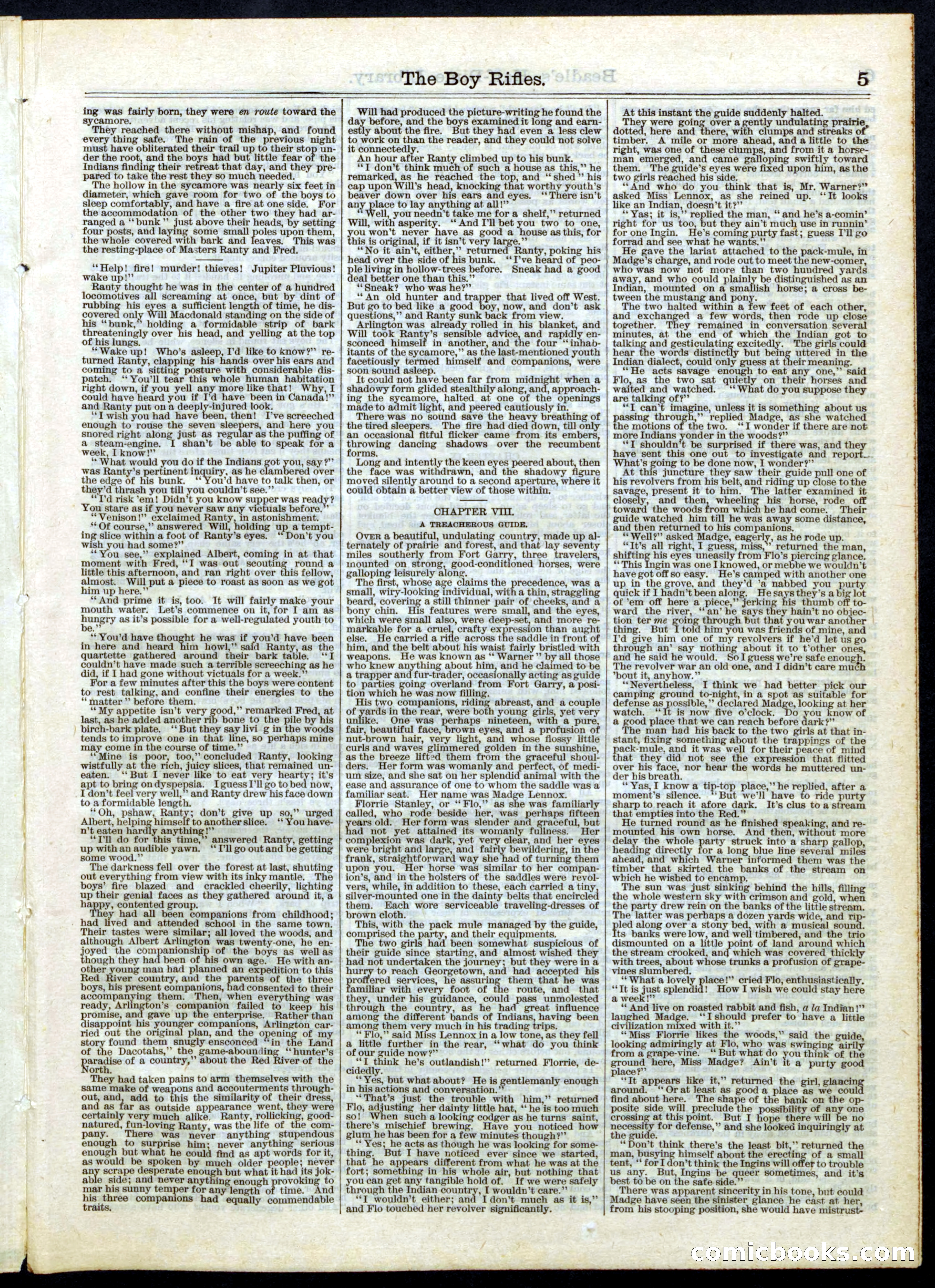
A restored page from Pulp Fiction, 1878. Page through the whole issue in the reader above.
📄 Transcribed text from this page (OCR, searchable)
Machine-transcribed from the original scan — historical spelling and the odd misread are preserved.
i th oe A a _birch-bark plate. ‘‘ But they say livi g in The Boy Rifles. 5 ing was fairly born, they were en route toward the sycamore. They reached there without mishap, and found every thing safe. The rain of the previous night must have obliterated their trail up to their stop un- der the root, and the boys had but little fear of the Indians finding their retreat that day, and they pre- pared to take the rest they so much needed. The hollow in the sycamore was nearly six feet in diameter, which gave room for two of the boys to sleep comfortably, and have a fire at one side. For the accommodation of the other two they had ar- ranged a ‘“* bunk” just above their heads, by setting four posts, and laying some small poles upon them, the whole covered with bark and leaves. This was the resting-place of Masters Ranty and Fred. ‘Help! fire! murder! thieves! Jupiter Pluvious! wake up!”’ Ranty thought he was in the center of a hundred locomotives all screaming at once, but by dint of rubbing his eyes a sufficient length of time, he dis- cove only ill Macdonald standing on the side of his “ bunk,” ory a formidable strip of bark threateningly over his head, and yelling at the top of his lungs. ‘Wake up! Who's asleep, I'd like to know?” re- turned Ranty, clapping his hands over his ears and coming to a sitting posture with considerable dis- patch. ‘“ You'll tear this whole human habitation right down, if you yell any more like that! Why, I could have heard you if I’d have been in Canada!” and Ranty put on a deeply-injured look. “IT wish you had have n, then! I’ve screeched enough to rouse the seven sleepers, and here you snored right te just as regular as the puffing of a steam-engine. shan’t be able to speak for a week, I know!”’ “What would you do if the Indians got you, say ?”’ was Ranty’s pertinent inquiry, as he clambered over the edge of his bunk. ‘* You’d have to talk then, or they'd thrash you till you couldn't see.”’ “I'd risk em! Didn’t you know papper was ready? You stare as if you never saw ~~ victuals before.” “Venison!” exclaimed Ranty, in astonishment. **Of course,” answered Will, holding up a tempt- ing slice within a foot of Ranty’s eyes. “ Don’t you wish you had some?” “You see,’’ explained Albert, coming in at that moment with Fred, ‘‘I was out scouti round a little this afternoon, and ran right over this fellow, almost. Will put a piece to roast as soon as we got him up here.” “And prime it is, too. It will fairly make your mouth water. Let's commence on it, for I am as hungry as it’s possible for a well-regulated youth to e 9 be. ** You'd have thought he was if you’d have been in here and heard him howl,” said Ranty, as the quartette gathered around their bark table. ‘I couldn’t have made such a terrible screeching as he did, if | had gone without victuals for a week.” For a few minutes after this the boys were content to rest talking, and confine their energies to the ‘*matter’’ before them. ‘“*My appetite isn’t very good,” remarked Fred, at last, as he added another rib bone to the Cone by his he woods tends to improve one in that line, so perhaps mine may come in the course of time.”’ ‘*Mine is — too,” concluded Ranty, looking wistfully at the rich, juicy slices, that remained un- eaten. ‘‘ But I never like to eat very hearty; it’s apt to bring on dys epsia. I guess I'll go to bed now, I don’t feel very well,” and Ranty drew his face down to a formidable length. “Oh, pshaw, Ranty; don’t give up so,” urged Albert, helping himself to another slice. “You have- n’t eaten h y anything !”’ “Tl do for this time,”’ answered mre as getting up with an audible yawn. “T'll go outand be getting some wood.” The darkness fell over the forest at last, shutting out everything from view with its inky mantle. The boys’ fire blazed and crackled cheerily, lighting up their genial faces as they gathered around it, a happy, contented group. 7 had all been companions from childhood; had lived and attended school in the same town. Their tastes were similar; all loved the woods, and although Albert Arlington was twenty-one, he en- joyed the companionship of the boys as well as hough they had been of his own age. He with an- other young man had planned an expedition to this ver country, and the — of the three boys, his present companions, had consented to their SS ae them. Then, when everything was ready, Arl ngton’s companion failed to keep his romise, and gave up the enterprise. Rather than isappoint his younger companions, Arlington car- ried out the original plan, and the opening of my story found them snugly ensconced “in the Land of the Dacotahs,”’ the game-abounding “hunter's pneeee of a country,’’ about the Red River of the orth. They had taken pains to arm themselves with the same make of weapons and accouterments through- out, and, add to this the similarity of their dress, and as far as outside appearance went, they were certainly very much alike. Ranty, rollickin , Food- natured, fun-loving Ranty, was the life of the com- pany. There was never anything stupendous enough to surprise him: never anything serious enough but what he could find as apt words for it, as would be spoken by much older people; never an aceene desperate enough but what it had its jok- able side; and never enough ent ae | to mar his sunny te r for any length of time. And rise 1. ome com ons had equally commendable raits, Will had produced the picture-writing he found the aw! before, and the boys examined it long and earn- estly about the fire. But they had even a less clew to work on than the reader, and they could not solve it a ie An hour after Ranty climbed up to his bunk. **T don’t think much of such a house as this,”’ he remarked, as he reached the top, and “shed ” his cap upon Will’s head, knocking that worthy youth's beaver down over his ears and eyes. ‘‘ There isn’t any place to lay anything at all!” ** Well, you needn't take me for a shelf,’’ returned Will, with asperity. ‘“‘ And I'll bet you two to one, Ae won't never have as good a house as this, for his is original, if it isn’t very large.” “No it ain't, either,’’ returned Ranty, poking his head over the side of his bunk. “I’ve heard of peo- le living in hollow-trees before. Sneak had a good eal better one than this.” *“Sneak? who was he?”’ ‘‘An old hunter and trapper that lived off West. But go to bed like a good , now, and don’t ask questions,”’ and Ranty sunk back from view. Arlington was already rolled in his blanket, and Will took Ranty’s sensible advice, and rapidly en- sconced himself in another, and the four “ inhab- itants of the sycamore,” as the last-mentioned youth facetiously termed himself and companions, were soon sound asleep. It could not have been far from midnight when a shadowy form glided stealthily along, and, approach- ing the sycamore, halted at one of the openings made to admit light, and peered cautiously in. There was no sound save the heavy breathing of the tired sleepers. The fire had died down, till only an occasional fitful flicker came from its embers, | he dancing shadows over the recumbent orms., Long and intently the keen eyes peered about, then the face was withdrawn, and the shadowy figure moved silently around to a second aperture, where it could obtain a better view of those within. CHAPTER VIIL A TREACHEROUS GUIDE. Over a beautiful, undulating country, made up al- ternately of prairie and forest, and that lay seventy miles southerly from Fort Garry, three travelers, mounted on strong, good-conditioned horses, were galloping leisurely along. The first, whose age claims the Ho higeaet te was a small, wiry-looking individual, with a thin, straggling beard, covering a still thinner pair of cheeks, and a bony chin. His features were small, and the eyes, which were small also, were deep-set, and more re- markable for a cruel, crafty ex yression than aught else. He carried a rifle across the saddle in front of him, and the belt about his waist fairly bristled with weapons. He was known as “* Warner” by all those who knew anything about him, and he claimed to be a trapper and fur-trader, occasionally acting as guide to parties going overland from Fort Garry, a posi- tion which he was now filling. His two companions, riding abreast, and a couple of yards in the rear, were both young girls, yet very u e. One was rhaps nineteen, with a pure, fair, beautiful face, brown eyes, and a profusion of nut-brown hair, very light, and whose flossy little curls and waves glimmered golden in the sunshine, as the breeze lifted them from the graceful shoul- ders. Her form was womanly and perfect, of medi- um size, and she sat on her splendi animal with the ease and assurance of one to whom the saddle was a familiar seat. Her name was Madge Lennox. Florrie Stanley, or “ Flo,” as she was familiarly called, who rode beside her, was omens fifteen bean old. Her form was slender an ful, but ad not yet attained its womanly fullness. Her complexion was dark, yet very clear, and her eyes were bright and large, and fairly bewildering, in the frank, vc «pri Ayer way she of turning them upon you. Her horse was similar to her compan- ion’s, and in the holsters of the saddles were revol- vers, while, in addition to these, each carried a tiny silver-mounted one in the dainty belts that encircled them. Each wore serviceable traveling-dresses of brown cloth. This, with the pack mule managed by the guide, comprised the party, and their equipments. The two girls been somewhat suspicious of their guide since starting,and almost wished they had not undertaken the journey; but they were in a hurry to reach Georgetown, and had accepted his roffered services, he assuring them that he was amiliar with every foot of the route, and that they, under his guidance, could pass unmolested through the country, as he had great influence among the different bands of Indians, having been among them very much in his trading trips. * Flo,” said Miss Lennox in a low tone, as they fell a little further in the rear, “what do you think of our guide now?” “I think he’s outlandish!’ returned Florrie, de- cidedly. _ ‘Yes, but what about? He is gentlemanly enough in his actions and conversation.’ “That’s just the trouble with him,” returned Flo, adjusting her dainty little hat, ‘‘ he is too much so! en such a looking codger as he turns saint, there’s mischief brewing. Have you noticed how glum he has been for a few minutes though?” “Yes; he acts as though he was looking for some- thing. But I have noticed ever since we started, that he appears different from what he was at the fort; something in his whole air, but nothing that you can get any tangible hold of. If we were safely through the Indian country, I wouldn't care.” **T wouldn’t either; and I don’t much as it is,” and Flo touched her revolver significantly. LLL LLL LLL LL LLL LLL LLL LLL LLL LLL LL LL LE LL LL LL OL CC LC LL LL CT CC Le tt i tt At this instant the guide suddenly halted. They were going over a gently undulating prairie dotted, here and there, with clumps and streaks of” timber. A mile or more ahead, and a little to the right, was one of these clumps, and from it a horse- man emerged, and came galloping swiftly toward them. The guide’s eyes were fixed upon him, as the two girls reached his side. ‘“‘And who do you think that is, Mr. Warner?” asked Miss Lennox, as she reined up. “It looks like an Indian, doesn’t it?” “Yas; it is,’’ replied the man, “ and he’s a-comin’ right for us too, but they ain’t much use in runnin’ for one Ingin. He’s coming purty fast; guess I'll zo forrad and see what he wants.” He gave the lariat attached to the pack-mule, in Madge’s charge, and rode out to meet the new-comer, who was now not more than two hundred yards away, and who could plainly be distinguished as an Indian, mounted ona amatite h horse; a cross be- tween the mustang and gee’ € The two halted within a few feet of each other, and egy Se a few words, then rode up close together. ey remained in conversation several minutes, at the end of which the Indian got to calking an gesticulating excitedly. The girls could hear the words distinctly but being uttered in the Indian dialect, could only guess at their meaning. “He acts savage enough to eat any one,” said Flo, as the two sat quietly on their horses and waited and watched. ‘‘ What do you suppose they are talking of?’’ “I can’t imagine, unless it is something about us — through,” replied Madge, as she watched he motions of the two. “I wonder if there are not more Indians yonder in the woods?” ‘*T shouldn’t be surprised if there was, and the have sent this one out to investigate and fendst What's going to be done now, I wonder?” At this juncture they saw their guide pull one of his revolvers from his belt, and caatng Up close to the savage, present it to him. The latter examined it closely, and then, wheeling his horse, rode off toward the woods from which he had come. Their guide watched him till he was away some distance, and then returned to his companions. “Well?” asked Madge, eagerly, as he rode up. “It’s all right, I guess, miss,’ returned the man, shifting his eyes uneasily from Flo’s piercing glance. “This Ingin was one I knowed, or mebbe we wouldn't have got off so easy. He's camped with another one up in the grove, and they’d ‘a nabbed you purty quick if I hadn’tbeen along. Hesaysthey’s a big lot of ‘em off here a piece,” Sérkin is thumb off to- ward the river, *‘an’ he says they hain’t no objec- — tion ter me going through but that you war another thing. But I told him you was friends of mine, and I'd give him one of my revolvers if he'd let us go through an’ say nothing about it to t’other ones, and he said he would. SolI guess we’re safe enough. The revolver war an old one, and I didn’t care mu *bout it, anyhow.” “Nevertheless, I think we had better pick our camping ground to-night, in a spot as suitable for defense as Bg declared Legis SS looking at her watch. “It is now five o’clock. Do you know of a good place that we can reach before dark?” e man had his back to the two girls at that in- stant, fixing something about the trappings of the pack-mule, and it was well for their peace of mind that they did not see the expression that flitted over his face, nor hear the words he muttered un- der his breath. “Yas, I know a tip-top place,” he replied, after a moment's silence. *‘But we'll have ride purty sharp to reach it afore dark, It’s clus to a stream that empties into the Red.” He turned round as he finished speaking, and re- mounted his own horse. And then, without more delay the whole say struck into a sharp gallop, heading directly for a long blue line several miles ahead, and which Warner informed them was the timber that skirted the banks of the stream on which he wished to encamp. The sun was just sinking behind the hills, filling the whole western sky with crimson and gold, when the party drew rein on the banks of the little stream. The latter was perhaps a dozen yards wide, and ri led along over a stony bed, with a musical sound. ts banks were low, and well timbered, and the trio dismounted on a little point of land around which the stream crooked, and which was covered thickly with trees, about whose trunks a profusion of grape- vines slumbered. ‘““What a tin A eos cried Flo, enthusiastically. “Tt is Pi splendid! How I wish we could stay here a week!” ** And live on roasted rabbit and fish, a /a Indian!’ laughed Madge. ‘I should prefer to have a little civilization ed with it.” “Miss Florrie likes the woods,” said the guide, looking admiringly at Flo, who was swinging airily from a grape-vine. “ But what do you think of the ground here, Miss Madge? Ain't it a purty good p ‘It appears like it,” returned the girl, glancing around. “Orat least as good a place as we coul find about here. The shape of the bank on the op- posite side will preclude the ility of any one crossing at this point. But I hope there will no a for defense,” and she looked inquiringly at e e. “Don’t think there’s the least bit,’’ returned the man, bus himself about the erecting of a small tent, *‘ for I don’t think the Ingins will o er to trouble us any. But, Ingins be queer sometimes, and it’s best to be on the safe side.” There was apparent sincerity in his tone, but could Madge have seen the sinister glance he cast at her, from his stooping position, she would have mistrust- Eomicbooks:€o _ ee et ee ree ee oe ee ee re eee —--—_ — — a ee — ae ee eee i RR, a ee eee ee ee ee ee