
Pulp Fiction, 1878 · page 2 of 16
Beadle's Half Dime Library, No. 51 — page 2: what you’re looking at
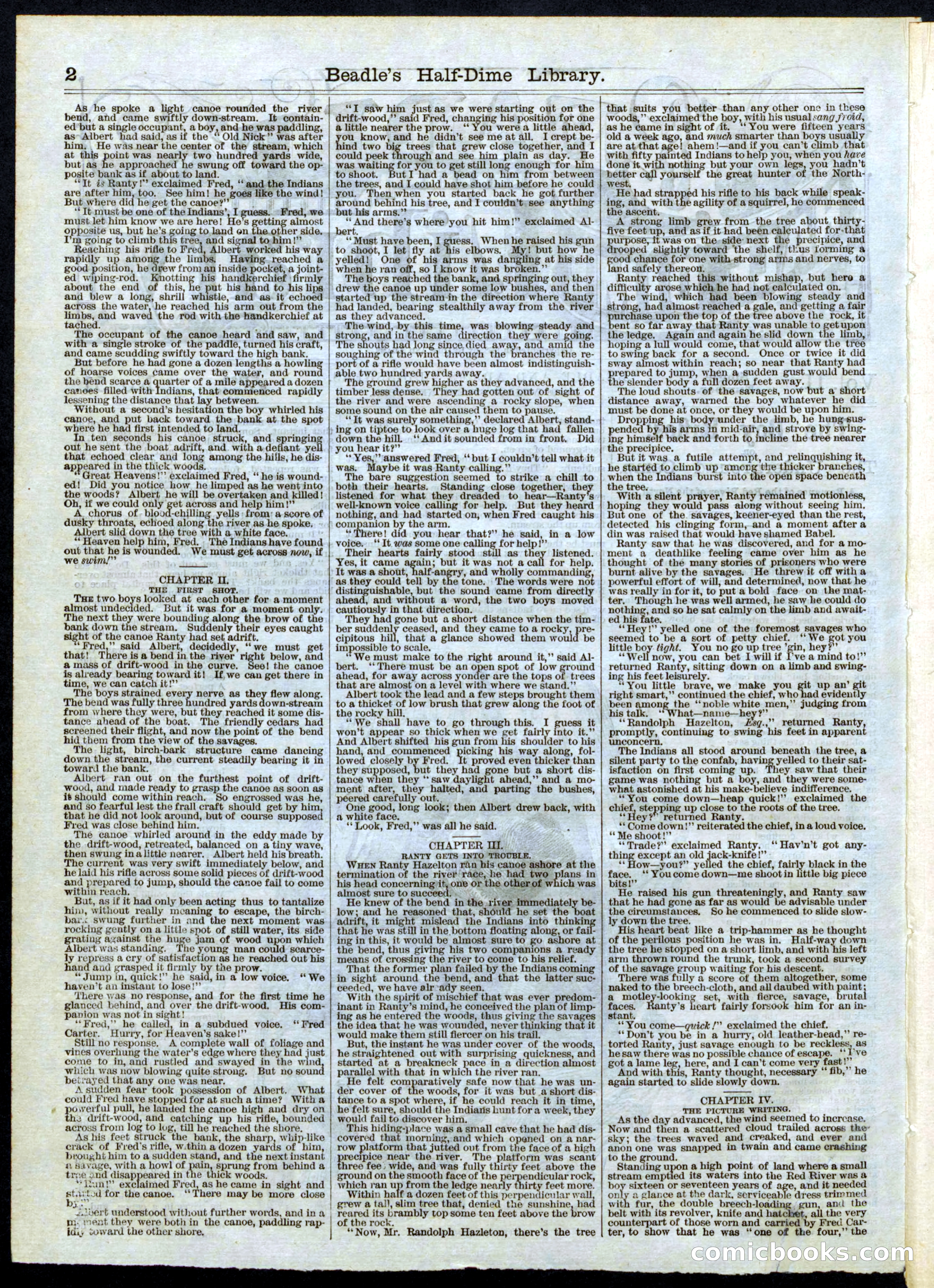
A restored page from Pulp Fiction, 1878. Page through the whole issue in the reader above.
📄 Transcribed text from this page (OCR, searchable)
Machine-transcribed from the original scan — historical spelling and the odd misread are preserved.
2 As he spoke a bend, and came swiftly down-stream. It contain- ed but a single occupant, a boy, and he was paddling, as” Albert had said, as if the ‘‘ Old Nick” was after him, . He was near the center of the stream, which at this point was nearly two hundred yards wide, but as he approached he swung off toward the op- posite bank as if about to land. ‘““It is Ranty!"’ exclaimed Fred, ‘‘ and the Indians are after him, too. See him! he goes like the wind! But where did he get ~~ COR OF ””’ : Fred, ‘Tt mus one of the Indians’ guess. we must.let him know we are here! He's getting almost opposite us, but he’s going to. land en the.other side, I’m going to climb this tree, and signal to him!” Reaching his rifle to Fred, Albert worked his way rapidly up among the lim Having. reached a good position, he drew from an inside pocket, a joint- ed wiping-rod. org | his handkerchief firmly about the end of this, he put his hand to his lips and blew a long, shrill whistle, and as it echoed across the water, he reached his arm out from the eee waved the rod with the handkerchief at ched. The occupant of the canoe heard and saw, and with a single stroke of the paddle, turned his craft, and came scudding swiftly toward the high bank. But before he had gone a dozen lengths a howlin of hoarse voices came over the water, and roun the bend scarce a quarter of a mile appeared a dozen canoes filled with Indians, that commenced rapidly lessening the distance that lay between. Without a second’s hesitation the boy whirled his canoe, and put back toward the bank at the spot where he had first intended to land. In ten seconds his canoe struck, and springin out he sent the boat adrift, and. with a deflant ye that echoed clear and long among the hills, he dis- appeared in the thick woods. “Great Heavens!’’ exclaimed Fred, “‘ he is wound- ed! Did you notice how he limped as he went into the woods? Albert he will be overtaken and killed! Oh, if we could only get across and help him!” A chorus of. blovo ening yells : from: a score of dusky throats, echoed along the river as he spoke, Albert slid down the tree with a white face. ““Heaven help him, Fred. Thé Indians have found out br he is wounded. We must get across now, if we swim!” | CHAPTER I. THE FIRST SHOT. Tue two aie by looked at each other for a moment almost undecided. But it was for a moment only. The next they were bounding along the brow of the bank down the stream. Suddenly their eyes caught sight of the canoe Ranty had set adrift. ‘Fred,” said Albert, decidedly, “‘we must get that! There is a bend in the river ht below, and a mass of drift-wood in the curve. 6! the canoe is already bearing toward it! If,we can get there in time, we can catch it!”’ The boys strained every nerve as they flew along. The bend was fully three hundred yards down-stream from where they were, but they reached it some dis- tance ahead of the boat. The friendly cedars had screened their flight, and now the point of the bend hid them from the view of the savages. The light, birch-bark structure came dancing down the stream, the current steadily bearing it in toward the bank. Albert ran out on the furthest point of drift- wood, and made ready to grasp the canoe as soon as it should come within reach. So engrossed was he, and so fearful lest the frall craft should get by him that he did not look around, but of course supposed Fred was close behind him. The canoe whirled around in the eddy made by the drift-wood, retreated, balanced on a tiny wave, then swung inalittle nearer. Albert held his breath. The current was very swift immediately below, and he laid his rifle across some solid pieces of drift-wood and prepared to jump, should the canoe fail to come within reach. But, as if it had only been acting thus to tantalize hij», without really meaning to escape, the birch- bar< swung further in and the next moment was rocking gently on a little spot of still water, its side grating against the huge jam of wood upon which Albert was standing. The pouns man could searce- ly repress a cry of satisfaction as he reached out his hand and grasped it firmly by the prow. “Jump in, quick!’ he said, in a low voice. “ We haven’t an instant to lose!” There was no response, and for the first time he glanced behind, and over the drift-wood, His com- panion was not in sight! ‘*Fred,’’ he called, in a subdued voice. ‘“ Fred Carter. Hurry, for Heaven’s sake!” Still no response, A complete wall of foliage and vines overhung the water’s edge where they had just come to in, and rustled and swayed in the wind which was now blowing quite strong. But no sound betrayed that any one was near. A sudden fear took possession of Albert. What could Fred have stopped for at such a time? Witha powers ul pull, he landed the canoe high and dry on 2 drift-wood, and catching up his rifle, bounded across from log to log, till he reached the shore. As his feet struck the bank, the sharp, whip-like crack of Fred's rifle, w.thin a dozen yards of him, brought him to a sudden stand, and the next instant a. Savage, with a howl of pen sprung from behind a tree and disappeared in the thick woods. “lvun!” exclaimed Fred, as he came in sight and wie for the canoe. ‘There may be more close “Enbert understood without further words, and in a m-. ment they were both in the canoe, paddling rap- idi, coward the other shore, light canoe rounded the river, Beadle’s Half-Dime Library. ee — ee eee “T saw him just as we were starting out on the drift-wood,”’ said Fred, changing his position for one a little nearer the prow. ‘“‘ You were a little ahead, be know, and he didn’t see me at all, I crept be- nd two big trees that grew close together, and I could peek through and see him plain as day. He was erring for you to get still long enough for him to shoot. ButI had a bead on him from between the trees, and I could have shot him before he could you. Then when you started back he got further around behind his tree, and I couldn’tesee anything but his arms.” ‘* And there’s where you hit him!’’ exclaimed Al- rt, : ‘*Must have been, I guess. When he raised his gun to shoot, I let fly at his elbows. ! but how he yelled! One of his arms was dangling at his side when he ran off, so I know it was broken.” The boys reached the bank, and springing out, they drew the canoe up under some low bushes, and then started up the stream-in the direction where Ranty had landed, bearing stealthily away from the river as they advanced. The wind, by this time, was blowing steady and strong, and in the same direction they were going. The shouts had long since. died away, and amid the sOngnINS of the wind through the branches the re- port of a rifle would have been almost indistinguish- able two hundred yards away. The ground grew higher as they advanced, and the timber less dense. They had gotten out of sight of the river and were ascending a rocky slope, when some sound on the air caused them to pause. ‘*It was surely something,’’ declared Albert, stand- » ing on tiptoe to look over a huge log that had fallen down the hill ‘'Andit sounded from in front, Did you hear it?” 7 ven answered Fred, ‘*‘ but I couldn’t tell what it was. aybe it was Ranty calling.” The bare suggestion seemed to strike a chill to both their hearts. Standing close together, the listened for what they dreaded to hear—Ranty’s well-known voice calling for help. But they heard nothing, and had started on, when Fred caught his companion by the arm. “There! did you hear that?” he said, in a low voice. ‘* It was some one calling for help!”’ Their hearts fairly stood still as they listened. Yes, it came again; but it was not a call for help. It was a shout, half-angry, and wholly commanding as they could tell by the tone. The words were no distinguishable, but the sound came from di ahead, and without a word, the two boys moved cautiously in that direction. They had gone but a short distance when the tim- ber vege | ceased, and they came to a rocky, pre- cipitous hill, that a glance showed them would be impossible to scale, “We must make to the right around it,’’ said Al- bert. ‘‘ There must be an open spot of low ground ahead, for away across yonder are the tops of trees that are almost on a level with where we stand.”’ Albert took the lead and a few steps brought them to a thicket of low brush that grew along the foot of the rocky hill. ‘“We shall have to go through this. I guess it won't appear so thick when we get fairly into it.” And Albert shifted his gun from his shoulder to his hand, and commenced picking his way along, fol- lowed closely by Fred. It proved even thicker than they supposed, but they had gone but a short dis- tance when they “saw daylight ahead,’’ and a mo- ment after, they halted, and parting the bushes, peered carefully out.. One good, long look; then Albert drew back, with a white face. , ‘** Look, Fred,”’ was all he said. CHAPTER It. | RANTY GETS INTO TROUBLE. : WHEN Ranty Hazelton ran his canoe ashore at the termination of the river race, he had two plans in his head concerning/it, one or the otherof which was almost sure to su dy. oth ae He knew of the bend in the river seatirediately be- low; and he reasoned that, should he set the t adrift, it might mislead the Indians into thin that he was still in the bottom floating along, or fail- ing in this, it would be almost sure to go ashore at the bend, thus giving his two companions a ready means of crossing the river to come to his relief. That the former plan failed by the Indians coming in sight around the bend, and that the latter suc- ceeded, we have alr-ady seen. With the spirit of mischief that was ever predom- inant in Ranty’s mind, he conceived the plan of limp- ing as he entered the woods, thus giving the sghhe. 92 the idea that he was wounded, never thinking that it would make them still flercer on his trail. But, the instant he was under cover of the woods he straightened out with surprising quickness, and started at a breakneck pace in a direction almost parallel with that in which the river ran. He felt ere gman f safe now that he was un- der cover of the woods, for it was but _a short dis- tance to a spot where, if he could reach it in time, he felt sure, should the Indiazis hunt for a week, they would fail to discover him. This hiding-place was a small cave that he had dis- i # . . ' covered that morning, and which opened on a nar- row platform that jutted out from the face of a high recipice near the river. The platform was scant hree fee. wide, and was fully thirty feet above the ground on the smooth face of the pe ndicular rock, which ran up from the ledge nearly thirty feet more. Within half a dozen feet of this perpendicular wall | grew a tal), slim tree that, denied the sunshine had reared its brambly top some ten feet above the brow of the rock. ‘*Now, Mr. Randolph Hazleton, there’s the tree that suits you better than any other one in these woods,”’ exclaimed the boy, with his usual sang j7 oid, as he came in sight of it. ‘‘ You were fifteen years old a week ago, and much smarter than ee usually are at-that age! ahem !—and if you can’t climb that with fifty painted Indians to help you, when you have done it.with nothing but your own legs, you hadn’t better call yourself the great hunter of the North- west, ‘ : He had strapped his rifle to his back while speak- ing, and with the agility of a squirrel, he commenced the ascent. A strong limb grew from the tree about thirty- five feet up, and as if it had been calculated for-that wel ery it was on the-side next the precipice, and rooped slightly toward ‘the shelf, thus forming a E00 chance for one with strong arms and nerves, to and safely thereon. Ranty reached this without mishap, but here a difficulty arose which he had not calculated on. The wind, which had been blowing steady and strong, had almost reached a gale, and getting a fair enya upon the ne of the tree above the rock, it nt so far away that Ranty was unable to get upon the ledge. Again and again he slid down the limb, hoping a lull would come, that would allow the tree to swing back for a second. Once or twice it did sway almost within reach; so near that Ranty had ee epee to jump, when a sudden gust would bend he slender body a full dozen feet away. The loud shouts. of the savages, now but a short distance away, warned the boy whatever he did must be done at once, or they would be upon him. Dropping his body under the limb, he hung sus- pended by his arms in mid-air, and strove by swing- ing himself back and forth to incline the tree nearer the precipice. . ae But it was_a futile attempt, and relinquishing it, he startéd to climb up among the thicker branches, when the Indians burst into the open space beneath the tree. , With a silent prayer, Ranty remained motionless, hoping they would pass along without seeing him, But one of the savages, keener-eyed than the rest, detected his clinging form, and a moment after a din was raised that would have shamed Babel. Ranty saw that he was discovered, and for a mo- ment a deathlike feeling came over him as he thought of the many stories of prisoners who were burnt alive by the savages. He threw it off witha powerful effort of will, and determined, now that he was really in for it, to put a bold face on the mat- ter. Though he was well armed, he saw he could do pe tow and so he sat calmly on the limb and await- ed his fate. ‘**Hey!"’ yelled one of the foremost savages who seemed to be a sort of petty chief. ‘We got you little boy tight. You no go up tree ‘fn, hey?” ‘*Well now, you can bet I will if I’ve a mind to!”’ returned Ranty, sitting down on a limb and swing- ing his feet leisurely. ‘You little brave, we make you git up an’ git right smart,’’ continued the chief, who evidently been among the ‘‘noble white men,’’ judging from his talk. ‘*What—name—hey?”’ ‘*Randolph Hazelton, Zsg.,’’ returned Ranty promptly, continuing to swing his feet in apparent unconcern. The Indians all stood around beneath the tree, a silent party to the confab, having yelled to their sat- isfaction on first coming up. ey saw that their game was nothing but a boy, and they were some- what astonished at his make-believe indifference. ‘“You come down—heap quick!’’ exclaimed the chief stepping up close to the roots of the tree. “Hey returned Ranty. ‘ ‘*Come down!” reiterated the chief, in a loud voice. ** Me shoot!” ‘“Trade?”’ exclaimed Ranty. it except an old jack-knife!”’ ‘* How—you?” yelled the chief, fairly black in the ** You come down—me shoot in little big piece ‘*Hav'n’t got any- face. bits!’ He raised his gun threateningly, and Ranty saw that he had gone as far as would be advisable under the circumstances. So he commenced to slide slow- ly down the tree. His heart beat like a trip-hammer as he thought of the perilous position he was in. Half-way down the tree he stopped on a short limb, and with his left arm thrown round the trunk, took a second survey of the savage group waiting for his descent. There was fully a score of them altogether, some naked to the breech-cloth, and all daubed with paint; a cg? fearon set, with fierce, savage, rutal “sa ty’s bart fairly forsook him for an in- ant. “You come—gquick /” exclaimed the chief. **Don’t you be in a hurry, old leather-head,” re- torted Ranty, just savage enough to be reckless, as he saw there was no possible chance of escape. “J ‘ve got a lame leg, here, and I can’t come very fast ” And with this, Ranty thought, necessary “ fib,”’ he again started to slide slowly down. CHAPTER IV. THE PICTURE WRITING. As the day advanced, the wind seemed to increase. Now and then a scattered cloud trailed across the: sky; the trees waved and creaked, and ever and anon one was snapped in twain and came to the und. Standing upon a high point of land where a small stream emptied its waters into the Red River was a boy sixteen or seventeen years of age, and it needed only a glance at the dark, serviceable dress trimmed with fur, the double breech-] gun, ani the belt with its revolver, knife and st, all the very counterpart of those worn and carried by Fred Car- ter, to show that he was “one of the four,’’ the Gomicbooks (E(@)