
Pulp Fiction, 1877 · page 3 of 32
Beadle's Half Dime Library, No. 5 — page 3: what you’re looking at
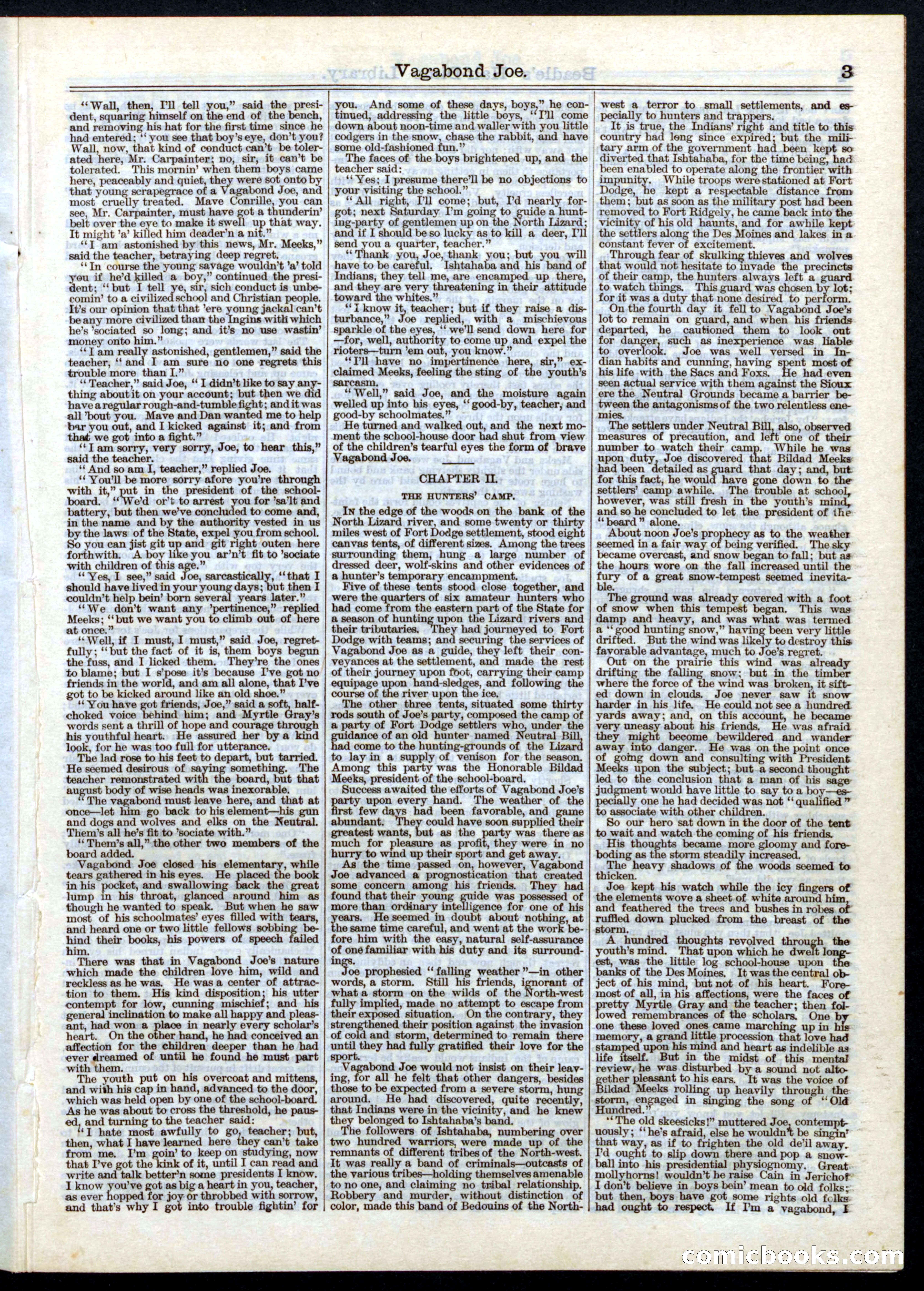
A restored page from Pulp Fiction, 1877. Page through the whole issue in the reader above.
📄 Transcribed text from this page (OCR, searchable)
Machine-transcribed from the original scan — historical spelling and the odd misread are preserved.
Vagabond Joe. 3 ‘“Wall, then, Pll tell you,” said the presi- dent, squaring himself on the end of the bench, and removing his hat for the first time since he had entered; *‘ you see that boy’s eye, don’t you? Wall, now, that kind of conduct can’t be toler- ated here, Mr. Carpainter; no, sir, it can’t be tolerated. This mornin’ when them boys came here, peaceably and quiet, they were sot onto by that young scrapegrace of a Vagabond Joe, and most cruelly treated. Mave Conrille, you can see, Mr. Carpainter, must have got a thunderin’ belt over the eye to make it swell up that way. It might ’a’ killed him deader’n a nit.” ‘“‘T am astonished by this news, Mr. Meeks,” said the teacher, betraying deep regret. ‘‘In course the young savage wouldn’t ’a’ told you if he’d killed a boy,” continued the presi- dent; ‘‘ but I tell ye, sir, sich conduct is unbe- comin’ to a civilized school and Christian people. It’s our opinion that that ’ere young jackal can’t be any more civilized than the Ingins with which he’s ’sociated so long; and it’s no use wastin’ money onto him.” ‘‘T am really astonished, gentlemen,” said the teacher, ‘‘and I am sure no one regrets this trouble more than I.” ‘“‘ Teacher,” said Joe, ‘‘ I didn’t like to say any- thing about it on your account; but then we did have aregular rough-and-tumble fight ; and it was all bout you. Mave and Dan wanted me to help bar you out, and I kicked against it; and from that we got into a fight.” ‘‘T am sorry, very sorry, Joe, to hear this,” said the teacher. ‘*‘ And so am I, teacher,” replied Joe. ‘¢ You'll be more sorry afore you're with it,” put in the president of the school- board. ‘We'd or’t to arrest you for ’sa’lt and battery, but then we’ve onahaded to come and, in the name and by the authority vested in us by the laws of the State, expel you from school. So you can jist git = and git right outen here forthwith. A boy like you ar’n’t fit to ’sociate with children of this a ‘‘ Yes, I see,” said Joe, eee oy “that I should have lived in your young days; but then I couldn’t help bein’ born several years later.” ‘‘We don’t want any ’pertinence,” replied Meeks; ‘‘ but we want you to climb out of here at once.” . ‘‘Well, if I must, I must,” said Joe, regret- fully; ‘‘ but the fact of it is, them boys the fuss, and I licked them. They’re the ones to blame; but I s’pose it’s because I’ve got no friends in the world, and am all alone, that I’ve got to be kicked around like an old shoe.” ‘* You have got friends, Joe,” said a soft, half- choked voice behind him; and Myrtle Gray’s words sent a thrill of hope and co through his youthful heart. He assured her by a kind look, for he was too full for utterance. The lad rose to his feet to depart, but tarried. He seemed desirous of saying something. The teacher remonstrated with the board, but that au body of wise heads was inexorable. The vagabond must leave here, and that at once—let ao go back to his element—his gun and dogs and wolves and elks on the Neutral. Them’s all he’s fit to ’sociate with.” ‘* Them’s all,” the other two members of the board added. Vagabond Joe closed his elemen , while tears gathered in his eyes. He placed book in his pocket, and swallowing the great lump in his throat, glanced around him as though he wanted to speak. But when he saw most of his schoolmates’ eyes filled with tears, and heard one or two little fellows sobbing be- hind their books, his powers of speech failed him There was that in Vagabond Joe’s nature which made the children love him, wild and reckless as he was. He wasa center of attrac- tion to them. His kind disposition; contempt for low, cunning mischief ; and his general inclination to make all happy and pleas- ant, had won a place in nearly every scholar’s heart. On the r he had conceived an affection for the children deeper than he had ever med of until he found he must part with them. The youth put on his overcoat and mittens, and with his cap in hand, advanced to the door, which was held open by one of the school-board. As he was about to cross the threshold, he paus- ed, and turning to the teacher said: “T hate most awfully to go, teacher; but, then, what I have learned here they can’t take from me. I’m goin’ to keep on studying, now that I’ve got the of it, until I can read and write and talk better’n some presidents I know, I know you've got as big a heart in you, teacher, as ever hopped for joy or throbbed with sorrow, and that’s why I got into trouble fightin’ for u. And some of these days, boys, inued, addressing the little boys, ‘“‘IT’ll come down about noon-time and waller with you little codgers in the snow, chase the rabbit, and have some old-fashioned fun.” The faces of the boys brightened up, and the teacher said: ‘* Yes; I presume there’ll be no objections to your visiting the school.” ‘All right, TU come; but, I’d nearly for- got; next Saturday I’m going to guide a hunt- ing-party of gentlemen up on the North Lizard; and if I should beso lucky as to kill a deer, ri send you a quarter, teacher.” “Thank you, Joe, thank you; but you will have to be careful. Ishtahaba and his band of Indians, they tell me, are encamped up there, and they are very threatening in their attitude toward the whites.” **] know it, teacher; but if they raise a dis- turbance,” Joe replied, with a mischievous sparkle of the eyes, ‘‘ we’ll send down here for —for, well, authority to come up and expel the rioters—turn ’em out, you know.” ““Tll have no impertinence here, sir,” ex- claimed Meeks, feeling the sting of the youth’s sarcasm, “Well,” said Joe, and the moisture again welled up into his eyes, ‘‘ good-by, teacher, and good-by schoolmates,” He turned and walked out, and the next mo- ment the school-house door had shut from view of the children’s tearful eyes the form of brave Vagabond Joe. CHAPTER IL. THE HUNTERS’ CAMP, In the edge of the woods on the bank of the North Lizard river, and some twenty or thirty miles west of Fort Dodge settlement, stood eight canvas tents, of different sizes. Among the trees surrounding them, hung a 1 number of dressed deer, wolf-skins and other evidences of a hunter’s temporary encampment, Five of these tents stood close together, and were the quarters of six amateur hunters who had come from the eastern part of the State for a season of hunting upon the Lizard rivers and their tributaries. ey had journeyed to Fort Dodge with teams; and securing the services of Vagabond Joe as a guide, cm | left their con- pr hearty at the omnes an mas the rest of their journey upon foot, carrying their camp equipage ie hand-sledges, and following the course of the river upon the ice, The other three tents, situated some thirty rods south of Joe’s party, composed the camp of a party of Fort Dodge settlers who, under the dance of an old hunter named Neutral Bi come to the hunting-grounds of the to lay in a supply of venison for the season. Among this party was the Honorable Bildad Meeks, president of the school-board. Success awaited the efforts of Vagabond Joe’s —_, upon every hand. The weather of the few days had been favorable, and game abundant. ey could have soon supplied their greatest wants, but as the party was there as much for pleasure as profit, they were in no hurry to wind up their sport and get away. As the time passed on, however, Vagabond Joe advanced a prognostication that created some concern among his friends. They had found that their young guide was possessed of more than 0 intelligence for one of his ewes He seemed in doubt about nothing, at he same time careful, and went at the work be-. fore him with the easy, natural self-assurance of oné familiar with his duty and its surround- oe prophesied “falling weather ”—in other words, a storm. Still his friends, ignorant of what a storm on the wilds of the North-west fully implied, made no attempt to escape from their exposed situation. On the contrary, they epgmenes their position against the invasion of cold and storm, determined to remain there until they had fully gratified their love for the sport. Vagabond Joe would not insist on their leay- ing, for all he felt that other dangers, besides those to be expected from a severe storm, hung around, He had discovered, quite recently, that Indians were in the vicinity, and he knew or, belonged to Ishtahaba’s band. e followers of Ishtahaba, numbering over two hundred warriors, were made up of the remnants of different tribes of the North-west. It was really a band of criminals—outcasts of the various tribes—holding themselves amenable to no one, and claiming no tribal relationship. Robbery and murder, without distinction of color, made this band of Bedouins of the North- ” he con- west a terror to small settlements, and es- pecially to hunters and trappers. It is true, the Indians’ right and title to this country had leng since expired; but the mili arm of the government had_been kept so | diverted that Ishtahaba, for the time being, had | been enabled to operate along the frontier with While troops were stationed at Fort img 6 Dodge, he kept a respectable distance from _ them; but as soon as the military oe had been removed to Fort Ridgely, he came back into the M secs of his old haunts, and for awhile kept the settlers along the Des Moines and lakes ina constant fever of excitement. Through fear of skulking thieves and wolves that would not hesitate to invade the precincts of their camp, the hunters always left a guard to watch things. This guard was chosen by lot; for it was a duty that none desired to perform. On the fourth day it fell to Vagabond Joe’s lot to remain on guard, and when his friends departed, he cautioned them to look out for d r, such as inexperience was _ liable to overlook. Joe was well versed in dian habits and cunning, having nt most of his life with the Sacs and Foxs. He had even seen actual service with them against the Sioux ere the Neutral Grounds became a barrier be- tween the antagonisms of the two relentless ene- mies. The settlers under Neutral Bill, also, observed measures of precaution, and left one of their number to watch their camp. While he was upon duty, Joe discovered that Bildad Meeks had been detailed as guard that day; and, but for this fact, he would have gone down to the settlers’ camp awhile. The trouble at school, however, was still fresh in the youth’s mi and so he concluded to let the president of the “beard ” alone. About noon Joe’s prophecy as to the weather seemed in a fair way of being verified. The sky became overcast, and snow began to fall; but ae the hours wore on the fall increased until the zy of a great snow-tempest seemed inevita- e. The ground was already covered with a foot of snow when this tempest began. is was damp and heavy, and was what was termed ” ie hunting snow,” having been very little drifted. But the wind was likely to destroy this favorable advantage, much to Joe’s regret. Out on the prairie this wind was already drifting the falling snow; but in the timber where the force of the wind was broken, it sift- ed down in clouds. Joe never saw it snow harder in his life. He could not see a hundred yards away; and, on this account, he became very uneasy about his friends, He was afraid they might become bewildered and wander away into danger. He was on the point once = omg =e pow 4 ar ery | with President upon subject; but.a second thought led to the conclusion $25 a man of his p judgment would have little to say to a boy—es- pecially one he had decided was not ‘‘ qualified ” to associate with other children. So our hero sat down in the door of the tent to wait and watch the coming of his friends. His pop. oye became more gloomy and fore- boding as the storm steadily increased, The heavy shadows of woods seemed to wos t his watch while the icy fingers oe kept his watch while the of the elements wove a sheet of wiibe suctind him and feathered the trees and bushes in robes. of maine down plucked from the breast of the A hundred thoughts revolved capone’ the youth’s mind. That upon which he dwelt I est, was the little log school-house upon t banks of the Des Moines, It was the central ob- ject of his mind, but not of his heart. Fore- most of all, in his affections, were the faces of cates | Myrtle Gray and the teacher; then fol- owed remembrances of the scholars. One one these loved ones came marching up in memory, a grand little procession that love had stamped upon his mind and heart as indelible as life itself. But in the midst of this mental review, he was disturbed by a sound not alto- gether leasant to his ears. It was the voice of ildad Meeks rolling up heavily through the storm, en i Hundred.’ ‘The old skeesicks!” muttered Joe, con uously ; ‘‘he’s afraid, else he wouldn't be ines that way, as if to frighten the old de’il away. I'd ought to slip down there and pop a snow- ball into his presidential physiognomy. Great. mollyhorns! wouldn’t he raise Cain in Jerichof’ I don’t believe in boys bein’ mean to old folks; but then, boys have got some rights old folks: had ought to respect. If I'm a vagabond, I up in singing the song of “Old GOMGE cS JOO GOl