
Pulp Fiction, 1877 · page 29 of 32
Beadle's Half Dime Library, No. 5 — page 29: what you’re looking at
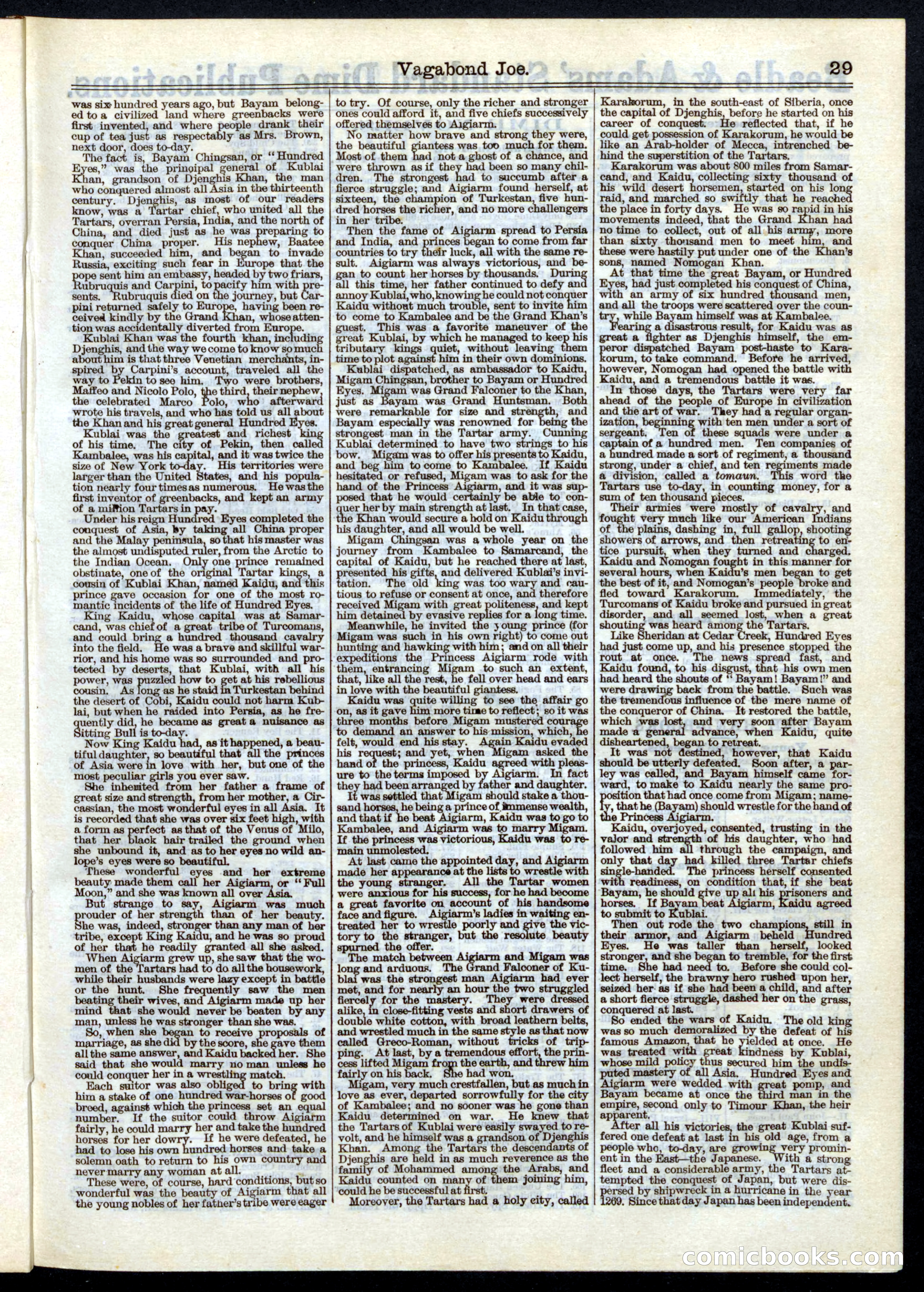
A restored page from Pulp Fiction, 1877. Page through the whole issue in the reader above.
📄 Transcribed text from this page (OCR, searchable)
Machine-transcribed from the original scan — historical spelling and the odd misread are preserved.
Vagabond Joe. 29 was six: hundred years ago, but Bayam_belong- ed toa civilized land where greenbacks were first invented, and where le drank their cup of tea just as respectably as Mrs. Brown, next door, does to-day. The fact. is, Bayam Chingsan, or ‘‘ Hundred Eyes,” was the pringipal general of Kublai an, grandson of Djenghis Khan, the man who conquered almost all Asia in the thirteenth century. Djenghis, as most of our readers know, was a Tartar chief, who united all the Tartars, overran Persia, India, and the north of China, and died just as he was peoPanng to conquer China proper. His nephew, Baatee Khan, succeeded him, and an to invade Russia, exciting such fear in Kurope that the pore sent him an embassy, headed by two friars, ubruquis and Sg ee to pacity him with pre- sents. *Rubraqiia ied on the journey, but : pini returned safely to Europe, having been re- ceived kindly by the Grand n, whose atten- tion was accidentally diverted from arene. Kublai Khan was the fourth khan, inc pang Djenghis, and the way we come to know somuc about him is that three Venetian merchants, in- spired by Carpini’s account, traveled all the way to Pekin to see him. Two were brothers, Majffeo and Nicolo Polo, the third, their nephew the celebrated Marco Polo, who afterw wrote his travels, and who has told us all about the Khan and his great general Hundred Eyes. Kublai was the test and richest kin of his time. The olty of Pekin, then call Kambalee, was his capital, and it was twice the size of New York ay. His territories were larger than the United States, and his popula- tion nearly four timesas numerous. He was the first inventor of greenbacks, and kept an army of a miFion Tartars am pay. Under his reign Hun Eyes completed the conquest of Asia, by China proper and the Malay peninsula, so that his master was the almost undisputed ruler, from the Arctic to the Indian Ocean. one prince remained obstinate, one of the original Tartar kings, a cousin of Kublai Khan, named Kaidu, this prince gave occasion for one of the most ro- mantic incidents of the life of Hundred Eyes. King Kaidu, whose capital was at Samar- cand, was chief of a great tribe of Turcomans, and could bring a hundred thousand cavalry into the field. He was a brave and skillful war- rior, and his home was so surrounded and pro- tected by deserts, that Kublai, with all his power, was puzzled how to get at his rebellious cousin, As long as he staid in Turkestan behind the desert of Cobi, Kaidu could not harm Kub- lai, but when he raided into Persia, as he fre- uently did, he became as great a nuisance as ditting Bull is to-day. Now King Kaidu as it happened, a beau- tiful daughter, so beautiful that all the princes of Asia were in love with her, but one of the most peculiar girls you ever saw. She inhenited from her father a frame of great size and from her mother, a Cir- cassian, the most w rful eyes in all Asia. It is reeorded that she was over six feet high, with a form as perfect as that of the Venus of Milo, that her black hair trailed the ground when she unbound it, and as to her eyes no wild an- lope’s eyes were so beautiful. These wonderful eyes and her extreme beauty made them call her Ai or “Full Moon,” and she was known all over Asi But strange to say, Aigiarm was much Recenar of her strength than of her beauty. he was, indeed, stronger than any man of her tribe, — King Kaidu, and he was so proud of her t he readily granted all she asked. When Aigi grew up, she saw that the wo- men of the Tartars had to do ali the housework, while their husbands were lazy except in battle or the hunt. She frequently saw the men beating their wives, and Aigiarm made up her mind that she would never be beaten by any man, unless he was stronger than she was. So, when she ne to receive proposals of marriage, as she by the score, she all the same answer, and Kaidu backed her. She said that she would marry no man unless he could conquer her in a wrestling match. h suitor was also obli to bring with him a stake of one hundred war-horses of good breed, against which the princess set an equal number. If the suitor could throw Aigiarm fairly, he could marry her and take the hundred horses for her do If he were defeated, he had to lose his own hundred horses and take a solemn oath to return to his own country and nevermarryany woman atall, These were, of course, hard conditions, but so wonderful was the beauty of Aigiarm that all the young nobles of her father’s tribe were eager to try. Of course, only the richer and stronger ones could afford it, and five chiefs successively offered themselves to Aigiarm. No matter how brave and strong they were, the beautiful giantess was too much for them. Most of them not a ghost of a chance, and were thrown asif they had been so many chil- dren. The strongest to succumb after a fierce struggle; and Aigiarm found herself, at sixteen, the champion of Turkestan, five hun- dred horses the richer, and no more challengers in her tribe. Then the fame of Aigi spread to Persia and India, and princes an to come from far countries to try their luck, all with the same re- sult. Aigiarm was rots fe victorious, and be- gan to count her horses by thousands. Durin all this time, her father continued to defy an annoy Kublai, who, knowing he could not conquer Kaidu without much trouble, sent to invite to come to Kambalee and be the Grand Khan’s guest. This was a favorite maneuver of the great Kublai, by which he managed to meee tributary kings quiet, without leaving them time to plot against him in their own dominions. Kublai dispatched, as ambassador to Kaidu Migam Chingsan, brother to Bayam or Hun Eyes. Migam was Grand Falconer to the Khan, just as yam was Grand Huntsman. Both were remarkable for size and , and Bayam especially was renowned for g the strongest man in the Tartar army. ing Kublai determined to have two strings to his bow. Migam was to offer his presents to Kaidu, and beg him to come to balee. If Kaidu hesitated or refused, Migam was to ask for the hand of the Princess Aigi , and it was sup- posed that he would certainly be able to con- uer her by main strength at last. In that case, the Khan would secure a hold on Kaidu through his daughter, and all would be well. Migam Chin was a whole year on the journey from Kambalee to Samarcand, the capital of Kaidu, but he reached there at last, presented his gifts, and delivered Kublai’s invi- tation. The old king was too wary and cau- tious to refuse or consent at once, and therefore received Mi with great politeness, and kept him detai by evasive replies for a long time. Meanwhile, he invited the joung prince (for Migam was such in his own right) to come out hunting and hawking with him; and on all their expeditions the Princess Aigiarm rode with them, entrancing Mi to such an extent, that, like all the rest, he fell over head and ears in love with the beautiful giantess. Kaidu was quite willing to see the affair go on, as it gave him more time to reflect; so it was three months before Migam mustered co to demand an answer to his mission, which, he felt, would end his stay. ain Kaidu evaded his request; and yet, when Mi asked the hand of the princess, Kaidu agreed with pleas- ure to the terms imposed by Aigiarm. In fact they had been arr by father and daughter. it was settled that Migam should stake a thou- sand h he being a prince of #mmense wealth, and thatif he beat Aigiarm, Kaidu was to go to Kambalee, and Aigiarm was to marry Migam. If the princess was victorious, Kaidu was to re- main unmolested. At last came the appointed day, and Aigiarm made her ap ce at the lists to wrestle with the y . All the Tartar women were pe, Hi for his success, for he had a gen favorite on accoun a ~ Gawplatiie ti face and figure. ae gpd es en- treated her to e@ poorly and give the vic- tory to eg stranger, but the ute beauty e offer spurned ; The match between vy, am and Migam was long and pny stiatieas of Ku- blai was the str man ever met, and for nearly an hour the two struggled fiercely for the mastery. They were dressed alike, in close-fitting vests and short drawers of double white cotton, with broad leathern belts, and wrestled much in the same —— as that now called Greco-Roman, without tricks of trip- ping. At last, by a tremendous effort, the prin- cess lifted Migam gt des earth, and him fairly on his back. had won, Migam, very much crestfallen, but as much in love as ever, departed sorrowfully for the city of Kambalee; and no sooner was he gone than Kaidu determined on war. He knew that the Tartars of Kublai were easily swayed to re- volt, and he himself was a grandson of Djenghis Khan. Among the Tartars the descen of Djenghis are held in as much reverence as the family of Mohammed among the Arabs, and Kaidu counted on many of them joining him, could he be successful at first. : Moreover, the Tartars had a holy eity, called Karakorum, in the south-east of Siberia, once the capital of Djenghis, before he started on his career of conquest. He reflected that, if he could get possession of Karakorum, he would be like an Arab-holder of Mecca, intrenched be- hind the superstition of the Tartars. rakorum was about 800 miles from Samar- cand, and Kaidu, collecting sixty thousand of his wild desert horsemen, started on his lon raid, and marched so swiftly that he reach the place in forty ed He was so rapid in his movements indeed, that the Grand an had no time to collect, out of all his army, more than sixty thousand men to meet him, and these were hastily put under one of the Khan’s sons, named Nomogan Khan. At that time the great Bayam, or Hundred Eyes, had just completed his conquest of China, with an army of six hundred thousand men, and all the troops were scattered over the coun- wij, Dich Bayam himself was at Kambalee. i ge disastrous result, for Kaidu was as great a fighter as Djenghis himself, the em- ror dispatched Bayam post-haste to Kara- orum, to take command. Before he arrived, however, Nomogan had opened the battle with Kaidu, and a tremendous battle it was. In those days, the Tartars were very far ahead of the people of Europe in civilization and the art of war. They had a regular organ- ization, i ng with ten men under a sort of sergeant. Ten of these squads were under a captain of a hundred men. Ten com a hundred made a sort of regiment, a thousand strong, under a chief, and ten iments made a division, called a tomaun. word the Tartars use to-day, in counting money, for a sum of ten thousand pieces. Their armies were mostly of mothe and Hg very much like our American Indians of plains, dashing in, full gallop, shooting showers of arrows, and then retreating to en- tice pursuit, when they turned and p dealin 4 Kaidu and Nomogan fought in this manner for several hours, when Kaidu’s men a to get the best of it, and Nomogan’s people broke and fled toward Karakorum. Immediately, the Turcomans of Kaidu broke and pursued in great disorder, and all seemed lost, when a great shouting was heard among the Tartars. Like Sheridan at Cedar Hundred Eyes had just come up, and his presence stopped the rout at once. The news spread fast, and Kaidu found, to his disgust, t his own men had heard the shouts of ‘*‘ Bayam! Bayam!” and were drawing back from the battle. Such was the tremendous influence of the mere name of the conqueror of China. It restored the battle, which was lost, and very soon after Bayam made a advance, when Kaidu, quite disheartened, began to retreat. It was not destin however, that Kaidu should be utterly defea Soon after, a par- ley was called, and Bayam himself came for- ward, to make to Kaidu nearly the same pro- tion that had once come from Migam; name- , that he (Bayam) should wrestle for the hand of e Princess Aigiarm. Kaidu, overjoyed, consented, trusting in the vajor and of his daughter, who had followed him through the campaign, and only that day had killed three Tartar chiefs single-hand The princess herself consented with readiness, on condition that, if she beat Bayam, he should give up ali his pan and horses. If Bayam beat iarm, Kaidu agreed to submit to Kublai. Then out rode the two champi still in their armor, and Aigiarm beheld Eyes. He was taller than herself, looked stronger, and she an to tremble, for the first time. She had to. Before she could col- lect herself, the brawny hero rushed upon her, seized her- as if she had been a child, and after a short fierce struggle, dashed her on the grass, conquered at last. : So ended the wars of Kaidu. The old king was so much demoralized by the defeat of his famous Amazon, that he yielded at once. He was treated with great kindness by Kublai, a whose mild poly. thus secured him the undis- t pomp, and Bayam became at once the third han in the empire, second only to Timour Khan, the heir sia gy r all his victories, the great Kublai suf- fered one defeat at last in his old age, from a people who, to-day, are growing very promin- ent in the Kast—the Japanese. ith a strong fleet and a considerable army, the Tartars at- tempted the conquest of Japan, but were dis- persed by shipwreck in a hurricane in the year . Since that day Japan has been independent. ies of GOmiGooo (E “S (E(@)