
Pulp Fiction, 1877 · page 20 of 32
Beadle's Half Dime Library, No. 5 — page 20: what you’re looking at
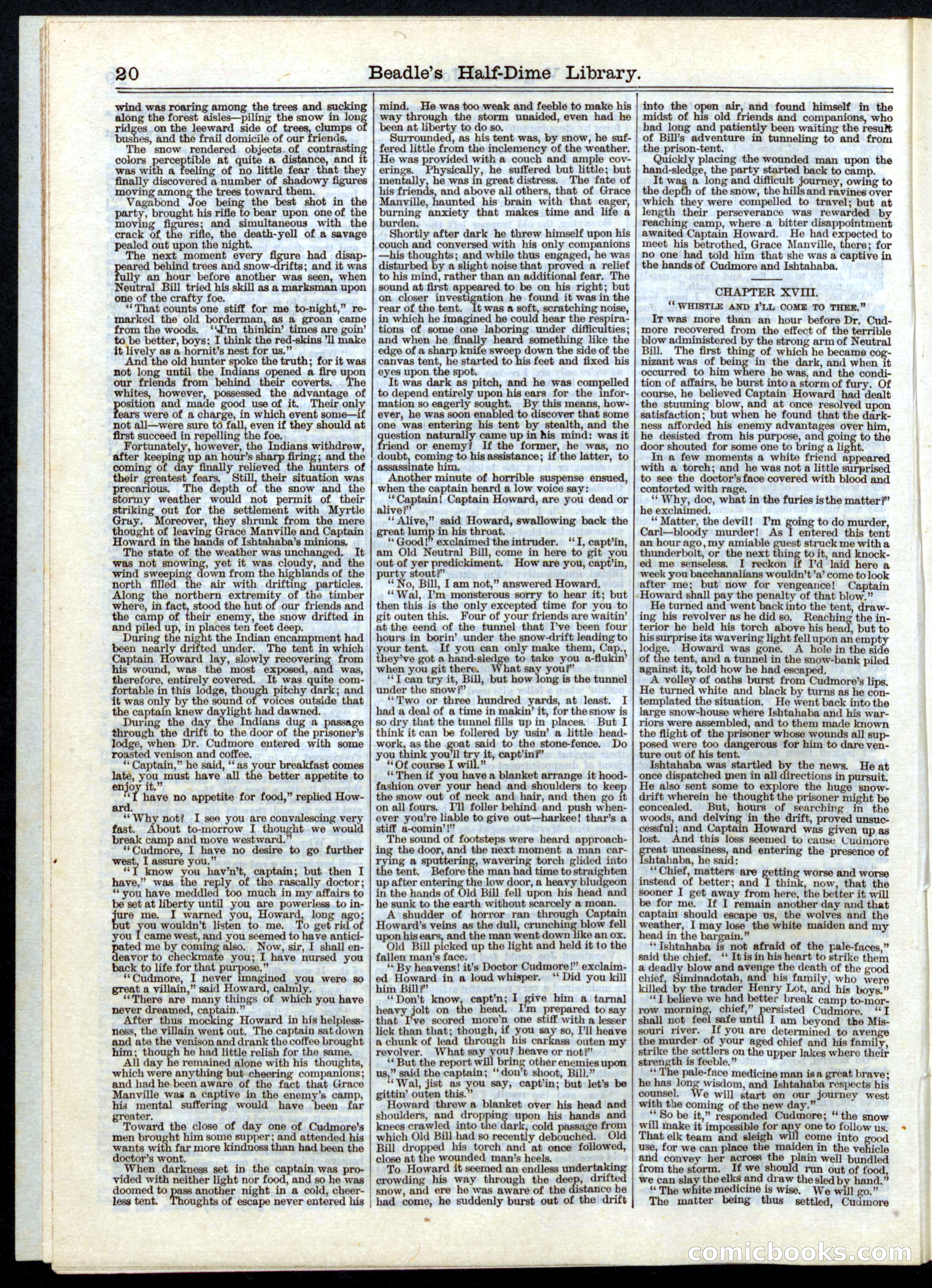
A restored page from Pulp Fiction, 1877. Page through the whole issue in the reader above.
📄 Transcribed text from this page (OCR, searchable)
Machine-transcribed from the original scan — historical spelling and the odd misread are preserved.
os. eS Se “Sas Se ow a 2 +e, Et of 20 wind was roaring among the trees and sucking along the forest aisles—piling the snow in lon ion on the leeward side of tr clumps 0 bushes, and the frail domicile of our friends. _ The snow rendered objects.of contrasting colors perceptible at quite a distance, and it was with a feeling of no little fear that they finally discovered a number of shadowy figures moving among the trees toward them. Vagabond Joe being the best shot in the party, brought his rifle bear upon one of the moving 7 pair? and simultaneous with the e rifle crack of , the death-yell of a savage pealed out upon the night. The next moment every figure had disap- ed behind trees and snow-drifts; and it was ully an hour before another was seen, when Neutral Bill tried his skill as a marksman upon one of the crafty foe. “That counts one stiff for me to-night,” re- marked the old borderman, as a groan came from the woods. ‘‘d’m thinkin’ times are goin’ be better, boys; I think the red-skins ’1l make it lively as a hornit’s nest for us.” And the old hunter spoke the truth; for it was not long until the Indi opened a fire upon Wills, Woneehe, oustel. the. Advantage. of w owever, e advantage o ition and made good use of it. Their only ears were of a charge, in which event some—if not all—were sure to fall, even if they should at first succeed in repelling the foe. Fortunately, however, the Indians withdrew, after keeping up an hour’s firing; and the coming of day finally relieved the hunters of their greatest fears, Still, their situation was precarious. The depth of the snow and the stormy weather would not permit of their striking out for the settlement with Myrtle Gray. Moreover, they shrunk from the mere thought of leaving Grace Manville and Captain Howard in the hands of Ishtahaba’s minions, The state of the weather was unchanged. It was not snowing, yet if was cloudy, and the wind se own from the highlands of the north filled the air with drifting particles. Along the northern extremity of the timber where, in fact, stood the hut of our friends and the camp of their enemy, the snow drifted in and piled up, in places ten feet deep. During the night the Indian encampment had been Beery drifted under. The tent in which Captain Howard lay, slowly recovering from his wound, was the most exposed, and was, therefore, entirely covered. It was quite com- fortable in this lodge, though pitchy dark; and it was only by the sound of voices outside that the captain knew daylight had dawned. During the day the Indians dug a passage through the drift to the door of the prisoner’s odge, when Dr. Cudmore entered with some roasted venison and coffee. ** Captain,” he said, ‘‘as your breakfast comes late, ve, must have all the better appetite to enjoy it. } . 1 tave no appetite for food,” replied How- ‘Why not? I see you are convalescing very fast. About to-morrow I thought we would break camp and move westward. ‘*Cudmore, I have no desire to go further west, I assure you.” “TY know you hav’n’t, captain; but then I have,” was the reply of the rascally doctor; ** you have meddled too much in my affairs to be set at liberty until you are powerless to in- que me. I warned you, Howard, long ago; ut you wouldn’t listen to me. To get rid of you | came west, and you seemed to have antici- ete me by co also. Now, sir, I shall en- leavor to checkmate you; I have nursed you back to life for that par pee, y **Cudmore, I never imagined you were so great a villain,” said Howard, calmly. ‘There are many things of which you have never dreamed, captain.” After thus ting Howard in his helpless- ness, the villain went out, The captain sat down and ate the venison and drank the coffee brought him; though he had little relish for the same. All day he remained alone with his thoughts, which were anything but cheering companions; and had he-been aware of the fact that Grace Manville was a captive in the enemy’s camp, his mental suffering would have been far greater. Toward the close of day one of Cudmore’s men brought him some supper; and attended his wants with far more kindness than had been the doctor’s wont. When darkness set in the captain was pro- vided with neither light nor food, and so he was doomed to another night in a cold, cheer- less tent. oughts of escape never entered his a - Se ee ee 8 Sere eee Beadle’s Half-Dime Library. mind. He was too weak and feeble to make his way through the storm unaided, even had he been at liberty to do so. Surrounded, as his tent was, by snow, he suf- fered little from the inclemency of the weather. He was provided with a couch and ample cov- erin Physically, he suffered but little; but mentally, he was in great distress. The fate of his friends, and above all others, that of Grace Manville, haunted his brain with that ea r, burning anxiety that makes time and life a burden. Shortly after dark he threw himself upon his couch and conversed with his only companions —his thoughts; and while thus engaged, he was disturbed by a slight noise that proved a relief to his mind, rather than an additional fear. The sound at first appeared to be on his right; but on closer investigation he found it was in the rear of the tent. it was a soft, scratching noise, in which he imagined he could hear the respira- tions of some one laboring under difficulties; and when he finally heard something like the edge of a sharp knife wth ne oe the side of the canvas tent, he started to his feet and fixed his eyes upon the spot. It was dark as pitch, and he was compelled to depend entirely upon his ears for the infor- mation so eagerly sought. By this means, how- ever, he was soon enabled to discover that some one was entering his tent by stealth, and the uestion na y came up in his mind: was it riend or enemy? If the former, he was, no doubt, coming to his assistance; if the latter, to assassinate him. Another minute of horrible suspense ensued, when the captain heard a low voice say: <7 eee Captain Howard, are you dead or ve ‘** Alive,” said Howard, swallowing back the great lump in his throat. ‘*Good!” exclaimed the intruder. “I, capt’in, am Old Neutral Bill, come in here to git you out of yer predickiment. How are you, capt’in, purty stout?” ‘No, Bill, I am not,” answered Howard. ‘Wal, I’m monsterous sorry to hear it; but then this is the only excepted time for you to git outen this. Four of your friends are waitin’ at the eend of the tunnel that I’ve been four hours in borin’ under the snow-drift leading to your tent. If you can only make them, Cap., they’ve got a hand-sledge to take you a-flukin’ when you git there. hat say you?” ‘*T can try it, Bill, but how long is the tunnel under the snow?’ “Two or three hundred yards, at least. I had a deal of a time in makin’ it, for the snow is so dry that the tunnel fills up im places. But I think it can be follered by usin’ a little head- work, as the goat said to the stone-fence. Do you think you'll 4 it, capt’in?”’ ‘Of course I will.” ‘Then if you have a blanket arrange it hood- fashion over your head and shoulders to kee the snow out of neck and hair, and then go it on all fours. Ill foller behind and push when- ever you're liable to give out—harkee! thar’s a stiff a-comin’!” The sound of footsteps were heard approach- ing the door, and the next moment a man car- rying a sputtering, wavering torch glided into the tent. Before the man had time to straighten up after entering the low door, a heavy bludgeon in the hands of Old Bill fell upon his head and he sunk to the earth without scarcely a moan. A shudder of horror ran through Captain Howard’s veins as the dull, re fell upon his ears, and the man went down ke an ox. Old Bill picked up the light and held it to the fallen man’s face. ‘“* By heavens! it’s Doctor Cudmore!” exclaim- ed Howard in a loud whisper. “ Did you kill him Bill?’ ‘‘Don’t know, capt’n; I give him a tarnal heavy jolt on the head. I’m repared to say that I’ve scored more’n one stiff with a lesser lick than that; though, if you say so, I’ll heave a chunk of lead through his car outen my revolver. What say you? heave or not?” ‘‘ But the report will bring other enemies upon us,” said the captain; ‘don’t shoot, Bill.” ‘Wal, jist as you say, capt’in; but let’s be gittin’ outen this.” Howard threw a blanket over his head and shoulders, and cropping - upon his hands and knees crawled into the dark, cold passage from which Old Bill had so recently debouched. Old Bill dropped his torch and at once followed, close at the wounded man’s heels. To Howard it seemed an endless undertaking crowding his way through the deep, drifted snow, and ere he was aware of the ce he had come, he suddenly burst out of the drift ‘Howard shall pay the ——~ — 2 0 ee ~~ — into the open air, and found himself in the midst of his old friends and companions, who had long and patiently been waiting the result of Bill’s adventure in tunneling to and from the prison-tent. Quickly placing the wounded man upon the hand-sledge, the party started back to camp. It was a long and difficult journey, owing to the depth of the snow, the hills and ravines over which they were compelled to travel; but at length their perseverance was rewarded by reaching camp, where a bitter disappointment awaited Captain Howard. He had expected to meet his betrothed, Grace Manville, there; for no one had told him that she was a captive in the hands of Cudmore and Ishtahaba. CHAPTER XVIII. *‘ WHISTLE AND I'LL COME TO THEE.” IT was more than an hour before Dr. Cud- more recovered from the effect of the terrible blow administered by the strong arm of Neutral Bill. The first thing of which he became cog- nizant was of being in the dark, and when it occurred to him where he was, and the condi- tion of affairs, he burst into a storm of fury. Of course, he believed Captain Howard had dealt the stuuning blow, and at once resolved upon satisfaction; but when he found that the dark- ness afforded his enemy advantages over him, he desisted from his purpose, and going to the door shouted for some one to bring a light. In a few moments a white friend ap with a torch; and he was not a little surprised to see the doctor’s face covered with blood and contorted with rage. ‘* Why, doc, what in the furies isthe matter?” he exclaimed. ‘“* Matter, the devil! I’m going to do murder Carl—bloody murder! As I entered this tent an hour ago,my amiable guest struck me with a thunderbolt, or the next thing to it, and knock- ed me senseless. I reckon if I’d laid here a week you bacchanalians wouldn’t’a’ come to look after me; but now for vengeance! Captain nalty of that blow.” He turned and went back into the tent, draw- ing his revolver as he did so. Reaching the in- terior he held his torch above his head, but to his surprise its wavering light fell upon an empt lodge. Howard was gone. A hole in the side of the tent, and a tunnel in the snow-bank piled against it, told how he had escaped. A volley of oaths burst from Cudmore’s lips. He turned white and black by turns as he con- templated the situation. He went back into the large snow-house where Ishtahaba and his war- riors were assembled, and to them made known the flight of the prisoner whose wounds all sup- posed were too rous for him to dare ven- ture out of his tent. Ishtahaba was startled by the news. He at once dispatched men in all directions in pursuit. He also sent some to explore the huge snow- drift wherein he thought the prisoner might be concealed. But, hours of searching in the woods, and delving in the drift, proved unsuc- cessful; and Captain Howard was given up as lost. And this loss seemed to cause Cudmore uneasiness, and entering the presence shtahaba, he said; . % _ “Chief, matters are Se worse and worse instead of better; and I think, now, that the sooner I get away from here, the better it will be for me. If I remain another day and that captain should escape us, the wolves and the weather, I may lose the white maiden and my head in the bargain.” ‘‘ Ishtahaba is not afraid of the pale-faces,” said the chief. ‘‘ Itisin his heart to strike them a deadly blow and avenge the death of the good chief, Siminadotah, and his family, who were killed by the trader Henry Lot, and his boys.” ‘‘T believe we had better break camp to-mor- row morning, chief,” persisted Cudmore. ‘TI shall not feel safe until I am beyond the Mis- souri river. If you are determined to avenge on ange tog i your sed — and “+ ag nh e the settlers on the upper lakes where thei strength is feeble.” iets 4 ‘‘ The pale-face medicine man isa great brave; he has ae enous, and Ishtahaba respects his counsel. We will start on our journey west with the coming of the new day.” ‘* So be it,” responded Cudmore; “the snow will make it impossible for any one to follow us. That elk team and sleigh come into use, for we can place the maiden in the vehicle and convey her across the plain well bundled from the storm. If we should run out of food we can slay the elks and draw thesled by hand. % “The white medicine is wise, We will go.” The matter being thus settled, Cudmore Eomicbooksscom