
Pulp Fiction, 1877 · page 18 of 32
Beadle's Half Dime Library, No. 5 — page 18: what you’re looking at
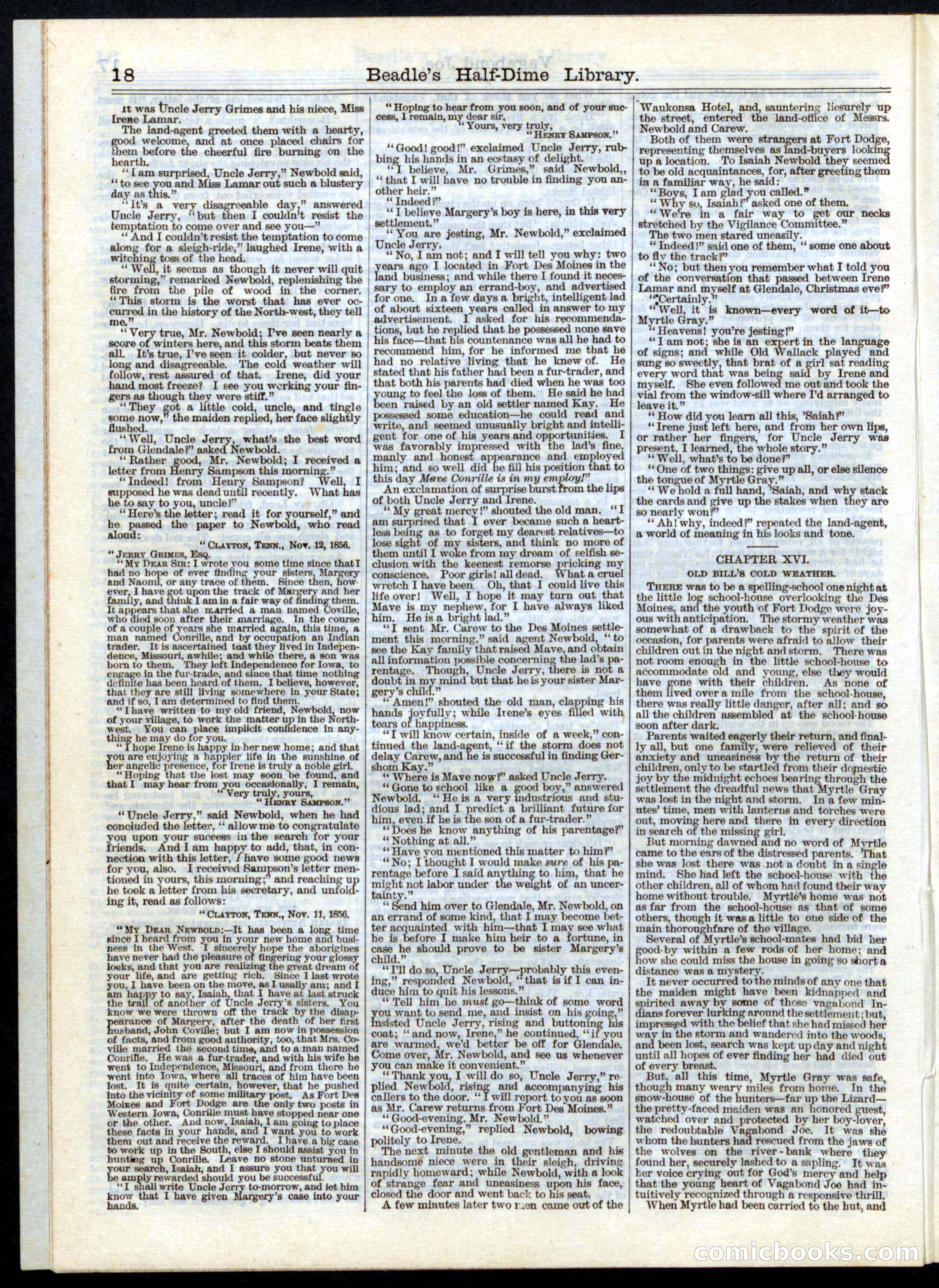
A restored page from Pulp Fiction, 1877. Page through the whole issue in the reader above.
📄 Transcribed text from this page (OCR, searchable)
Machine-transcribed from the original scan — historical spelling and the odd misread are preserved.
i} i in | | . ined — ee —_ = BSS Ee —_— Se el 18 Beadle’s Half-Dime Library. it was Uncle Jerry Grimes and his niece, Miss | “Hoping to hear from you soon, and of your suc- [rene Lamar. The land-agent greeted them with a hearty, welcome, and at once placed hearth, ‘‘[ am surprised, Uncle Jerry,” Newbold said, ** to see day as this.” “It’s a very disagreeable day,” answered | ‘ut ass | | Uncle Jerry, I couldn't resist the temptation to come over and see you—” ‘‘ And I couldn’t resist the temptation to come | | | along for a sleigh-ride,” laughed Irene, with a witching toss of the head. ‘Well, it seems as though it never will quit storming,” remarked Newbold, replenishing the fire from the pile of wood in the corner, “This storm is the worst that has ever oc- curred in the history of the North-west, they tell me, ‘‘ Very true, Mr. Newbold; I’ve seen nearly a score of winters here, and this storm beats them all. It’s true, I’ve seen it colder, but never so long and disagreeable. The cold weather will follow, rest assured of that. Irene, did your hand most freeze? I see you werking your fin- gers as though they were stiff.” ‘They got a little cold, uncle, and tingle some now,” the maiden replied, her face slightly flushed. ‘Well, Uncle Jerry, what’s the best word from Glendale?’ asked Newbold. ‘‘Rather good, Mr. Newbold; I received a letter from Henry Sampson this morning.” “‘Indeed! from Henry Sampson? ell, I What has supposed he was dead until recently. he to say to you, uncle?” “* Here’s the letter; read it for yourself,” and ne eames the paper to Newbold, who read oud: ** CLayTon, TENN., Nov. 12, 1856. * Jerry Grimes, Esq. ‘*My Dear Str: I wrote you some time since thatI had no hope of ever soaps 4 your sisters, Margery and Naomi, or any trace of them. Since then, how. ever, I have got — the track of = and her family, and think I am in a fair way of fin oe It appears that she married a man named Coville, who died soon after their marriage. In the course of a couple of years she married again, this time, a man named Conrille, and by occupation an Indian trader. It is ascertained taat they lived in Indepen- dence, Missouri, awhile; and while there, a son was born to them. They left Independence for Iowa, to eng in the fur-trade, and since that time nothing definite has been heard of them, I believe, however, that they are still living somewhere in your State; and if so, Iam determined to find them. “Thave written to my old friend, Newbold, now of your village, to work the matter up in the North- west. You can place implicit confidence in any- thing he may do for you. ““T hope Irene is happy in her new home; and that bie are enjoying a happier life in the sunshine of er angelic presence, for Irene is truly a noble girl. “Hoping that the lost may soon be found, and that I may hear from you occasionally, I remain, Very rx yours, ENRY SAMPSON.”’ ‘Uncle Jerry,” said Newbold, when he had concluded the letter, ‘‘ allow me to congratulate ou upon your suceess in the search for your riends. And Iam happy to add, that, in con- nection with this letter, / have some good news for you, also. I received Sampson’s letter men- tioned in yours, this morning;” and reaching u he took a letter from his secretary, and unfold- ing it, read as follows: “CLayTon, TENN., Nov. 11, 1856. “My Dear Newsoip;—It has been a long time since I heard from you in your new home and busi- ness in the West. I eeccrely hope the aborigines have never had the pleasure of fingering your glossy loeks, and that you are realizing the great dream of your life,and are getting rich. Since I last wro you, I have been on the move, asI usally am; and am happy to say, Isaiah, that I have at last struck the trait of another of Uncle Jerry's sisters. You know we were thrown off the track by the disap- eames of Margery. after the death of her first band, John Co ; but I am now in possession of facts, and from good authority, too, that Mrs. Co- ville married the second time, and to a man named Conrifle. He was a fur-trader, and with his wife he went to Independence, Missouri, and from there he went into Iowa, where all traces of him have been lost. It is quite certain, however, that he pushed into the vicinity of some military post. As Fort Des Moines and Fort Dodge are the only two posts in Western Iowa, Conrille must have stopped near one or the other. And now, Isaiah, I am going to place these facts in your hands, and I want you to work them out and receive the reward. I have a big case to work up in the South, else I should assist you in hunting up Conrille. Leave no stone unturned in our search, Isaiah, and I assure you that you will ome rewarded should you be succ ‘*T shall write Uncle Jerry to-morrow, and let him cones that I have given ’s case into your chairs for them before the cheerful fire burning on the ou and Miss Lamar out such a blustery bin cess, 1 remain, my al sir, nie ‘Yours, very truly, “Henry SAMPSON,”’ ‘Good! good!” exclaimed Uncle Jerry, rub- his hands in an ecstasy of delight. ‘*T believe, Mr. Grimes,” said Newbold,, | “that I will have no trouble in finding you an- _ other heir.” ** Indeed?” | ‘‘T believe Margery’s boy is here, in this very settlement.’ “You are jesting, Mr. Newbold,” exclaimed Uncle Jerry. ‘‘ No, Iam not; and I will tell you why: two ears ago I located in Fort Des Moines in the land business; and while there I found it neces- sary to employ an errand-boy, and advertised for one. Ina few days a bright, intelligent lad of about sixteen years called in answer to my advertisement. I asked for his recommenda- tions, but he replied that he possessed none save his face—that his countenance was all he had to recommend him, for he informed me that he had no relative living that he knew of. He stated that his father had been a fur-trader, and that both his parents had died when he was too oung to feel the loss of them. He said he had n raised by an old settler named Kay. He some education—he could read and write, and seemed unusually bright and intelli- gent for one of his years and opportunities, I was favorably impressed with the lad’s fine manly and honest appearance and em loyed him; and so well did he fill his position that to this day Mave Conrille isin my employ!” _ An exclamation of surprise burst from the lips of both Uncle Jerry and Irene. “ My great mercy!” shouted the old man, “I am surprised that I ever became such a heart- less pecs 2 as to forget my dearest relatives—to lose sight of m rs, and think no more of them until I woke from my dream of selfish se- clusion with the keenest remorse pees my conscience, Poor girls! alldead. What a cruel wretch I have been. Oh, that I could live this life over! Well, I hope it may turn out that Mave is my nephew, for I have always liked him. He isa bright lad.” “T sent Mr. Carew to the Des Moines settle- ment this morning,” said agent Newbold, “to see the Kay family that raised Mave, and obtain all information possible ponce ning ie lad’s pa- rentage. Though, Uncle Jerry, there is not a doubt in my mind but that he is your sister Mar- gery’s child.” ** Amen!” shouted the old man, clapping his hands joytully ; while Irene’s eyes filled with tears of happiness. ‘“*T will know certain, inside of a week,” con- tinued the seneragen’, “if the storm does not delay Carew, and he is successful in finding Ger- shom Kay.” ‘* Where is Mave now?” asked Uncle Jerry. “*Gone to school like a boy,” answered Newbold. ‘‘ He is a very industrious and stu- dious lad; and I predict a brilliant future for him, even if he is the son of a fur-trader.” “Does he know anything of his parentage?’ “ Nothing at all.” ‘‘Have you mentioned this matter to him?’ “No; I thought I would make sure of his pa- rentage before I said anything to him, that he might not labor under the weight of an uncer- arr - ‘Send him over to Glendale, Mr. Newbold, on an errand of some kind, that I may become bet- ter acquainted with him—that I may see what he is before I make him heir to a fortune, in ie he should prove to be sister Margery’s child, ‘T'll do so, Uncle Jerry—probably this even- ing,” responded Newbold, ‘that is if I can in- duce him to quit his lessons.” “Tell him he must go—think of some word ou want to send me, and insist on his going,” Uncle Jerry, rising and buttoning hi coat; ‘‘and now, Irene,” he continued, “if you are warmed, we'd better be off for Glendale. Come over, Mr, Newbold, and see us whenever you can make it convenient.” “ Thank you I will do so, Uncle Jerry,” re- plied Newbold, rising and accompanying his callers to the door. ‘‘ I will report to you as soon as Mr. Carew returns from Fort Des Moines.” ‘““Good-evening, Mr. Newbold.” ‘*Good-evening,” replied Newbold, bowing politely to Irene. The next minute the old gentleman and his handsomé niece were in their sleigh, driving rapidly homeward; while Newbold, with a look of strange fear and uneasiness upon his face, closed the door and went bacl: to his seat. A few minutes later two rien came out of the ‘Waukonsa Hotel, and, sauntering liesurely up the street, entered the land-office of Messrs. Newbold and Carew. Both of them were rs at Fort Dodge, representing themselves as land-buyers lookin up a location. To Isaiah Newbold they seem to be old acquaintances, for, after greeting them in a familiar way, he said: “Boys, Iam glad you called.” ae LY 8, Isaiah?” asked one of them. “We're in a fair way to get our necks stretched by the Vigilance Committee.” e two men stared uneasily. “* Indeed!” said one of them, ‘‘ some one about to flv the track?” ‘“No; but then you remember what I told you of the conversation that passed between [rene Lamar and myself at Glendale, Christmas eve?’ ‘“Certainly.” Well, it is known—every word of it—to Myrtle Gray.” ‘Heavens! you’re jesting!” “Tam not; she is an expert in the a iraee of signs; and while Old Wallack pla and sung so sweetly, that brat of a girl sat readin every word that was being said by Irene an myself. She even followed me out and took the vial from the window-sill where I'd arranged to leave it.” “* How did you learn all this, ’Saiah?”’ ““Trene just left here, and from her own lips, or rather her fingers, for Uncle Jerry was present, I learned, the whole story.” Well, what’s to be done?” **One of two things: give up all, or else silence the tongue of Myrtle Gray.” “We hold a full hand, ’Saiah, and why stack the cards and ave up the stakes when they are so nearly won?” ‘* Ah! why, indeed?’ repeated the land-agent, a world of meaning in his looks and tone. CHAPTER XVI. OLD BILL’S COLD WEATHER. THERE was to be a spelling-school one night at the little log school-house overlooking the Des Moines, and the youth of Fort Dodge were joy- ous with anticipation. The stormy weather was somewhat of a drawback to the spirit of the occasion, for parents were afraid to allow their children out in the night and storm. There was not room enough in the little school-house to accommodate old and young, else they would have gone with their children. As none of them lived over a mile from the school-house, there was really little danger, after all; and so all the children assembled at the school-house soon after dark. Parents waited rly their return, and final- ly all, but one family, were relieved of their anxiety and uneasiness by the return of their children, only to be startled from their domestic joy by the midnight echoes bearing through the settlement the dreadful news that Myrtle Gray was lost in the night and storm. In a few min- utes’ time, men with lanterns and torches were out, sete here and there in every direction in search of the missing girl. But morning dawned and no word of Myrtle came to the ears of the distressed parents. That she was lost there was not a doubt in a single mind. She had left the school-house with the other children, all of whom had found their way home without trouble. Myrtle’s home was not as far from the school-house as that of some others, though it was a little to one side of the main thoroughfare of the village. Several of Myrtle’s school-mates had bid her eotagt within a few rods of her home; and ow she could miss the house in going so shorta distance was a mystery. It never occurred tothe minds of any one that the maiden might have been kidnapped and irited away 6 Rams of those vagabond In- Gaia forever lurking around the settlement; but, impressed with the belief that she had missed her way in the storm and wandered into the woods and been lost, search was kept up day and nigh until all hopes of ever finding her had died out of every breast. But, all this time, Myrtle Gray was safe, though many we miles from home. In the snow-house of the hunters—far up the Lizard— the pretty-faced maiden was an honored guest, watched over and protected by her boy-lover the redoubtable Vagabond Joe. It was she whom the hunters rescued from the jaws of the wolves on the river-bank where they found her, securely lashed to a sapling. It was her voice crying out for God’s mercy and help that the young heart of Vagabond Joe had in- tuitively recognized through a responsive thrill. When Myrtle had been carried to the hut, and <S COMMUCGLXOO) (EO)