
Pulp Fiction, 1877 · page 13 of 32
Beadle's Half Dime Library, No. 5 — page 13: what you’re looking at
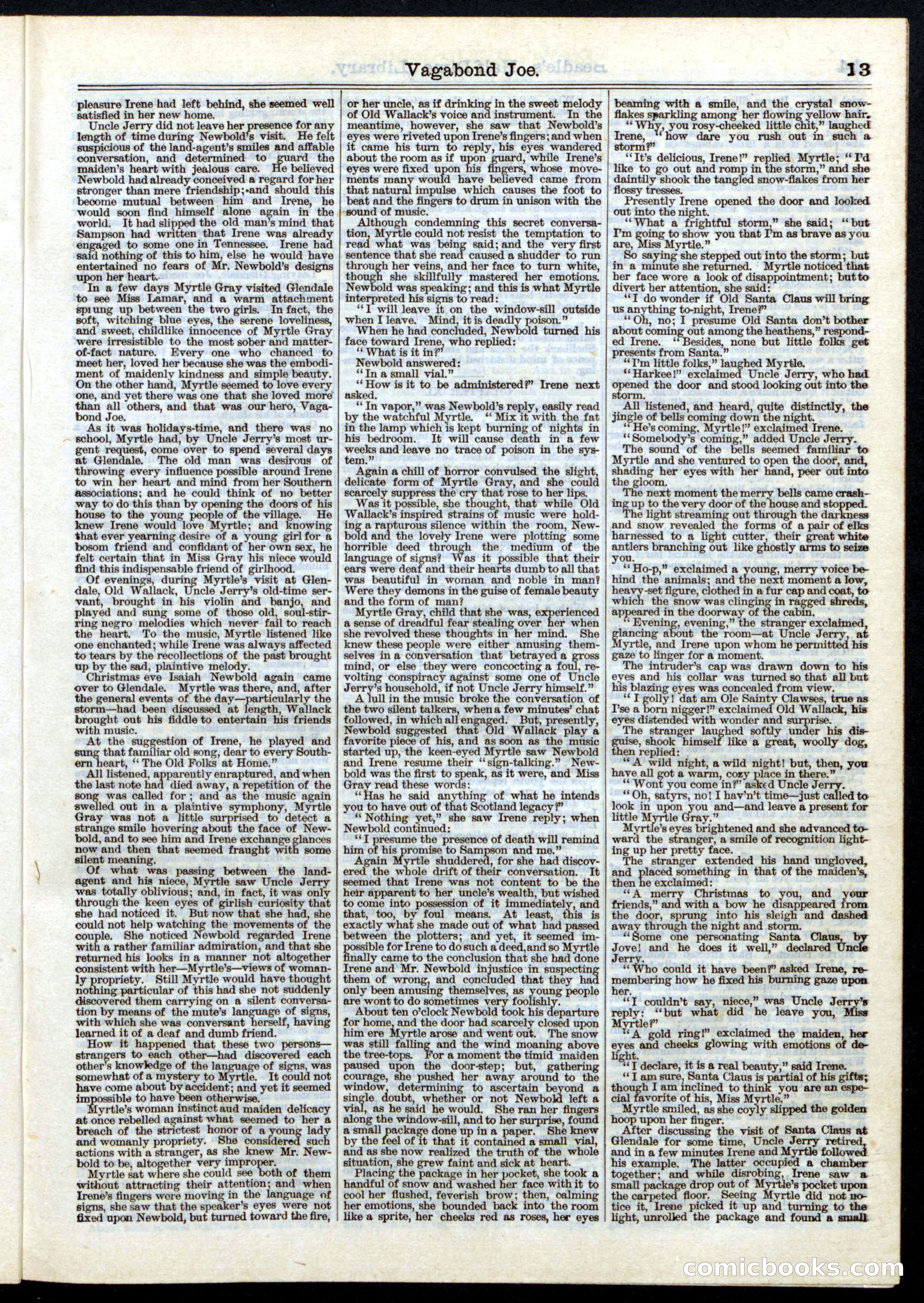
A restored page from Pulp Fiction, 1877. Page through the whole issue in the reader above.
📄 Transcribed text from this page (OCR, searchable)
Machine-transcribed from the original scan — historical spelling and the odd misread are preserved.
Vagabond Joe. 13 pleasure Irene had left behind, she seemed well satisfied in her new home. Uncle Jerry did not leave her presence for an length of time during Newbold’s visit. He felt suspicious of the land-agent’s smiles and affable conversation, and determined to ard the maiden’s heart with jealous care. He believed Newbold had already conceived a regard for her stronger than mere friendship;-and should this become mutual between him and Irene, he would soon find himself alone again in the world. It had slipped the old man’s mind that Sampson had written that Irene was already engaged to some onein Tennessee. Irene had said nothing of this to him, else he would have entertained no fears of Mr, Newbold’s designs upon her heart.. In a few days Myrtle Gray visited Glendale to see Miss Lamar, and a warm attachment splung up between the two girls. In fact, the soft, witching blue eyes, the serene loveliness, and sweet, childlike innocence of Myrtle Gray were irresistible to the most sober and matter- of-fact nature. Every one who chanced to meet her, loved her because she was the embodi- ment of maidenly kindness and simple beauty. On the other hand, Myrtle seemed to love every one, and yet there was one that she loved more than all others, and that was our hero, Vaga- bond Joe, As it was holidays-time, and there was no school, Myrtle had, by Uncle Jerry’s most ur- gent uest, come over to spend several days at Glendale. The old man was desirous of throwing every influence possible around Irene to win her heart and mind from her Southern associations; and he could think of no better way to do this than by opening the doors of his house to the young people of the village. He knew Irene would love Myrtle; and knowing that ever yearning desire of a young girlfor a bosom friend and confidant of her own sex, he felt certain that in Miss Gray his niece would find this indispensable friend of girlhood. Of evenings, os Myrtile’s visit at Glen- dale, Old Wallack, Uncle Jerry’s old-time ser- vant, brought in his violin and banjo, and played and sung some of those old, soul-stir- ring negro melodies which never fail to reach the heart. To the music, Myrtle listened like one enchanted; while Irene was always affected to tears by the recollections of the past brought up by the sad, plaintive melody. Christmas eve Isaiah Newbold again came over to Glendale. Myrtle was there, and, after the general events of the day— icularly the storm—had been discussed at length, Wallack brought out his fiddle to entertain his friends with music. At the suggestion of Irene, he played and sung that familiar old song, dear to every South- ern heart, ‘‘ The Old Folks at Home.” All listened, apparently enraptured, and when the last note had died away, a repetition of the song was called for; and as the music again swelled out in a oo symphony, Myrtle Gray was not a little rised to detect a strange smile hovering about the face of New- bold, and to see him and Irene exchange glances now and then that seemed fraught with some silent meaning. Of what was passing between the land- agent and his niece, Myrtle saw Uncle Jerry was totally oblivious; and, in fact, it was only through the keen eyes of girlish curiosity that she had noticed it. But now that she had, she could not help watching the movements of the couple. She noticed Newbold regarded Irene with a rather familiar admiration, and that she returned his looks in a manner not altogether consistent with her—Myrtle’s—views of woman- ly propriety. Still Myrtle would have thought mor particular of this had she not suddenly discovered them carrying on a silent conversa- tion by means of the mute’s lan of signs, with which she was conversant herself, having learned it of a deaf and dumb friend. How it happened that these two persons— strangers to each other—had discovered each other’s knowkedge of the language of signs, was somewhat of a mystery to Myrtle. It could not have come about by accident; and yet it seemed im ible to have otherwise. yrtle’s woman instinct aud maiden delicacy at once rebelled t what seemed to her a breach of the strictest honor of ME Ses | lad and womanly propriety. She conside suc actions with a stranger, as she knew Mr. New- bold to be, altogether very — Myrtle sat where she could see both of them without attracting their attention ; and when Irene’s fingers were moving in the language of signs, she saw that the speaker’s eyes were not fixed upon Newbold, but turned toward the fire, or her uncle, as if drinking in the sweet melody of Old Wallack’s voice and instrument. In the meantime, however, she saw that Newbold’s eyes were riveted upon [rene’s fingers; and when it came his turn to reply, his eyes wandered about the room as if upon fuard, while Irene’s eyes were fixed upon his rs, whose move- ments many would have believed came from that nat impulse which causes the foot to beat and the fingers to drum in unison with the sound of music. Although condemning this secret conversa- tion, Myrtle could not resist the temptation to read what was bein said; and the very first sentence that she r caused a shudder to run through her veins, and her face to turn white, tho she ski y mastered her emotions. Newbold was speaking; and this is what Myrtle interpreted his signs to read: ‘*] will leave it on the window-sill outside when I leave. Mind, it is deadl ison.” When he had concluded, Newbold turned his face toward Irene, who replied: ‘* What is it in? Newbold answered: **In a small vial.” ‘* How is it to be administered?’ Irene next asked. **In vapor,’ was Newbold’s reply, easily read by the watchful Myrtle. “ Mix it with the fat in the lamp which is kept burning of nights in his bedroom. It will cause death in a few Nbc and leave no trace of poison in the sys- m. Again a chill of horror convulsed the slight delicate form of Myrtle Gray, and she could scarcely suppress the cry that rose to her lips. Was it possible, she thought, that while Old Wallack’s inspired strains of music were hold- ng a rapturous silence within the room, New- bold and the lovely Irene were plotting some horrible deed through the medium of the language of signs? as it possible that their ears were deaf and their hearts dumb to all that was beautiful in woman and noble in man? Were they demons in the guise of female beauty and the form of man? Myrtle Gray, child that she was, e enced a sense of dreadful fear stealing over her when she revolved these thoughts in her mind. She knew these people were either amusing them- selves in a conversation that betrayed a gross mind, or else they were concocting a foul, re- volting conspirac inst some one of Uncle Jerry’s household, if not Uncle Jerry himself.” A lull in the music broke the conversation of the two silent talkers, when a few minutes’ chat followed, in which al sn But, presently, Newbold suggested that Old Wallack play a favorite piece of his, and as soon as the music started up, the keen-eyed Myrtle saw Newbold and Irene resume their “sign-talking.” New- bold was the first to aero as it were, and Miss Gray read these words: “Has he said anything of what he intends you to have out of that Scotland legacy?” “Nothing yet,” she saw Irene reply; when Newbold continued: **T presume the presence of death will remind him of his promise to Sampson and me.” Again le shuddered, for she had discov- ered the whole drift of their conversation. It seemed that Irene was not content to be the heir apparent to her uncle’s wealth, but wished to come into possession of it immediately, and that, too, by foul means. At least, this is exactly what she made out of what had passed between the plotters; and yet, it seemed im- ible for Irene to do such a deed,and so Myrtle nally came to the conclusion that she had done Irene and Mr. Newbold injustice in suspectin them of wrong, and concluded that they only been amusing themselves, as young people are wont to do sometimes very foo é About ten o’clock Newbold took his departure for home, and the door had scarcely closed upon him ere Myrtle arose and went out. The snow was still falling and the wind m above the tree-tops. a moment the timid maiden paused upon the door-step; but, gathering courage, she pushed her away around to the window, determining to ascertain beyond a single doubt, whether or not Newbold left a vial, as he said he would, She ran her fingers along the window-sill, and to her surprise, found a small cae done up ina paper. She knew by the feel of it that it contained a small and as she now realized the truth of the whole situation, she grew faint and sick at heart. Placing the package in her pocket, she took a dful of snow and washed her face with it cool her flushed, feverish brow; then, i her emotions, she bounded back into the room like a sprite, her cheeks red as roses, her eyes beaming with a smile, and the crystal snow- flakes sparkling among her flowing yellow hair, ‘Why, you rosy-cheeked little chit,” hed sy es dare you rush out in such a rm ‘It’s delicious, Irene!” replied Myrtle; “Td like to go out and romp in the storm,” and she daintily shook the tangled snow-flakes from her flossy tresses. Presently Irene opened the door and looked out into the night. ‘What a frightful storm,” she said; “ but I’m going to show you that I’m as brave as you are, Miss Myrtle.” So saying she stepped out into the storm; but in a minute she returned. Myrtle noticed that her face wore a look of disappointment; but to divert her attention, she said: ““T do wonder if Old Santa Claus will bring us paying to-night, Irene?” “Oh, no; I presume Old Santa don’t bother about coming out among the heathens,” respond- ed Irene. ‘ Besides, none but little folks get presents from Santa.” “*T'm little folks,” laughed Myrtle. **Harkee!” exclaimed Uncle Jerry, who had ee the door and stood looking out into the rm _All listened, and heard, quite distinctly, the jingle of bells coming down the night. ‘* He’s coming, Myrtle!” exclaimed Irene. *‘Somebody’s coming,” added Uncle Jerry. The sound of the bells seemed familiar to Myrtle and she ventured to open the door, shading her eyes with her hand, peer out into the gloom. The next moment the merry bells came crash- ing UP to the very door of the house and stopped. he light streaming out through the darkness and snow revealed the forms of a pair of elks harnessed to a light cutter, their great white antlers branching out like ghostly arms to seize you. “*Ho-p,” exclaimed a young, merry voice be- hind the animals; and the next moment a low, heavy -set figure, clothed in a fur cap and coat, to which the snow was clinging in shreds, ap in the doorway of the cabin, ‘Evening, evening,” the stranger exclaimed lancing about the room—at Uncle Jerry, a yrtle, and Irene upon whom he permitted his gaze to linger for a moment. The intruder’s cap was drawn down to his eyes and his collar was turned so that all but his blazing eyes was concealed from view. ak polly’ dat am Ole Sainty Clawses, true as I’se a born nigger!” exclaimed Old Wallack, his eyes distended with wonder and rise. The stranger angen softly under his dis- ise, Shook himself like a great, woolly dog, ea pile. ni ht, a wild night! but, th wi ght, a u have all got a warm, cozy ace in there” -ega ‘** Wont you come in?’ asked Uncle Jerry. “Oh, satyrs, no! I hay’n’t time—just called to look in upon you and—and leave a present for little Myrtle Gray.” Myrtle’s eyes brightened and she advanced to- ward the stranger, a smile of recognition light- ing up her pretty face. The stranger extended his hand ungloved, and placed something in that of the maiden’s, then he exclaimed: “A me Christmas to you, and heen friends,” and with a bow he disappeared from the door, sprung into his sleigh and dashed away through the night and storm. “Some one personating Santa ae Jove! and he does it well,” declared ihe Jerry. Who could it have been?” asked Irene, re- peeve ng how he fixed his burning gaze upon er. “T couldn’t say, niece,” was Uncle J reply: pa but what did he leave yon, e ‘A gold ring!” exclaimed the maiden, her eyes and cheeks glowing with emotions of de- li ht. ss I declare, it is a real beauty,” said Irene. “T am sure, Santa Claus is partial of his gifts; pry Iam inclined to think you are an espe- cial favorite of his, Miss i dae Myrtle smiled, as she coyly slipped the golden hoop upon her finger. After discussing the visit of Santa Claus at Glendale for some time, Uncle Jerry aber , and in a few minutes Irene and Myrtle fo his example. The latter occupied a together; and while disrobing, Irene saw a small drop out of M ’s pocket upon the carpeted floor. Seeing Myrtle did not no tice it, Lrene picked it up and turning to the light, unrolled the package and found a small <SiGO — EGomichboo — — — ———— ~—<