
Pulp Fiction, 1877 · page 11 of 32
Beadle's Half Dime Library, No. 5 — page 11: what you’re looking at
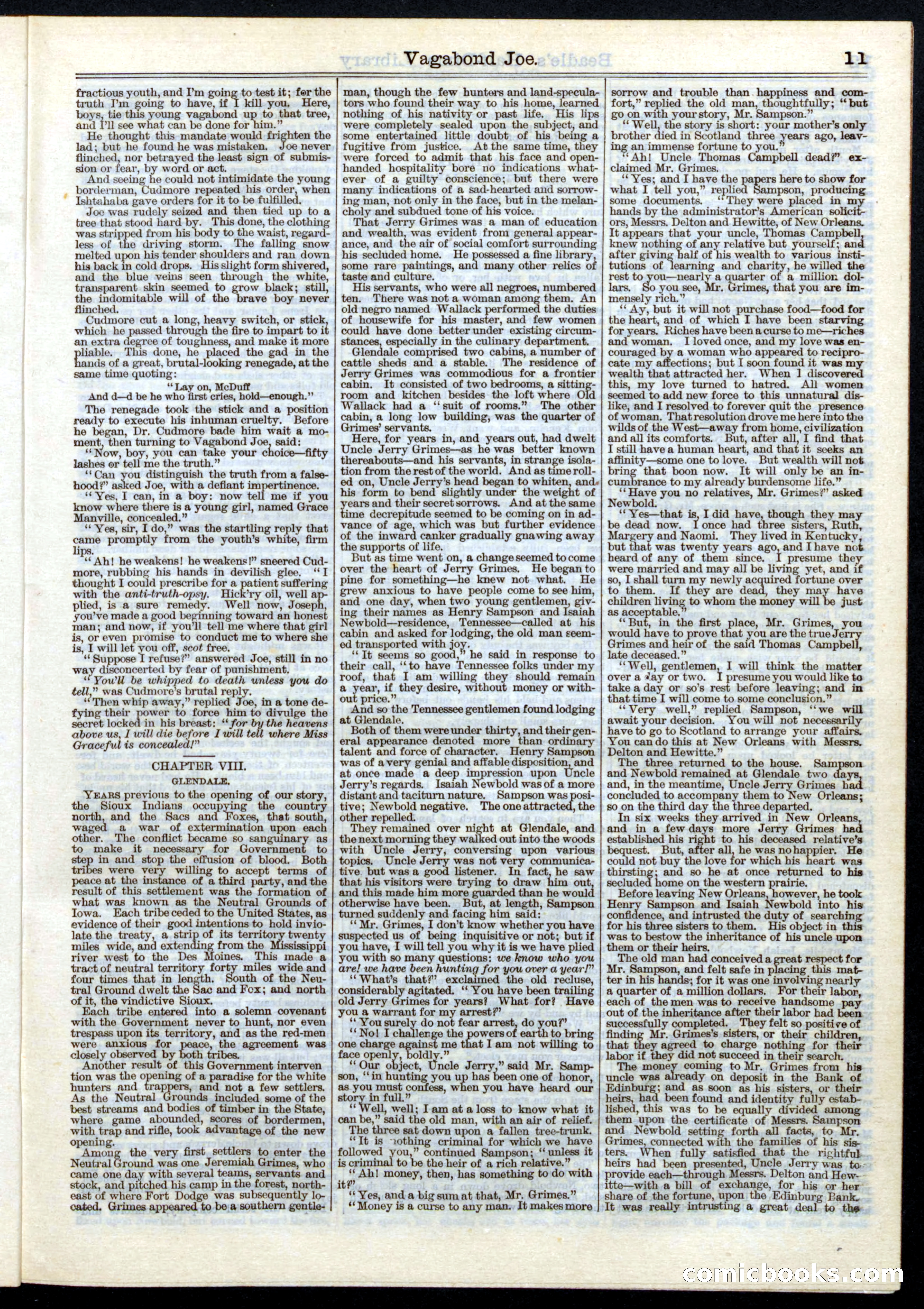
A restored page from Pulp Fiction, 1877. Page through the whole issue in the reader above.
📄 Transcribed text from this page (OCR, searchable)
Machine-transcribed from the original scan — historical spelling and the odd misread are preserved.
nd Vagabond Joe. 11 fractious youth, and I’m going to test it; for the truth I’m going to have, if I kill you, Here, boys, tie this young vagabond my tm that tree, and Ill see what can be done for him.” He thought this mandate would frighten the lad; but he found he was mistaken, Joe never flinched, nor betrayed the least sign of submis- sion or fear, by word or act. And seeing he could not intimidate the young borderman, Cudmore repeated his order, when Ishtahaba gave orders for it to be fulfilled. Joe was rudely seized and then tied up to a tree that stood hard by. This done, the clothing was stripped from his y to the waist, regard- less of the driving storm. The falling snow melted upon his tender shoulders and ran down his back in cold drops. His slight form shivered, and the blue veins seen through the white, transparent skin seemed to om black; still, the indomitable will of the brave boy never flinched. Cudmore cut a long, heavy switch, or stick, which he prance through the fire to impart to it an extra degree of toughness, and make it more liable. This done, he placed the gad in the oun of a great, brutal-looking renegade, at the same time quoting: ‘*Lay on, McDuff And d—d be he who first cries, hold—enough.”’ The renegade took the stick and a position ready to execute his inhuman cruelty. Before he began, Dr. Cudmore bade him wait a mo- ment, then turning to Vagabond Joe, said: ‘‘Now, boy, you can take your choice—fifty lashes or tell me the truth.” ‘‘Can you distinguish the truth from a false- hood?” ed Joe, with a defiant impertinence. ‘* Yes, I can, in a boy: now tell me if you know where there is a young girl, named Grace Manville, concealed.” ‘* Yes, sir, Ido,” was the startling reply that came promptly from the youth’s white, firm Ms Ah! he weakens! he weakens!” sneered Cud- more, rubbing his hands in devilish glee. ‘I thought I could prescribe for a patient suffering with the anti-truth-opsy. Hick’ry oil, well a plied, is a sure remedy. Well now, Joseph, you’ve made a good beginning toward an honest man; and now, if you'll tell me where that girl is, or even promise to conduct me to where she is, I will let you off, scot free. “Suppose I refuse?” answered Joe, still in no way disconcerted by fear of punishment. “Yow be whipped to death unless you do tell,” was Cudmore’s brutal reply. “Then whip away,” replied Joe, in a tone de- fying their power to force him to divulge the secret locked in his breast: “‘ for by the heavens above us, I will die before I will tell where Miss Graceful is concealed!” CHAPTER VIII, GLENDALE, YEARS previous to the opening of our story, the Sioux Indians occupying the country north, and the Sacs and Foxes, that south, a war of extermination upon each other. The conflict became so sanguinary as to make it n for Government to step in and stop the effusion of blood. Both tri were ae, Cues to accept terms of peace at the ce of a third party, and the result of this settlement was the formation of what was known as the Neutral Grounds of Iowa. Each tribe ceded to the United States, as evidence of their good intentions to hold invio- late the treaty, a strip of its territory twenty miles wide, and extending from the | ippi river west to the Des Moines. This made a tract of neutral territory forty miles wide and four times that in length, uth of the Neu- tral Ground dwelt the Sac and Fox; and north of it, the vindictive Sioux. Each tribe entered into a solemn covenant with the Government never to hunt, nor even trespass upon its territory, and as the red-men were anxious for Peace, the agreement was closely observed by both tribes. Another result of this Government interven tion was the opening of a paradise for the white hunters and trappers, and not a few settlers. As the Neutral Grounds included some of the best streams and bodies of timber in the State, where game abounded, scores of bordermen, pla Na and rifle, took advantage of the new opening. ee the very first_settlers to enter the Neutral Ground was one Jeremiah Grimes, who came one day with several teams, servants and stock, and pitched his camp in the forest, north- east of where Fort Dodge was subsequently lo- cated, Grimes appeared to be a southern gentle- man, though the few hunters and land-specula- tors who found their way to his home, learned nothing of his nativity or past life. His lips were completely sealed upon the subject, and some entertained little doubt of his being a fugitive from justice. At the same time, they were forced to admit that his face and open- handed hospitality bore no indications what- ever of a guilty conscience; but there were many indications of a sad-hearted and sorrow- ing man, not only in the face, but in the melan- choly and subdued tone of his voice. That Jerry Grimes was a man of education and wealth, was evident from general appear- ance, and the air of social comfort surrounding his secluded home. He possessed a fine library, some rare paintings, and many other relics of taste and culture. His servants, who were all negroes, numbered ten. There was not a woman among them. An old negro named Wallack performed the duties of housewife for his master, and few women could have o— — —_— ot gd stances, especially in the culinary departmen Glendale comprised two cabins, a number of cattle sheds and a stable. The residence of Jerry Grimes was commodious for a frontier cabin. It consisted of two bedrooms, a sitting- room and kitchen besides the loft where Old Wallack had a ‘“‘suit of rooms.” The other cabin, a long low building, was the quarter of Grimes’ servants. Here, for years in, and years out, had dwelt Uncle Jerry Grimes—as he was better known thereabouts—and his servants, in strange isola- tion from the rest of the world. And as time roll- ed on, Uncle Jerry’s head began to whiten, and» his form to bend slightly under the weight of — and their secret sorrows. And at the same ime decrepitude seemed to be coming on in ad- vance of age, which was but further evidence of the inward canker gradually gnawing away the supports of life. But as time went on, a change seemed to come over the heart of Jerry Grimes. He began to pine for something—he knew not what. He grew anxious to have people come to see him, and one day, when two young gentlemen, giv- ing their names as Henry Sampson and Isaiah Newbold—residence, Tennessee—called at his cabin and asked for lodging, the old man seem- ed transported with joy. ‘*Tt seems so good,” he said in response to their call, ‘‘to have Tennessee folks under my roof, that I am willing they should remain a year, if they desire, without money or with- out price.” And so the Tennessee gentlemen found lodging at Glendale. Both of them were under thirty, and their gen- eral appearance denoted more than ordinary talent and force of character. Henry Sampson genial and affable disposition, and was of ave at once made a deep impression upon Uncle Jerry’s regards. Isaiah Newbold was of a more distant and taciturn nature. Sampson was posi- tive; Newbold negative. The one attracted, the other repelled. They remained over night at Glendale, and the next morning they walked out into the woods with Uncle Jerry, conversing upon various topics. Uncle Jerry was not very communica- tive. but was a listener. In fact, he saw that his visitors were trying to draw him out and this made him more guarded than he would otherwise have been. But, at length, Sampson turned suddenly and facing him said: ‘* Mr. Grimes, I don’t know whether you have suspected us of being inquisitive or not; but if you have, I will tell you why it is we have plied you with so many questions: we know who you are! we have been hunting for you over a year!” ‘*'What’s that?’ exc ed the old recluse, copelerenly agitated. ‘* You have been trailing old Jerry Grimes for years? What for? Have you a warrant for my arrest?’ Hee eee not fear do you?” ‘* Nol I challenge the powers o to bring one tase ane tlam not willing to face ope “ Idly.” ‘Our object, Uncle Jerry,” said Mr. Samp- son, ‘‘in hunting you up has been one of honor, as you reas confess, when you have heard our sto “Well, well; Iam at aloss to know what it can be,” said the old man, with an air of relief. e t sat down upon a fallen tree-trunk. “It is nothing criminal for which we have followed you,” continued Sampson; ‘‘ unless it is cri to be the heir of a rich relative.” a : ‘Ah! money, then, has something to do with ‘Yes, and a big sum at that, Mr. Grimes.” ‘Money is a curse to any man, It makes more sorrow and trouble than happiness and com- fort,” replied the old man, thoughtfully; “ but go on with your story, Mr. Sampson.” ** Well, the story is short: your mother’s only brother died in Scotland three years ago, leav- ing an immense fortune to you. ‘Ah! Uncle Thomas Campbell dead?’ ex- claimed Mr. Grimes. ‘* Yes; and I have the ) Bemers here to show for what I tell you,” repli pson, producing some documents. ‘They were placed in m hands by the administrator’s American solici ors, Messrs. Delton and Hewitte, of New Orleans. It appears that your uncle, Thomas Campbell knew nothing of any relative but yourself; and after giving half of his wealth to various insti- tutions of learning and charity, he willed the rest to you—nearly a quarter of a million dol- you see, Mr, Grimes, that you are im- mensely rich.” ‘* Ay, but it will not purchase food—food for the heart, and of which I have been for years. Riches have been a curse to me—riches and woman. I loved once, and my love was en- couraged by a woman who appeared to recipro- cate my affections; but I soon found it was my wealth that attracted her. When |] discovered this, my love turned to hatred. All women seemed to add new force to this unnatural dis- like, and I resolved to forever quit the presence of woman, That resolution drove me here into the wilds of the West—away from home, civilization and all its comforts. But, after all, I find that I still have a human heart, and that it seeks an affinity—some one to love. But wealth will not bring that boon now. It will only be an in- cumbrance to my already burdensome life.” ‘*Have you no relatives, Mr. Grimes?’ asked Newbold. ‘* Yes—that is, I did have, though they may be dead now. Ionce had three sisters, Ruth, aig and Naomi. They lived in Kentucky but that was twenty years ago, and I have not heard of any of them since. i presume they were married and may all be living yet, and if so, I shall turn my newly acquired fortune over to them. If they are d they may have children living to whom the money will be just as acceptable,” “But, in the first place, Mr. Grimes, you would have to prove that you are the true Je Grimes and heir of the said Thomas Campbell, late deceased.” ‘*Well, gentlemen, I will think the matter over a #ay or two. I presume you would like te take a day or so’s rest before leaving; and in that time I will come to some conclusion.” ‘“Very well,” replied Sampson, ‘‘we will await your decision. You will not necessarily have to go to Scotland to arrange your affairs, You can do this at New Orleans with Messrs, Delton and Hewitte.” The three returned to the house. Sampson and Newbold remained at Glendale two and, in the meantime, Uncle Jerry Grimes h concluded to scqornTaay them to New Orleans; so on the third day the three departed, In six weeks they arrived in New Orleans and in a fewdays more Jerry Grimes had established his Sb to his deceased relative’s est. But, r all, he was no iy ee He could not buy the love for which his heart was mre Pe g and so he at once returned to his secluded home on the western prairie. Before leaving New Orleans, however, he took prea 3h Sampson and Isaiah Newbold into his confidence, and intrusted the duty of searching for his three sisters to them. His object in this was to bestow the inheritance of his uncle upon Dee eld tina hadi somonivcl.a.pasksaibsast e old man conceived a t t for Mr. Sampson, and felt safe in ied this mat- ter in his hands; for it was one involving nearly a quarter of a million dollars. For their labor, each of the men was to receive handsome pay out of the inheritance after their labor had been successfully completed. They felt so positive of finding Mr. Grimes’s sisters, or their chil that they agreed to charge nothing for their labor if they did not succeed in their search. The nine coming to Mr. Grimes from his uncle was y on deposit in the Bank of Edinburg; and as soon as his sisters, or their heirs, had been found and identi fully estab- lished, this was to be y divided among them upon the certificate of Messrs. Sampson and Newbold setting forth all facts, to Mr. Grimes, connected with the families of his sis- ters. When fully satisfied that the rightful heirs had been presented, Uncle Jerry was to. provide each—through Messrs. Delton and Hew-- itte—with a bill of exchange, for his or her share of the fortune, upon the Edinburg Bank. It was really intrusting a great deal to the rc Eomicbooks _ — — ~ . _ 2 a - _ = —— = (E@)