
Pulp Fiction, 1878 · page 1 of 16
Beadle's Half Dime Library, No. 47 — page 1: what you’re looking at
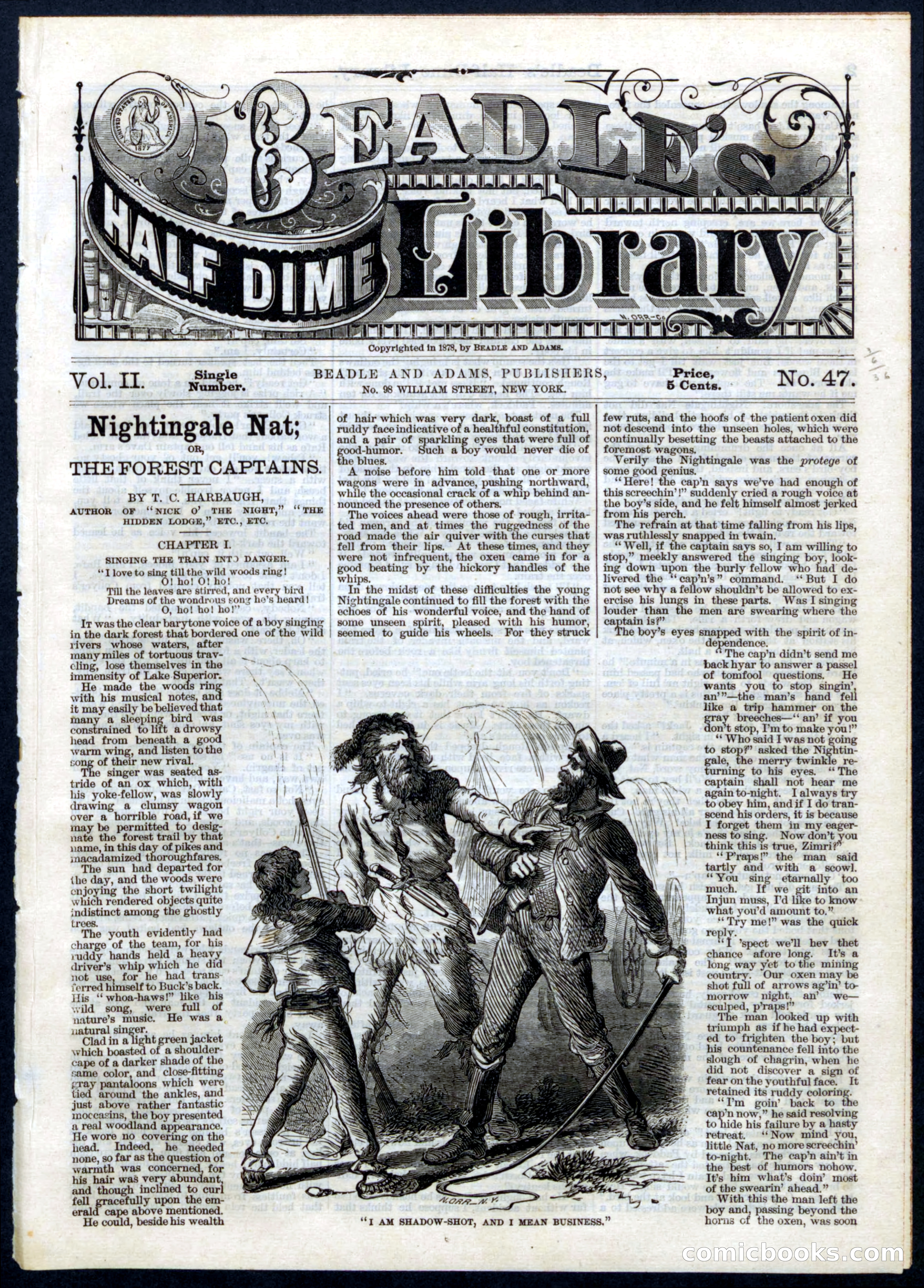
A restored page from Pulp Fiction, 1878. Page through the whole issue in the reader above.
📄 Transcribed text from this page (OCR, searchable)
Machine-transcribed from the original scan — historical spelling and the odd misread are preserved.
me Caer ee v > ~ 4 — —e — ——— —S—— —— Nightingale Nat; THE FOREST CAPTAINS. BY T. C. HARBAUGH, AUTHOR OF ‘“‘NICK 0’ HIDDEN LODGE,” ETC., ETC, CHAPTER LI. SINGING THE TRAIN INT) DANGER. *Tlovetos tillthe wild woods ring! ! ho! O! ho! Till the leaves are stirred, and every bird Dreams of the wondrous song he’s heard! O, ho! ho! ho!” Ir was the clear barytone voice of a boy singing | in the dark forest that bordered one of the wild | seemed to guide his wheels. rivers whose waters, after many miles of tortuous trav- _ cling, lose themselves in the ali a a immensity of Lake Superior. He made the w rin with his musical notes, an it may easily be believed that many a sleeping bird was constrained to lift a drowsy head from beneath a good warm wing, and listen to the song of their new rival. e singer was seated as- tride of an ox which, with his yoke-fellow, was slowly drawing a clumsy wagon over a horrible road,if we may be permitted to desig- nate the forest trail by that name, in this day of pikes and inacadamized thoroughfares. The sun had departed for {he day, and the woods were enjoying the short twilight which rendered objects quite indistinct among the ghostly Crees. The youth evidently had charge of the team, for his ruddy hands held a heavy driver’s whip which he did not use, for he had trans- ferred h If to Buck’s back. His ‘“‘ whoa-haws!” like his vild song, were full of nature’s music. He was a uatural singer. Clad in a a. green jacket which boasted of a shoulder- cape of a darker shade of the same color, and oe ae gray oons which were tied ieeatnd the ankles, and just above rather fantastic moccasins, the boy presented a real woodland appearance. He wore no covering on the head. Indeed, he needed none, so far as the question of warmth was concerned, for his hair was very abundant and though inclined to curl fell fully upon the em- erald cape above mentioned. He could, beside his wealth —_ _ en BEADLE AND ADAMS, PUBLISHERS, THE NIGHT,” ‘‘ THE ll HT - — = = - ———— = — —-= —> —————— pop | NY x | \\ \ 5 \ x AY . ANS = ln ll ll nl Te Sl a Copyrighted in 1878, by BEADLE AND ADAMS. — —— ee Ee No. 98 WILLIAM STREET, NEW YORK. of hair which was very dark, boast of a full ruddy face indicative of a healthful constitution, and a pair of eee eyes that were full of ood-humor. uch a boy would never die of the blues. A noise before him told that one or more wagons were in advance, pushing northward, while the occasional crack of a whip behind an- nounced the presence of others. The voices ahead were those of rough, irrita- ted men, and at times the ruggedness of the road made the air quiver with the curses that fell from their lips. At these times, and they were not infrequent, the oxen came in for a ats beating by the hickory handles of the whips. In the midst of these difficulties the young Nightingale continued to fill the forest with the echoes of his wonderful voice, and the hand of some unseen spirit, pleased with his humor, For they struck — — ‘‘] AM SHADOW-SHOT, AND I MEAN BUSINESS,” — - F = = ‘ bcm QE, URE I SO ——— eee eee t ‘ =a = = — . o- Y 5 =——s _— == == y r | A : “ x . — Price, 5 Cents. No. AT. few ruts, and the hoofs of the patient oxen did not descend into the unseen holes, which were continually besetting the beasts attached to the foremost wagons. Verily the Nightingale was the protege of some good genius. ‘Here! the cap’n says we’ve had enough of this screechin’!” suddenly cried a rough voice at the boy’s side, and he felt himself almost jerked from his a The refrain at that time falling from his lips, was ruthlessly snapped in twain. “Well, if the captain says so, I am willing to stop,” meekly answered the singing boy, look- ing down upon the burly fellow who had de- livered the ‘“‘cap’n’s” command. ‘* But I do not see why a fellow shouldn’t be allowed to ex- ercise his lungs in these parts. Was I singing louder than the men are swearing where the me is?” e boy’s eyes snapped with the spirit of in- dependence. ** The cap’n didn’t send me back hyar to answer a passel of tomfool questions. He wants you to stop singin’ an’”—the man’s hand fell like a trip hammer on the gray breeches—‘‘ an’ if you on’t stop, I’m to make you!” ‘** Who said I was not going to stop?’ asked the Nightin- gale, the merry twinkle re- turning to his eyes. “ The captain shall not hear me again to-night. I always try to obey him, and if I do tran- scend his orders, it is because I forget them in my eager- ness to sing. Now don’t you think this is true, Zimri?’ ‘*P’raps!” the man said tartly and with a scowl. “You sing etarnally too much. If we git into an Injun muss, I'd like to know what you’d amount to.” “Try me!” was the quick reply. ‘T ‘spect we'll hev thet chance afore long. It’s a long way yet to the mining country. Our oxen may be shot full of arrows ag’in’ to- morrow night, an’ we— re p’raps!” The man looked up with triumph as if he had expect- ed to frighten the boy; but his countenance fell into the slough of chagrin, when he did not discover a sign of fear on the youthful face. It retained its ruddy a “Tm goin’ back to the cap’n now,” he said resolving to hide his failure by a hasty retreat. ‘‘Now mind you, little Nat, no more screechin’ to-night. The cap’n ain’t in the best of humors nohow. It’s him what’s doin’ most of the swearin’ ahead.” With this the man left the boy and, passing beyond the horns of the oxen, was soon colim (E| 6\(6\(6) “S (El)