
Pulp Fiction, 1886 · page 4 of 16
Beadle's Half Dime Library No. 460 — page 4: what you’re looking at
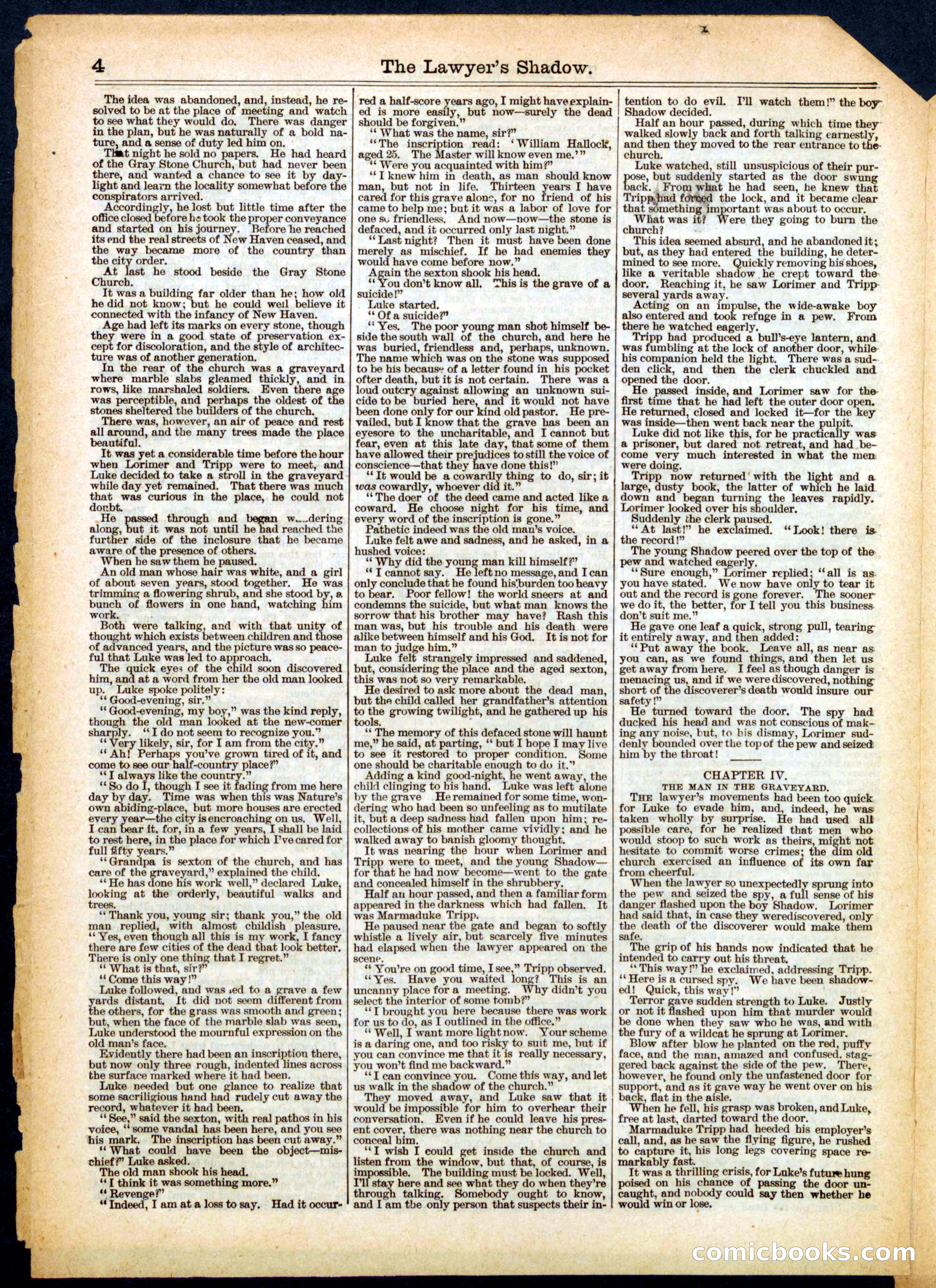
A restored page from Pulp Fiction, 1886. Page through the whole issue in the reader above.
📄 Transcribed text from this page (OCR, searchable)
Machine-transcribed from the original scan — historical spelling and the odd misread are preserved.
"© on A. . «Qs : y > » > * 4 4 ‘ ’ . 4 - a > . * - ' ' 7 ‘ ‘ The idea was abandoned, and, instead, he re- solved to be at the place of meeting and watch to see what they would do. There was danger in the plan, but he was naturally of a bold na- ture, and a sense of duty led him on. That night he sold no papers. He had heard of the Gray Stone Church, but had never been there, and wanted a chance to see it by day- light and learn the locality somewhat before the conspirators arrived. pe ores , he lost but little time after the office closed before he took the proper conveyance and started on his journey. Before he reached its end the real streets of New Haven ceased, and the way became more of the country than the city order. At last he stood beside the Gray Stone Church. It was a building far older than he; how old he did not know; but he could weil believe it connected with the infancy of New Haven. Age had left its marks on every stone, though they were in a good state of preservation ex- cept for discoloration, and the style of architec- ture was of another generation, In the rear of the church was a graveyard where marble slabs gleamed thickly, and in rows, like marshaled soldiers. Even there age was perceptible, and perhaps the oldest of the stones sheltered the builders of the church. There was, however, an air of peace and rest all around, and the many trees made the place beautiful. It was yet a considerable time before the hour when Lorimer and Tripp were to meet, and Luke decided to take a stroll in the graveyard while day yet remained. That there was much that was curious in the place, he could not dorbt. .He through and w....dering along, but it was not until he had reached the further side of the inclosure that he became aware of the presence of others. When he saw them he paused. An old man whose hair was white, and a girl of about seven years, stood together. He was trimming a flowering shrub, and she stood by, a bunch of flowers in one hand, watching him work. Both were talking, and with that yf of thought which exists between children and those of advanced years, and the picture was so peace- ful that Luke was led to approach. The quick eyes of the child soon discovered him, - lag a ban om her the old man looked up. Luke spoke y: 7 Seuierasinn’ da! % ** Good-evening, my boy,” was the kind reply, though the old man looked at the new-comer sharply. ‘‘I do not seem to recognize you.” ** Very likely, sir, for I am from the city.” ‘* Ah! Perhaps ii grown tired of it, and come to see our half-country place?” ‘*T always like the country.” ‘So do I, though I see it fading from me here day by day. Time was when this was Nature’s own abiding-place, but more houses are erected every year—the city isencroaching on us. Well, I can it, for, in a few years, I shall be laid to rest here, in the place for which ve cared for full fifty years.” ‘Grandpa is sexton of the church, and has care of the veyard,” explained the child. ** He has done his work well,” declared Luke looking at the orderly, beautiful walks an trees. ‘Thank you, young sir; thank you,” the old man replied, with almost childish pleasure. ‘* Yes, even though all this is my work, I fancy there are few cities of the dead that look better. There is only one thing that I regret.” ‘* What is that, sir?” ** Come this way!” Luke followed, and was .ed to a grave a few ards distant. It did not seem different from he others, for the grass was smooth and green; but, when the face of the marble slab was seen, Luke understood the mournful expression on the old man’s face. zy Evidently there had been an inscription there, but now only three rough, indented lines across the surface marked where it had been. _ Luke needed but one glance to realize that some sacriligious hand had rudely cut away the record, whatever it had been. ‘* See,” said the sexton, with real pathos in his voice, ‘‘some vandal has been here, and you see his mark. The inscription has been cut away.” ‘What could have been the object—mis- chief?’ Luke asked. The old man shook his head. ‘“‘T think it was something more.” ** Reven “Indeed, I am ata losstosay, Had it occur- The Lawyer’s Shadow. red a half-score years ago, I might have explain- ed is more easily, but now—surely the dead should be forgiven.” ‘* What was the name, sir?” ‘The inscription read: ‘ William Hallock, aged 25. The Master will know even me.’” ‘* Were you acquainted with him?” ‘*T knew him in death, as man should know man, but not in life. Thirteen years I have cared for this grave alone, for no friend of his came to help me; but it was a labor of love for one su friendless, And now—now—the stone is defaced, and it occurred only last night.” ‘Last night? Then it must have been done merely as mischief. If he had enemies they would have come before now.” Again the sexton shook his head. **’You don’t know all, “his is the grave of a suicide!” Luke started. ** Of a suicide?” ‘** Yes. The poor young man shot himself be- side the south wall of the church, and here he was buried, friendless and, perhaps, unknown. The name which was on the stone was supposed to be his because of a letter found in his pocket ofter death, but itis not certain. There was a loud outcry against allowing an unknown sui- cide to be buried here, and it would not have been done only for our kind old pastor. He pre- vailed, but I know that the grave has been an eyesore to the uncharitable, and I cannot but fear, even at this late day, that some of them have allowed their prejudices to still the voice of conscience—that they have done this!” ‘“* It would be a cowardly thing to do, sir; it was cowardly, whoever did it.” ‘*The doer of the deed came and acted like a coward. He choose night for his time, and every word of the inscription is gone.” Pathetic indeed was the old man’s voice. Luke felt awe and sadness, and he asked, in a hushed voice: ‘* Why did the young man kill himself?” “‘T cannot say. He leftno message, and I can only conclude that he found his'burden too heavy to bear. Poor fellow! the world sneers at and condemns the suicide, but what man knows the sorrow that his brother may have? Rash this man was, but his trouble and his death were alike between himself and his God. It is not for man to judge him.” Luke felt strangely impressed and saddened, but, considering the place and the aged sexton, this was not so very remarkable. He desired to ask more about the dead man, but the child called her grandfather’s attention rd growing twilight, and he gathered up his s. ‘* The memory of this defaced stone will haunt me,” he said, at parting, ‘‘ but I hope I may live to see it restored to proper condition. Some one should be charitable enough to do it.” Adding a kind good-night, he went away, the child clinging to bis hand. Luke was left alone by the grave Heremained for some time, won- dering who had been so unfeeling as to mutilate it, but a deep sadness had fallen upon him; re- collections of his mother came vividly; and he walked away to banish gloomy thought, It was nearing the hour when Lorimer and Tripp were to meet, and the young Shadow— for that he had now become—went to the gate and concealed himself in the shrubbery, Half an hour passed, and then a familiar form appeared in the darkness which had fallen. It was Marmaduke Tripp. He paused near the gate and began to softly whistle a lively air, but scarcely five minutes had elapsed when the lawyer appeared on the scene, * You're on good time, I see,” Tripp observed. “Yes. Have you waited long? This is an uncanny place fora meeting. Why didn’t you select the interior of some tomb?” ‘ ‘*T brought you here because there was work for us to do, as I outlined in the office.” ‘ Well, I want more lightnow. Your scheme is a daring one, and too risky to suit me, but if you can convince me that it is really necessary, you won’t find me backward.” ‘*T can convince you. Come this way, and let us walk in the shadow of the church,” They moved away, and Luke saw that it would be impossible for him to overhear their conversation. Even if he could leave his pres- ent cover, there was nothing near the church to conceal him. ‘*] wish I could get inside the church and listen from the window, but that, of course, is im ble. The building must be locked. Well, I'll stay here and see what they do when they’re through talking. Somebody ought to know, and I am the only person that suspects their in- Shadow decided. Half an hour passed, during which time they- walked slowly back and forth talking earnestly, and then they moved to the rear entrance to the- church. Luke watched, still unsuspicious of their pur- , but suddenly started as the door swung ack... From what he had seen, he knew that Tripphad forged the lock, and it became clear that something important was about to occur. What was it? ere they going to burn the church? This idea seemed absurd, and he abandoned it; but, as they had entered the building, he deter- mined to see more. Quickly removing bis shoes, like a veritable shadow he crept toward the door. Reaching it, he saw Lorimer and Tripp several yards away. Acting on an we eee the wide-awake boy also entered and took refuge in a pew. From there he watched eagerly. Tripp had produced a bull’s-eye lantern, and was fumbling at the lock of another door, while his companion held the light. There was a sud- den click, and then the clerk chuckled and opened the door. He inside, and Lorimer saw for the first time that he had left the outer door open. He returned, closed and locked it—for the key was inside—then went back near the pulpit. Luke did not like this, for he practically was a prisoner, but dared not retreat, and had _be- come very much interested in what the men were doing. Tripp now returned’ with the light and a large, dusty book, the latter of which he laid. down and began turning the leaves rapidly. Lorimer looked over his shoulder. Suddenly the clerk paused. “Look! there is ““At last!” he exclaimed. the record!” The young Shadow peered over the top of the pew and watched eagerly. ‘Sure enough,” Lorimer replied; ‘‘all is as. you have stated. We now have only to tear it out and the record is gone forever. The sooner we do it, the better, for I tell you this business don’t suit me.” He gave one leaf a quick, strong pull, tearing it entirely away, and then added: **Put away the book. Leave all, as near as you can, as we found things, and then let us get away from here. menacing us, and if we were discovered, nothing short of the discoverer’s death would insure our safety!” He turned toward the door. The spy had ducked his head and was not conscious of mak- ing any noise, but, to his dismay, Lorimer sud- denly bounded over the top oft the pew and seized him by the throat! CHAPTER IV. THE MAN IN THE GRAVEYARD. THE lawyer’s movements had been too quick for Luke to evade him, and, indeed, he was taken wholly by surprise. He had used all possible care, for he realized that men who would stoop to such work as theirs, might not hesitate to commit worse crimes; the dim old church exercised an influence of its own far ae ee en the Jawyer so unexpectedly sprung into the pew and seized the spy, a full sense of his danger flashed upon the boy Shadow. Lorimer had said that, in case they werediscovered, only = death of the discoverer would make them safe. The grip of his hands now indicated that he intended to carry out his threat, ‘This way!” he exclaimed, addressing Tripp. ‘*Here is a cursed spy. We have been shadow- ed! Quick, this way!” | Terror gave sudden strength to Luke. Justly or not it flashed upon him that murder would be done when they saw who he was, and with the fury of a wildcat he sprung at Lorimer. Blow after blow he planted on the red, puffy face, and the man, amazed and confused, stag- gered back against the side of the pew. There, however, he found only the unfastened door for support, and as it gave way he went over on his back, flat in the aisle. When he fell, his grasp was broken, and Luke, free at last, darted toward the door. Marmaduke Tripp had_ heeded his employer's call, and, as he saw the flying figure, he rushed to capture it, his long legs covering space re- markably , It was a thrilling crisis, for Luke’s future hung poised on his chance of passing the door un- caught, and nobody could say then whether he would win or lose, (E() m : tention to do evil. I'll watch them!” the boy I feel as though danger is - he ae i. ler ee