
Pulp Fiction, 1886 · page 2 of 16
Beadle's Half Dime Library No. 460 — page 2: what you’re looking at
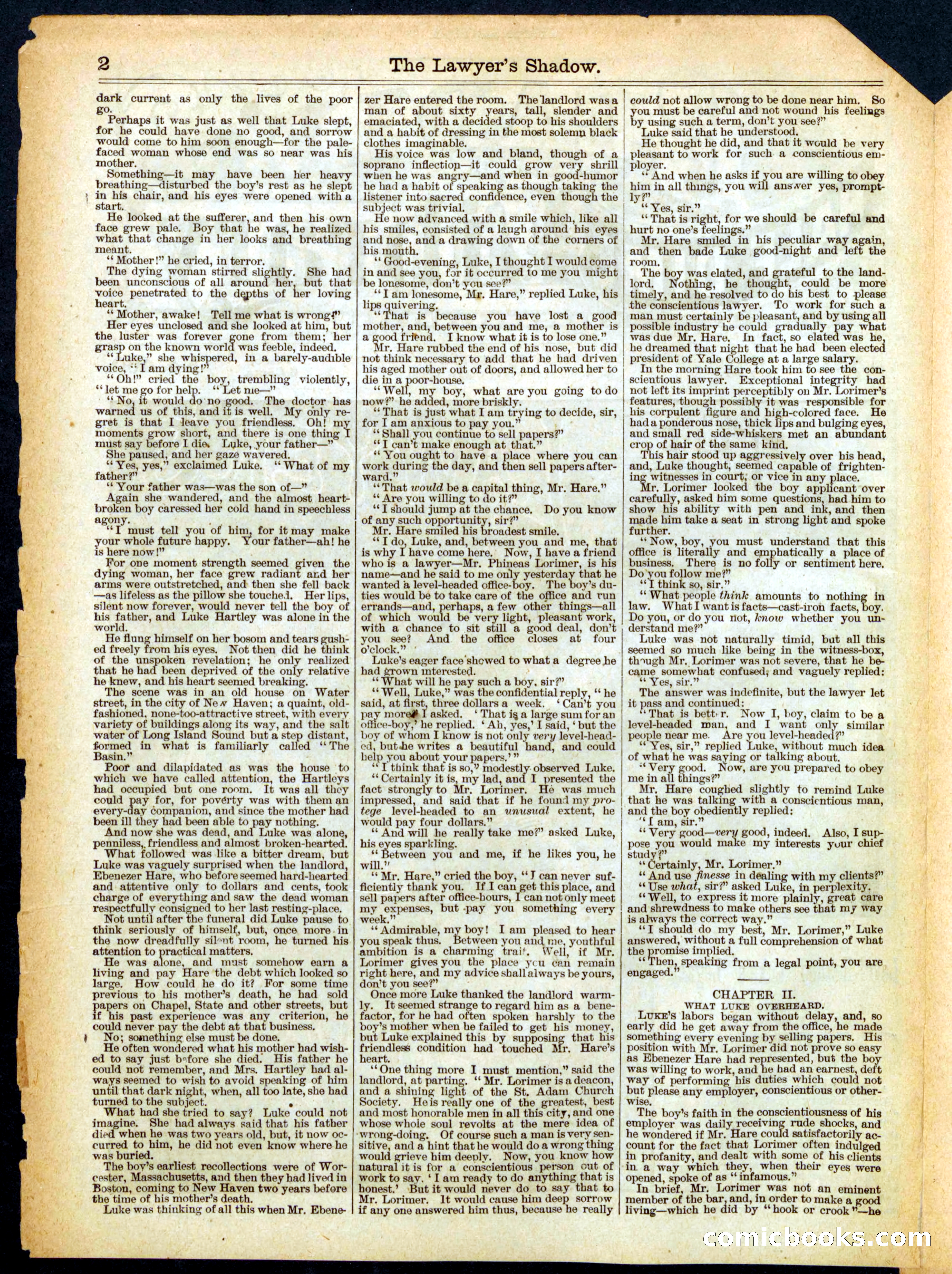
A restored page from Pulp Fiction, 1886. Page through the whole issue in the reader above.
📄 Transcribed text from this page (OCR, searchable)
Machine-transcribed from the original scan — historical spelling and the odd misread are preserved.
~ ye « - . + if je Eat 4 i: 6 Ye, ae ae. ee ; ms Soke ~~ 1 < * 7] i r e .' dark current as only the lives of the poor £0. Perhaps it was just as well that Luke slept, for he could have done no good, and sorrow would come to him soon enough—for the pale- faced woman whose end was so near was his mother. Something—it may have been her heavy breathing—disturbed the boy’s rest as he slept in his chair, and his eyes were opened witha start. He looked at the sufferer, and then his own face grew pale. Boy that he was, he realized what that change in her looks and breathing meant. ‘* Mother!” he cried, in terror. The dying woman stirred slightly. She had been unconscious of all around her, but that — penetrated to the depths of her loving eart. ‘* Mother, awake! Tell me what is wrong?” Her eyes unclosed and she looked at him, but the luster was forever gone from them; her grasp on the known world was feeble, indeed. ** Luke,” she whispered, in a barely-audible voice, ** lam dying!” ‘**Oh!” cried the boy, trembling violently, *‘let me go for help. ‘* Let nie—” ‘* No, it would dono good, The doctor has warned. us of this, and it is well. My only re- gret is that I Jeave you friendless. Oh! m moments grow short, and there is one thing must say before ldie. Luke, your father—” She paused, and her gaze wavered. ‘** Yes, yes,” exclaimed Luke. ‘‘ What of my father?” ‘** Your father was—was the son of—” Again she wandered, and the almost heart- broken boy caressed her cold hand in speechless agony. Me 5 ‘*T must tell you of him, for it may make your whole future happy. Your father—ah! he is here now!” For one moment strength seemed given the dying woman, her face grew radiant ard her arms were outstretched, and then she fell back —as lifeless as the pillow she touched. Her lips, silent now forever, would never tell the boy of his father, and Luke Hartley was alone in the world. He flung himself on her bosom and tears gush- ed freely from his eyes. Not then did he think of the unspoken revelation; he only realized that he had been deprived of the only relative he knew, and his heart seemed breaking. The scene was in an old house on Water street, in the city of New Haven; a quaint, old- fashioned, none-too-attractive street, with every variety of buildings along its way, and the salt water of Long Island Sound but a step distant, formed in what is familiarly called ‘‘ The Basin.” : Poor and dilapidated as was the house to which we have called attention, the Hartleys had occupied but one room. It was all they could pay for, for povérty was with them an every-day Companion, and since the mother had been ill they had been able to pay nothing. And now she was dead, and Luke was alone, penniless, friendless and almost broken-hearted. What followed was like a bitter dream, but Luke was vaguely surprised when the landlord, Ebenezer Hare, who before seemed hard-hearted and attentive only to dollars and cents, took charge of everything and saw the dead woman respectfully consigned to her last resting-place. Not until after the funeral did Luke pause to think seriously of himself, but, once more. in the now dreadfully silent room, he turned his attention to practical matters, He was alone, and must somehow earn a living and pay Hare the debt which looked so large. How could he do it? For some time previous to his mother’s death, he had sold ng rs on Chapel, State and other streets, but f past experience was any criterion, he could never pay the debt at that business. No; something else must be done. He often wondered what his mother had wish- ed to say just before she died. His father he could not remember, and Mrs. Hartley had al- ways seemed to wish to avoid speaking of him until that dark night, when, all too late, she had turned to the subject. ° What had she tried to say? Luke could not imagine. She had always said that his father died when he was two years old, but, it now oc- curred to him, he did not even know where he was buried. The boy’s earliest recollections were of Wor- cester, Massachusetts, and then they had lived in Boston, coming to New Haven two years before the time of his mother’s death. Luke was thinking of all this when Mr. Ebene- ‘ ™~ The Lawyer’s Shadow. zer Hare entered the room. The landlord wasa man of about sixty years, tall, slender and emaciated, with a decided stoop to his shoulders and a habit of dressing in the most solemn black clothes imaginable. His voice was low and bland, though of a | pleasant to work for such a conscientious em- . shrill | ployer. ' soprano inflection—it could grow ver when he was angry—and when in g he had a habit of speaking as though takin -humor ' the him in all things, you wi ’ i | could not allow wrong to be done near him. So a ou must be careful and not wound his feelings yen il y using such a term, don’t you see?” Luke said that he understood. : He thought he did, and that it would be very tte ‘** And when he asks if ps are willing to obey ! answer yes, prompt- listener into sacred confidence, even though the | ly?” subject was trivial. He now advanced with a smile which, like all ** Yes, sir.” “That is right, for we should be careful and his smiles, consisted of a laugh around his eyes | hurt no one’s feelings.” and nose, and a drawing down of the corners of his mouth, Mr. Hare smiled in his peculiar way again, and then bade Luke good-night and left the ‘‘ Good-evening, Luke, I thought I would come | room. in and see you, for it occurred to me you might be lonesome, don’t you see?” : ‘*T am lonesome, Mg. Hare,” replied Luke, his lips quivering. ' i i The boy was elated, and grateful to the land- lord, Nothing, he thought, could be more timely, and he resolved to do his best to please the conscientious lawyer. To work for such a ‘That is because you have lost a good | man must certainly be pleasant, and by using all mother, and, between you and me, a mother is | possible industry he could gradually a good friénd. I know what it is to lose one.” Mr. Hare rubbed the end of his nose, but did | ay what was due Mr. Hare. In fact, so elated was he he dreamed that night that he had been elected not think necessary to add that he had driven | president of Yale College at a large salary. his aged mother out of doors, and allowed her to die in a poor-house, | In the morning Hare took him to see the con- scientious lawyer. Exceptional integrity had . ‘Well, my boy, what are you going to do | not left its imprint perceptibly on Mr. Lorimer’s now?” he added, more briskly. “That is just what I am trying to decide, sir, | for I am anxious to pay you.” ; ‘** Shall you continue to sell papers?” **T can’t make enough at that.” ** You ought to have a place where you can work during the day, and then sell papers after- ward.” ‘*That would be a capital thing, Mr. Hare.” ** Are you willing to do it?” ‘7 should jump at the chance. of any such opportunity, sir?” Mr. Hare smiled his broadest smile. ‘** I do, Luke, and, between you and me, that is why I have come here. Now, I have a friend who is a lawyer—Mr. Phineas Lorimer, is his name—and he said to me culy yews that he wanted a level-headed office-boy. The boy’s du- ties would be to take care of the office and run errands—and, perhaps, a few other things—all of which would be very light, pleasant work, with a chance to sit still a good deal, don’t you see? And the office closes at four o'clock.” ° Luke’s eager face showed to what a degree he had grown interested. ‘What will he pay such a boy, sir?” ‘** Well, Luke,” was the confidential reply, ‘* he said, at first, three dollars a week. ‘Can't you pay moreé I asked. ‘ That ig a large sum for an office-boy,’ he replied. ‘ Ah, yes,’ I said, ‘ but the boy of whom I know is not only very level-head- ed, but-he writes a beautiful hand, and could help you about vour papers,’ ” ‘* T think that is so,? modestly observed Luke. ‘** Certainly it is, my lad, ak resented the fact strongly to Mr. Lorimer. He was much impressed, and said that if he found my pro- Do you know features, though possibly it was responsible for his corpulent figure and high-colored face. He had a ponderous nose, thick lips and bulging eyes, and small red side-whiskers met an abundant crop of hair of the same kind, This hair stood up aggressively over his head, and, Luke thought, seemed capable of frighten- ing witnesses in court, or vice in any place. r. Lorimer looked the boy applicant over carefully, asked him some questions, had him to show his ability with pen and ink, and then made him take a seat in strong light and spoke further. ] ‘* Now, boy, you must understand that this fi office is literally and emphatically a place of business. There is no folly or sentiment here, Do'you follow me?” **T think so, sir.” ** What people think amounts to nothing in 7 law. What I wantis facts—cast-iron facts, Boy. Do you, or do you not, know whether you un- derstand me?” i Luke was not naturally timid, but all this ih seemed so much like being in the witness-box, though Mr, Lorimer was not severe, that he be- are somewhat confused; and vaguely replied: * Yes, sir.’ The answer was indefinite, but the lawyer let it pass and continued: + {rae ‘That is bett-r. Now I, boy, claim to be a level-headed man, and I want only similar people near me. Are you level-headed?” “Yes, sir,” replied Luke, without much idea | of what he was saying or talking about. ‘Very good. Now, are you prepared to obey me in all things?” #! Mr, Hare coughed slightly to remind Luke _ ir tege level-headed to an unusual extent, he | and the boy obediently replied: ik would pay four dollars.” ‘“* And will he really take me?’ asked Luke, his eyes sparkling. Botweets you and me, if he likes you, he will.”’ ‘‘ Mr. Hare,” cried the boy, ‘‘J can never suf- ficiently thank you. If I can get this place, and sell papers after office-bours, I can not only meet my expenses, but -—pay you something every week,” ‘* Admirable, my boy! I am pleased to hear you speak thus. etween you and me, youthful ambition is a charming trait. Well, if Mr. Lorimer gives you the place ycu can remain right here, and my advice shall always be yours, don’t you see?” Once more Luke thanked the landlord warm- ly. It seemed strange to regard him as a bene- factor, for he had often spoken harshly to the boy’s mother when he failed to get his money, but Luke explained this by supposing that his i aha condition had tiedhed Hare’s eart. ‘*One thing more I must mention,” said the landlord, at parting. ‘‘ Mr. Lorimer is a deacon, and a shining light of the St, Adam Church Society. Heis really one of the greatest, best and most honorable men in all this city, and one whose whole soul revolts at the mere idea of ‘wrong-doing. Of course such a man is very sen- sitive, and a hint that he would do a wrong thing would grieve him deeply. Now, you know how natural it is for a conscientious person out of work to say. ‘I am ready to do anything that is honest.’ But it would never do to say that to Mr. Lorimer. It would cause him deep sorrow if any one answered him thus, because he really that he was talking with a conscientious man, ees ‘$T am, sir.” 5 4 “Very good—very good, indeed, Also, I sup- pose you would make my interests your chief study ?”’ “ Certainly, Mr. Lorimer.” y ‘** And use he in déaling with my clients?” an ‘Use what, sir?’ asked Luke, in perplexity. ** Well, to express it more plainly, great care and shrewdness to make others see that my way is always the correct way.” “TI should do my best, Mr. Lorimer,” Luke answered, without a full comprehension of what the promise implied. = hen, speaking from a legal point, you are. engaged.” CHAPTER II. WHAT LUKE OVERHEARD. LUKE’s labors began without delay, and, so early did he get away from the office, he made something every evening by selling papers. His position with Mr. Lorimer did not prove soeasy | as Ebenezer Hare had represented, but the bo was willing to work, and he had an earnest, deft way of performing his duties which could not but please any employer, conscientious or other- wise, The boy’s faith in the conscientiousness of his employer was daily receiving rude shocks, and he wondered if Mr. Hare could satisfactorily ac- count for the fact that Lorimer often indulged in profanity, and dealt with some of his clients in. a way which they, when their eyes were $ opened, spoke of as ‘‘ infamous.” i. Py In brief, Mr. Lorimer was not an eminent AS member of the bar,and,inordertomakea good — living—which he did by “‘hook or crook "~he er EOMIcHOOKS.com 4 $; i a eS gil ae. p i. a . he + er ts 4 SS 4 ; *» ‘ x eS ¢ vw ue ples SSS 7 aS Ty