
Pulp Fiction, 1878 · page 4 of 16
Beadle's Half Dime Library, No. 48 — page 4: what you’re looking at
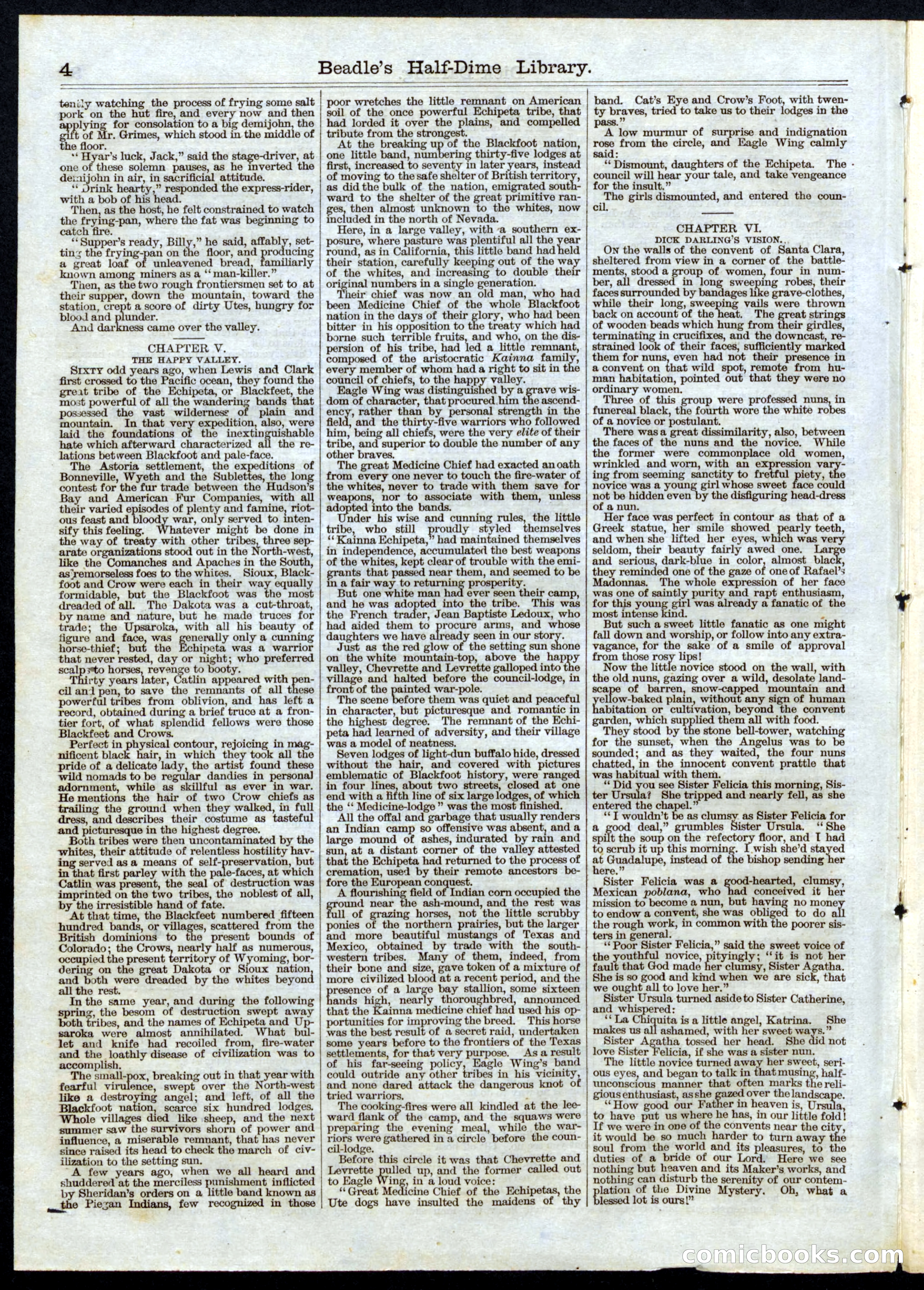
A restored page from Pulp Fiction, 1878. Page through the whole issue in the reader above.
📄 Transcribed text from this page (OCR, searchable)
Machine-transcribed from the original scan — historical spelling and the odd misread are preserved.
pork on the hut fire, and every now and then applying for consolation to a big demijohn, the ait of Mr. Grimes, which stood in the middie of ee Hyar’s luck, Jack,” said th stage-driver, at ** Hyar’s luck, Jack,” said the iver, a one of these solemn pauses, as he inverted the deinijohn in air, in sacrificial attitude. ‘* Drink hearty,” responded the express-rider, with a bob of his head. Then, as the host, he felt constrained to watch the frying-pan, where the fat was beginning to catch fire. ‘‘Supper’s ready, Billy,” he said, affably, set- tins the frying-pan on the floor, and producing a great loaf of unleavened bread, familiarly known among miners as a “ man-killer.” Then, as the two rough frontiersmen set to at their supper, down the mountain, toward the station, crept a score of dirty Utes, hungry for blood and sengah And darkness came over the valley. CHAPTER V. THE HAPPY VALLEY. Srxty odd years ago, when Lewis and Clark first crossed to the Pacific ocean, they found the great tribe of the Echipeta, or Blackfeet, the most powerful of all the ce bands that essed the vast wilderness of plain and mountain. In that very expedition, also, were laid the foundations of the inextin ewes hate which afterward characterized all the re- lations between Blackfoot and pale-face. The Astoria settlement, the expeditions of Bonneville, Wyeth and the Sublettes, the long contest for the fur trade between the Hudson’s Bay and American Fur Companies, with all their varied gee of plenty and famine, riot- ous feast and bloody war, only served to inten- sify this feeling. hatever might be done in the way of treaty with other tribes, three sep- arate organizations stood out in the North-west, like the Comanches and Apaches in the South, as"remorseless foes to the whites. Sioux, Black- foot and Crow were each in their way equally formidable, but the Blackfoot was the most dreaded of all. The Dakota was a cut-throat, by name and nature, but he made truces for trade; the Upsaroka, with all his beauty of figure and face, was generally only a cunning horse-thief; but the Echipeta was a warrior that never rested, day or night; who preferred pe horses, revenge to booty. rty years later, atlin appeared with pen- cil ani pen, to save the remnants of all these powerful tribes from oblivion, and has left a record, obtained during a brief truce at a fron- tier fort, of what splendid fellows were those Blackfeet and Crows. Perfect in physical contour, rejoicing in mag- nificent black hair, in which they took all the pride of a delicate lady, the artist found these wild nomads to be re dandies in persona] adornment, while as skillful as ever in war. He mentions the hair of two Crow chiefs as the ground when they walked, in full dress, and describes their costume as tasteful and picturesque in the highest degree. Both tribes were then uncontaminated by the whites, their attitude of relentless hostility hav- ing served asa means of self-preservation, but in that first parley with the pale-faces, at which Catlin was present, the seal of destruction was imprinted on the two tribes, the noblest of all, by the irresistible hand of fate. At that time, the Blackfeet numbered fifteen hundred bands, or villages, scattered from the British dominions to the present bounds of Colorado; the Crows, nearly half as numerous, occupied the present territory of Wyoming, bor- dering on the great Dakota or Sioux nation and both were dreaded by the whites beyond all the rest. In the same year, and during the following sp , the besom of destruction swept away both tribes, and the names of Echipeta and Up- saroka were almost annihilated. What bul- let and knife had recoiled from, fire-water and the loathly disease of civilization was to accomplish, The small-pox, breaking out in that year with fearful virulence, swept over the North-west like a brags Sa. angel; and left, of all the Blackfoot nation, scarce six hundred lodges. ©) Whole villages died like sheep, and the next summer saw the survivors shorn of power and influence, a miserable remnant, that has never since raised its head to check the march of civ- ilization to the setting sun. ‘A few years ago, when we all heard and shuddered at the merciless punishment inflicted by Sheridan’s orders on a little band known as __ the Piezan few recognized in those ee Beadle’s Half-Dime Library. ——— —— poor wretches the little remnant on American soil of the once powerful Echipeta tribe, that had lorded it over the plains, and compelled tribute from the strongest. At the breaking up of the Blackfoot nation, one little band, numbering thirty-five lodges at first, increased to seventy in later years, instead of moving to the safe shelter of British territory, as did the bulk of the nation, emigrated south- ward to the shelter of the great primitive ran- ges, then almost unknown to the whites, now included in the north of Nevada. Here, in a large valley, with a southern ex- posure, where pasture was plentiful all the year round, as in California, this little band had held their station, carefully keeping out of the wa of the whites, and increasing to double their original numbers in a single generation. Their chief was now an old man, who had been Medicine Chief of the whole Blackfoot nation in the days of their glory, who had been bitter in his opposition to the treaty which had borne such terrible fruits, and who, on the dis- persion of his tribe, had led a little remnant, composed of the aristocratic Kainna family, every member of whom had a right to sit in the council of chiefs, to the happy valley. Eagle Wing was distinguished by a grave wis- dom of character, that procured. him the ascend- rete rather than by personal strength in the field, and the thirty-five warriors who followed him, being all chiefs, were the very elite of their tribe, and superior to double the number of any other braves. The great Medicine Chief had exacted an oath from every one never to touch the fire-water of the whites, never to trade with them save for weapons, nor to associate with them, unless adopted into the bands. nder his wise and cunning rules, the little tribe, who still proudly styled themselves ‘‘Kainna Echipeta,” had maintained themselves in independence, accumulated the best weapons of the whites, kept clear of trouble with the emi- nts that passed near them, and seemed to be in a fair way to returning prosperity. But one white man had ever seen their camp, and he was adopted into the tribe. This was the French trader, Jean Baptiste Ledoux, who had aided them to procure arms, and whose daughters we have already seen in our Joh s Just as the red glow of the setting sun shone on the white mountain-top, above the happy valley, Chevrette and Levrette galloped into the village and halted before the council-lodge, in front of the painted war-pole. The scene before them was quiet and peaceful in character, but picturesque and romantic in the highest degree. The remnant of the Echi- peta had learned of adversity, and their village was a model of neatness. Seven lodges of light-dun buffalo hide, dressed without the hair, and covered with pictures emblematic of Blackfoot history, were ranged in four lines, about two streets, closed at one end with a fifth line of six large lodges, of which the ‘‘ Medicine-lodge ” was the most finished. All the offal and garbage that usually renders an Indian camp so offensive was absent, and a large mound of ashes, indurated by rain and sun, at a distant corner of the valley attested that the Echipeta had returned to the process of cremation, used by their remote ancestors be- fore the European conquest. A flourishing field of Indian corn occupied the und near the ash-mound, and the rest was ull of grazing horses, not the little scrubby ponies of the northern prairies, but the larger and more beautiful mustangs of Texas and Mexico, obtained by trade with the south- western tribes. Many of them, indeed, from their bone and size, gave token of a mixture of more civilized blood at a recent period, and the resence of a a bay stallion, some sixteen tants high, nearly thoroughbred, announced that the Paitcs medicine chief had used his op- portunities for improving the breed. This horse was the best result of a secret raid, undertaken some years before to the frontiers of the Texas settlements, for that very purpose. Asa result of his far-seeing policy, Eagle Wing’s band could outride any other tribes in his vicinity, and none dared attack the dangerous knot of tried warriors, ; The cooking-fires were all kindled at the lee- ward flank of the camp, and the squaws were preparing the evening meal, while the war- riors were gathered in a circle before the coun- cil-lodge. Before this circle it was that Chevrette and Levrette pulled up, and the former called out to Eagle Wing, in a loud voice: ‘‘Great Medicine Chief of the Echipetas, the Ute dogs have insulted the maidens of thy 2 eee Oe band. Cat’s Eye and Crow’s Foot, with twen- ty braves, tried to take us to their lodges in the A ‘low murmur of rose from the circle, said rise and indignation pain Eagle Wing calmly council will hear your tale, and take vengeance for the insult.” ee girls dismounted, and entered the coun- cil, CHAPTER VI. DICK DARLING’S VISION., On the walls of the convent of Santa Clara, ere from view ray corner of the battle- ments, stood a group of women, four in num- ber, all dtemed th long swee ing robes, their faces surrounded by bandages hike grave-clothes, while their long, sweeping vails were thrown back on account of the heat. The great strings of wooden beads which hung from their girdles, terminating in crucifixes, and the downcast, re- strained look of their faces, sufficiently marked them for nuns, even had not their presence in a convent on that wild spot, remote from hu- man habitation, pointed out that they were no ordinary women. Three of this group were professed nuns, in funereal black, the fourth wore the white ro of a novice or postulant. There was a great dissimilarity, also, between the faces of the nuns and the novice. While the former were commonplace old women, wrinkled and worn, with an ression - ing from seeming sanctity to fre picty, e novice was a young girl whose sweet face could = be hidden even by the disfiguring head-dress of a nun. Her face was perfect in contour as that of a Greek statue, her smile showed pearly teeth, and when she lifted her eyes, which was very seldom, their beauty fairly awed one. Aor and serious, dark-blue in color, almost black, they reminded one of the gaze of oneof Rafael’s Madonnas. The whole expression of her face was one of saintly purity and rapt enthusiasm, for this er was already a fanatic of the most intense kind. 2 But such a sweet little fanatic as one might fall down and worship, or follow into any extra- vagance, for the sake of a smile of approval from those rosy lips! Now the little novice stood on the wall, with the old nuns, gazing over a wild, desolate land- scape of barren, snow-capped mountain and ellow-baked plain, without any sign of human abitation or cultivation, beyond the convent garden, which supplied them all with food. They stood by the stone bell-tower, watching for the sunset, when the Angelus was to be sounded; and as they waited, the four nuns chatted, in the innocent convent prattle that was habitual with them. “Did you see Sister Felicia this morning, Sis- ter Ursula? She tripped and nearly fell, as she entered the oe a ca ‘**T wouldn’t be as rcnaag 4 as Sister Felicia for a good deal,” grumbles Sister Ursula. ‘ She spilt the soup on the refectory floor, and I had to scrub it up this morning. 1 wish she’d stayed + Guadalupe, instead of the bishop sending her ere, Sister Felicia was a -hearted, clumsy, Mexican poblana, who conceived it her mission to become a nun, but ha no mone to endow a convent, she was obli to do the rough work, in common with the poorer sis- tersin general. ‘Poor Sister Felicia,” said the sweet voice of the youthful novice, pityingly ; “it is not her fault that God made her clumsy, Sister Agatha. She is so good and kind when we are sick, that we ought all to love her.” Sister Ursula turned aside to Sister Catherine, and a ee ‘* La Chiquita is a little angel, Katrina. She makes us all ashamed, with her sweet ways.” Sister Agatha tossed her head. She did not love Sister Felicia, if she was a sister nun. The little novice turned oy ed sweet, seri- ous eyes, and began to talk in t musing, half- unconscious manner that often marks the reli- ous enthusiast, asshe — over the landscape. “How good our Father in heaven is, Ursula, to have put us where he has, in our little fold! If we were in one of the convents near the city, it would be so much harder to turn away the soul from the world and its pleasures, to the duties of a bride of our Lord. Here we see nothing but heaven and its Maker’s works, and nothing can disturb the serenity of our contem- lation of the Divine Mystery. Oh, what a blessed lot is ours!” COMME DOO KS (E “Dismount, daughters of the Echipeta. The - (E(o)