
Pulp Fiction, 1878 · page 10 of 16
Beadle's Half Dime Library, No. 48 — page 10: what you’re looking at
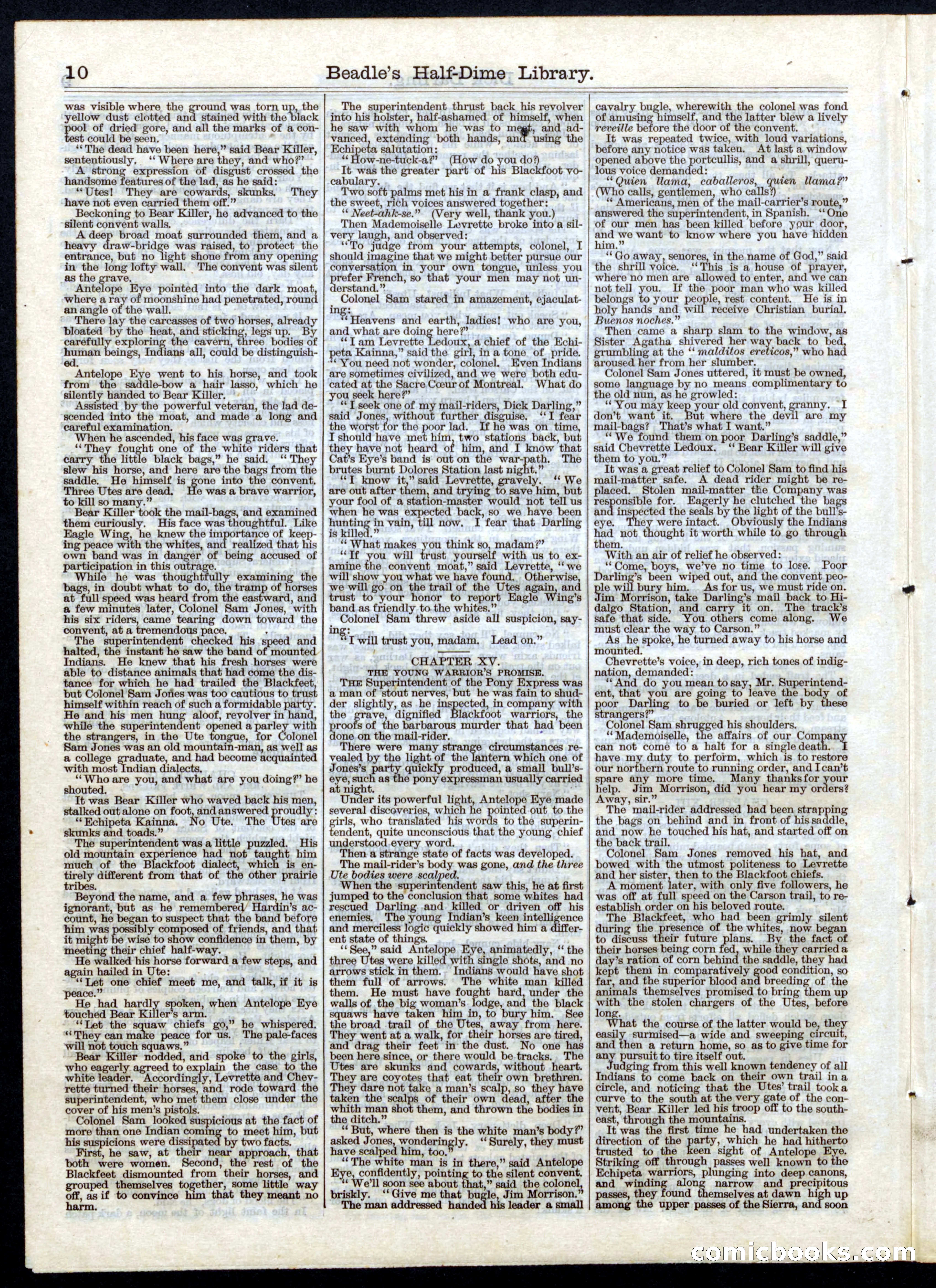
A restored page from Pulp Fiction, 1878. Page through the whole issue in the reader above.
📄 Transcribed text from this page (OCR, searchable)
Machine-transcribed from the original scan — historical spelling and the odd misread are preserved.
10 ---- —— was visible where the ground was torn Ups the yellow dust clotted and stained with the black ae of dried gore, and all the marks of a con- could be seen. ' **The dead have been here,” said Bear Killer, sententiously, ‘‘ Where are they, and who?’ A oie expression of disgust crossed the handsome features of the lad, as he said: “Utes! They are cowards, skunks, They have not even carried them off.” Beckoning to Bear Killer, he advanced to the silent convent walls. A deep broad moat surrounded them, and a heavy w-bridge was raised, to protect the entrance, but no light shone from any opening in the long lofty wall. The convent was silent as the grave, Antelope Eye pointed into the dark moat where a ray of moonshine had penetrated, round an angle of the wall. There lay the carcasses of two horses, already bloated by the heat, and sticking, legs up. By carefully exploring the cavern, three bodies of ny ings, Indians all, could be distinguish- Antelope Eye went to his horse, and took from the saddle-bow a hair lasso, which he silently handed to Bear Killer. - Assisted by the powerful veteran, the lad de- scended into the moat, and made a long and careful examination. When he ascended, his face was grave. ** The rie a ck i the. ba iret on carry the little black bags,” he said. ‘ They slew his horse, and here are the bags from the saddle. He himself is gone into the convent, Three Utes are dead, e was a brave warrior, to kill so many.” Bear Killer took the mail-bags, and examined them curiously. His face was thoughtful. Like Eagle Wing, he knew the importance of keep- ing peace with the whites, and realized that his own band was in danger of being accused of participation in this outrage. ile he was thoughtfully examining the bags, in doubt what to do, the tramp of horses at full was heard from the eastward, and a few minutes later, Colonel Sam Jones, with his six riders, came tearing down toward the convent, at a tremendous pace. : The superintendent checked his and halted, the instant he saw the band of mounted Indians. He knew that his fresh horses were able to distance animals that had come the dis- tance for which he had trailed the Blackfeet, but Colonel Sam Jories was too cautious to trust himself within reach of such a formidable party. He and his men hung aloof, revolver in hand, while the superintendent opened a parm with the strangers, in the Ute tongue, for Colonel Sam Jones was an old mountain-man, as well as a college graduate, and had become acquainted with most Indian dialects, ‘““Who are you, and what are you doing?’ he shouted. It was Bear Killer who waved back his men, stalked out alone on foot, and answered proudly: - “Echipeta Kainna. No Ute. The Utes are skunks and toads.” The superintendent was a little puzzled. His old mountain experience had not taught him much of the Blackfoot dialect, which is en- ond different from that of the other prairie tri Beyond the name, and a few phrases, he was ignorant, but as he remembered’ Hardin’s ac- count, he began to suspect that the band before him was ibly composed of friends, and that it t be wise to show confidence in them, by meeting their chief half-way. He walked his horse forward a few steps, and again hailed in Ute: . we Let one chief meet me, and talk, if it is ce. He had hardl spoken, when Antelope Eye votes th : a8 Ky f ” he whispered e squaw chiefs go,” he w A ““They can inal peace for us. The pale-faces will not touch squaws.” ‘Bear Killer nodded, and spoke to the girls, who eagerly agreed to explain the case_to the white leader. Accordingly, Levrette and Chev- rette turned their horses, and rode toward the superintendent, who met them close under the cover of his men’s pistols. Colonel Sam looked suspicious at the fact of more than one Indian comin ing to meet him, but his cions were dissi by two facts. , he saw, at their near approach, that were women. Second, the rest of the Blackfeet dismounted from their horses, and grouped themselves ther, some little way off, as if to convince that they meant no Beadle’s. Half-Dime- Library. ee nanan The superintendent thrust back his revolver into his holster, half-ashamed of himself, when he saw with whom he was to megt, and ad- vanced, extending both hands, and using the Echi salutation: “* How-ne-tuck-a?’ (How do you do?%) It- was the greater part of his Blackfoot vo- cabulary. Two soft palms met his in a frank clasp, and the sweet, rich voices answered together: ‘* Neet-ahk-se.” ery well, thank you.) Then Mademoiselle Levrette broke into a sil- very laugh, and observed: ‘To judge from your attempts, colonel, I should imagine that we might better pursue our conversation in your own tongue, unless you prefer French, so that your men may not un- derstand.” Colonel Sam stared in amazement, ejaculat- ing: Heavens and earth, ladies! who are you, and what are doing here?” *“T am Levrette Ledoux, a chief of the Echi- ta Kainna,” said the girl, ina tone of pride. ‘You need not wonder, colonel. Even Indians are sometimes civilized, and we were both edu- cated at the Sacre Coeur of Montreal. What do you seek here?” “IT seek one of my mail-riders, Dick Darling,” said Jones, without further disguise, ‘‘I fear the worst for the poor lad. If he was on time, I should have met him, two stations back, but they have not heard of him, and I know that Cat’s Eye’s band is out on the war-path. The brutes burnt Dolores Station last night.” “1 know it,” said Levrette, gravely. ‘‘ We are out after them, and t g to save him, but your fool of a station- r would not tell us when he was expected back, so we have been hunting in vain, till now. I fear that Darling is killed.” “What makes you think so, madam?’ “Tf you will trust yourself with us to ex- amine the convent moat,” said Levrette, ‘we will show you what we have found, Otherwise we will go on the trail of the Utes again and trust to your honor to report Eagle Wing’s band as friendly to.the whites.” Colonel Sam threw aside all suspicion, say- ing: @ I will trust you, madam, Lead on.” CHAPTER XYV. THE YOUNG WARRIOR’S PROMISE. THE Superintendent of the Pony Express was a man of stout nerves, but he was fain to shud- der slightly, as he inspected, in company with the ve, dignified Blackfoot warriors, the roofs of the barbarous murder that had been one on the mail-rider. : There were man y stran ces re- vealed by the light of the circumstan tern which one of Jones’s quickly produced, a small bull’s- eve, or as the pony expressman usually carried at night. Under its powerful light, Antelope Eye made several discoveries, which he pointed out to the girls, who translated his words to the superin- tendent, quite unconscious that the young chief understood.every word. Then a strange state of facts was developed. The mail-rider’s body was gone, and the three Ute bodies were scalped. When the superintendent saw this, he at first jumped to the conclusion that some whites had rescued Darling and killed or driven off his enemies. The young Indian’s keen intelligence and merciless logic quickly showed him a differ- ent state of things. ‘* See,” said Antelope Eye, animatedly, “ the three Utes were killed with single shots, and no arrows stick in them. Indians would have shot them full of arrows. The white man kill them. He must have he oe hard, under the walls of the big woman’s lodge, and the black squaws have taken him in, to bury him. See the broad trail of the Utes, away from here. They went at a walk, for their horses are tired, and drag their feet in’ the dust. No one has been here since, or there would be.tracks, The Utes are skunks and cowards, without heart. They are coyotes that eat their own brethren. They dare not take a man’s scalp, so they have taken the scalps of their own dead, r the whith man shot them, and thrown the bodies in the ditch.” ‘“* But, where then is the white man’s body?” asked Jones wonderingly. “Surely, they must have him, too. “The white man is in there,” said Antelope Eye, confidently, pointing to the silent convent. «We'll soon see about that,” said the colonel, briskly. ‘‘ Give me that on Jim Morrison. The man addressed handed his leader a small ee ———— —_—__~ cavalry bugle, wherewith the colonel was fond of amusing himself, and the latter blew a lively reveille before the door of the convent. It was repeated twice, with loud variations, before any notice was taken. At last a window opened above the portcullis, and a shrill, queru- lous voice demanded: “Quien Uama, caballeros, quien Uama?” (Who calls, gentlemen, who calls!) _ ‘“* Americans, men of the mail-carrier’s route,” answered the superintendent, in Spanish. ‘‘One of our men has been killed before your door, _ we want to know where you have hidden im. ‘Go away, senores, in the name of God,” said the shrill voice. “This is a house of prayer, where no men are allowed to enter, and we can not tell you. If the poor man who was killed belongs to your people, rest content. He is in holy hands and will receive Christian burial. Buenos noches.” Then came a sharp slam to the window, as Sister Agatha shivered her way back to bed grumbling at the ‘‘ malditos ereticos,” who had aroused her from her slumber. Colonel Sam Jones uttered, it must be owned, some language by no means complimentary to the old nun, as he growled: “You may keep your old convent, granny. I don’t want it. Bat where the devil are my mail-bags? That’s what I want.” “We found them on poor Darling’s saddle,” said Chevrette Ledoux. ‘ Bear Killer will give them to you.” It was a great relief to Colonel Sam to find his mail-matter safe. A dead rider might be re- placed. Stolen mail-matter the Company was responsible for. ais at he clutched the bags and inspected the seals by the light of the bull’s- eye. ey were intact. Obviously the Indians had not thought it worth while to go through them. With an air of relief he observed: ‘* Come, boys, we’ve no time to lose. Poor Darling’s been wiped out, and the convent peo- le will bury him. _ As for us, we must ride on. im Morrison, take Darling’s mail back to Hi- dalgo Station, and carry it on. The track’s safe that side. You others come along. We must clear the way to Carson.” As he spoke, he turned away to his horse and mounted. Chevrette’s voice, in deep, rich tones of indig- nation, demanded: “And do you mean to say, Mr. Superintend- ent, that Seem are going to leave the body of poor Darling to buried or left by these strangers?” Colonel Sam shrugged his shoulders. ““Mademoiselle, the affairs of our rea aa can not come to a halt for a single death. have my duty to perform, which is to restore our northern route to running order, and Ican’t spare any more time. Many thanksfor your help. Jim Morrison, did you hear my orders? Away, sir.” | The mail-rider addressed had been strapping the bags on behind and in front of his saddle, and now he touched his hat, and started off on the back trail. Colonel Sam Jones removed his hat, and bowed with the utmost politeness to Levrette and her sister, then to the Blackfoot chiefs. A moment later, with only five followers, he was off at full speed on the Carson trail, to re- establish order on his beloved route. The Blackfeet, who had been grimly silent during the presence of the whites, now be to discuss their future plans. By the fact of their horses being corn fed, while they carried a day’s ration of corn behind the saddle, they had kept them in comparatively good condition, so far, and the superior blood and breeding of the animals themselves promised to bring them up with the stolen chargers of the Utes, before ORE. t the course of the latter would be, the coary surmised—a wide and sweeping circuit, and then a return home, so as to give time for a u ursuit to tire itself out. ging from this well known tendency of all Indians to come back on their own trail ina circle, and noticing that the Utes’ trail tooka curve to the south at the very gate of the con- vent, Bear Killer led his troop off to the south- east, through the mountains. It was the first time he had undertaken the direction of the party, which he had hitherto trusted to the keen sight of Antelope Eye. Striking off through passes well known to the Echipeta warriors, plunging into deep canons, and along narrow and precipitous passes, they found themselves at dawn high up among the upper passes of the Sierra, and soon Eomichbooks ec com