
Pulp Fiction, 1878 · page 2 of 16
Beadle's Half Dime Library No. 41 — page 2: what you’re looking at
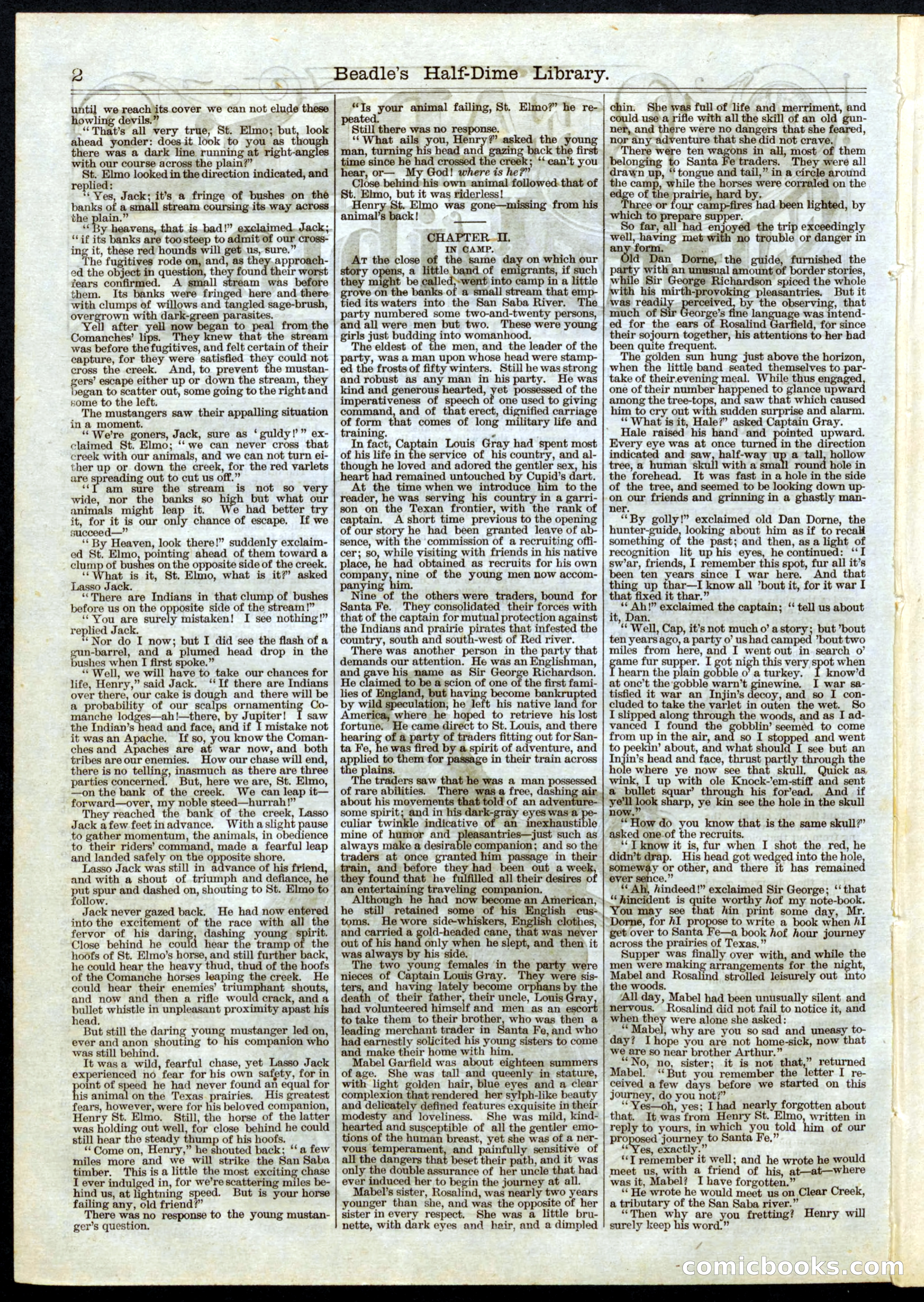
A restored page from Pulp Fiction, 1878. Page through the whole issue in the reader above.
📄 Transcribed text from this page (OCR, searchable)
Machine-transcribed from the original scan — historical spelling and the odd misread are preserved.
2 eee — until we reach its cover we can not elude these howling devils. | “That’s all very true, St. Elmo; but, look ahead yonder: doesit look to you as though there was a dark line running at right-angles with our course across the plain?” St. Elmo looked in the direction indicated, and replied: ‘Yes, Jack; it’s a fringe of bushes on thé banks of a small stream coursing its way across the plain.” ‘By heavens, that is bad!” exclaimed.Jack,; ‘if its banks are toosteep to admit of our cross- ing it, these red hounds will get us, sure.” The fugitives rode on, and, as they, approach- ed the object in question, they found their worst fears confirmed. A small am was before them. Its banks were fringed here and there with clumps ef willows and tangled sage-brush, overgrown with dark-green parasites. Yell after yell now began to peal from the Comanches’ lips. They knew that the stream was before the fugitives, and felt certain of their capture, for they were satisfied they could not cross the creek. And, to prevent the mustan- gers’ escape either up or down the stream, they began to scatter out, some going to the right and some to the left. ; The mustangers saw their appalling situation in a moment. ‘“ We're goners, Jack, sure as ‘guldy!’” ex- claimed St. Elmo; ‘‘ we can never cross that creek with our animals, and we can not turn ei- ther up or down the creek, for the red varlets are spreading out to cut us off.” me 5 am sure the stream is not so very wide, nor the banks so high but what our animals might leap it. e had better try it, for it is our only chance of escape, If we succeed—”’ ‘‘ By Heaven, look there!” suddenly exclaim- ed St. Elmo, pointing ahead of them toward a clump of bushes on the opposite side of the creek. a What is it, St. Elmo, what is it?’ asked Lasso Jack. “There are Indians in that clump of bushes before us on the opposite side of the stream!” ‘“You are surely mistaken! I see nothing!” replied Jack. ‘Nor do I now; but I did see the flash of a gon tarts and a plumed head drop in the ushes when I first spoke.” ‘* Well, we will have to take our chances for life, Henry,” said Jack. ‘If there are Indians over there, our cake is dough and there will be a probability of our scalps ornamenting Co- manche eg Ps !—there, by Jupiter! I saw the Indian’s head and face, and if I mistake not it was an Apache. If so, you know the Coman- ches and Apaches are at war now, and both tribes are our enemies. How our chase will end, there is no telling, inasmuch as there are three parties concerned. But, here we are, St. Elmo, —on the bank of the creek. We can leap it— forward—over, my noble steed—hurrah!”’ They reached the bank of the creek, Lasso Jack afew feetinadvance. Withaslight ee to gather momentum, the animals, in obedience to their riders’ command, made a fearful leap and landed safely on the opposite shore. Lasso Jack was still in advance of his friend, and with a shout of triumph and defiance, he ye spur and dashed on, shouting to St. Elmo to ollow. oe Jack never gazed back. He had now entered into the excitement of the race with all the fervor of his as pening young spirit. Close behind he could hear the tramp of the hoofs of St. Elmo’s horse, and still further back, he could hear the heavy thud, thud of the hoofs of the Comanche horses leaping the creek. He could hear their enemies’ triumphant shouts, and now and then a rifle would crack, and a bullet whistle in unpleasant proximity apast his head. But still the daring young mustanger led on, ever and anon shouting to his companion who was still behind. It wasa wild, fearful chase, yet Lasso Jack experienced no fear for his own safety, for in int of s he had never found an equal for is animal on the Texas prairies. His greatest fears, however, were for his beloved companion, Henry St. Elmo. Still, the horse of the latter was holding out well, for close behind he could still hear the steady thump of his hoofs. ‘“Come on, Henry,” he shouted back; ‘‘ a few miles more and we will strike the San Saba timber. This is a little the most exciting chase I ever ind in, for we’re scattering miles be- hind us, at lightning ~ gs But is your horse failing any, old friend?” There was no response to the young mustan- ger’s question. hol j animal failing, St. Elmo?’ he re- peat ‘Still there was no response. : ‘‘ What ails you, Henry?’ asked, the young man, turning his head and gazing back the fi time since he had crossed the cree hear, or— My God! where is he?” Close behind his own animal followed. that of .—, 35" ea was riderless! pf en t. 0 was gone—missing from auimale back! CHAPTER..-IL. _ IN CAMP, At the close of the same day on which our story opens, a little band of , if such they might be called;-went into camp in a little ove on the banks of a small stream that emp- ied its waters into the San Saba River. The party numbered some two-and-twenty persons, and all were men but two. These were young girls just budding into womanhood. The eldest of the men, and the leader of the party, was a man upon whose head were stamp- ed the frosts of fifty winters. Still he was strong and robust as any man in his party. He was kind and generous hearted, ee possessed of the imperativeness of speech of one used to giving command, and of that erect, dignified carriage of form that comes of long military life and training. P In fact, Captain Louis Gray had spent most of his life in the service of his country, and al- though he loved and adored the gentler sex, his heart had remained untouched by Cupid’s dart. At the time when we introduce him to the reader, he was serving his country in a garri- son on the Texan frontier, with the rank of captain. A short time previous to the opening of our story he had been granted leave of ab- sence, with the commission of a recruiting offi- cer; so, while visiting with friends in his native place, he had obtained as recruits for his own company, nine of the young men now accom- panying Nine of the others were traders, bound for Santa Fe. They consolidated their forces with that of the captain for mutual protection against the Indians and prairie pirates that infested the country, south and south-west of Red river. There was another person in the party that demands our attention. He was an Englishman, and gave his mame as Sir George Richardson. He claimed to be a scion of one of the first fami- lies of England, but having become bankrupted by wild s lation; he left his native land for America, where he hoped to retrieve his lost fortune. He came direct to St. Louis, and there hearing of a party of traders fitting out for San- ta Fe, he was fired by a.spirit of adventure, and Cee to them for passage in their train across DB ger > ee e traders saw that he was a man possessed of rare abilities. bbe 2 vx free, dashing air. about his movements th: id of an adventu some spirit; and in his dark- eyes was a culiar twinkle indicative an neeniisti le mine of humor and pl tries—just such as always make a desirable companion; and so the traders at once granted him in their train, and before they bad been out a week, they found that he all their desires of an en i traveling companion. Although he had now become an ‘American, he ag ter ap Pec =~ *, Bglish ol cus- toms. wore side-whiskers, at es, - that was never and carried a gold-headed cane out of his pata only when he slept, and then it was always by his side. = Re The two young females in the party were nieces of Captain Louis Gray. They were sis- p> oe having lately become orld by the death of their father, their uncle, Louis Gray had volunteered himself and men as an esco to take them to their brother, who was then a leading merchant trader in Santa Fe, and who had earnestly solicited his young sisters to come and make their home with him. Mabel Garfield was about eighteen summers of age. She was tall and queenly in stature, with light golden hair, blue eyes and a clear complexion that rendered her sylph-like beauty and delicately defined features exquisite in their mod and loveliness. She was mild, kind- h and susceptible of all the gentler emo- eee ne human scent, yet she was of a De vous perament, and painfully sensitive o all the dangers that beset their path, and it was only the double assurance of her uncle that had ever induced her to begin the journey at all. Mabel’s sister, Rosalind, was nearly two years younger than she, and was the opposite of her sister in every respect. She was a little bru- nette, with dark eyes and heir, and a dimpled ; “can’t you | ‘Dorne, for AI pro <a N LLLLLLLL GL ES chin. She was full of life and merriment, and could use’a rifle with all the skill of an old gun- ner, and there were no dangers that she feared, nor any adventure that she did not crave. © ‘There were ten wagons in all, most of them belonging to Santa Fe traders. They were all drawn up, “ tongue and tail,” in a circle around the com while the horses were corraled on the e of the prairie, hard by. ‘hree or four camp-fires had been lighted, by which to prepare supper. | = far, all had enjoyed the trip exceedingly well, having Tatts no trouble or danger in Old Dan Dorne,'the guide, furnished the party with an unusual amount of border stories, while Sir George Richardson spiced the whole with his mirth-provoking pleasantries. But it ‘was een = a aa, the observing, that rge’s much of e language was intend- ed for the ears of Rosalind Garfield, for since their sojourn together, his attentions to her bad been quite frequent. The golden sun hung just above the horizon, when the little band seated themselves to par- take of their.evening meal. While thus engaged one of their number happened to glance upward among the tree-tops, and saw that which caused him to cry out with sudden surprise and alarm. ‘** What is it, Hale?’ asked Captain Gray. Hale raised his hand and pointed upward. Every eye was at once turned in the direction indicated and saw, half-way a tall, hollow tree, a human s with a small round hole in the forehead. It was fast in a hole in the side of the tree, and seemed to be looking down up- on our friends and grinning in a ghastly man- ner. “By golly!” exclaimed old Dan Dorne, the hunter-guide, looking about him asif to recall something of the past; and then, as a light of recognition lit up his eyes, he continued: “I sw’ar, friends, I remember this spot, fur all it’s been ten years since I war here. And that thing up thar—I know all ’bout it, for it war I that fixed it thar.” _ ** Ah!” exclaimed the captain; ‘ tell us about it, Dan. ** Well, Cap, it’s not much o’ astory; but bout ten years ago, a party o’ us had camped *bout two miles from here, and I went out in search 0’ — fur supper. I got nigh this very s hearn the plain gobble o’ a turkey. know’d at onc’t the gobble warn’t ginewine. I war sa- tisfied it war an Injin’s decoy, and so I con- cluded to take the varlet in outen the wet. So I slipped along through the woods, and as I ad- vanced I found the gobblin’ seeméd to come from up in the air, and so I stopped and went to peekin’ about, and what should I see but an Injin’s head and face, thrust ly through the hole where ye now see that skull, Quick as, wink, I up with ole Knock-’em-stiff and sent a bullet squar’ through his for’ead. And if he ae sharp, ye kin see the hole in the skull = _ “How do you know that is the same skull?’ ked one.of the recruits. ‘1 know it is, fur when I shot the red, he didn’t drap. His head got wedged into the hole someway or other, and there it has remained ever sence.” ** Ah, hindeed!” exclaimed Sir George; ‘‘ that “‘hincident is —_ worthy hof my note-book. You may see that hin print some day, Mr. ; to write a book when Al get over to Santa Fe—a book hof hour journey across the prairies of Texas,” Supper was finally over with, and while the men were g arrangements for the night, Mabel and Rosalind strolled leisurely out into the woods. ‘All day, Mabel had been unusually silent and nervous. Rosalind did not fail to notice it, and when they were alone she asked: “Mabel, why are you so sad and uneasy to- day? Ihope you are not home-sick, now that we are so near brother Arthur.” No, no, sister; it is not that,” returned Mabel. ‘But you remember the letter I re- ceived afew days before we started on this journey, do you not?” ‘““Yes—oh, yes; I had nearly forgotten about that. It was from Henry St. Elmo, written in reply to yours, in which you told him of our pro journey to Santa Fe,” ‘Yes, exactly.” ““T remember it well; and he wrote he would meet us, with a friend of his, at—at—where was it, Mabel? I have forgotten.” “He wrote he would meet us on Clear Creek, a tributary of the San Saba river.” , “Then why are you fretting? Henry will surely keep his word.” t when Gboo scOm cS (E(0)