
Pulp Fiction, 1884 · page 9 of 16
Beadle's Half Dime Library, No. 377 — page 9: what you’re looking at
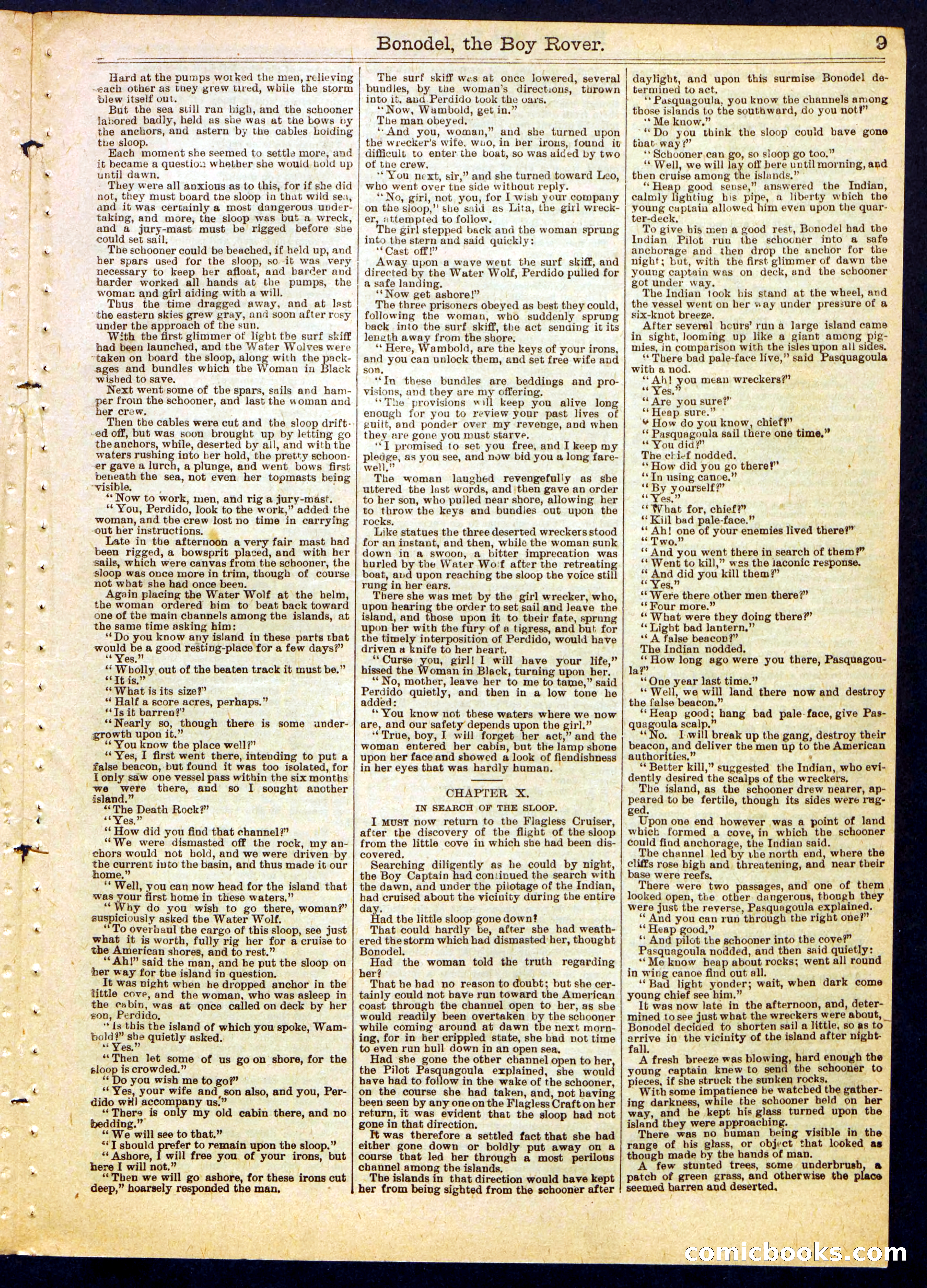
A restored page from Pulp Fiction, 1884. Page through the whole issue in the reader above.
📄 Transcribed text from this page (OCR, searchable)
Machine-transcribed from the original scan — historical spelling and the odd misread are preserved.
-” © + , ae co “Si * “we ee ee ee eee - Ome tl em Hard at the pumps worked the men ert each other as they grew tired, while the storm blew itself out. But the sea still ran high, and the schooner labored badly, held as she was at the bows by the anchors, and astern by the cables bLoiding the sloop. Each moment she seemed to settle more, and it became a question whether she wouid bold up until dawn, They were all anxious as to this, for if she did not, they must board the sloop in that wild sea, and it was certainly a most dangerous under- taking, and more, the sloop was but a wreck, and a jury- -mast must be rigged before she could set sail. The schooner could be beached, if held up, and her spars used for the sloop, so it was very necessary to keep her afloat, and barder and barder worked all hands at the pumps, the womac and girl aiding with a will. Thus the time dragged away, and at lest the eastern skies grew gray, and soon after rosy under the approach of the sun. With the first glimmer of light the surf skiff had been launched, and the Water Wolves were “taken on board the sloop, along with the pack- ages and bundles which the Woman in Black wished to save. Next went some of the spars, sails and ham- per froin the schooner, and last the woman and her crew Then the cables were cut and the sloop drift- -ed off, but was soon brought up by letting go the anchors, while, deserted by all, and with the waters rushing into her hold, ‘the pretty schoon- er gave a lurch, a plunge, and went bows first beneath the sea, not even her topmasts being “visible, ‘* Now to work, men, and rig a jury-mast. ** You, Per dido, look to the w ork,” added the woman, and the crew lost no time in car rying out her instructions. Late in the afternoon a very fair mast had been rigged, a bowsprit placed, and with her sails, which were canvas from the schooner, the sloop was once more in trim, though of course not what she had once been Again placing the Water Wolf at the helm, the woman ordered him to beat back toward one of the main channels among the islands, at the same time asking him: ‘Do you know any island in these parts tbat ane be a good resting-place for a few days?” -* ORs “ oly out of the beaten track it must be.” tis ‘*What is its size?” ‘“* Half a score acres, perhaps. > ‘*Ts it barren?” ‘Nearly so, though there is some under- growth upon it.” ‘** You know the place well?” ‘Yes, I first went there, intending to put a false beacon, but found it was too isolated, for Lonly saw one vessel pass within the six months were there, and so I sought another island.” | “The Death Rock?” dae at Te ‘* How did you find that channel?” ‘“We were dismasted off the rock, my an- ebhors would not bold, and we were driven by the current into the basin, and thus made it our home,” ** Well, you can now head for the island that was your first home in these waters,” by do you wish to go there, woman?” suspicious! y asked the Water Wolf. ‘To overhaul the cargo of this sloop, see just what it is worth, fully rig her for a cruise to the American shores, and to rest.” “Ah!” said the man, and he put the sloop on her way for tbe island in question. It was night when he dropped anchor in the little cove, and the woman, who was asleep in the cabin, was at once called on deck by her £00, Perdido, ‘* Is this the island of which you spoke, Wam- bold?” she quietly asked. es es,”? “Then let some of us goon shore, for the sloop is crowded.” ‘Do you wish me to go?” | ‘‘ Yes, your wife and. son also, and you, Per- dido will accompany us “‘There is only my ‘id cabin there, and no bedding.” “We will see to that.” **T should — to remain upon the sloop.” ‘‘ Ashore, I will free you of your irons, but her I will not,” ben we will go ashore, for these irons cut Soon, ” hoarsely responded the man, _ Bonodel, the _Bonodel, the Boy Rover. —-—— —- ‘ The surf skiff wes at once lowered, several | daylight, and upon this surmise Bonodel de- bundles, by the woman’s directions, turown into it, aud.Perdido took the vars. ‘*Now, Wambold, get in.” The man obeyed, ‘And you, woman,” and she turned upon the wrecker’s wife, wuo, in ber irous, found ip difficult to enter the boat, so was aided by two of the crew, ‘You next, sir,” and she turned toward Leo, who went over the side without reply. ‘No, girl, not you, for I wish your company om the sloop, ” she said as Lita, the girl wreck- ttempted to follow. "Phe girl stepped back and the woman sprung into the stern and said quickly: ‘*Cast off!” Away upon a wave went the surf skiff, and directed by the Water Wolf, Perdido pulled for a safe landing. ‘* Now get ashore!” The three prisoners obeyed as best they could, following the woman, who suddenly sprung back into the surf skiff, the act sending it its length away from the shore. ‘* Here, Wambold, are the keys of your irons, and you can unlock them, and set free wife and son, ‘In these bundles are beddings and pro- visions, and they are my offering, “The provisions vill keep you alive long enough for you to review your past lives of guilt, and ponder over my revenge, and when they are gone you must starve. ‘‘T promised to set you free, and I keep my pledge, as you see, and nuw bid you a long fare- well,” The woman laughed revengefuliy as she uttered the last words, and then gave an order to her son, who pulled near shore, allowing her to throw the keys and bundles out upon the rocks, Like statues the three deserted wreckers stood for an instant, and then, while the woman sunk down in a swoon, a bitter imprecation was hurled by the Water Wo'f after the retreating boat, avd upon reaching the sloop the voice still rung in her ears. Tbere she was met by the girl wrecker, who, upon hearing the order to set sail and Jeave the island, and those upon it to their fate, sprung upon her with the fury of a tigress, and but for the timely interposition of Perdido, would have driven a knife to her beart. ‘Curse you, girl! I will have your life,” hissed the Woman in Black, turning upon her. ‘* No, mother, leave her to me to tame,” said Perdido quietly, and then in a low tone he added: ‘You know not these waters where we now are, and our safety depends upon the girl,” “True, boy, J will forget her act,” and the woman entered her cabin, but the lamp shone upon her face and showed a look of fiendishness in her eyes that was hardly human. CHAPTER X, IN SEARCH OF THE SLOOP. I must now return to the Flagless Cruiser, after the discovery of the flight of the sloop from the little cove in which she had been dis- covered, Searching diligently as he could by night, the Boy Captain had continued the search with the dawn, and under the pilotage of the Indian, ve cruised about the vicinity during the entire “Nad the little sloop gone down? That could hardly be, after she had weath- ered the storm which had dismasted her, thought Bonodel. Had the woman told the truth regarding her? That he bad no reason to doubt; but she cer- tainly could not bave run toward the American coast through the chanuel open to her, as sbe would readily been overtaken by the schooner while coming around at dawn tbe next morn- ing, for in ber crippled state, she bad not time to even run hull down in an open sea, Had she gone the other channel open to her, the Pilot mo ik Se explained, she would have had to follow in the wake of the schooner, on the course she had taken, and, not having been seen by any one on the Flagless Craft on her return, it was evident that the sloop had not gone in that direction. It was therefore a settled fact that she had either gone down or boldly put away on a course that led her through a most perilous channel among the islands. _ The islands in that direction would have kept her from being sighted from the schooner oer \ : ' termined to act, ‘* Pasquagoula, you know the channels among those islands to the southward, do you not?’ ‘* Me know,” “Do you think the sloop couid bave gone toat way ?”’ ‘* Schooner can go, so sloop go too.” ‘* Well, we will lay off bere until morning, and then cruise among the islands.” ‘Heap good sense,” answered the Indian, een lighting bis pipe, a liberty which the young captain allowed him even upon the quar- ter-deck, To give bis men a good rest, Bonodel had the Indian Pilot run the schooner into a safe anchorage and then drop the anchor for the night; but, with the first glimmer of dawn the young captain was on deck, end the schooner got under way. The Indian took his stand at the wheel, and the vessel went on her way under pressure of a six-knot breeze. After several beurs’ run a large island came in sight, looming up like a giant among pig- mies, in comparison with the isles upon all sides. ‘‘ There bad pale-face live,” said Pasquagoula with a nod. ‘‘ Ah! you mean wreckers?” sé Yes. ” “Are you sure? , ‘** Heap sure.’ * How do you know, chief?” “ Pasquagoula sail there one time,” ‘You did?” The chief nodded. | ‘‘ How did you go there?” ’ ‘*Tn using canoe,’ ‘* By yourself?” 46 Yes. ? ‘What for, chief?” . ** Kill bad pale-face.” ‘* Ah! one of your enemies lived there?” sé Two. ” ‘‘ And you went there in search of them?” ‘* Went to kill,” wes the laconic response. ** And did you kill them?” cs Yes. ” “Were there other men there?” ‘Four more.’ “What were files doing there?” ‘* Light bad lantern.” ‘‘ A false beacon?” The Indian nodded, : How long ago were you there, Pasquagou- a?’ ‘‘One year last time.” ‘* Well, we will land there now qnd destroy © the false beacon.” ‘‘Heap good; hang bad pale: face, give Pas- quagoula scalp.” o. Iwill break up the gang, destroy their beacon, and deliver the men up a. the American authorities,” ‘* Better kill,” suggested the Indian, who evi- dently desired ‘the scalps of the wreckers, The island, as the schooner drew nearer, ap- pearge to be ‘fertile, though its sides were rug- ge Upon one end however was a point of land which formed a cove, in which the schooner could find anchorage, the Indian said. The channel led by vhe north end, where the cliffs rose high and threatening, and near their base were reefs, There were two passages, and one of them looked open, the other. dangerous, though they were just the reverse, Pasquagoula explained, “ And you can rup through the right one?” ‘** Heap good,” + and. pilot the schooner into the cove?” Pasquagoula nodded, and then said quietly: ‘Me know hea about rocks; went all round in wing canoe find out all. ‘* Bad light yonder; wait, when dark come young chief see him.” | It was now late in the afternoon, and, deter- mined to see just what the wreckers were ‘about, Bonodel decided to shorten sail a little, so fhe. arrive in the vicinity of the island after night- fall. A fresh breeze was blowing, bard enovgh the young captain knew to seni he schooner to- she struck the sunk ponte per he watcbod the gather- 3 ile the schooner held on her turned upon the pieces, if With some im ing darkness, w way, and he kept his glass island they were approaching. There was po buman being visible in the range of his glass, or object that looked as though made by the hands of man. A few stunted trees, some underbrush . patch of green grass, and otherwise the place seemed barren and deserted, — (Se) Ai HIS 4