
Pulp Fiction, 1884 · page 13 of 16
Beadle's Half Dime Library, No. 377 — page 13: what you’re looking at
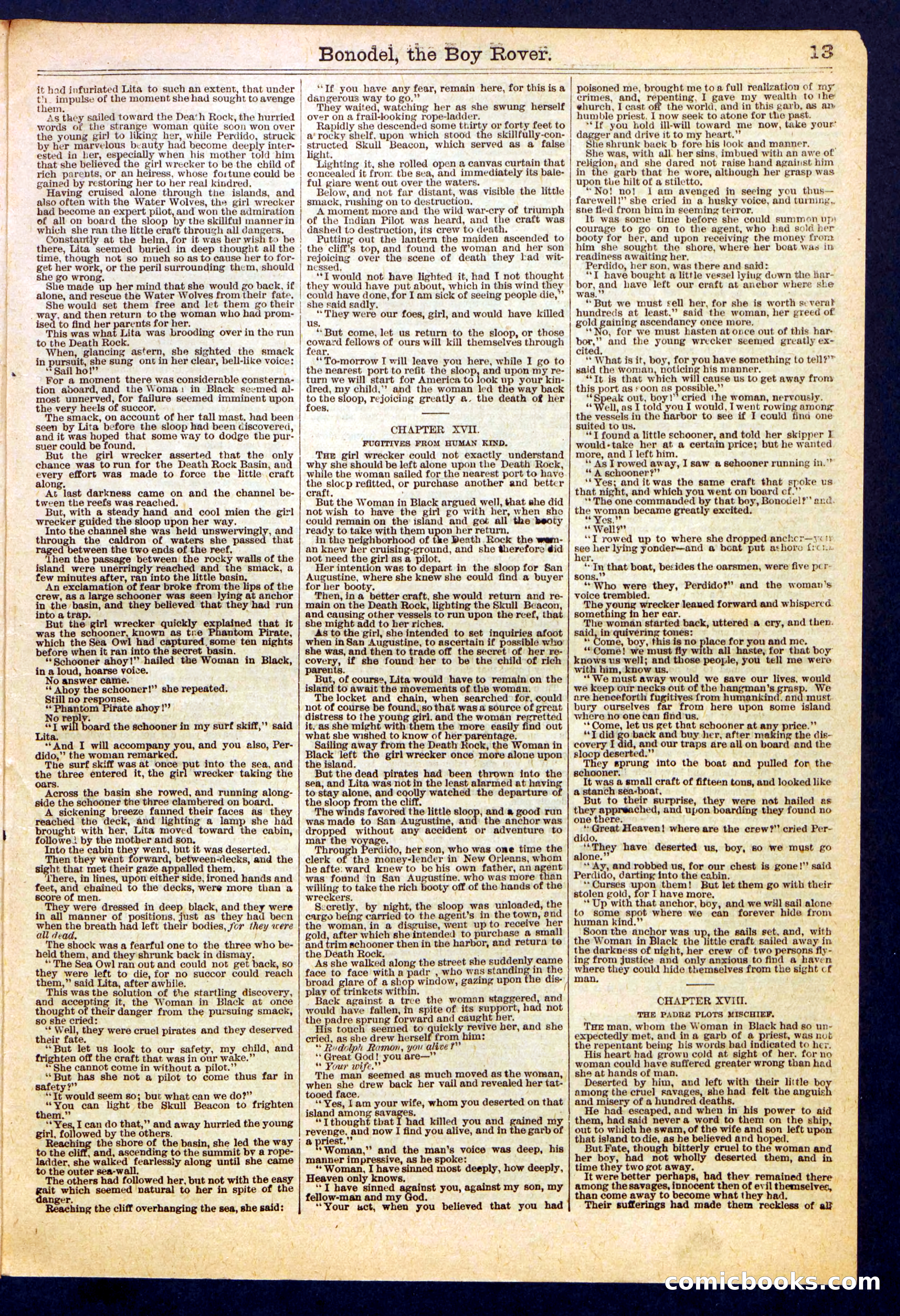
A restored page from Pulp Fiction, 1884. Page through the whole issue in the reader above.
📄 Transcribed text from this page (OCR, searchable)
Machine-transcribed from the original scan — historical spelling and the odd misread are preserved.
it had infuriated Lita to such an extent, that under Bs impulse of the moment she had sought to avenge them. As they sailed toward the Death Rock, the hurried words of the strange woman quite soon won over the young girl] to liking her, while Perdido, struck by her marvelous beauty had become deeply inter- ested in her, especially when his mother told him that she believed the girl wrecker to be the child of rich parents, or an heiress, whose fo:tune could be gained by restoring her to her real kindred. Having cruised alone through the islands, and also often with the Water Wolves, the girl wrecker had become an expert pilot, and won the admiration of all on board the sloop by the skillfu) manner in which she ran the little craft through all dangers. Constantly at the helm, for it was her wish to be there, Lita seemed buried in deep thought all the time, though not so much so as to cause her to for- get her work, or the peril surrounding them, should she go wrong. She made up her mind that she would zo back, if | alone, and rescue the Water Wolves from their fate. She would set them free and let them go their | way. and then return to the woman who had prom- ised to find her parents for her. This was what Lita was brooding over in the run to the Death Rock. When, glancing astern, she sighted the smack | in pursuit, she sung ont in her clear, bell-like voice: ** Sail ho!”’ For a moment there was considerable consterna- tion aboard, and the Woma: in Black seemed al- most unnerved, for failure seemed imminent upon the very heels of succor. The smack, on account of her tall mast. had been seen by Lita before the sloop had been ciscovered, and it was hoped that some way to dodge the pur- suer could be found. But the girl wrecker asserted that the onl chance was torun for the Death Rock Basin, anc emery effort was made to force the little craft along. At last darkness came on and the channel be- tween the reefs was reached. But, with a steady hand and cool mien the girl wrecker guided the sloop upon her way. Into the channel she was held unswervingly, and through the caldron of waters she passed that raged between the two ends of the reef, ‘Lhen the passage between the rocky walls of the island were unerringly reached and the smack, a few minutes after, ran into the little basin. An exclamation of fear broke from the lips of the crew, as a large schooner was seen lying at anchor in the basin, and they believed that they had run into a trap. But the girl wrecker quickly explained that it was the schooner, known as tre Phantom Pirate, which the Sea Owl had captured. some ten nights before when it ran into the secret basin. ‘Schooner ahoy!” hailed the Woman in Black, in a loud, hoarse voice. No answer came. ‘‘ Ahoy the schooner!”’ she repeated. Still no response. ‘*Phantom Pirate ahoy!”’ No ort, ‘“‘] will board the schooner in my surf skiff,’’ said Lita. | **And I will accompany you, and you also, Per- dido,” the woman remarked, The surf skiff was at once the three entered it, the gir oars. Across the basin she rowed, and running along- side the schooner the three clambered on board. A sickening breeze fanned their faces as they reached the deck, and lighting a lamp she had brought with her, Lita moved toward the cabin, followe. by the motber and son, Into the cabin they went, but it was deserted. Then they went forward, between-decks, and the sight that met their gaze appalled them. rhere, in lines, upon either side, ironed hands and feet, and chained to the decks, were more than a score of men. They were dressed in deep black, and they were in all manner of positions, just as they had been when the breath had left their bodies, for they were all dead, The shock was a fearful one to the three who be- held them, and they shrunk back in dismay, * The Sea Owl ran out and could not get back, so they were left to die, for no succor could reach them,” said Lita, after awhile. This was the solution of the startling discovery, and emg Br it, the Woman in Black at once thought of their danger from the pursuing smack, so she cried: ‘* Well, they were cruel pirates and they deserved their fate. ‘**But let us look to our safety, my child, and frighten off the craft that was in our wake.” *She cannot come in without a pilot.” ‘But has she not a pilot to come thus far in safety?” ‘*Tt would seem so; but what can we do?” ee a can light the Skull Beacon to frighten em.” ‘* Yes, I can do that,” and away hurried the young girl, followed by the others. Reaching the shore of the basin, she led the way to the cliff, and, ascending to the summit by a rope- ladder, she walked fearlessiy along until she came to the outer sea-wall. The others had followed her, but not with the easy gait which seemed natural to her in spite of the danger. Reaching the cliff overhanging the sea, she said: ut into the sea, and wrecker taking the | | | | | ; Bonodel, the Boy Rover. a a a ee 1d i ee ee a ee eee ee “Tf you have any fear, remain here, for this is a | poisoned me, brought me toa full realization of my dangerous way to go.”’ They waited, watching her as she swung herself over on a frail-looking rope-ladder. Rapidly she descended some thirty or forty feet to a’ rocky shelf, upon which stood the skillfully-con- bea Skull Beacon, which served as a false ight, Tiehting it, she rolled open a canvas curtain that concealed it from the sea, and immediately its bale- | ful glare went out over the waters. Below, and not far distant, was visible the little smack, rushing on to destruction. A moment more and the wild war-cry of triumph of the Indian Pilot was heard, and the craft was dashed to destruction, its crew to death. Putting out the lantern the maiden ascended to the cliff’s top, and found the woman and her son rejoicing over the scene of death they kad wit- nessed, ‘*T would not have lighted it, had IT not thought they would have put about, which in this wind they could have done, for I am sick of seeing people die,” she said sadly. ‘They were our foes, girl, and would have killed us. ‘**But come, let us return to the sloop, or those — fellows of ours will kill themselves through ear. ‘*To-morrow I will leave you here, while I go to the nearest port to refit the sloop, and upon my re- turn we will start for America to look up your kin- dred, my child,’’ and the woman led the way back to the sloop, rejoicing greatly a. the death of her oes, CHAPTER XVII. FUGITIVES FROM HUMAN KIND. Tue girl wrecker could not exactly understand why she should be left alone upon the Death Rock, while the woman sailed for the nearest port to have Soe MACD refitted, or purchase another and better craft. But the Woman in Black argued well, that she did not wish to have the girl go with her, when sho could remain on the island and get all the beoty ready to take with them ey her return, In the neighborhood of tke Benth Rock the wem- an knew her cruising-ground, and she therefore did not need the girl as a pilot. Her intention was to depart in the sloop for San Augustine, where she knew she could find a buyer for her booty. Then, in a better craft, she would return and re- main on the Death Rock, lighting the Skull Beacon, and causing other vessels to run upon the reef, that she might add to her riches. As to the girl, she intended to set inquiries afoot when inSan Augustine, to ascertain if possible who she was, and then to trade off the secret of her re- etn 1d if she found her to be the child of rich n But, of course, Lita would have to remain on the island to await the movements of the woman. The locket and chain, when searched for, could not of course be found,)so that was a source of great distress to the young girl. and the woman regretted it. as she might with them the more easily find out what she wished to know of her parentage. Sailing away from the Death Rock, the Woman in Black left the girl wrecker once more alone upon the island. But the dead pirates had been thrown into the sea, and Lita was notin the least alarmed at havin to stay alone, and coolly watched the departure o the sloop from the cliff. The winds favored the little sloop, and a good run was made to San Augustine, and the anchor was dropped without any accident or adventure to mar the voyage. Through Perdido, her son, who was one time the clerk of the money-lender in New Orleans, whom he afte: ward knew to be his own father, an agent was found in San Augustine. who was more than willing to take the rich booty off of the hands of the wreckers. Sceretly, by night, the sloop was unloaded, the cargo being carried to the agent’s in the town, end the woman,in a disguise, went up to receive her gold, after which she intended to purchase @ small and trim schooner then in the harbor, and retura to the Death Rock, As she walked along the street she suddenly came face to face with a padr , who was standin in the broad glare of a mee window, play of trinkets within. Back against a tree the woman staggered, and would have fallen, in spite of its support, had not the padre sprung forward and caught her. His touch seemed to quickly revive her, and she cried, as she drew herself from him: ** Rudolph Ramon, you alive?” ‘* Great God! you are—”’ * Your wife.” The man seemed as much moved as the woman, when she drew back her vail and revealed her tat- tooed face. ‘Yes, lam your wife, whom you deserted on that island amon pith ke “I thought that I had killed you and gained my Adem <p and now I find you alive, and in the garb of a priest.’ ‘Woman,”’ and the man’s voice was deep, his manner impressive, as he spoke: ‘* Woman, I have sinned most deeply, how deeply, Heaven only knows. ‘I have sinned i you, against my son, my fellow-man and my , “Your uct, when you believed that you had / gazing upon the dis- | 3 > crimes, and, repenting, I gave my wealth to the ehurch, I cast off the world, and in this garb, as ar 1umble priest, 1 now seek to atone for the past. ‘Tf you hold ill-will toward me now, take your’ dagger and drive it to my heart.” She shrunk back b fore his look and manner. . She was, with all. her sins, imbued with an awe of religion, and she dared not raise hand against him in the garb that he wore, although her grasp was upon the hilt of a stiletto, “No! no! Iam avenged in seeing you thus— farewell!” sbe cried in a husky voice, and turning, sne fled from him in seeming terror. lt was some time before she could summon uf courage to go on to the agent, who had sold her booty for her, and upon receiving the money from him she sougbt the shore, where her boat Was in readiness awaiting her. Perdido, her son, was there and said: “I have bought a little vessel lyiug duwn the har- bor, and have left our craft at anchor where she was.’ ‘But we must sell her, for she is worth severat hundreds at least.”’ said the woman, her greed of gold gaining ascendancy once more. ‘*No, for we must hasten at once out of this har Oe and the young wrecker seemed greatly ex- cited, ‘* What is it, boy, for you have something to tell?” said the woman, noticing his manner. “Tt is that which will cause us to get away from this port as soon as possible.” “*Speak out, boy)’ cried the woman, nervously. abe Vell, as I told youl would, Iwent rowing among the vessels in the harbor to see if I could fina one suited to us. ‘*T found a little schooner, and told her skipper I would-take her at a certain price; but he wanted more, and J left him. ‘* As Lrowed away, I saw a sehooner running in.’ ““ A schooner?”’ ‘* Yes; and it was the same craft that spoke us that night, and which you went on board cf.” ‘The one commanded by that boy, Bonodel?” and. the woman became greatly excited. “< Yes.’’ ‘* Well?” ‘‘T rowed up to where she dropped anchcr—)« '! see her lying yonder—and a boat put ashore frc1. ’ er, ." In that boat, besides the oarsmen, were five pcr- sons.’ ‘““Who were they, Perdido?” and the woman's voice trembled. . The ‘pate wrecker leaned forward and whispered something in her ear. The woman started back, uttered a cry, and then. said, in quivering tones: ** Come, boy, this is no place for you and me, ‘*Come! we must fly with all haste, for that boy knows us well; and those people, you tell me were with him, know us. ‘*We must away would we save our lives, would we keep our necks out of the hangman's gree . We are henceforth fugitives from humankind. and must bury ourselves far from here upon some island where no one can find us, ‘*Come, let us get that schooner at any price.”’ “T did go back and buy her, after making the dis- covery I did, and our traps are all on board and the sloop deserted.” They sprung into the boat and pulled for the schooner. It was a small craft of fifteen tons, and looked like a stanch sea-boat, But to their surprise, they were not hailed as they appreached, and upon boarding they found no one there. A; Great Heaven! where are the crew?"’ cried Per- 0. ‘‘They have deserted us, boy, so we must go alone.” ‘Ay, and robbed us, for our chest is gone!’’ said Perdido, darting into the cabin. ‘“Ourses upon them! But let them go with their stolen gold, for I have more, ‘Up with that anchor, boy, and we wil sail alone to some spot where we ean forever hide from human kind.” Soon the anchor was UP, the sails set, and, with the Woman in Black the little craft sailed away in the darkness of night, her crew of two persons fly- ing from justice and only anxious to find a haven where they could hide themselves from the sight cf man, CHAPTER XVIII. THE PADRE PLOTS MISCHIEF. THE man, whom the Woman in Black had so un- expectedly met, and ina garb of a priest, was nut the eepeners being his words bad indicated to her. His heart had grown cold at sight of her. for no woman could have suffered greater wrong than had she at hands of man. Deserted by him, and left with their little bo among the cruel savages, she had felt the anguis and misery of a hundred deaths. He had escaped, and when in his power to aid them, had said never a word to them on the ship, out to which he swam, of the wife and son left upon that island to die, as he believed and hoped. But Fate, though bitterly cruel to the woman and her boy, had not wholly deserted them, and in time they two got away. It were better perhaps, had they remained there among the savages, innocent then of evil themselves, than come away to become what they had. Their sufferings had made them reckless of al? om oloye) <yrerolan