
Pulp Fiction, 1878 · page 2 of 16
Beadle's Half Dime Library, No. 36 — page 2: what you’re looking at
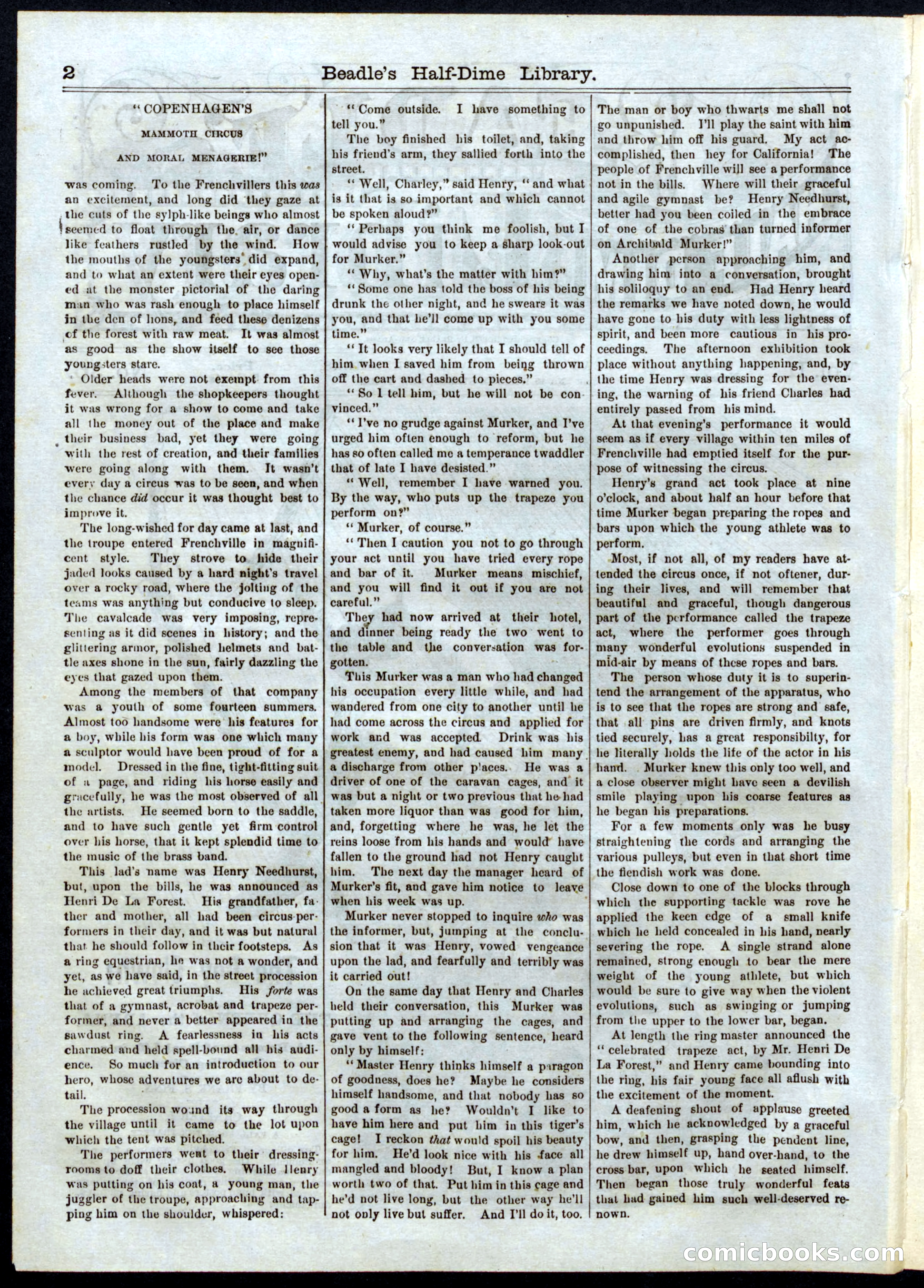
A restored page from Pulp Fiction, 1878. Page through the whole issue in the reader above.
📄 Transcribed text from this page (OCR, searchable)
Machine-transcribed from the original scan — historical spelling and the odd misread are preserved.
Beadle’s Half-Dime Library. ** COPENHAGEN'S MAMMOTH CIRCUS AND MORAL MENAGERIE!” was coming. ‘To the Frenchvillers this was an excitement, and long did ‘they gaze at the cuts of the sylph-like beings who almost ‘seemed to float through the, air, or dance like feathers rustled by the wind. How the mouths of the youngsters’ did expand, and to what an extent were their eyes open- ed at the monster pictorial of the daring man who was rash enough to place himself in the den of hons, and feed these denizens of the forest with raw meat. It was almost as good as the show itself to see those youngsters stare. ‘ Older heads were not exempt. from this fever. Although the shopkeepers thought it was wrong for a show to come and take all the money out of the place and make _ their business bad, yet they were going with the rest of creation, and their families were going along with them. It wasn’t every day a circus was to be seen, and when the chance did occur it was thought best to improve it. The long-wished for day came at last, and the troupe entered Frenchville in magnifi- cent style. They strove to. hide their jaded looks caused by a hard night's travel over a rocky road, where the jolting of the teams was anything but conducive to sleep. The cavalcade was very imposing, repre- senting as it did scenes in history; and the glittering armor, polished helmets and _ bat- tle axes shone in the sun, fairly dazzling the eyes that gazed upon them. Among the members of that company was a youth of some fourteen summers. Almost too handsome were his features for a boy, while his form was one which many a sculptor would have been proud of for a model. Dressed in the fine, tight-fitting suit of « page, and riding his horse easily and gracefully, he was the most observed of all. the artists. He seemed born to the saddle, and to have such gentle yet firm control over his horse, that it kept splendid time t the music of the brass band. ; This lad’s name was Henry Needhurst, but, upon the bills, he was announced as Henri De La Forest. His grandfather, fa: ther and mother, all had been circus-per- formers in their day, and it was but natural that he should follow in their footsteps. As a ring equestrian, he was not a wonder, and yet, as we have said, in the street procession he achieved great triumphs. His forte was that of a gymnast, acrobat and trapeze per- former, and never a better appeared in the sawdust ring. A fearlessness in his acts charmed and held spell-bound all his audi- ence. So much for an introduction to our hero, whose adventures we arc about to de- tail. The procession wound its way through the village until it came to the lot upon which the tent was pitched. The performers went to their dressing- rooms to doff their clothes. While Jlenry Was putting on his coat, a young man, the juggler of the troupe, approaching and tap- ping him on the shoulder, whispered: **Come outside. tell you.” The boy finished his toilet, and, taking his friend’s arm, they sallied forth into the street. “Well, Charley,” said Henry, ‘‘ and what is it that is so important and which cannot be spoken aloud?” ‘‘ Perhaps you think me foolish, but I would advise you to keep a sharp look-out for Murker.” ‘“ Why, what’s the matter with him?” ‘Some one has told the boss of his being drunk the other night, and he swears it was you, and that he’ll come up with you some time.” ‘Tt looks very likely that I should tell of him when I saved him from being thrown off the cart and dashed to pieces.” ** So 1 tell him, but he will not be con. vinced.” ‘**]’ve no grudge against Murker, and I’ve urged him often enough to reform, but he has so often called me a temperance twaddler that of late I have desisted.” “Well, remember I have warned you. By the way, who puts up the trapeze you perform on?” ** Murker, of course.” ‘‘Then I caution you not to go through your act until you have tried every rope and bar of it. Murker means mischief, and you will find it out if you are not careful.” They had now arrived at their hotel, and dinner being ready the two went to the table and the conversation was for- gotten. : This Murker was a man who had changed his occupation every little while, and had wandered from one city to another until he had come across the circus and applied for work and was accepted Drink was his I have something to greatest enemy, and had caused him many. a discharge from other p!aces.. He was a driver of one of the caravan cages, and it was but a night or two previous that he had taken more liquor than was good for him, and, forgetting where he was, he let the reins loose from his hands and would have fallen to the ground had not Henry caught him. The next day the manager heard of Murker’s fit, and gave him notice to leave when his week was up. Murker never stopped to inquire who was the informer, but, jumping at the conclu- sion that it was Henry, vowed vengeance upon the lad, and fearfully and terribly was it carried out! On the same day that Henry and Charles held their conversation, this Murker was putting up and arranging the cages, and gave vent to the following sentence, heard only by himself: ‘Master Henry thinks himself a paragon of goodness, does he? Maybe he considers himself handsome, and that nobody has so good a form as he? Wouldn't I like to have him here and put him in this tiger’s cage! I reckon that would spoil his beauty for him. He’d look nice with his face all mangled and bloody! But, I know a plan worth two of that. Put him in this cage and he’d not live long, but the other way he'll not only live but suffer. And I'll doit, too. The man or boy who thwarts me shall not go unpunished. J’ll play the saint with him and throw him off his guard. My act ac- complished, then hey for California! The people of Frenchville will see a performance not in the bills. Where will their graceful and agile gymnast be? Henry Needhurst, better had you been coiled in the embrace of one of the cobras than turned informer on Archibald Murker!” Another person approaching him, and drawing him into a conversation, brought his soliloquy to an end. Had Henry heard the remarks we have noted down, he would have gone to his duty with less lightness of spirit, and been more cautious in his pro- ceedings. The afternoon exhibition took place without anything happening, and, by | the time Henry was dressing for the even- ing, the warning of his friend Charles had entirely passed from his mind. At that evening’s performance it would seem as if every village within ten miles of Frenchville had emptied itself for the pur- pose of witnessing the circus. Henry’s grand act took place at nine o’clock, and about half an hour before that time Murker began preparing the ropes and bars upon which the young athlete was to perform. Most, if not all, of my readers have at- tended the circus once, if not oftener, dur- ing their lives, and will remember that beautiful and graceful, though dangerous part of the performance called the trapeze act, where the performer goes through many wonderful evolutions suspended in mid-air by means of these ropes and bars. The person whose duty it is to superin- tend the arrangement of the apparatus, who is to see that the ropes are strong and safe, that all pins are driven firmly, and knots tied securely, has a great responsibilty, for he literally holds the life of the actor in his hand. | Murker knew this only too well, and a close observer might have seen a devilish smile playing upon his coarse features as he began his preparations. For a few moments only was he busy straightening the cords and arranging the various pulleys, but even in that short time the fiendish work was done. Close down to one of the blocks through ‘| which the supporting tackle was rove he applied the keen edge of a small knife which he held concealed in his hand, nearly severing the rope. A single strand alone remained, strong enough to bear the mere weight of the young athlete, but which would be sure to give way when the violent evolutions, such as swinging or jumping from the upper to the lower bar, began. At length the ring master announced the ‘celebrated trapeze act, by Mr. Henri De La Forest,” and Henry came bounding into the ring, his fair young face all aflush with the excitement of the moment. A deafening shout of applause greeted him, which he acknowledged by a graceful bow, and then, grasping the pendent line, he drew himself up, hand over-hand, to the cross bar, upon which he seated himself. Then began those truly wonderful feats that had gained him such well-deserved re- nown. IOO cS <€om € (E(@)