
Pulp Fiction, 1883 · page 2 of 16
Beadle's Half Dime Library, No. 322 — page 2: what you’re looking at
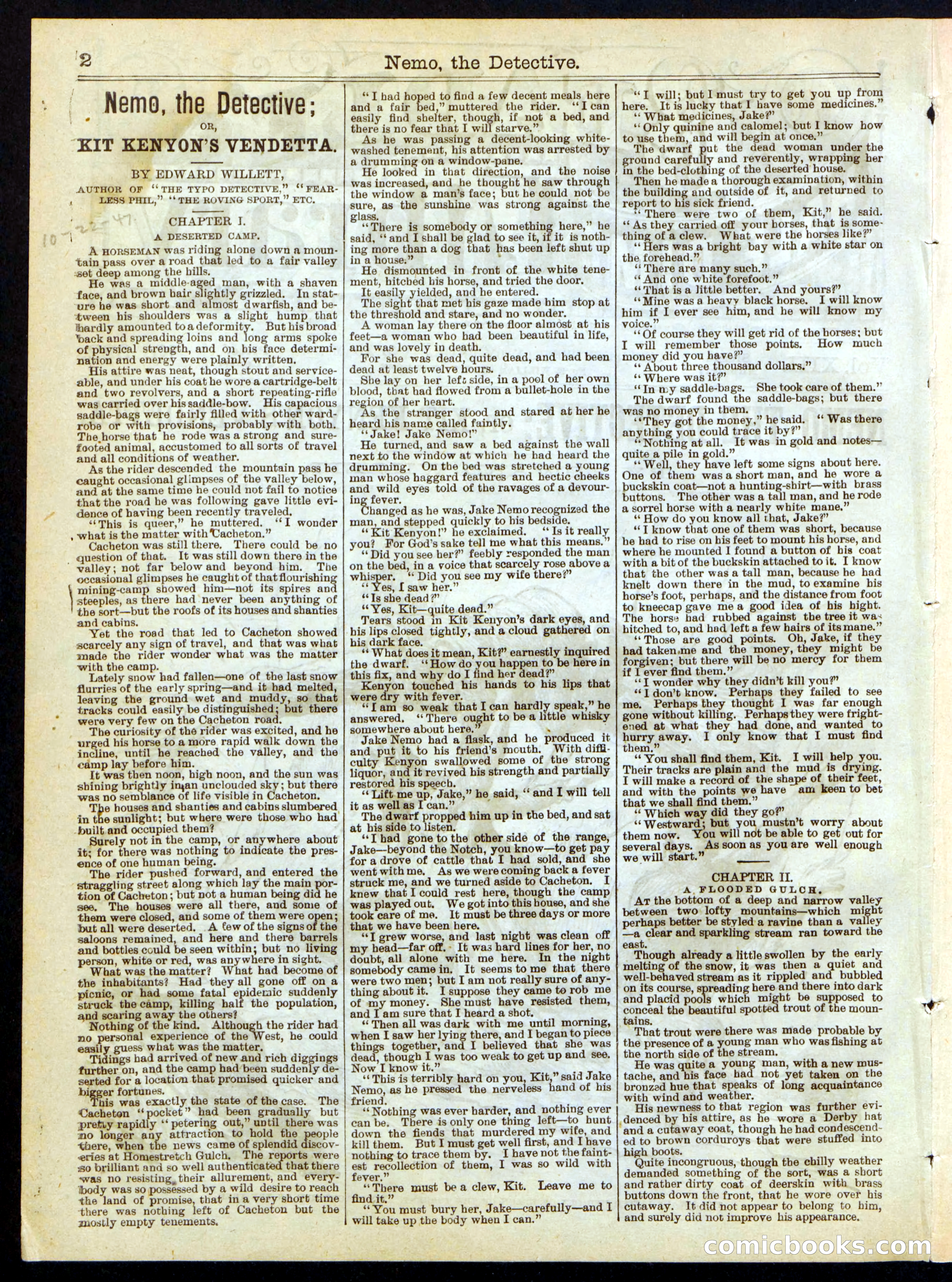
A restored page from Pulp Fiction, 1883. Page through the whole issue in the reader above.
📄 Transcribed text from this page (OCR, searchable)
Machine-transcribed from the original scan — historical spelling and the odd misread are preserved.
rh 1V __ Nemo, the Detective; a OR, ‘KIT KENYON’S VENDETTA. BY EDWARD WILLETT, AUTHOR OF ‘‘ THE TYPO DETECTIVE,” ‘‘ FEAR- S PHIL,” ** THE ROVING SPORT,” ETC, mY CHAPTER I. a | ‘ ; A DESERTED CAMP, A HORSEMAN was riding alone down a moun- tain pass over a road that led to a fair valley set deep among the bills. He was a middle-aged man, with a shaven face, and brown bair slightly grizzled. In stat- ‘ure he was short and almost dwarfish, and be- tween his shoulders was a slight hump that hardly amounted toadeformity. But his broad ‘back and spreading loins and iene arms spoke of physical strength, and on bis face determi- nation and energy were plainly written, His attire was neat, though stout and service- able, and under his coat he wore a cartridge-belt and two revolvers, and a short repeating-rifle was carried over hissaddle-bow. His capacious saddle-bags were fairly filled with other ward- robe or with provisions, probably with both. The horse that he rode was a strong and sure- footed animal, accustomed to all sorts of travel and all conditions of weather. As the rider descended the mountain pass he caught occasional glimpses of the valley below, and at the same time he could not fail to notice that the road he was following gave little evi- _~ dence of having been recently traveled, ‘This is queer,” he muttered. ‘‘I wonder . what is the matter with Cacheton.” _ question of that. Cacheton was still there. There could be no It was still down there in the valley; not far belowand beyond him. The occasional glimpses he caught of that flourishing mining-camp showed him—not its spires and steeples, as there had never been anything of the sort—but the roofs of its houses and shanties and cabins. Yet the road that led to Cacheton showed scarcely any sign of travel, and that was what made the rider wonder what was the matter with the camp. Lately snow had fallen—one of the last snow flurries of the early spring—and it had melted, leaving the ground wet and muddy, so that tracks could easily be distinguished; but there were very few on the Cacheton road, The curiosity of the rider was excited, and he urged his horse to a more rapid walk down the incline, until he reached the valley, and the camp lay before him. It was then noon, high noon, and the sun was shining brightly ingan unclouded sky; but there was no semblance of life visible in Cacheton. The houses and shanties and cabins slumbered in the sunlight; but where were those who had _built.and occupied them? rely not in the camp, or anywhere about it; for there was nothing to indicate the pres- ence of one human being. The rider pushed forward, and entered the ‘straggling street along which lay the main Ee e tion of Cacheton; but not a human being di see. The houses were all there, and some of them were closed, and some of them were open; but all were deserted. A few of the signs of the saloons remained, and here and there barrels and bottles could be seen within; but no living rson, white or red, was anywhere in sight. What was the matter? What had become of the inhabitants? Had they all gone off on a picnic, or had some fatal epidemic suddenly struck the camp, killing half the population, and — ‘ing away the others? Nothing of the kind. Although the rider had no personal experience of the West, he could easily guess what was the matter. Tidings had arrived of new and rich diggings further on, and the camp had been suddenly de- ‘ted for a location that promised quicker and bigger fortunes. This was exactly the state of thecase. The Cacheton srg * had been gradually but pretiy rapidly ‘* petering out,” until there was mo longer any attraction to hold the ple there, when the news came of splendid Peay. eries at Homestretch Gulch, The reports were so brilliant and so well authenticated that there was no resisting, their allurement, and every- body was so possessed by a wild desire to reach the land of promise, that in a very short time there was nothing left of Cacheton but the mostly empty tenements, Wemo, the Detective. —_—- + om. ee ee **T had hoped to find a few decent meals here and a fair bed,” muttered the rider. ‘‘I can easily find shelter, though, if not a bed, and there is no fear that I will starve.” As he was passing a decent-looking white- washed tenement, his attention was arrested by a drumming on a window-pane. He looked in that direction, and the noise was increased, and he thought he saw through the window a man’s face; but he could not be nein as the sunshine was strong against the glass, ‘‘There is somebody or something here,” he said, ** and I shall be glad to see if, if it is noth- ing more than a dog that has been left shut up in a house,” . He dismounted in front of the white tene- ment, hitcbed his horse, and tried the door. It easily yielded, and he entered. The sight that met his gaze made bim stop at the threshold and stare, and no wonder. A woman lay there on the floor almost at his feet—a woman who had been beautiful in life, and was lovely in death. For she was dead, quite dead, and had been dead at least twelve hours. She lay on her lefs side, in a pool of her own blood, that had flowed from a bullet-hole in the region of her beart. As the stranger stood and stared at her he heard his name called faintly. ‘* Jake! Jake Nemo!” He turned, and saw a bed against the wall next to the window at which he had heard the drumming. On the bed was stretched a young man whose haggard features and hectic cheeks and wild eyes told of the ravages of a devour- ing. fever. hanged as he was, Jake Nemo recognized the man, and stepped quickly to his bedside. ‘Kit Kenyon!” he exclaimed. ‘Is it really you? For God’s sake tell me what this means.” ‘Did you see her?’ feebly responded the man on the bed, in a voice that scarcely rose above a whisper. ‘ Did you see my wife there?” ‘** Yes, [ saw her.” **Ts she dead?” “Yes, Kit—quite dead.” Tears stood in Kit Kenyon’s dark eyes, and his lips closed tightly, and a cloud gathered on his dark face. ‘¢ What does it mean, Kit?’ earnestly inquired the dwarf. ‘‘Howdo you pepeen to be here in this fix, and why do I find her dead?” Kenyon touched his hands to his lips that were dry with fever. ‘‘fam so weak that I can hardly speak,” he answered, ‘‘ There ought to be a little whisky somewhere about here,’ . ; Jake Nemo had a flask, and he produced it and put it to his friend’s mouth. With difli- culty Kenyon swallowed some of the strong liquor, and it revived his strength and partially restored his speech. ‘‘ Lift. me up, Jake,” he said, ‘‘ and I will tell it as well as I can.” The dwarf propped him up in the bed, and sat at his side to listen. ‘‘T bad gone to the other side of the range, Jake—beyond the Notch, you know—to get pay for a drove of cattle that I had sold, and she went withme, As we werecoming back a fever struck me, and we turned aside to Cacheton. I knew that I could rest here, though the camp was played out. We got into this house, and she took care of me. It must be three days or more that we have been here. ‘“‘T grew worse, and last night was clean off my head—far off. It was hard lines for her, no doubt, all alone with me here. In the night somebody camein, It seems to me that there were two men; but I am not really sure of any- thing about it. I suppose they came to rob me of my money. She must have resisted them, and I am sure that I heard a shot. “Then all was dark with me until morning, when I saw her lying there, and I began to piece things together, and I believed that she was dead, though I was too weak to get up and see, Now I know it.” : ‘his is terribly hard on you, Kit,” said Jake Nemo, as he pressed the nerveless hand of his friend. ‘‘ Nothing was ever harder, and nothing ever can be. There is only one thing left—to hunt down the fiends that murdered my wife, and killthem. But I must get well first, and I have nothing to trace them by. I have not the faint- est recollection of them, I was so wild with fever.” “There must be a clew, Kit. find it,” Leave me to ‘You must bury her, Jake—carefully—and I | cutaway. will take up the body when I can.” “T will; but I must try to get you up from here. It is lucky that I have some medicines.” ‘‘ What medicines, Jake?” ‘Only quinine and calomel; but I know how to use them, and will begin at once.” The dwarf put the dead woman under the round tagttully and reverently, wrapping her in the bed-clothing of the deserted house. Then he madea thorough examination, within the building and outside of it, and returned to report to his sick friend. ‘‘ There were two of them, Kit,” he said. ‘‘ As they carried off your borses, that is some- be. of aclew. What were the horses like?’ ‘‘Hers was a bright bay with a white star on the forehead.” ‘There are many such.” ‘¢ And one white forefoot.” ‘That is a little better. And yours?” ‘¢Mine was a heavy black horse. I will know him if I ever see him, and he will know my voice.” ‘‘Of course they will get rid of the horses; but I will remember those points. How much money did you have?” ‘¢ About three thousand dollars.” ‘Where was it?’ ‘‘In my saddle-bags. She took care of them.” The dwarf found the saddle-bags; but there was no money in them. ‘‘They got the money,” hesaid, ‘‘ Was there anything you could trace it by?” “Nothing at all. It was in gold and notes— quite a pile in gold.” ‘Well, they have left some signs about here. One of them wasa short man, and he wore a buckskin coat—not a hunting-shirt—with brass buttons. The other was a tall man, and he rode a sorrel horse with a nearly white mane,” ‘‘ How do you know all that, Jake?” ‘‘T know that one of them was short, because be had to rise on his feet to mount his horse, and where he mounted I found a button of bis coat with a bit of the buckskin attached to it. I know that the other was a tall man, because he had knelt down there in the mud, to examine his horse’s foot, perhaps, and the distance from foot to kneecap gave mea good idea of his hight. The horse bad rubbed against the tree it wa- hitched to, and had left a few hairs of its mane.” ‘‘Those are good points. Oh, Jake, if they had taken.me and the money, they might be forgiven; but there will be no mercy for them if 1 ever find them.” ‘‘T wonder why they didn’t kill you?” ‘¢] don’t know. Perhaps they failed to see me. Perhaps they thought I was far enough gone without killing. Perhaps they were fright- ened at what they had done, and wanted to hurry away. I only know that I must find them.’ ‘‘- You shall find them, Kit. I will help you. Their tracks are plain and the mud is drying. I will make a record of the shape of their feet, and with the points we have am keen to bet that we shall find them.” ‘‘ Which way did they go?” ‘‘Westward; but you mustn’t worry about them now. You will not be able to get out for several days. Assoon as youare well enough we will start.” or veel CHAPTER II. A FLOODED GULCR, At the bottom of a deep and narrow valley between two lofty mountains—which might perhaps better be styled a ravine than a valley ec me and sparkling stream ran toward the east. Though already a littleswollen by the early melting of the snow, it was then a quiet and well-behaved stream as it rippled and bubbled on its course, spreading here and there into dark and placid Booth which might be supposed to aa the beautiful spotted trout of the moun- ins, That trout were there was made probable by the presence of a young man who was fishing at the north side of the stream. He was quite a young man, with a new mus- tache, and his face had not yet taken on the bronzed hue that speaks of long acquaintance with wind and weather. His newness to that region was further ev1- denced by his attire, as he wore a Derby hat and a cutaway coat, though he had condescend- ed to brown corduroys that were stuffed into high boots. Quite incongruous, though the chilly weather demanded something of the sort, was a short and rather dirty coat of deerskin with brass buttons down the front, that he wore over his It did not appear to belong to him, and surely did not improve his appearance, COMIC S ,00