
Pulp Fiction, 1878 · page 13 of 20
Beadle's Half Dime Library No. 32 — page 13: what you’re looking at
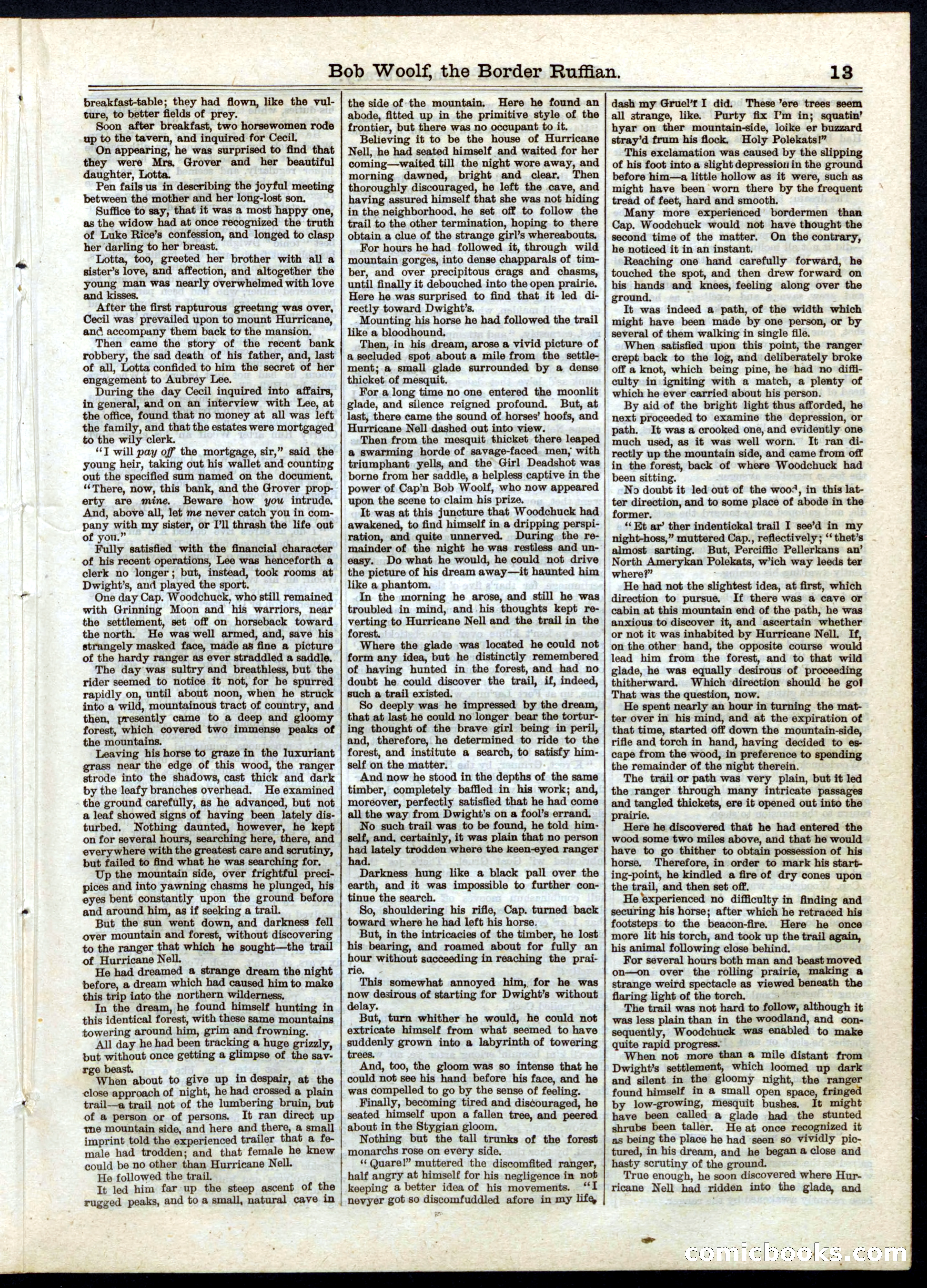
A restored page from Pulp Fiction, 1878. Page through the whole issue in the reader above.
📄 Transcribed text from this page (OCR, searchable)
Machine-transcribed from the original scan — historical spelling and the odd misread are preserved.
Bob Woolf, the Border Ruffian. 13 breakfast-table; they had flown, like the vul- ture, to better fields of prey. Soon after breakfast, two horsewomen rode up to the tavern, and inquired for Cecil. On appearing, he was surprised to find that they were Mrs, Grover and her beautiful daughter, Lotta. Pen fails us in describing the joyful meeting between the mother and her long-lost son. Suffice to say, that it was a most happy one, as the widow had at once recognized the truth of Luke Rice’s confession, and longed to clasp her darling to her breast. Lotta, too, greeted her brother with all a sister’s love, and affection, and altogether the young man was nearly overwhelmed with love and kisses. After the first rapturous greeting was over, Cecil was prevailed upon to mount Hurricane, and accompany them back to the mansion. Then came the story of the recent bank robbery, the sad death of his father, and, last of all, Lotta confided to him the secret of her engagement to Aubrey Lee. During the day Cecil inquired into affairs, in general, and on an interview with Lee, at the office, found that no money at all was left the family, and that the estates were mortgaged to the wily clerk. ““T will pay off the mortgage, sir,” said the young heir, taking out his wallet and counting out the specified sum named on the document, “There, now, this bank, and the Grover prop- erty are mine. Beware how yow intrude, And, above all, let me never catch you in com- pany with my sister, or I’ll thrash the life out of you.” Fully satisfied with the financial character of his recent operations, Lee was henceforth a clerk no longer; but, instead, took rooms at Dwight’s, and played the sport. One day Cap. Woodchuck, who still remained with Grinning Moon and his warriors, near the settlement, set off on horseback toward the north. He was well armed, and, save his strangely masked face, made as fine a picture of the hardy ranger as ever straddled a saddle, The day was sultry and breathless, but the rider seemed to notice it not, for he spurred rapidly on, until about noon, when he struck into a wild, mountainous tract of country, and then, presently came to a deep and gloomy forest, which covered two immense peaks of the mountains. Leaving his horse to graze in the luxuriant grass near the edge of this wood, the ranger strode into the shadows, cast thick and dark by the leafy branches overhead, He examined the ground carefully, as he advanced, but not a leaf showed signs of having been lately dis- turbed. Nothing daunted, however, he kept on for several hours, searching here, there, and every where with the greatest care and scrutiny, but failed to find what he was searching for. Up the mountain side, over frightful preci- pices and into yawning chasms he plunged, his eyes bent constantly upon the ground before and around him, as if seeking a trail. But the sun went down, and darkness fell over mountain and forest, without discovering to the ranger that which he sought—the trail of Hurricane Nell. He had dreamed a strange dream the night before, a dream which had caused him to make this trip iato the northern wilderness, In the he found himself hunting in this identical forest, with these same mountains towering around him, grim and frowning. All day he had been tracking a huge grizzly, but without once getting a glimpse of the sav- rge beast. When about to give up in despair, at the close approach of night, he had crossed a plain trail—a trail not of the lumbering bruin, but of a person or of persons. It ran direct up tne mountain side, and here and there, a small imprint told the experienced trailer that a fe- male had trodden; and that female he knew could be no other than Hurricane Nell. He followed the trail. It led him far up the steep ascent of the rugged peaks, and to a small, natural cave in the side of the mountain. Here he found an abode, fitted up in the primitive style of the frontier, but there was no occupant to it. Believing it to be the house of Hurricane Nell, he had seated himself and waited for her coming—waited till the night wore away, and morning dawned, bright and clear, Then thoroughly discouraged, he left the cave, and having assured himself that she was not hiding in the neighborhood, he set off to follow the trail to the other termination, hoping to there obtain a clue of the strange girl’s whereabouts, For hours he had followed it, through wild mountain gorges, into dense chapparals of tim- ber, and over precipitous crags and chasms, until finally it debouched into the open prairie. Here he was surprised to find that it led di- rectly toward Dwight’s. Mounting his horse he had followed the trail like a bloodhound, Then, in his dream, arose a vivid picture of a secluded spot about a mile from the settle- ment; a small glade surrounded by a dense thicket of mesquit. For a long time no one entered the moonlit glade, and silence reigned profound. But, at last, there came the sound of horses’ hoofs, and Hurricane Nell dashed out into view. Then from the mesquit thicket there leaped a swarming horde of savage-faced men, with triumphant yells, and the Girl Deadshot was borne from her saddle, a helpless captive in the power of Cap’n Bob Woolf, who now appeared upon the scene to claim his prize. It was at this juncture that Woodchuck had awakened, to find himself in a dripping perspi- ration, and quite unnerved. During the re- mainder of the night he was restless and un- easy. Do what he would, he could not drive the picture of his dream away—it haunted him like a phantom. In the morning he arose, and still he was troubled in mind, and his thoughts kept re- verting to Hurricane Nell and the trail in the forest. Where the glade was located he could not form any idea, but he distinctly remembered of having hunted in the forest, and had no doubt he could discover the trail, if, indeed, such a trail existed. So deeply was he impressed by the dream, that at last he could no longer bear the tortur- ing thought of the brave girl being in peril, and, therefore, he determined to ride to the forest, and institute a search, to satisfy him- self on the matter. And now he stood in the depths of the same timber, completely baffled in his work; and, moreover, perfectly satisfied that he had come all the way from Dwight’s on a fool’s errand. No such trail was to be found, he told him- self, and, certainly, it was plain that no person had lately trodden where the keen-eyed ranger had. Darkness hung like a black pall over the earth, and it was impossible to further con- tinue the search. So, shouldering his rifle, Cap. turned back toward where he had left his horse. But, in the intricacies of the timber, he lost his bearing, and roamed about for fully an i without succeeding in reaching the prai- e, This somewhat annoyed him, for he was —_ desirous of starting for Dwight’s without delay. But, turn whither he would, he could not extricate himself from what seemed to have suddenly grown into a labyrinth of towering trees. And, too, the gloom was so intense that he could not see his hand before his face, and he was compelled to go by the sense of feeling. Finally, becoming tired and discouraged, he seated himself upon a fallen tree, and peered about in the Stygian gloom. Nothing but the tall trunks of the forest monarchs rose on every side. ‘‘ Quare!” muttered the discomfited ranger, half angry at himself for his negligence in not keeping a better idea of his movements. “I nevyer got so discomfuddled afore in my lifg dash my Gruel’t I did. These ’ere trees seem all strange, like. Purty fix I’m in; squatin’ hyar on ther mountain-side, loike er buzzard stray’d frum his flock, Holy Polekats!” This exclamation was caused by the slipping of his foot into a slight depression in the ground before him—a little hollow as it were, such as might have been worn there by the frequent tread of feet, hard and smooth. Many more experienced bordermen than Cap. Woodchuck would not have thought the second time of the matter. On the contrary, he noticed it in an instant. Reaching one hand carefully forward, he touched the spot, and then drew forward on his hands and knees, feeling along over the ground. It was indeed a path, of the width which might have been made by one person, or by several of them walking in single file. When satisfied upon this point, the ranger crept back to the log, and deliberately broke off a knot, which being pine, he had no diffi- culty in igniting with a match, a plenty of which he ever carried about his person. By aid of the bright light thus afforded, he next proceeded to examine the depression, or path. It was a crooked one, and evidently one much used, as it was well worn. It ran di- rectly up the mountain side, and came from off in the forest, back of where Woodchuck had been sitting. No doubt it led out of the woo:, in this lat- ter direction, and to some place of abode in the former. ‘‘ Et ar’ ther indentickal trail I see’d in my night-hoss,” muttered Cap., reflectively; “‘ thet’s almost sarting. But, Perciffic Pellerkans an’ North Amerykan Polekats, w’ich way leeds ter where?” : He had not the slightest idea, at first, which direction to pursue, If there was a cave or cabin at this mountain end of the path, he was anxious to discover it, and ascertain whether or not it was inhabited by Hurricane Nell. If, on the other hand, the opposite course would lead him from the forest, and to that wild glade, he was equally desirous of proceeding thitherward. Which direction should he gof That was the question, now. He spent nearly an hour in turning the mat- ter over in his mind, and at the expiration of that time, started off down the mountain-side, rifle and torch in hand, having decided to es- cape from the wood, in preference to spending the remainder of the night therein. The trail or path was very plain, but it led the ranger through many intricate passages and tangled thickets, ere it opened out into the prairie. Here he discovered that he had entered the wood some two miles above, and that he would have to go thither to obtain possession of his horse. Therefore, in order to mark his start- ing-point, he kindled a fire of dry cones upon the trail, and then set off. He experienced no difficulty in finding and securing his horse; after which he retraced his footsteps to the beacon-fire. Here he once more lit his torch, and took up the trail again, his animal following close behind. For several hours both man and beast moved on—on over the rolling prairie, making a strange weird spectacle as viewed beneath the flaring light of the torch. The trail was not hard to follow, although it was less plain than in the woodland, and con- sequently, Woodchuck was enabled to make quite rapid progress. When not more than a mile distant from Dwight’s settlement, which loomed up dark and silent in the gloomy night, the ranger found himself in a small open space, fr by low-growing, mesquit bushes. It might have been called a glade had the stunted shrubs been taller. He at once recognized it as being the place he had seen so vividly pic- tured, in his dream, and he began a close and hasty scrutiny of the ground. True enough, he soon discovered where Hur- ricane Nell had ridden into the glade, and 0)(0)(0) com C S (E(0)