
Pulp Fiction, 1878 · page 11 of 20
Beadle's Half Dime Library No. 32 — page 11: what you’re looking at
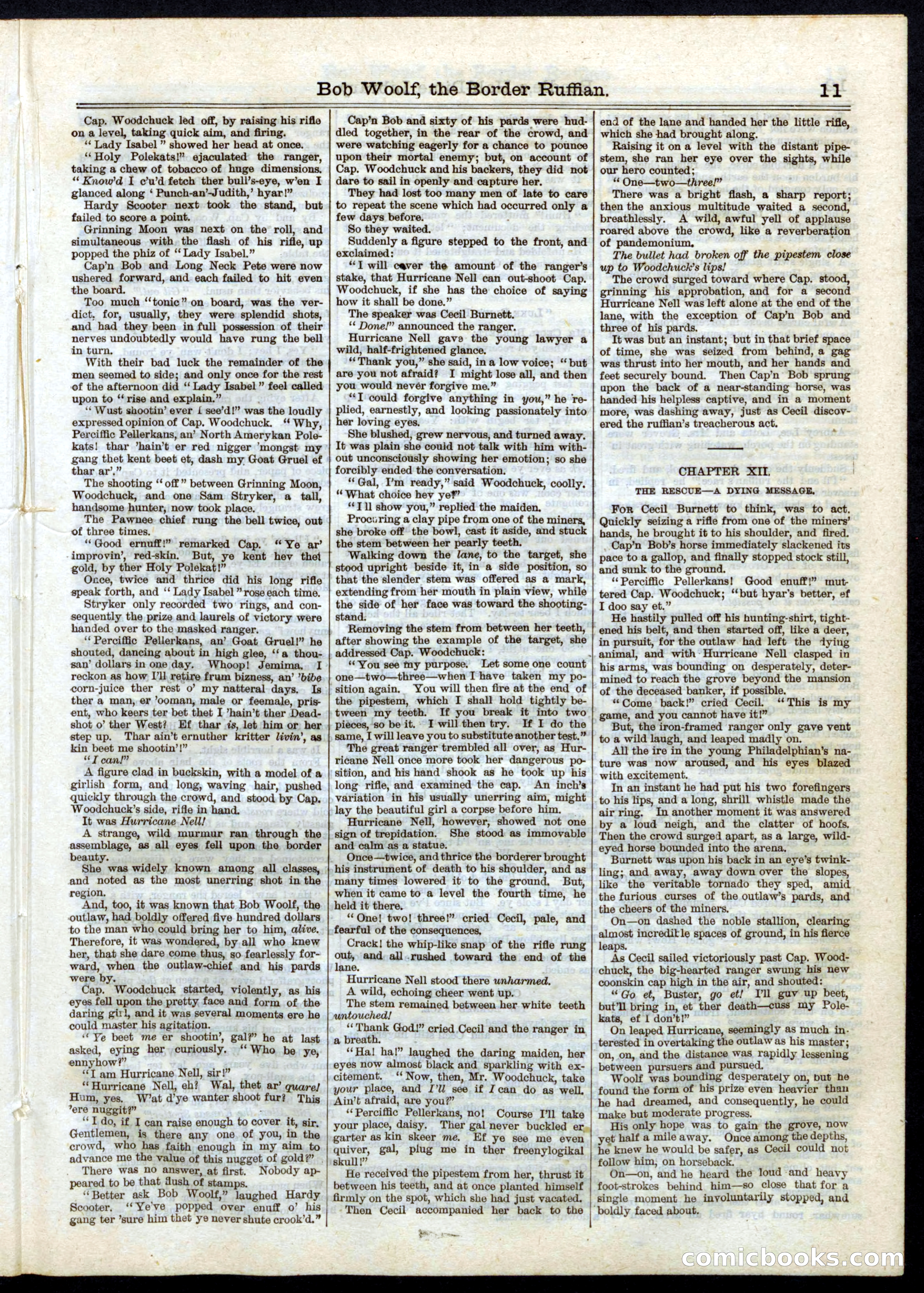
A restored page from Pulp Fiction, 1878. Page through the whole issue in the reader above.
📄 Transcribed text from this page (OCR, searchable)
Machine-transcribed from the original scan — historical spelling and the odd misread are preserved.
- Bob Woolf, the Border Ruffian. Ti Cap. Woodchuck led off, by raising his rifle on a level, taking quick aim, and firing. “ Lady Isabel ” showed her head at once. ‘Holy Polekats!” ejaculated the ranger, taking a chew of tobacco of huge dimensions, ‘* Know’d I ec’u’d fetch ther bull’s-eye, w’en I glanced along ‘ Punch-an’-Judith,’ hyar!” Hardy Scooter next took the stand, but failed to score a point. Grinning Moon was next on the roll, and simultaneous with the flash of his rifle, up popped the phiz of ‘‘ Lady Isabel.” Cap’n Bob and Long Neck Pete were now ushered forward, and each failed to hit even the board. Too much “tonic” on board, was the ver- dict, for, usually, they were splendid shots, and had they been in full possession of their nerves undoubtedly would have rung the bell in turn, With their bad luck the remainder of the men seemed to side; and only once for the rest of the afternoon did ‘‘ Lady Isabel” feel called upon to “rise and explain.” ‘* Wust shootin’ ever { see’d!” was the loudly expressed opinion of Cap. Woodchuck. ‘ Why, Perciffic Pellerkans, an’ North Amerykan Pole- kats! thar ’hain’t er red nigger ’mongst my gang thet kent beet et, dash my Goat Gruel ef thar ar’,” The shooting “‘ off” between Grinning Moon, Woodchuck, and one Sam Stryker, a tall, handsome hunter, now took place. The Pawnee chief rung the bell twice, out of three times. “Good ernuff!” remarked Cap. ‘“ Ye ar’ improvin’, red-skin. But, ye kent hev thei gold, by ther Holy Polekat!” Once, twice and thrice did his long rifle speak forth, and ‘‘ Lady Isabel ” rose each time. Stryker only recorded two rings, and con- sequently the prize and laurels of victory were handed over to the masked ranger. ‘‘ Perciffic Pellerkans, an’ Goat Gruel!” he shouted, dancing about in high glee, ‘‘a thou- san’ dollars in one day. Whoop! Jemima, I reckon as how Ill retire frum bizness, an’ ’bibe corn-juice ther rest o’ my natteral days, Is ther a man, er ’ooman, male or feemale, pris- ent, who keers ter bet thet I ’hain’t ther Dead- shot o’ ther West? Ef thar ds, let him or her step up. Thar ain’t ernuther kritter livin’, as kin beet me shootin’!” ‘ec ps can ,? A figure clad in buckskin, with a model of a girlish form, and long, waving hair, pushed quickly through the crowd, and stood by Cap. W oodchuck’s side, rifle in hand. It was Hurricane Nell! A strange, wild murmur ran through the assemblage, as all eyes fell upon the border beauty. She was widely known among all classes, and noted as the most unerring shot in the region, And, too, it was known that Bob Woolf, the outlaw, had boldly offered five hundred dollars to the man who could bring her to him, alive. Therefore, it was wondered, by all who knew her, that she dare come thus, so. fearlessly for- ward, when the outlaw-chief and his pards were by. Cap. Woodchuck started, violently, as his eyes fell upon the pretty face and form of the daring girl, and it was several moments ere he could master his agitation. ‘“Ve beet me er shootin’, gal?’ he at last asked, eying her curiously. ‘Who be ye, ennyhow?” ‘“‘T am Hurricane Nell, sir!” “Hurricane Nell, eh? Wal, thet ar’ quare/ Hum, yes, W’at d’ye wanter shoot fur? This ere nuggit?” ‘I do, if I can raise enough to cover it, sir, Gentlemen, is there any one of you, in the crowd, who has faith enough in my aim to advance me the value of this nugget of gold?” . There was nO answer, at first. Nobody ap- peared to be that dush of stamps. “Better ask Bob Woolf,” laughed Hardy Scooter, ‘‘Ye’ve popped over enuff o’ his gang ter ’sure him thet ye never shute crook’d.” Cap’n Bob and sixty of his pards were hud- dled together, in the rear of the crowd, and were watching eagerly for a chance to pounce upon their mortal enemy; but, on account of Cap. Woodchuck and his backers, they did not dare to sail in openly and capture her. They had lost too many men of late to care to repeat the scene which had occurred only a few days before. So they waited. Suddenly a figure stepped to the front, and exclaimed: | “1 will caver the amount of the ranger’s stake, that Hurricane Nell can out-shoot Cap. Woodchuck, if she has the choice of saying how it shall be done.” The speaker was Cecil Burnett. ‘* Done!” announced the ranger. Hurricane Nell gave the young lawyer a wild, half-frightened glance. **Thank you,” she said, ina low voice; “ but are you not afraid? I might lose all, and then you would nevér forgive me.” “T could forgive anything in you,” he re- plied, earnestly, and looking passionately into her loving eyes. She blushed, grew nervous, and turned away. It was plain she could not talk with him with- out unconsciously showing her emotion; so she forcibly ended the conversation. “Gal, I’m ready,” said Woodchuck, coolly, What choice hey ye?’ **T ll show you,” replied the maiden, Procuring a clay pipe from one of the miners, she broke off the bowl, cast it aside, and stuck the stem between her pearly teeth. Walking down the lane, to the target, she stood upright beside it, in a side position, so that the slender stem was offered as a mark, extending from her mouth in plain view, while the side of her face was toward the shooting- stand. Removing the stem from between her teeth, after showing the example of the target, she addressed Cap. Woodchuck: ‘You see my purpose, Let some one count one—two—three—when I have taken my po- sition again. You will then fire at the end of the pipestem, which I shall hold tightly be- tween my teeth. If you break it into two pieces, so be it. I will then try. If I do the same, I will leave you to substitute another test.” The great ranger trembled all over, as Hur- ricane Nell once more took her dangerous po- sition, and his hand shook as he took up his long rifle, and examined the cap. An inch’s variation in his usually unerring aim, might lay the beautiful girl a corpse before him, Hurricane Nell, however, showed not one sign of trepidation. She stood as immovable and calm as a statue. Once—twice, and thrice the borderer brought his instrument of death to his shoulder, and as many times lowered it to the ground, But, when it came to a level the fourth time, he held it there. “One! two! three!” cried Cecil, pale, and fearful of the consequences, Crack! the whip-like snap of the rifle rung i and all .rushed toward the end of the ane. Hurricane Nell stood there unharmed. A wild, echoing cheer went up. The stem remained between her white teeth untouched! “Thank God!” cried Cecil and the ranger in a breath. ‘“‘Hal hal” laughed the daring maiden, her eyes now almost black and sparkling with ex- citement. ‘ Now, then, Mr. Woodchuck, take your place, and I’ll see if Ican do as well. Ain’t afraid, are you?” ‘‘Perciffic Pellerkans, no! Course I'll take your place, daisy, Ther gal never buckled e garter as kin skeer me. Ef ye see me even quiver, gal, plug me in ther freenylogik skull!” ; He received the pipestem from her, thrust it between his teeth, and at once planted himself firmly on the spot, which she had just vacated. -Then Cecil accompanied her back to the end of the lane and handed her the little rifle, which she had brought along. Raising it on a level with the distant pipe- stem, she ran her eye over the sights, while our hero counted; “* One—two—three!” There was a bright flash, a sharp report; then the anxious multitude waited a second, breathlessly. A wild, awful yell of applause roared above the crowd, like a reverberation of pandemonium, The bullet had broken off the pipestem close up to Woodchuck’s lips! The crowd surged toward where Cap. stood, grinning his approbation, and for a second Hurricane Nell was left alone at the end of the lane, with the exception of Cap’n Bob and three of his pards. It was but an instant; but in that brief space of time, she was seized from behind, a gag was thrust into her mouth, and her hands and feet securely bound. Then Cap’n Bob sprung upon the back of a near-standing horse, was handed his helpless captive, and in a moment more, was dashing away, just as Cecil discov- ered the ruffian’s treacherous act. c CHAPTER XII, | THE RESCUE—A DYING MESSAGE, For Cecil Burnett to think, was to act. Quickly seizing a rifle from one of the miners’ hands, he brought it to his shoulder, and fired. Cap’n Bob’s horse immediately slackened its pace to a gallop, and finally stopped stock still, and sunk to the ground. ‘‘Perciffic Pellerkans! Good enuff!” mut- tered Cap. Woodchuck; “but hyar's better, ef I doo say et.” He hastily pulled off his hunting-shirt, tight- ened his belt, and then started off, like a deer, in pursuit, for the outlaw had left the dying |. animal, and with: Hurricane Nell clasped in his arms, was bounding on desperately, deter- mined to reach the grove beyond the mansion of the deceased banker, if possible. “Come back!” cried Cecil. “This is my game, and you cannot have it!” But, the iron-framed ranger only gave vent to a wild laugh, and leaped madly on. All the ire in the young Philadelphian’s na- ture was now aroused, and his eyes blazed with excitement. In an instant he had put his two forefingers to his lips, and a long, shrill whistle made the air ring. In another moment it was answered by a loud neigh, and the clatter of hoofs, Then the crowd surged apart, as a large, wild- eyed horse bounded into the arena, Burnett was upon his back in an eye’s twink- ling; and away, away down over the slopes, like the veritable tornado they sped, amid the furious curses of the outlaw’s pards, and the cheers of the miners, On—on dashed the noble stallion, clearing almost increditle spaces of ground, in his fierce leaps. As Cecil sailed victoriously past Cap. Wood- chuck, the big-hearted ranger swung his new coonskin cap high in the air, and shouted: | “Go et, Buster, go et! Ill guv up beet, but’ll bring in, et ther death—cuss my Pole- kats, ef I don’t!” On leaped Hurricane, seemingly as much in. terested in overtaking the outlaw as his master; on, on, and the distance was rapidly lessening between pursuers and pursued, Woolf was bounding desperately on, but he found the form of his prize even heavier than he had dreamed, and consequently, he could make but moderate progress. His only hope was to gain the grove, now yet half a mileaway. Once among the depths, he knew he would be safer, as Cecil could not follow him, on horseback. On—on, and he heard the loud and heavy foot-strokes behind him—so close that for a single moment he involuntarily stopped, and ‘boldly faced about. “EOMIcbOoks, col