
Pulp Fiction, 1883 · page 2 of 16
Beadle's Half Dime Library, No. 284 — page 2: what you’re looking at
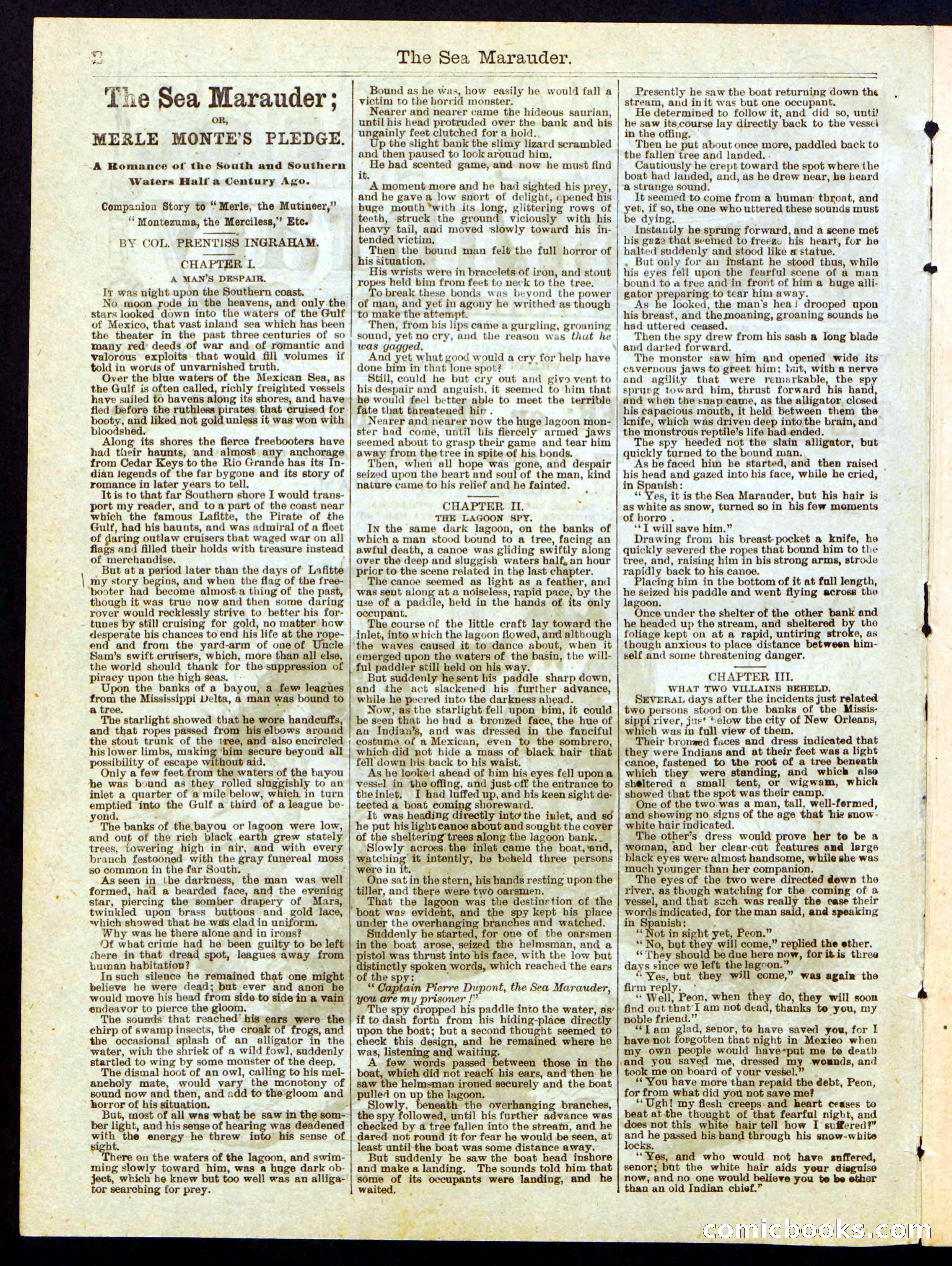
A restored page from Pulp Fiction, 1883. Page through the whole issue in the reader above.
📄 Transcribed text from this page (OCR, searchable)
Machine-transcribed from the original scan — historical spelling and the odd misread are preserved.
—_—_ ‘The Sea Marauder; OR, MERLE MONTE’S PLEDGE. A KBomance of the South and Southern Waters Half a Century Ago. Companion Story to “Merle, the Mutineer,”’ ‘‘ Montezuma, the Merciless,” Etc. BY COL. PRENTISS INGRAHAM. CHAPTER I. A MAN’S DESPAIR. It was night upon the Southern coast. ~ No moon rode in the heavens, and only the stars looked down into the waters of the Gulf of Mexico, that vast inland sea which has been the theater in the past three centuries of so! many red’ deeds of war and of romantic and valorous exploits that would fill volumes if told in words of unvarnished truth. Over the blue waters of the Mexican Sea, as the Gulf is often called, richly freighted vessels have sailed to havens along its shores, and have fled before the ruthless pirates that cruised for booty, and liked not gold unless it was won with bloodshed. Along its shores the fierce freebooters have had their haunts, and almost any anchorage from Cedar Keys to the Rio Grande has its In- dian legends of the far bygone and its story of romance in later years to tell. It is to that far Southern shore I would trans- port my reader, and toa part of the coast near which the famous Lafitte, the Pirate of the Gulf, had his haunts, and was admiral of a fleet of daring outlaw cruisers that waged war on all flags and filled their holds with treasure instead of merchandise. But at a period later than the days of Lafitte my story begins, and when the flag of the free- ‘booter had become almost a thing of the past, though if was true now and then some daring rover would recklessly strive to better his for- tunes by still cruising for gold, no matter how desperate his chances to end his life at the rope- end and from the yard-arm of oneof Uncle Sam’s swift cruisers, which, more than all else, the world should thank for the suppression of piracy upon the high seas. 2 Upon the banks of a bayou, a few leagues from the Mississippi Velta, a man was bound to a tree. ; The starlight showed that he wore handcuffs and that ropes passed from his elbows aroun the stout trunk of the tee, and also encircled his lower limbs, making ‘him secure beyond all possibility of escape without aid. Only a few feet. from the waters of the bayou he was bound as they rolled sluggishly to an inlet a quarter of a mile below, which in turn emptied into the Gulf a third of a league be- ond, ; The banks of the. bayou or lagoon were low, and out of the rich black earth grew stately trees, towering high in air, and with every branch festooned with the gray funereal moss so common in the far South. | As seen in tbe darkness, the man was well formed, had a bearded face, and the evening star, piercing the somber drapery of Mars, twinkled upon brass buttons and gold lace, which showed that be was clad in uniform. Why was he there alone and in irons? Ot what criale had he been guilty to be left chere in that dread spot, leagues away from buman habitation? In such silence he remained that one might believe he were dead; but ever and anon he would move his head from side to side ina vain endeavor to pierce the gloom. ae The sounds that reached’ his ears were the chirp of swamp insects, the croak of frogs, and the occasional splash of an alligator in the water, with the shriek of a wild fowl, suddenly startled to wing by some monster of the deep. The dismal hoot of an owl, calling to his mel- aneholy mate, would vary the monotony of sound now and then, and add to the gloom and horror of his situation. But, most of all was what he saw in the som- was deadened ber light, and his sense of hearin his sense of with the energy he threw ino sight. | There on the waters of the lagoon, and swim- ming slowly toward him, was a huge dark ob- ject, which he knew but too well was an alliga- tor searching for prey. The Sea Marauder. Bound as he was, how easily he would fall a victim to the horrid monster. Nearer and nearer came the hideous saurian, until his head protruded over the bank and bis ungainly feet clutched for a hold. Up the slight bank the slimy lizard scrambled and then paused to look around him. He had scented game, and now he must find it. A moment more and he had sighted his prey, and he gave a low snort of delight, opened his buge mouth “with its long, glittering rows of teeth, struck the ground viciously with his heavy tail, and moved slowly toward his in- tended victim. Then the bound man felt the full horror of his situation. His wrists were in bracelets of iron, and stout s held bim from feet to neck to the tree. o break these bonds was beyond the power of man, and yet in agony he writhed as though to make the attempt. Then, from bis lips came a gurgling, groaning ro sound, yet no cry, and the reason was that he | was gagged. And yet what good would a cry for help have done bim in that lone spot? Still, could he but cry out and givo vent to his despair and anguish, it seemed to him that he would feel better able to meet the terrible fate that threatened hin . Nearer and nearer now the huge Jagoon mon- ster had come, until bis fiercely armed jaws seemed about to grasp their game and tear him away from the tree in spite of his bonds. Then, when all hope was gone, and despair seized upon the heart and soul of the man, kind nature came to his relief and he fainted. CHAPTER II. " THE LAGOON SPY. In the same dark lagoon, on the banks of which a man stood bound to a tree, facing an awtul death, a canoe was gliding swiftly along over the deep and sluggish waters half, an hour prior to the scene related in the last chapter. The canoe seemed as light as a feather, and was sent along at a noiseless, rapid pace, by the use of a paddle, held in the hands of its only occupant. ; The course of the little craft lay toward the inlet, into which the lagoon flowed, and although ‘the waves caused it to dance about, when it emerged upon the waters of the basin, the will- ful paddler still held on his way. But suddenly he sent his paddle sharp down, and the act slackened his further advance, while he pecred into the darkness abead. Now, as the starlight fell upon bim, it could be seen that he had a bron face, the hue of au ds OX and was dressed in the fanciful costume of a Mexican, even to the sombrero, which did wot hide a mass of black hair that fell down his back to his waist. As he looked ahead of him his eyes fell upona vessel in the offing, and just off the entrance to theinlef. I had luffed up, and his keen sight de- tected a boat coming shoreward. It was heading directly into the inlet, and sd he put his light Canoe about and sought the cover of the shqre along the lagoon bank. . Slowly across. the inlet came the boat, and, watching it intently, be beheld three persons wereinit. | . 4 One sat in the stern, his hands resting upon the tiller, and there were two oarsmen. That the lagoon was the destinetion of the boat was evident, and the spy kept his place under the overhanging branches and watched. Suddenly he started, for one of the oarsmen in the boat arose, seized the helmsman, and a was thrust into his face, with the low but tinctly spoken words, which reached the ears of the spy: , th — Pierre Dupont, the Sea Marauder, you are my prisoner !” The spy dropped his els into the water, as’ if todash forth from his hiding-place directly upon the boat; but a second thought seemed to check this design, and he remained where he was, listening and wal tie. A few words passed between those in the boat, which did not reacl his ears, and then he ay <p heinenenamaere securely and the boat pulled on up the lagoon. Slowly, bonanhhe ‘the overhanging branches, the spy followed, until bis further advance was checked by a tree fallen into the stream, and he not round it for fear he would be seen, at least until the boat was some distance away. But suddenly he saw the boat head inshore and make a landing. The sounds told him that wae its occupants were landing, and he wai ‘ | —— —_ $y ey Presently he saw the boat returning down the stream, and init was but one occupant, He determined to follow it, and did so, unti? he saw its course lay directly back to the vessel in the offing. Then he put about once more, paddled back to the fallen tree and landed. Cautiously he crept toward the spot where the boat had lauded, and, as he drew near, he beard a strange sound. It seemed to come from a human throat, and yet, if so, the one who uttered these sounds must e dying. Instantly he sprung forward, and a scene met his geza that seemed to freeze his heart, for he halted suddenly and stood like @ statue. . But only for an instant he stood thus, while his eyes fell upon the fearful scene of a man bound to a tree and in front of him a huge alli- gator preparing to tear him away. As he looked, the man’s hea! drooped upon his breast, and the moaning, groaning sounds he had uttered ceased. Then the spy drew from his sash a long blade and darted forward. The monster saw him and opened wide its cavernous jaws to greet him: but, with a nerve and agility that were remarkable, the spy sprung toward him, thrust forward his hand, and when the snap came, as the alligator closed his capacious mouth, it held between them the knife, which was driven deep into the brain, and the monstrous reptile’s life had ended. The spy heeded not the slain alligator, but quickly turned to the bound man, As he faced him he started, and then raised his head and gazed into his face, while he cried, in Spanish: ‘Yes, it is the Sea Marauder, but his hair is as white as snow, turned so in his few moments of horro . ‘*T will save him.” Drawing from his breast-pocket a knife, he quickly severed the ropes that bound him to the tree, and, raising him in his strong arms, strode ga y back to his canoe. lacing him in the bottom of it at fall length, paddle and went flying across the o he seized his lagoon. : nce under the shelter of the other bank and he headed up the stream, and sheltered by the foliage kept on at a rapid, untiring stroke, as though anxious to place distance between him- self and some threatening danger. CHAPTER III. WHAT TWO VILLAINS BEHELD, SEVERAL days after the incidents just related two persons stood on the banks of the Missis- sippi river, just *elow the city of New Orleans, w ‘ch was in full view of them. Their bronwed faces and dress indicated that they were Indians and at their feet was a light canoe, fastened to the root of a tree beneath which they were standing, and which alse sh@ltered a small tent, or wigwam, which showed that the spot was their camp. One of the two was a man, tall, well-formed, and showing no signs of the age that ‘hie snow- white hair indicated. The other’s dress would prove her te be a woman, and ber clear-cut features and large black eyes were almost handsome, while she was much younger than her companion. The eyes of the two were directed down the river, as though watching for the coming of a vessel, and that scch was really the case their words indicated, for the man , and speaking in Spanish: > “Not in sight yet, Peon.” ‘** No, but the will come,” replied the ether. ‘« They should be due bere now, foritis three days since we left the lagoon.” “Yes, but they will come,” was again the firm reply. ° “Well, Peon, when they do, they will soon find out that’I am not dead, thanks te you, my noble friend.” ‘“‘T am glad, senor, te have saved you, for I have not forgotten that night in Mexieo when my own people would have-put me te death and you saved me, dressed my wounds, and took me on board of year vesbel,” _ “You have more than repaid the debt, Peon, for from what did you not save me? ‘Ugh! my flesh creeps. and heart ceases to beat at the thought of that fearful night, and does not this white hair tell how I suffered?” — he passed his band through his snow-white ocks, ‘Yes, and who would not have suffered, senor; but the white hair aids your disguise now, and no one would believe you te be ethor than an old Indian chief.” (<O) books:¢ ime S (0) Ps ~.