
Pulp Fiction, 1882 · page 12 of 16
Beadle's Half Dime Library, No. 281 — page 12: what you’re looking at
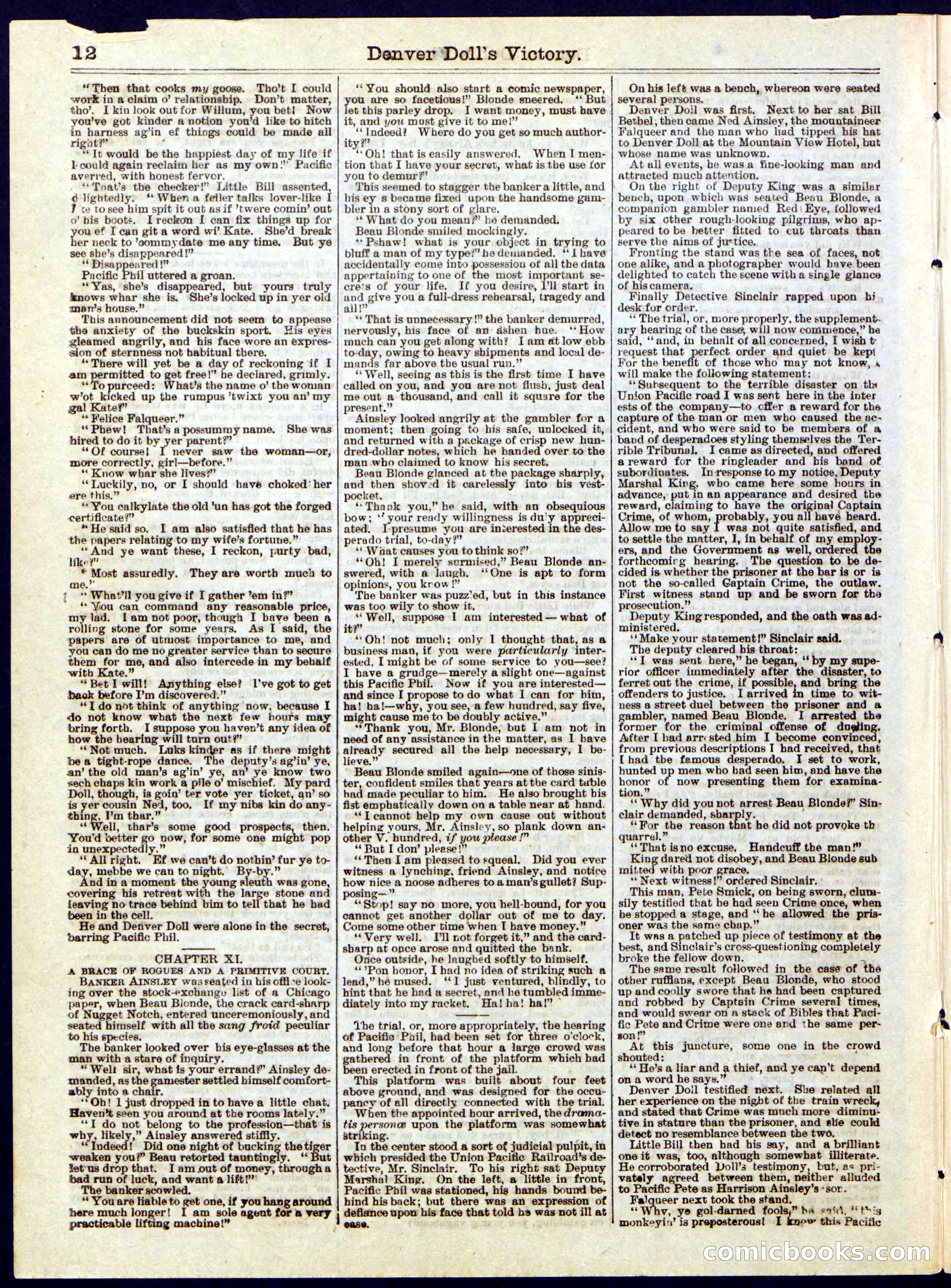
A restored page from Pulp Fiction, 1882. Page through the whole issue in the reader above.
📄 Transcribed text from this page (OCR, searchable)
Machine-transcribed from the original scan — historical spelling and the odd misread are preserved.
12 me es ce — cuiiintéil 7 » sen “Then that cooks my goose. Tho’t I could work in a claim o’ relationship. Don’t matter, tho’. I kin look out for Willum, you bet! Now you've got kinder a notion you'd like to hitch in pk ag ag’in ef things could be made all right ‘ sf It would be the happiest day of my Jife if l could again reclaim her as my own!” Pacific averred, with honest fervor. . *Poat’s the checker!” Little Bill assented, 6 lightedly. ‘* When a feller talks lover-like I ? <e tosee him spit it out as if ’twere comin’ out o’ bis boots. Ireckon I[ can fix things up for ou ef I can git a word wi’ Kate. She’d break er neck to ’s0mmydate me any time. But ye see she’s disappeared!” ‘* Disappeared !” Pacific Phil uttered a groan. ‘Yas, she’s disappeared, but yours truly fenows whar she is. She’s locked up in yer old mers house.” This announcement did not seem to appease the anxiety of the buckskin sport. His eyes gleamed angrily, and his face wore an expres- sion of sternness not babitual there. “There will yet be a day of reckoning if I am ge te to get free!” he declared, grimly. ‘To purceed: What’s the name o’ the woman w’ot kicked up the rumpus ’twixt you an’ my gal Kate?’ “* Felice Falqueer.” “Phew! That’s a possummy name. hired to do it by gent parent?” ** OF course] never saw the woman—or, more correctly, girl—before.”’ ** Know whar she lives?’ “Luckily, no, or I should have choked’ her ere this.” “You calkylate the old ’un has got the forged certificate?” “He said so. I am also satisfied that he has the papers relating to my wife’s fortune.” eters: ye want these, I reckon, purty bad, ike? * Most assuredly. They are worth much to She was me. 1 ‘“ What?ll you give if I gather ’em in?” * You can command any reasonable price, ay lad. Lam not poor, though I bave been a rolling stone for some years. As I said, the papers are of utmost importance to me, and you can do me no greater service than to secure them for me, and also intercede in my bebalf wit ’ “Bet I will! Ayything else? l've got to get back before I’m discovered.” “I do not think of anything now, because I do not know what the next few hours may bring forth. I suppose you haven’t any idea of how the hearing will turn out?” “Not much. Luks kinder as if there might be a tight-rope dance. The deputy’s ag’in’ ye, an’ the old man’s ag’in’ ye, an’ ye know two sech chaps kin work a pile o’ mischief. My pard Doll, though, is goin’ ter vote yer ticket, an’ so is yer cousin Ned, too, If my nibs kin do any- thing, I’m thar.” “Well, thar’s some good prospects, then. ‘You'd better go now, for some one might pop in unexpectedly.” ‘‘ Allright. Ef we can’t do nothin’ fur ye to- on mebbe we can to night. ot a nd in a moment the young sleuth was gone, covering his retreat with the large stone and leaving no trace behind bim to tell that he had been in the cell. He and Denver Doll were alone in the secret, barring Pacific Phil. CHAPTER XI. A BRACE OF ROGUES AND A PRIMITIVE COURT. BANKER AINSLEY was seated in his office look- ing over the stock-exchangw list of a Chicago paper, when Beau Bionde, the crack card-sharp of ugget Notch, entered unceremoniously, and seated himself with all the sang froid peculiar to his species. The banker looked over his eye-glasses at the man with a stare of inquiry. “Welt sir, what fs your errand?” Ainsley de- manded, as the gamester settled himself comfort- ably into a chair. ‘*Ob! 1 just dropped in to have a little chat. Haven seen you around at the rooms lately.” ‘*I do not belong to the profession—that is why, likely,” Ainsley answered stiffly. Indeed! Did one night of bucking thetiger weaken you?” Beau retorted tauntingly. ‘“‘ But let'us drop that. I am out of money, througha bad run of luck, and want a lift!” The banker scowled. “You are liable to get one, if you hang around practicable lifting machine!” ‘* You should also start a comic lee a ou are so facetious!” Blonde sneered. ** But et this parley drop. I want money, must have it, and you most give it to me!” 2 ee W bere do you get so much author- i 7 Oh! that is easily answered. When I men- tion that I have your secret, what is the use for you to demur?”’ This seemed to stagger the banker a little, and his ey s became fixed upon the handsome gam- bler in a stony sort of glare. ‘* What do you mean?’ he demanded. Beau Blonde smiled mockingly. ‘**Pshaw! what is your object in trying to bluff a man of my type?” he demanded. ‘1 have accidentally come into possession of all the data appertaining to one of the most important se- ere's of your life. If you desire, Vl start in and give you a full-dress rehearsal, tragedy and all!” ‘** That is unnecessary!” the banker demurred, nervously, his face of an dshen hue. ‘How much can you get along with? Iam at low ebb to-day, owing to heavy shipments and locul de- mands far above the usual run.” ‘‘ Well, seeing as this is the first time I have called on you, and you are not flusb, just deal me out a thousand, and call it square for the present.” Ainsley looked angrily at the gambler for a moment; then going to his safe, unlocked it, and returned with a package of crisp new hun- dred-dollar notes, which he banded over to the man who claimed to know his secret. Beau Blonde glanced at the package sharply, and then shoved it carelessly into his vest- ket. ‘Thank you,” he said, with an obsequious bow; *‘ your ready willingness is du'y appreci- ated. I-presume you are interested in the des- perado trial, to-day?” ‘* Wnat causes you to think so?’ ‘‘Oh! I merely sermised,” Beau Blonde an- swered, with a laugh. ‘‘One is apt to form opinions, you krow !” The banker was puzz'ed, but in this instance was too wily to show it, Y Well, suppose I am interested — what of it? ‘*‘Oh! not much; only I thought that, as a business man, if you were particularly inter- ested, I might be of some service to you—see? I have a Se nag ema a slight one—against this Pacific Phil. Now if you are interested— and since [ propose todo what I can for him, ha! ha!l—why, you see, a few hundred, say five, might cause me to be doubly active.” ‘Thank you, Mr. Blonde, but I am not in need of any assistance in the matter, as 1 bave already secured all the help necessary, I be- lieve.” Beau Blonde smiled again—one of those sinis- ter, confident smiles that years at the card tuble had made peculiar to him. He also brought bis fist emphatically down on a table near at hand. “TIT cannot help my own cause out without helping yours, Mr. Ainsley, so plank down an- other V. hundred, if you please !” ‘“* But I don’ please!” : ‘Then I am peur? tosqueal. Did you ever witness a lynching, friend Ainsley, and notice how nice a noose adheres to a man’s gullet? Sup- n ee “Stop! say pO more, you hell-hound, for you cannet get another dol out of me to day. Come some other time when T have money.” ‘Very well. Ill not forget it,” and the card- sharp at once arose and quitted the bank. Once outside, he laughed softly to himself. ‘*?Pon honor, I had no idea of striking such a lead,” hé mused. ‘I just ventured, blindly, to hint that he had a secret, and he tumbled imme- diately into my racket. Ha! ha! ha!” Lhe trial, or, more appropriately, the hearing of Pacifie Phil, had been set for three o'clock, and long before that hour a large crowd was athered in front of the platform which had oe erected in front of the jail. This platform was built about four feet above ground, and was designed for the occu- pancy of all directly connected with the trial. When the appointed hour arrived, the drama- tis persone upon the platform was somewhat striking. In the center stood a sort of judicial pulpit, in which presided the Union Pacific Railroad’s de- tective, Mr. Sinclair. To his right sat Deputy Marshal King. On the left, a little in front, Pacific Phil was stationed, his hands bound be- hind his back; but there was an ex ion of here much longer! I am sole agent for & very ; defiance upon his face that told he was not ill at * LLL LLL &. On his left was a bench, whereon were seated several persons, Denver Doil was first. Next to her sat Bill Bethel, then came Ned Ainsley, the mountaineer Falqueer and the man who had tipped his hat to Denver Doll at the Mountain View Hotel, but whose name was unknown. At all events, he was.a fine-looking man and attracted much attention. On the right of Deputy King was a similar bench, upon which was seated Beau Blonde, a companion gambler named Red‘ Eye, followed by six other rough-lookivg pilgrims, who ap- peared to be better fitted to cut throats than serve the aims of juttice, Fronting the stand was the sea of faces, not one alike, and a photogrepber would have been delighted to catch the scene with a single glance of his camera. Finally Detective Sinclair rapped upon bi desk for order. ‘“ The trial, or, more properly, the supplement-~ ary hearing of the case, will now commence,” he said, ‘‘and, in behalt of all concerned, I wish t request that Pegi wi order and quiet be kept For the benefit of those who may not know, 4 will make the following statement: ‘*Suhsequent to the terrible disaster on tl Union Pacific road I was sent here in the inter ests of the company—to offer a reward for the capture of the man or men who caused the ac- cident, and who were said to be members of a band of desperadoes styling themselves the Ter- rible Tribunal. I came as directed, and offered areward for the ringleader and bis band of subordinates. Inresponse to my notice, Deputy Marshal King. who came here some hours in advance, a in an appearance and desired the reward, claiming to have the cyienal Captain Crime, of whom, probably, you all have heard. Allow me to say 1 was not quite satisfied, and to settle the matter, I, in behalf of my emnplay- ers, and the Government as well, orde the forthcomirg hearing. The question to be de- cided is whether the prisoner at the bar is or is not the so-called Captain Crime, the outlaw. First witness stand up and be sworn for the prosecution.” Deputy King responded, and the oath was ad- ministered. ‘‘ Make your statement!” Sinclair said. The deputy cleared bis throat: ‘‘T was sent here,” he began, ‘“‘ by my supe- rior officer immediately after the disaster, to ferret out the crime, if possible, and bring the offenders to justice. I arrived in time to wit- ness a street duel between the prisoner and a ambler, named Beau Blonde. I arrested the ormer for the criminal offense of Snening, After I bad arr: sted him I become convinced, from previous descriptions I had received, that [had tbe famous desperado. I set to work, hunted vp men who had seen him, and have the honor of now presenting them for examina- on. ‘Why did you not arrest Beau Blonde?” Sin- clair demanded, ananply- ‘‘For the reason that he did not provoke th quarrel,” ‘*That isno excuse. Handcuff the man!” King dared not disobey, and Beau Blonde sub mitted with poor grace, ‘* Next witness!” ordered Sinclair. This man, Pete Smick, on being sworn, clum- sily testified that he had seen Crime once, when be stopped a stage, and ‘‘he allowed the pris- oner was the same chap.” It was a patched up piece of testimony at the best, and Sinclair’s cross-questioning completely broke the fellow down. :. The same result followed in the case of the other ruffians, except Beau Blonde, who stood up and coolly swore that he had been captured and robbed by Captain Crime several times, and would swear on a stack of Bibles that Paci- fic Pete and Crime were one and the same per- son! At this juncture, some one in the crowd shouted: “* Ho’s a liar and a thief, and ye can’t depend on a word he says.’ , Denver Doll testified next. She related all her experience on the night of the train wreck, and stated that Crime was much more diminu- tive in stature than the prisoner, and sie coukd detect no resemblance between the two. Little Bill then had his gay, and a brilliant one it was, too, although somewhat illiterate. He corroborated Dolls testimony, but, es pri- vately agreed between them, neither alluded to Pacific Pete as Harrison Ainsley’s «sor. Falqueer next took the stand, ‘*Why, ye gol-darned fools,” ha sid, * this monkeyin’ is preposterous! I this Pacific Gomicbooks (C (EO) |