
Pulp Fiction, 1882 · page 7 of 16
Beadle's Half Dime Library No. 278 — page 7: what you’re looking at
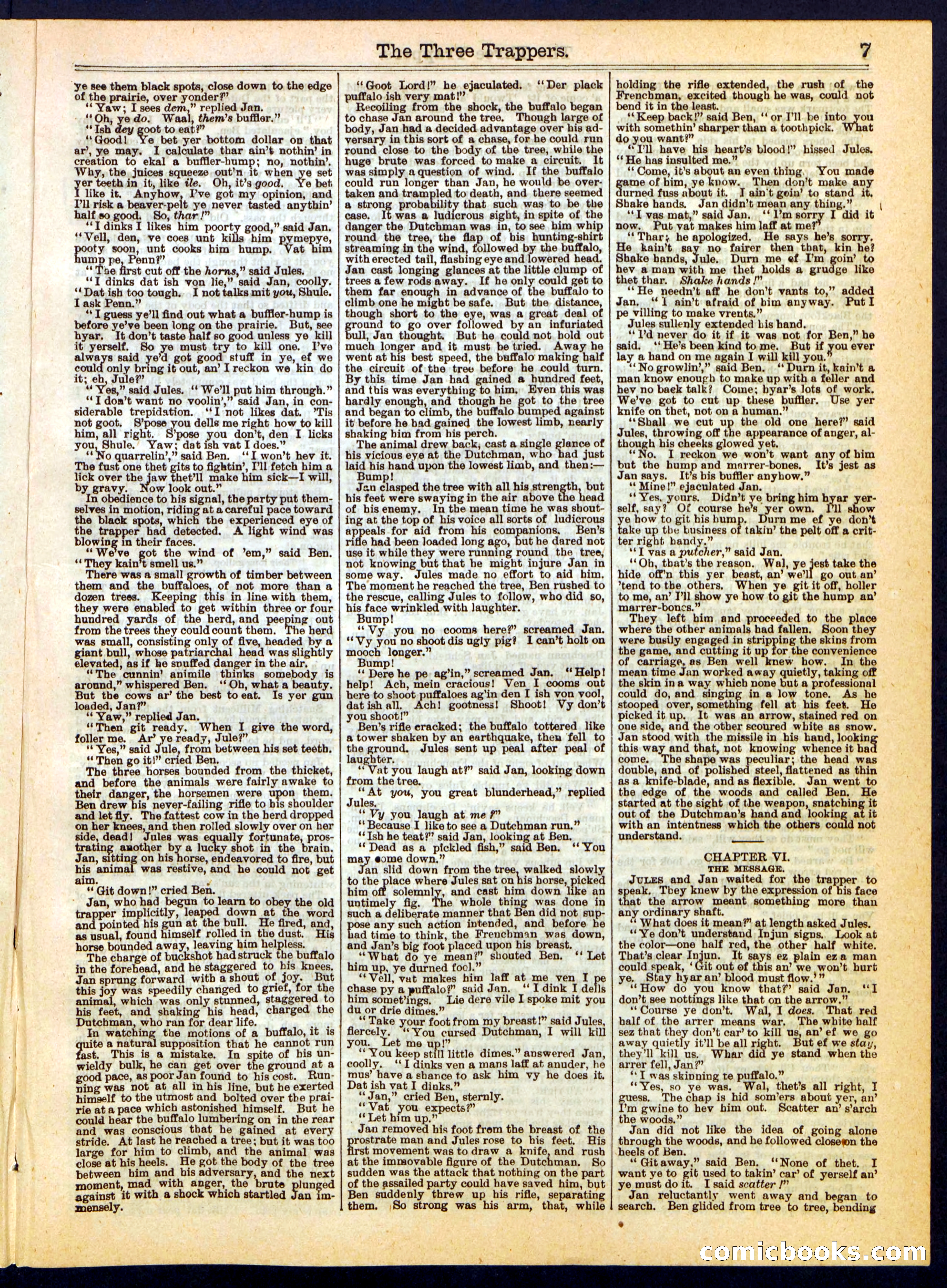
A restored page from Pulp Fiction, 1882. Page through the whole issue in the reader above.
📄 Transcribed text from this page (OCR, searchable)
Machine-transcribed from the original scan — historical spelling and the odd misread are preserved.
a »— ‘ye see them black spots, close down to the edge of the prairie, over yonder?’ “Yaw; I sees sad ” replied Jan. - “Oh, ye do. Waal, them’s buffler.”’ Po oot to eat?’ e bet yer bottom dollar on that ar’, ye may. I calculate thar ain’t nothin’ in creation to ekal a buffler-hump; no, nothin’, Why, the juices squeeze out’n it when ye set er teeth in it, like ile. Oh, it’s good. Ye bet like it, Anyhow, I’ve got my opinion, and Pll risk a beaver-pelt ye never tasted anythin’ half so good, So, thar!” ‘I dinks I likes him Roorty wens! said Jan. ‘* Vell, den, ve coes unt kills him pymepye, ty soon, unt cooks him hump. at him ump pe, Penn?’ “* Tse first cut off the horns,” said Jules. “I dinks dat ish von lie,” said Jan, coolly. ‘*Dat ish too tough, I not talks mit you, Shule. I ask Penn.” ‘‘T guess ye’ll find out what a buffler-hump is before ye’ve been long on the prairie. But, see hyar, It don’t taste half so good unless ye kill it yerself. So ye must try to kill one. I’ve always said ye’d got good stuff in ye, ef we could only bring it out, an’ I reckon we kin do it; eh, Jule?’ 9 Yes,” said Jules. ‘‘ We'll put him through.” **T don’t want no voolin’,” said Jan, in con- siderable trepidation. ‘‘I not likes dat. ’Tis not goot. S’pose you dells me right how to kill him, all right. S’pose you don’t, den I licks you, Shule. Yaw; dat ish vat I does.” “No quarrelin’,” said Ben. ‘‘I won’t hev it. The fust one thet gits to fightin’, I'll fetch him a lick over ag om het’ll make him sick—I will, by gravy. Now look out.” In obedience to his signal, the party put them- selves in motion, riding at a careful pace toward the black spots, which the experienced eye of the trapper had detected. A light wind was blowing in their faces. ‘We've got the wind of ’em,” said Ben. ‘They kain’t smell us.” owth of timber between them and the buffaloes, of not more than a dozen trees. Keeping this in line with them, they were enabled to get within three or four hundred yards of the herd, and peeping out from the trees they couldcount them. The herd was small, ae only of five, headed by a giant bull, whose patriarchal head was slightly elevated, as if he snuffed danger in the air, “The cunnin’ animile thinks somebody is around,” whispered Ben. ‘‘ Oh, what a beauty. But the cows ar’ the best toeat. Is yer gun loaded, Jan?” ‘* Yaw,” replied Jan. | “Then git ready. When I give the word, foller me. Ar’ ye ready, Jule?” ‘* Yes,” said Jule, from between his set teeth. “ Then go it!” cried Ben, The three horses bounded from the thicket, and before the animals were fairly awake to their danger, the horsemen were upon them. Ben drew his never-failing rifle to bis shoulder and let fly. The fattest cow in the herd dropped on her knees, and then rolled slowly over on her side, dead! Jules was ag fortunate, pros- Ses another a lucky shot in the brain. Jan, boing on his horse, endeavored to fire, but his animal was restive, and he could not get aim. 7 ‘* Git down!” cried Ben. Jan, who had begun to learn to obey the old trapper implicitly, leaped down at the word ar Painted his gun at the bull. He fired, and, as usual, found vse p rolled it ie ORat. His horse bounded away, leaving him helpless. The charge of buckshot had struck the buffalo in the forehead, and he staggered to his knees, Jan sprung forward witb a shout of joy. But this joy was speedily changed to grief, for the ariel. which was only stunned, staggered to his feet, and shaking his head, charged the Dutchman, who ran for dear life. ‘ In wens the motions of a buffalo, it is ite a natural supposition that he cannot run t. This is a mistake. In spite of his un- wieldy bulk, he can get over the ground at a , as poor Jan found to his cost. Run- ning was not at all in his line, but he exerted himself to the utmost and bolted over the prai- rie at a pace which astonished himself. But he could hear the buffalo lumbering on in the rear and was conscious that he gained at every stride. At last he reached a tree; but it was too large for him to climb, and the animal was close at his heels. He got the body of the tree between him and his adversary, and the next moment, mad with anger, the brute unged There was a small against it with a shock which startled Jan im- mensel y. The Three Trappers. ‘‘Goot Lord!” he ejaculated, ‘‘Der plack puffalo ish very mat!” Recoiling from the shock, the buffalo began to chase Jan around thetree. Though large of body, Jan had a decided advantage over his ad- versary in this sort of a chase, for be could run round close to the body of the tree, while the huge brute was forced to make a circuit. It was simply a question of wind. If the buffalo could run longer than Jan, he would be over- taken and trampled to death, and there seemed a strong probability that such was to be the case. It was a ludicrous sight, in spite of the danger the Dutchman was in, to see bim whip round the tree, the flap of bis hunting-shirt streaming in the wind, followed by the buffalo, with erected tail, flashing eye and lowered head. Jan cast longing glances at the little clump of trees a few rodsaway. If he only could get to them far enough in advance of the buffalo to climb one he might be safe. But the distance, though short to the eye, was a great deal of oun to go over followed by an infuriated wl, Jan thought. But he could not hold out much longer and it must be tried. Away he went at his best speed, the buffalo making half the circuit of the tree before he could turn. By this time Jan had gained a hundred feet, and this was everything to him, Even this was hardly enough, and though he got to the tree and began to climb, the buffalo bumped against it before he bad gained the lowest limb, nearly shaking bim from his perch. The animal drew back, cast a angie lance of his vicious eye at the Dutchman, who had just laid his hand upon the lowest limb, and then:— Bump! Jan Haanet the tree with all his strength, but his feet were swaying in the air above the head of hisenemy. In the mean time he was shout- ing at the top of his voice all sorts of ludicrous wh for aid from his companions. Ben’s rifle had been loaded long ago, but he dared not use it while they were running round the tree, not knowing but that he might injure Jan in some way. Jules made no effort to aid him, The moment he reached the tree, Ben rushed to the rescue, calling Jules to follow, who did so, his face wrinkled with laughter. Bump! ‘““Vy you no cooms here?’ screamed Jan. ‘*Vy you no shoot dis ugly pig? I can’t holt on mooch longer.” Bump! ‘* Dere he ag’in,” screamed Jan. ‘Help! help! Ach, mein cracious! Ven I cooms out here to shoot puffaloes ag’in den I ish von vool, dat ish all. Ach! gootness! Shoot! Vy don’t you shoot!” Ben’s rifle eracked; the buffalo tottered like a tower shaken by an earthquake, then fell to the ground. Jules sent up peal after peal of laughter. ‘** Vat you laugh at?” said Jan, looking down from the tree. r ‘ At you, you great blunderhead,” replied ules. ‘* Vy you laugh at me ?” ‘* Because I like to see a Dutchman run,” “Ish he teat?’ said Jan, looking at Ben. ‘* Dead as a pickled fish,” said Ben. ‘‘ You may @ome down,” an slid down from the tree, walked slowly to the place where Jules sat on his horse, picked him off solemnly, and cast him down like an untimely fig. The whole thing was done in such a deliberate manner that Ben did not sup- a any such action intended, and before he ad time to think, the Frencbman was down, and Jan’s big foot placed upon his breast. “What do ye mean?” shouted Ben. ‘‘ Let him up, ye durned fool.” ‘* Vell, vat makes him laff at me ven I chase py a puffalo?’ said Jan. ‘‘ I dink I dells him somet’ings. Lie dere vile I spoke mit you du or drie dimes.” ‘Take your foot from my breast!” said Jules, pervely, ‘““You cursed Dutchman, I will kill you. Let me up!” ** You keep stil little dimes.” answered Jan, coolly. ‘‘I dinks ven a mans laff at anuder, he mus’ have a shance to ask Dat ish vat I dinks.” re ohn cried Ben, 1 iia a ou expects . “Let him up.” Jan removed his foot from the breast of the rostrate man and Jules rose to his feet. His t movement was to draw a knife, and rush at the immovable figure of the Dutchman. So sudden was the attack that nothing on the part of the assailed y could have saved him, but Ben suddenly threw up his rifle, separating them. So strong was his arm, that, while vy he does it, heels of Ben. holding the rifle extended, the rush of the Frenchman, excited though he was, could not bend it in the least. , | ‘*Keep back!’ said Ben, ‘‘ or I'll be into you with somethin’ sharper than a toothpick. at do you want?” “Tl have his heart’s blood!” hissed Jules, ‘** He has insulted me.” ‘‘ Come, it’s about an even thing, You made me of him, ye know. Then don’t make an urned fuss about it. IJ ain't goin’ to stand it, Shake hands. Jan didn’t mean any thing.” ‘‘I vas mat,” said Jan. ‘‘ I’m sorry I did it now. Put vat makes him laff at me? ‘*Thar; he apologized. He says he’s sorry, He kain’t say no fairer then that, kin he? Shake hands, Jule. Durn me ef I’m goin’ to hev a man with me thet holds a grudge like thet thar. Shake hands!” ‘*He needn’t aff he don’t vants to,” added Jan, “I ain’t afraid of bim anyway. PutI pe villing to make vrents.” Jules sullenly extended bis hand. ‘Vd never do it if it was not for Ben,” he said, ‘‘He’s been kind tome. But if you ever lay a hand on me again I will kill you. ‘‘No growlin’,” said Ben. ‘ Durn it, kain’t a man know enough to make up with a feller and hev no baek talk? Come; byar’s lots of work, We've got to cut up these buffler. Use yer knife on thet, not on a human.” ‘‘Shall we cut up the old one here?” said Jules, throwing off the appearance of anger, al- though his cheeks glowed yet, ‘No. I reckon we won’t want any of him but the hump and marrer-bones, It’s jest as Jan says. It’s bis buffler anyhow.” ‘“* Mine!” ejaculated Jan. ‘*'Yes, yours. Didn’t ye bring him hyar yer- self, say? Of course he’s yer own. run show ye how to git his ibeapr urn me ef ye don’t take up the business of takin’ the pelt off a crit- ter right bandy.” ‘*T vas a putcher,” said Jan. , ‘Oh, that’s the reason. Wal, ye sons take the hide off’n this yer beast, an’ we'll go out an’ tend to the others, When ye git it off, holler to me, an’ I’ll show ye how to git the hump an’ marrer-boncs.” They left bim and proceeded to the place where the other animals had fallen, Soon they were busily engaged in stripping the skins from the game, and cutting it up for the convenience of carriage, as Ben well knew how. In the mean time Jan worked away quietly, taking off the skin ina way which none but a professional | could do, and singing in a low tone. As he stooped over, something fell at his feet. He picked it up. It was an arrow, stained red on one side, and the other scoured white as snow. Jan stood with the missile in his hand, lookin this WAY ANS that, not knowing whence it ba come, The shape was peculiar; the head was double, and of polished steel, flattened as thin as a knife-blade, and as flexible. Jan went to the edge of the woods and called Ben, He started at the sight of the weapon, snatching it out of the Dutchman’s hand and looking at it with an intentness which the others not understand. CHAPTER VI. THE MESSAGE. JuLes and Jan waited for the trapper to speak, Tbey knew by the expression of his face that the arrow meant something more than any ordinary shaft. ‘* What does it mean?” at length asked Jules. “Ye don’t understand Injun signs. Look at the color—one half red, the other half white. That’s clear Injun. It says ez plain eza man could speak, ‘Git out of this an’ we won’t hurt ye. Stay hyar an’ blood must flow.’” ‘“How do you know that?’ said Jan, ‘I don’t see nottings like that on the arrow.” ‘*Course ye don’t. Wal, I does. That red half of the arrer means war. sez that they don’t car’ to kill us, an’ ef we go away quietly it'll be all right. But ef we stay, they'll kill us. Whar did ye stand when the arrer fell, Jan?’ **T was skinning te puffalo,” “Yes, so ye was. Wal, thet’s all right, I guess. The chap is hid som’ers about yer, an’ I’m gwine to hev him out. Scatter an’ s’arch the woods,” Jan did not like the idea of going alone through the woods, and he followed closewn the ‘“‘Gitaway,” said Ben. ‘None of thet. I want ye to git used to takin’ car’ of yerself an’ ye must doit. I said scatter /” | Jan reluctantly went away and began to search. Ben glided from tree to tree, bending * te ) us _— The white half | chooks.co Phemaal ~~ a ane mM s 7 ‘i a