
Pulp Fiction, 1878 · page 7 of 20
Beadle's Half Dime Library, No. 25 — page 7: what you’re looking at
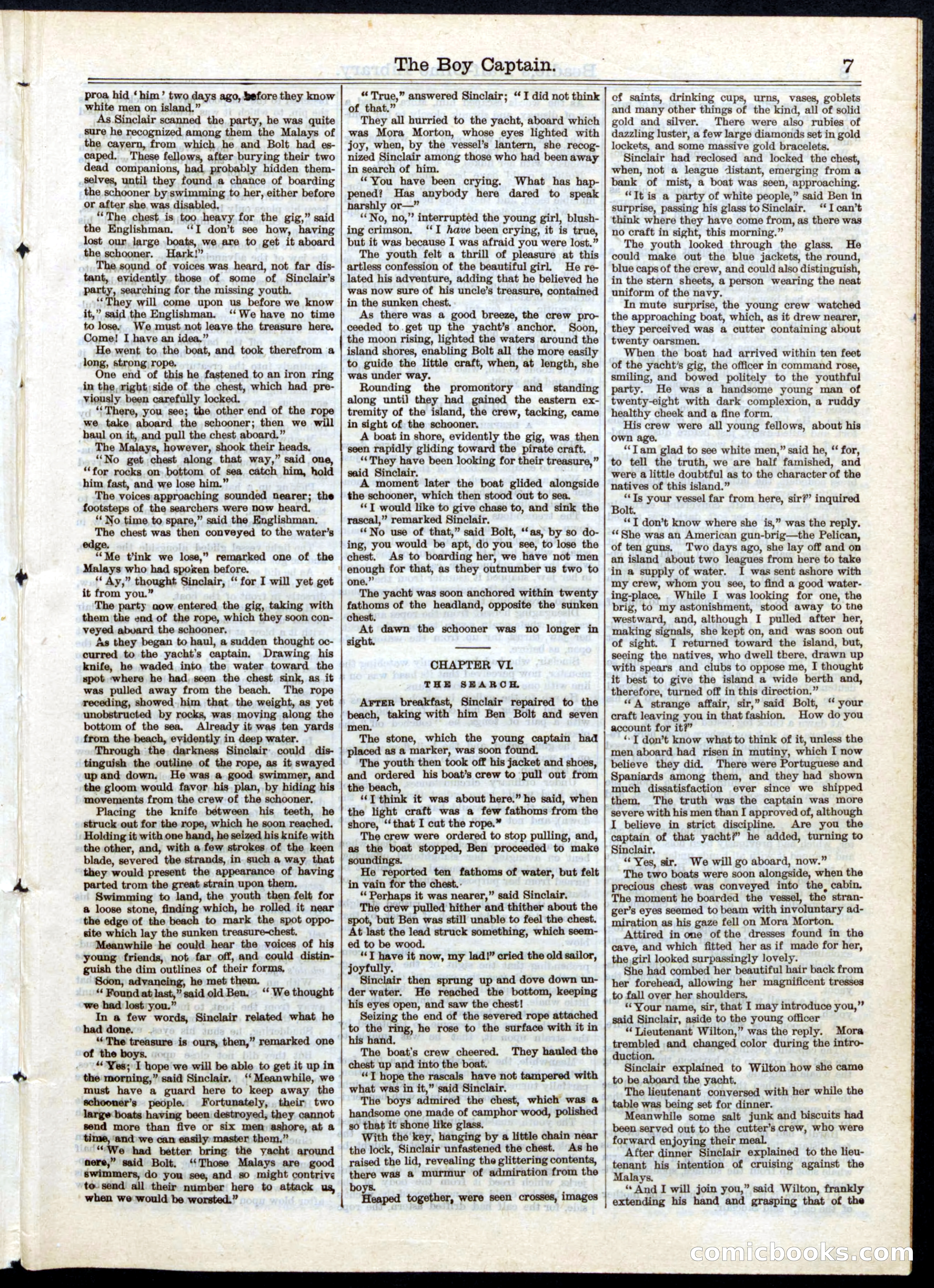
A restored page from Pulp Fiction, 1878. Page through the whole issue in the reader above.
📄 Transcribed text from this page (OCR, searchable)
Machine-transcribed from the original scan — historical spelling and the odd misread are preserved.
The Boy Captain. 7 proa hid ‘him’ two days ago, gefore they know white men on island,” As Sinclair scanned the party, he was quite sure he recognized among them the Malays of the cayern, from which he and Bolt had es- caped. . These fellows, after burying their two dead companions, had probably hidden them- selves, until they found a chance of boarding the schooner by swimming to her, either before or after she. was disabled, “The chest is too heavy for the gig,” said the Englishman. ‘I don’t see how, having lost our large boats, we are to get it aboard the schooner. Hark!” The sound of voices was heard, not far dis- tant, evidently those of some of Sinclair’s party, searching for the missing youth. ‘*They will come upon us before we know it,” said the Englishman. ‘‘ We have no time to loses We must not leave the treasure here, Come! I have an idea.” He went to the boat, and took therefrom a long, strong rope. One end of this he fastened to an iron ring in the right side of the chest, which had pre- viously been carefully locked. ‘There, you see; the other end of the rope we take aboard the schooner; then we will baul on it, and pull the chest aboard.” The Malays, however, shook their heads. “No get chest along that way,” said one, ‘for rocks on bottom of sea catch him, hold him fast, and we lose him.” The voices approaching sounded nearer; the footsteps of the searchers were now heard. ‘“‘ No time to spare,” said the Englishman. The chest was then conveyed to the water’s ““Me t’ink we lose,” remarked one of the Malays who had spoken before. ** Ay,” thought Sinclair, ‘ for I will yet get it from you.” The party aow entered the gig, taking with them the end of the rope, which they soon con- veyed abvard the schooner, As they began to haul, a sudden thought oc- curred to the yacht's captain. Drawing his knife, he waded into the water toward the spot where he had, seen the chest sink, as it was pulled away from the beach. The rope receding, showed him that the weight, as yet unobstructed by rocks, was moving along the bottom of the sea. Already it was ten yards from the beach, evidently in deep water. Through the darkness Sinclair could dis- tinguish the outline of the rope, as it swayed up and down. He was a good swimmer, and the gloom would favor his plan, by hiding his movements from the crew of the schooner, Placing the knife bétween his teeth, he struck out for the rope, which he soon reached. Holding it with one hand, he seized his knife with the other, and, with a few strokes of the keen blade, severed the strands, in such a way that they would present the appearance of having parted trom the great strain upon them. Swimming to land, the youth then felt for & loose stone, finding which, he rolled it near the edge of the beach to mark the spot oppo- site which lay the sunken treasure-chest. Meanwhile he could hear the voices of his young friends, not far off, and could distin- guish the dim outlines of their forms, Soon, ad he met them. “‘ Found at last,” said old Ben. ‘‘ We thought we had lost you.” In a few words, Sinclair related what he had done. “The treasure is ours, then,” remarked one of the boys. “Yes; I hope we will be able to get it up in the morning,” said Sinclair. ‘‘ Meanwhile, we must have a guard here to keep away the s people. Fortunately, their two large boats having been destroyed, they cannot send more than five or six men ashore, at a pee we we can easily master them,” “We had better bring the yacht around | nere,” said Bolt. ‘‘Those Malays are “ True,” answered Sinclair; “ I did not think of that.” They all hurried to the yacht, aboard which was Mora Morton, whose eyes lighted with joy, when, by the vessel’s lantern, she recog- nized Sinclair among those who had been away in search of him. “You have been crying. What has hap- pened? Has anybody here dared to speak harshly or—” “No, no,” interrupted the young girl, blush- ing crimson. “I have been crying, it is true, but it was because I was afraid you were lost.” The youth felt a thrill of pleasure at this artless confession of the beautiful girl He re- lated his adventure, adding that he believed he was now sure of his uncle’s treasure, contained in the sunken chest. As there was a good breeze, the crew pro- ceeded to.get up the yacht’s anchor. Soon, the moon rising, lighted the waters around the island shores, enabling Bolt all the more easily to guide the little craft, when, at length, she was under way. Rounding the promontory and standing along until they had gained the eastern ex- tremity of the island, the crew, tacking, came in sight of the schooner. A boat in shore, evidently the gig, was then seen rapidly gliding toward the pirate craft. “They have been looking for their treasure,” said Sinclair. A moment later the boat glided alongside the schooner, which then stood out to sea. **T would like to give chase to, and sink the rascal,” remarked Sinclair. ‘No use of that,” said Bolt, ‘‘as, by so do- ing, you would be apt, do you see, to lose the chest. As to boarding her, we have not men | enough for that, as they outnumber us two to one,”’ The yacht was soon anchored within twenty fathoms of the headland, opposite the sunken chest. At dawn the schooner was no longer in sight. CHAPTER VL THE SEARO Arter breakfast, Sinclair repaired to the beach, taking with him Ben Bolt and seven men. The stone, which the young captain had placed as a marker, was soon found. The youth then took off his jacket and shoes, and ordered his boat’s crew to pull out from the beach, ‘‘T think it was about here.” he said, when the light craft was a few fathoms from the shore, ‘‘that I cat the rope.” The crew were ordered to stop pulling, and, as the boat stopped, Ben proceeded to make soundings. He reported ten fathoms of water, but felt in vain for the chest.- “Perhaps it was nearer,” said Sinclair. The crew pulled hither and thither about the t, but Ben was still unable to feel the chest. At last the lead struck something, which seem- ed to be wood. ““T have it now, my lad!” cried the old sailor, joyfully. Sinclair then sprung up and dove down un- der water. He reached the bottom, keeping his eyes open, and saw the chest! Seizing the end of the severed rope attached to the ring, he rose to the surface with it in his hand, The boat's crew cheered. They hauled the chest up and into the boat. “T hope the rascals have not tampered with what was in it,” said Sinclair. The boys admired the chest, which was a _ handsome one made of camphor wood, polished so that it shone like glass. With the key, hanging by a little chain near the lock, Sinclair unfastened the chest. As he raised the lid, revealing the glittering contents, good do you see, and so might contrive there was a murmur of admiration from the swimmers, to send all their number here when we would be worsted.” to attack bo 3 Heaped together, were seen crosses, images ef saints, drinking cups, urns, vases, goblets and many other things of the kind, all of solid gold and silver. There were also rubies of dazzling luster, a few large diamonds set in gold lockets, and some massive gold bracelets. Sinclair had reclosed and locked the chest, when, not a league distant, emerging from a bank of mist, a boat was seen, approaching. “It is a party of white people,” said Ben in surprise, passing his glass toSinclair. ‘‘ I can’t think where they have come from, as there was no craft in sight, this morning.” The youth looked through the glass. He could make out the blue jackets, the round, blue caps of the crew, and could also distinguish, in the stern sheets, a person wearing the neat uniform of the navy. In mute surprise, the young crew watched the approaching boat, which, as it drew nearer, they perceived was a cutter containing about twenty oarsmen. When the boat had arrived within ten feet of the yacht’s gig, the officer in command rose, smiling, and bowed politely to the youthful party. He was a handsome young man of twenty-eight with dark complexion, a ruddy healthy cheek and a fine form. His crew were all young fellows, about his own “‘Tam glad to see white men,” said he, “ for, to tell the truth, we are half famished, and were a little doubtful as to the character of the natives of this island.” “Is your vessel far from here, sir?’ inquired Bolt. “*T don’t know where she is,” was the reply. **She was an American gun-brig—the Pelican, of ten guns, Two days ago, she lay off and on an island about two leagues from here to take in a supply of water. I was sent ashore with my crew, whom you see, to find a good water- ing-place. While I was looking for one, the brig, to my astonishment, stood away to the westward, and, although I pulled after her, making signals, she kept on, and was soon out of sight. I returned toward the island, but, seeing the natives, who dwell there, drawn up with spears and clubs to oppose me, I thought it best to give the island a wide berth and, therefore, turned off in this direction.” “A strange affair, sir,” said Bolt, “ your craft leaving you in that fashion. How do you account for it?’ ‘-T don’t know what to think of it, unless the men aboard had risen in mutiny, which I now believe they did. There were Portuguese and Spaniards among them, and they had shown much dissatisfaction ever since we shipped them, The truth was the captain was more severe with his men than I approved of, although I believe in strict discipline. Are you the captain of that yacht?” he added, turning to Sinclair, “Yes, sir. We will go aboard, now.” The two boats were soon alongside, when the precious chest was conveyed into the, cabin. The moment he boarded the vessel, the stran- ger’s eyes seemed to beam with involuntary ad- miration as his gaze fell on Mora Morton. Attired in one of the dresses found in the cave, and which fitted her as if made for her, the girl looked surpassingly lovely. She had combed her beautiful hair back from her forehead, allowing her magnificent tresses to fall over her shoulders, “Your name, sir, that I may introduce you,” said Sinclair, aside to the young officer “Lieutenant Wilton,” was the reply. Mora trembled and changed color during the intro- duction, Sinclair explained to Wilton how she came | to be aboard the yacht, The lieutenant conversed with her while the table was being set for dinner. Meanwhile some salt junk and biscuits had been served out to the cutter’s crew, who were forward enjoying their meal. After dinner Sinclair explained to the lieu- tenant his intention of cruising against the Malays. “* And I will join you,” said Wilton, frankly extending his hand and grasping that of the ECORMIGLOOO KS (E (E()