
Pulp Fiction, 1878 · page 19 of 20
Beadle's Half Dime Library, No. 25 — page 19: what you’re looking at
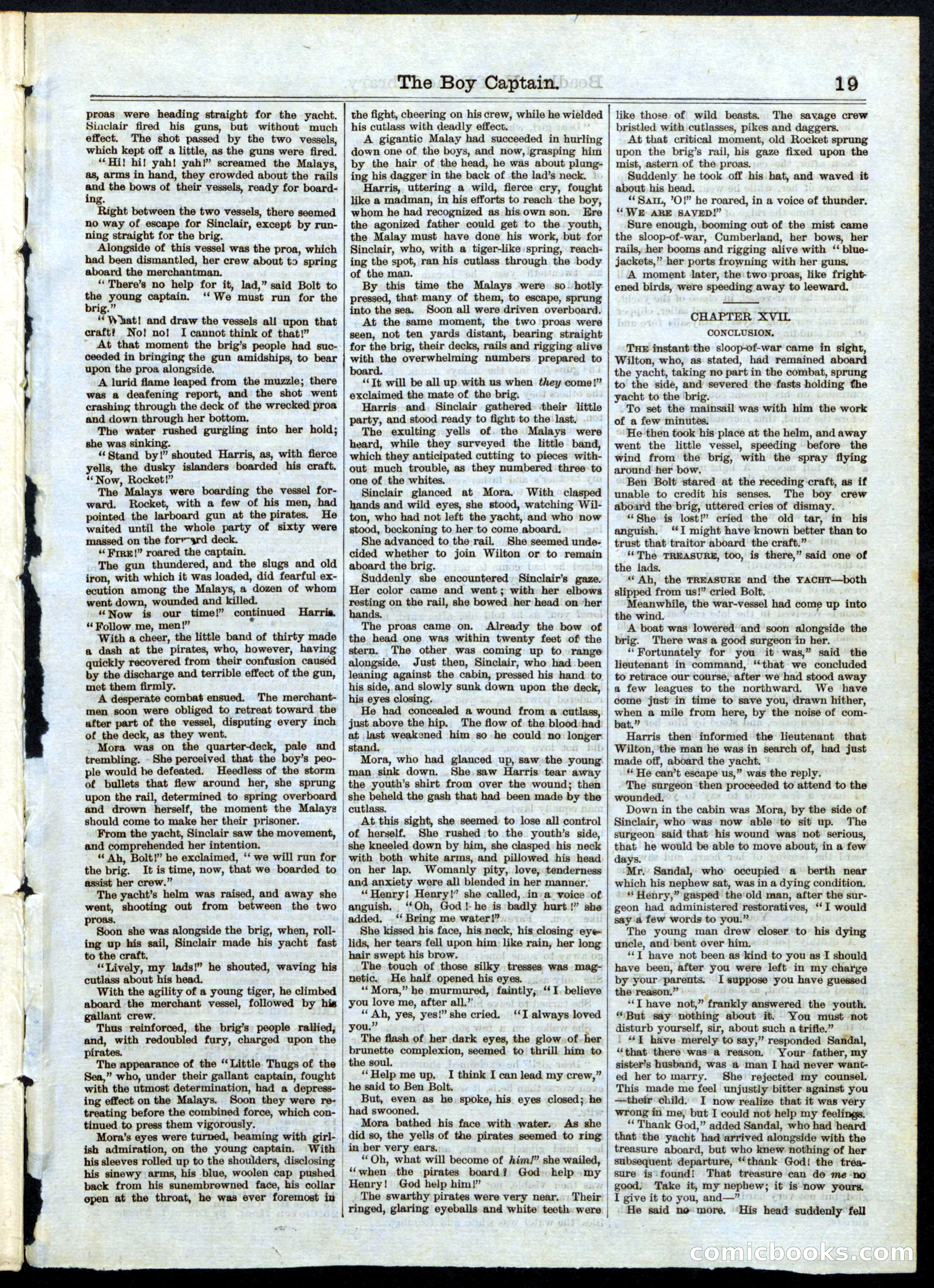
A restored page from Pulp Fiction, 1878. Page through the whole issue in the reader above.
📄 Transcribed text from this page (OCR, searchable)
Machine-transcribed from the original scan — historical spelling and the odd misread are preserved.
proas were heading straight for the yacht. Sioclair fired his guns, but without much effect. The shot passed by the two vessels, which kept off a little, as the guns were fired. “Hi! hi! yah! yah!” screamed the Malays, as, arms in hand, they crowded about the rails and the bows of their vessels, ready for board- ing. Right between the two vessels, there seemed no way of escape for Sinclair, except by run- ning straight for the brig. Alongside of this vessel was the proa, which had been dismantled, her crew about to spring aboard the merchantman. ‘“‘There’s no help for it, lad,” said Bolt to the young captain. ‘‘We must run for the brig.” ‘What! and draw the vessels all upon that craft? No! no! I cannot think of that!” At that moment the brig’s people had suc- ceeded in bringing the gun amidships, to bear upon the proa alongside. A lurid flame leaped from the muzzle; there was a deafening report, and the shot went crashing through the deck of the wrecked proa and down through her bottom. The water rushed gurgling into her hold; she was sinking. ‘‘Stand by!” shouted Harris, as, with fierce yells, the dusky islanders boarded his craft. ‘Now, Rocket!” The Malays were boarding the vessel for- ward. Rocket, with a few of his men, had pointed the larboard gun at the pirates. He waited until the whole party of sixty were massed on the forr-yrd deck. ‘‘Frre!” roared the captain. The gun thundered, and the slugs and old iron, with which it was loaded, did fearful ex- ecution among the Malays, a dozen of whom went down, wounded and killed. ‘Now is our time!” continued Harris. “Follow me, men!” With a cheer, the little band of thirty made a dash at the pirates, who, however, having quickly recovered from their confusion caused by the discharge and terrible effect of the gun, met them firmly. A desperate combat ensued. The merchant- men soon were obliged to retreat toward the after part of the vessel, disputing every inch of the deck, as they went. Mora was on the quarter-deck, pale and trembling. - She perceived that the boy’s peo- ple would he defeated. Heedless of the storm of bullets that flew around her, she sprung upon the rail, determined to spring overboard and drown herself, the moment the Malays should come to make her their prisoner. The Boy Captain. the fight, cheering on his crew, while he wielded his cutlass with deadly effect. A gigantic Malay had succeeded in hurling down one of the boys, and now, grasping him by the hair of the head, he was about plung- ing his dagger in the back of the lad’s neck. Harris, uttering a wild, fierce cry, fought like a madman, in his efforts to reach the boy, whom he had recognized as hisown son. Ere the agonized father could get to the youth, the Malay must have done his work, but for Sinclair, who, with a tiger-like spring, reach- ing the spot, ran his cutlass through the body of the man. By this time the Malays were so- hotly pressed, that many of them, to escape, sprung into the sea. Soon all were driven overboard. At the same moment, the two proas were seen, not ten yards distant, bearing straight for the brig, their decks, rails and rigging alive with the overwhelming numbers prepared to board. ‘(Tt will be all up with us when they come!” exclaimed the mate of the brig. Harris and Sinclair gathered their little party, and stood ready to fight to the last. The exulting yells of the Malays were heard, while they surveyed the little band, which they anticipated cutting to pieces with- out much trouble, as they numbered three to one of the whites. Sinclair glanced at Mora. With clasped hands and wild eyes, she stood, watching Wil- ton, who had not left the yacht, and who now stood, beckoning to her to come aboard. She advanced to the rail. She seemed unde- cided whether to join Wilton or to remain aboard the brig. Suddenly she encountered Sinclair's gaze. Her color came and went; with her elbows resting on the rail, she bowed her head on ‘her hands. The proas came on. Already the bow of the head one was within twenty feet of the stern. The other was coming up to range alongside, Just then, Sinclair, who had been leaning against the cabin, pressed his hand to his side, and slowly sunk down upon the deck, his eyes closing. He had concealed a wound from a cu just above the hip. The flow of the blood: had at last weakened him so he could no longer stand. Mora, who had glanced up, saw the young. man sink down. She saw Harris tear away the youth’s shirt from over the wound; then she beheld the gash that had been made by the cutlass. At this sight, she seemed to lose all control From the yacht, Sinclair saw the movement, ‘of herself. She rushed to the youth’s side, and comprehended her intention. | she kneeled down by him, she clasped his neck “ Ah, Bolt!” he exclaimed, “‘ we will run for with both white arms, and pillowed his head the brig. It is time, now, that we boarded to assist her crew.” The yacht’s helm was raised, and away she went, shooting out from betw proas. Soon she was alongside the brig, when, roll- | | | | een the two anguish, on her lap. Womanly pity, love, tenderness and anxiety were all blended in her manner. ‘“‘Henry! Henry!” she called, in a voice of “Oh, God !-he is badly hurt!” she added. ‘‘ Bring me water!” She kissed his face, his neck, his closing eye- ing up his sail, Sinclair made his yacht fast lids, her tears fell upon him like rain, her long to the craft. “Lively, my lads!” he shouted, waving his cutlass about his head. With the agility of a young tiger, he climbed aboard the merchant vessel, followed by his gallant crew. Thus reinforced, the brig’s people rallied, and, with redoubled fury, charged upon the pirates. The appearance of the “Little Thugs of the Sea,” who, under their gallant captain, fought with the utmost determination, had a depress- ing effect on the Malays. Soon they were re- treating before the combined force, which con- tinued to press them vigorously. Mora’s eyes were turned, beaming with girl- ish admiration, on the young captain. With his sleeves rolled up to the shoulders, disclosing his sinewy arms, his blue, woolen cap pushed back from his sunembrewned face, his collar open at the throat, he was ever foremost in ’ | hair swept his brow. The touch of those silky tresses was mag- netic. He half opened his eyes. ‘** Mora,” he murmured, faintly; ‘‘ I. believe you love me, after all,” ““ Ah, yes, yes!” she cried. you.” The flash of her dark eyes, the glow of. her brunette complexion, seemed to thrill him to the soul. ‘‘Help me up, I think I can lead my crew,” he said to Ben Bolt, But, even as he spoke, his eyes closed; he had swooned, Mora bathed his face with water. As she did so, the yells of the pirates seemed to ring in ber very ears. “Oh, what will become of him/” she wailed, **T always loved “when the pirates board? God. help my Henry! God help him!” 19 like those of wild beasts. The savage crew bristled with cutlasses, pikes and daggers. At that critical moment, old Rocket sprung upon the brig’s rail, his gaze fixed upon the mist, astern of the proas. Suddenly he took off his hat, and waved it about his head. | *“*Salrn, ’O!” he roared, in a voice of thunder. “WE ARE SAVED!” Sure enough, booming out of the mist came the sloop-of-war, Cumberland, her bows, her rails, her booms and rigging alive with ‘‘ blue- jackets,” her ports frowning with her guns, A moment later, the two proas, like fright- ened birds, were speeding away to leeward. CHAPTER XVIL CONCLUSION, Tue instant'the sloop-of-war came in sight Wilton, who, as stated, had remained aboard the yacht, taking no part in the combat, sprung to the side, and severed the fasts holding the yacht to the brig. To set the mainsail was with him the work of a few minutes. He then took his place at the helm, and away went the little vessel, speeding before the wind from the brig, with the spray flying around her bow. Ben Bolt stared at the receding craft, as if unable to credit his senses. The boy crew aboard the brig, uttered cries of dismay. “She is lost!” cried the old tar, in his anguish. “I might have known better than to trust that traitor aboard the craft.” “The TREASURE, too, is there,” said one of the lads. ‘* Ah, the TREASURE and the YACHT—both slipped from us!” cried Bolt. Meanwhile, the war-vessel had come up into the wind. A boat was lowered and soon alongside the brig. There was a good surgeon in her. “Fortunately for you it was,” said the lieutenant in command, “that we concluded to retrace our course, after we had stood away a few leagues to the northward. We have come just in time to save you, drawn hither, when a mile from here, by the noise of com- bat. ”? Harris then informed the lieutenant that Wilton, ‘the man he was in search of, had just made off, aboard the yacht. ** He can’t escape us,” was the reply. The surgeon then proceeded to attend to the wounded. Down in the cabin was Mora, by the side of Sinclair, who was now able to sit up. The surgeon said that his wound was not serious, that he would be able to move about, in a few days. Mr. Sandal, who occupied a berth near which his nephew sat, was in a dying condition. ** Henry,” gasped the old man, after the sur- geon had administered restoratives, ‘‘ I would say a few words to you.” The young man drew closer to his dying uncle, and bent over him. ‘*T have not been as kind to you as I should have been, after you were left in my charge by your parents. I suppose you have guessed the reason.” ; ) ‘‘T have not,” frankly answered the youth. * But say nothing about it. You must not disturb yourself, sir, about such a trifle.” _ “TE have merely to say,” responded Sandal, “that there was a reason. Your father, my sister’s husband, was a man I had never want- ed her to marry. She rejected my counsel. This made me feel unjustly bitter against you —their child. I now realize that it was very wrong in me, but I could not help my feelings. *“‘ Thank God,” added Sandal, who had heard that the yacht had arrived alongside with the treasure aboard, but who knew nothing of her subsequent departure, “thank God! the tréa- sure is found! That treasure can do me no good); Take it, my nephew; it is now yours. The swarthy pirates were very near. Their | I give it to you, and—” ringed, glaring eyeballs and white teeth were | He said no more. ‘His head suddenly’ fell ECO AMINE OOO) “Ss (E(6)