
Pulp Fiction, 1878 · page 10 of 20
Beadle's Half Dime Library, No. 25 — page 10: what you’re looking at
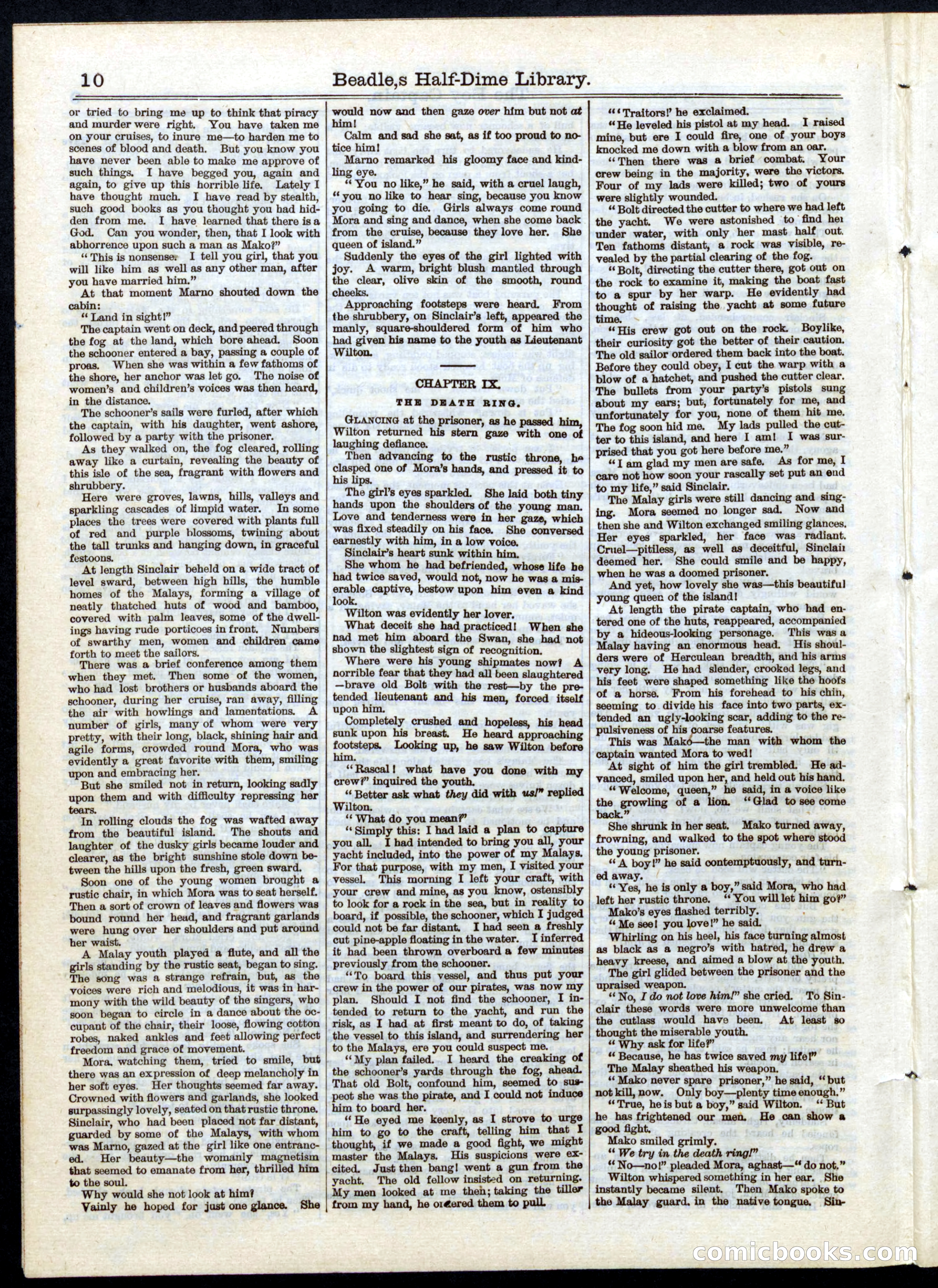
A restored page from Pulp Fiction, 1878. Page through the whole issue in the reader above.
📄 Transcribed text from this page (OCR, searchable)
Machine-transcribed from the original scan — historical spelling and the odd misread are preserved.
10 Beadle,s Half-Dime Library. or tried to bring me up to think that piracy and murder were right. You have taken me on your cruises, to inure me—to harden me to scenes of blood and death. But you know you have never been able to make me approve of such things. I have begged you, again and again, to give up this horrible life. Lately I have thought much. I have read by stealth, such good books as you thought you had hid- den from me. I have learned that there isa God. Can you wonder, then, that I look with abhorrence upon such a man as Mako?” ‘‘ This is nonsenser I tell you girl, that you will like him as well as any other man, after you have married him.” At that moment Marno shouted down the cabin: “ Land in sight!” The captain went on deck, and peered through the fog at the land, which bore ahead. Soon the schooner entered a bay, passing a couple of proas. When she was within a few fathoms of the shore, her anchor was let go. The noise of women’s and children’s voices was then heard, in the distance. The schooner’s sails were furled, after which the captain, with his daughter, went ashore, followed by a party with the prisoner. As they walked on, the fog cleared, rolling away like a curtain, revealing the beauty of this isle of the sea, fragrant with flowers and shrubbery. Here were groves, lawns, hills, valleys and sparkling cascades of limpid water. In some places the trees were covered with plants full of red and purple blossoms, twining about the tall trunks and hanging down, in graceful festoons. At length Sinclair beheld on a wide tract of level sward, between high hills, the humble homes of the Malays, forming a village of neatly thatched huts of wood and bamboo, covered with palm leaves, some of the dwell- ings having rude porticoes infront. Numbers of swarthy men, women and children came forth to meet the sailors. There was a brief conference among them when they met. Then some of the women, who had lost brothers or husbands aboard the schooner, during her cruise, ran away, filling the air with howlings and lamentations. A number of yirls, many of whom were very pretty, with their long, black, shining hair and agile forms, crowded round Mora, who was evidently a great favorite with them, smiling upon and embracing her. But she smiled not in return, looking sadly upon them and with difficulty repressing her tears. In rolling clouds the fog was wafted away from the beautiful island. The shouts and laughter of the dusky girls became louder and clearer, as the bright sunshine stole down be- tween the hills upon the fresh, green sward. Soon one of the young women brought a rustic chair, in which Mora was to seat herself. Then a sort of crown of leaves and flowers was bound round her head, and fragrant garlands were hung over her shoulders and put around her waist. A Malay youth played a flute, and all the girls standing by the rustic seat, began to sing. The song was a strange refrain, but, as the voices were rich and melodious, it was in har- mony with the wild beauty of the singers, who soon began to circle in a dance about the oc- cupant of the chair, their loose, flowing cotton robes, naked ankles and feet allowing perfect freedom and grace of movement. Mora, watching them, tried to smile, but there was an expression of deep melancholy in her soft eyes. Her thoughts seemed far away. Crowned with flowers and garlands, she looked surpassingly lovely, seated on that rustic throne, Sinclair, who had been placed not far distant, guarded by some of the Malays, with whom was Marno, gazed at the girl like one entranc- ed. Her beauty—the womanly magnetism that seemed to emanate from her, thrilled him to the soul. Why would she not look at him? Vainly he hoped for just one glance. She would now and then gaze over him but not at him! Calm and sad she sat, as if too proud to no- tice him! Marno remarked his gloomy face and kind- ling eye. “You no like,” he said, with a cruel laugh, ‘vou no like to hear sing, because you know you going to die. Girls always come round Mora and sing and dance, when she come back from the cruise, because they love her. She queen of island.” Suddenly the eyes of the girl lighted with joy. A warm, bright blush mantled through the clear, olive skin of the smooth, round cheeks. Approaching footsteps were heard. From the shrubbery, on Sinclair’s left, appeared the manly, square-shouldered form of him who bad given his name to the youth as Lieutenant ton. CHAPTER IX, THE DEATH RING. GLANCING at the prisoner, as he passed Wilton returned his stern ’ gaue with phage laughing defiance. Then advancing to the rustic throne, he clasped one of Mora’s hands, and pressed it to his lips. The girl’s eyes sparkled. She laid both tiny hands upon the shoulders of the young man. Love and tenderness were in her gaze, which was fixed steadily on his face. She conversed earnestly with him, in a low voice, Sinclair’s heart sunk within him. She whom he had befriended, whose life he had twice saved, would not, now he was a mis- ene captive, bestow upon him even a kind 00 Wilton was evidently her lover, What deceit she had practiced! When she nad met him aboard the Swan, she had not shown the slightest sign of recognition. Where were his young shipmates now? A norrible fear that they had all been slaughtered —brave old Bolt with the rest—by the pre- tended lieutenant and his men, forced itself upon him. Completely crushed and hopel his head sunk upon his breast. He toe ee Looking up, he saw Wilton before ‘*‘Rascal! what have you done with my crew?” inquired the youth. “ Better ask what they did with us/” replied Wilton. ‘¢ What do you mean?” ‘‘ Simply this: I had laid a plan to capture you all. I had intended to bring you all, your yacht included, into the power of my Malays. For that purpose, with my men, I visited your vessel, This morning I left your craft, with your crew and mine, as you know, ostensibly to look for a rock in the sea, but in reality to board, if possible, the schooner, which I judged could not be far distant. I had seen a freshly cut pine-apple floating in the water. I inferred it had been thrown overboard a few minutes previously from the schooner. “To board this vessel, and thus put your crew in the power of our pirates, was now my plan. Should I not find the schooner, I in- tended to return to the yacht, and run the risk, as I had at first meant to do, of taking the vessel to this island, and surrendering her to the Malays, ere you could suspect me. ‘‘ My plan failed. I heard the creaking of the schooner’s yards through the fog, ahead. That old Bolt, confound him, seemed to sus peot she was the pirate, and I could not induce him to board her. “He eyed me keenly, as I strove to urge him to go to the craft, telling him that I thought, if we made a good fight, we might master the Malays. His suspicions were ex- cited. Just then bang! went a gun from the yacht, The old fellow insisted on returning. My men looked at me then; taking the tiller from my hand, he oréered them to pull “‘¢ Traitors!’ he exclaimed. “He leveled his pistol at my head. I raised mine, but ere I could fire, one of your boys knocked me down with a blow from an oar, ‘Then there was a brief combat. Your crew being in the majority, were the victors. Four of my lads were killed; two of yours were slightly wounded. “ Bolt directed the cutter to where we had left the yacht. We were astonished to find her under water, with only her mast half out. Ten fathoms distant, a rock was visible, re- vealed by the partial clearing of the fog. “ Bolt, directing the cutter there, got out on the rock to examine it, making the boat fast to a spur by her warp. He evidently had thought of raising the yacht at some future time. “His crew got out on the rock. Boylike, their curiosity got the better of their caution. The old sailor ordered them back into the boat. Before they could obey, I cut the warp with a blow of a hatchet, and pushed the cutter clear. The bullets from your party’s pistols sung about my ears; but, fortunately for me, and unfortunately for you, none of them hit me. The fog soon hid me. My lads pulled the cut- ter to this island, and here I am! I was sur- prised that you got here before me,” “TI am glad my men are safe, As for me, I care not how soon your rascally set put an end to my life,” said Sinclair. The Malay girls were still dancing and sing- ing. Mora seemed no longer sad. Now and then she and Wilton exchanged smiling glances. Her eyes sparkled, her face was radiant. Cruel—pitiless, as well as deceitful, Sinclait deemed her. She could smile and be happy, when he was a doomed prisoner. And yet, how lovely she was—this beautiful young queer of the island! At length the pirate captain, who had en- tered one of the huts, reappeared, accompanied by a hideous-looking personage. This wasa Malay having an enormous head. His shoul- ders were of Herculean breadth, and his arms very long. He had slender, crooked legs, and his feet were shaped something like the hoofs of a horse. From his forehead to his chin, seeming to divide his face into two parts, ex- tended an ugly-looking scar, adding to the re- pulsiveness of his features. This was Maké—the man with whom the captain wanted Mora to wed! At sight of him the girl trembled. He ad- vanced, smiled upon her, and held out his hand. “Welcome, queen,” he said, in a voice like the growling of a lion. “Glad to see come back.” . She shrunk in her seat. Mako turned away, frowning, and walked to the spot where stood the young prisoner. ‘‘ A boy!” he said contemptuously, and turn- edaway. — ‘Yes, he is only a boy,” said Mora, who had left her rustic throne. “ You willlet him go?’ Mako’s eyes flashed terribly. . “‘ Me see! you love!” he said. Whirling on his heel, his face turning almost as black as a negro’s with hatred, he drew a heavy kreese, and aimed a blow at the youth. The girl glided between the prisoner and the upraised weapon. | ‘No, I do not love him!” she cried. To Sin- clair these words were more unwelcome than the cutlass would have been. At least so thought the miserable youth. “‘ Why ask for life?” ‘“‘ Because, he has twice saved my life!” The Malay sheathed his weapon. ‘‘ Mako never spare prisoner,” he said, “ but not kill, now. Only boy—plenty time enough,” “True, he is but a boy,” said Wilton. ‘“ But he has frightened our men, He can show a good fight. Mako smiled grimly. “* We try in the death ring!” ** No—no!” pleaded Mora, aghast—“ do not,” Wilton whispered something in her ear. She instantly became silent. Then Mako spoke to the Malay guard, in the native tongue, Sin- NOK KS €oim (G