
Pulp Fiction, 1878 · page 1 of 20
Beadle's Half Dime Library, No. 25 — page 1: what you’re looking at
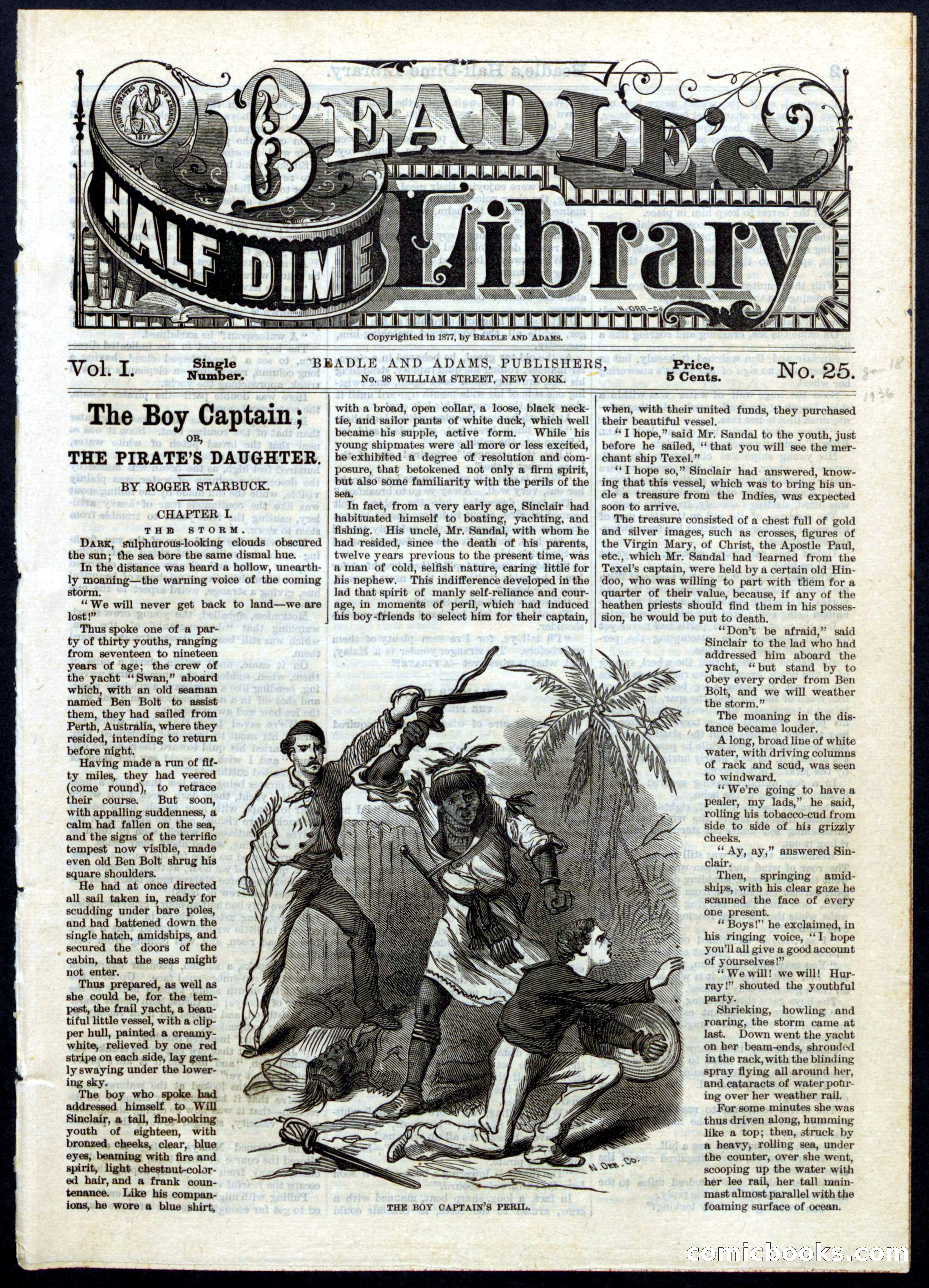
A restored page from Pulp Fiction, 1878. Page through the whole issue in the reader above.
📄 Transcribed text from this page (OCR, searchable)
Machine-transcribed from the original scan — historical spelling and the odd misread are preserved.
———_ ‘ AN can i —_— —— ! ] a ; : j | | | | (RYO | | 2 \ — ee i i I Witt = a —— . => = = = ” hei - _ === -= — — “— I] LalaliaLll 7 iN . a Be Bow We, @ \ (Oe BBS BUA BY) alia i, AL / TO a a ee Tl) 0 Vit il Vi! Vl Yl Yt Vt at i Vil Vt aU! Vl Vl Vt i! SOS mS hail el IANS ’ Copyrighted in 1877, by BEADLE AND ADAMS. abel) —-—- \ x z E Eg a SSS —_—— —$—————— BEADLE AND ADAMS, PUBLISHERS, Number. The Boy Captain ; THE PIRATE’S DAUGHTER. BY ROGER STARBUCK. CHAPTER L STORM. DARK, sulphurous-looking clouds obscured the sun; the sea bore the same dismal hue. In the distance was heard a hollow, unearth- ly moaning—the warning voice of the coming THD storm. “We will never get back to land—we are lost!” Thus spoke one of a par- ty of thirty youths, ranging from seventeen to nineteen years of age; the crew of the yacht “‘Swan,” aboard which, with an old seaman named Ben Bolt to assist them, they had sailed from Perth, Australia, where they resided, intending to return before night. Having made a run of fif- ty miles, they had veered (come round), to retrace their course. But soon, with appalling suddenness, a calm had fallen on the sea, and the signs of the terrific tempest now visible, made even old Ben Bolt shrug his square shoulders. He had at once directed all sail taken in, ready for scudding under bare poles, and had battened down the single hatch, amidships, and secured the doors of the cabin, that the seas might not enter. Thus prepared, as well as she could be, for the tem- pest, the frail yacht, a beau- tiful little vessel, with a clip- per hull, painted a creamy- white, relieved by one red stripe on each side, lay gent- ly swaying under the lower- ing sky. The boy who spoke. had addressed himself to Will Sinclair, a tall, fine-looking youth of eighteen, with bronzed, cheeks, clear, blue eyes, beaming with fire and spirit, light chestnut-color- ed hair, and a frank coun- tenance. Like his compan- ions, he wore a blue shirt, ly YY No, 98 WILLIAM STREET, NEW YORK. — with a broad, open collar, a loose, black neck- tie, and sailor pants of white duck, which well became his supple, active form. While his young shipmates were all more or less excited, he exhibited a degree of resolution and com- posure, that betokened not only a firm spirit, but also some familiarity with the perils of the sea. In fact, from a very early age, Sinclair had habituated himself to boating, yachting, and fishing. His uncle, Mr. Sandal, with whom he had resided, since the death of his parents, twelve years previous to the present time, was aman of cold, selfish nature, caring little for his nephew. This indifference developed in the lad that spirit of manly self-reliance and cour- age, in moments of peril, which had induced his boy-friends to select him for their captain, WA MN, WM 7 \ My VELL LLL Li W/Z. UY 7} U3 Uy \ WO i ‘ we \ S Yy 4 Y SN \\ S = WAYS RENT : THE BOY CAPTAIN’S PERIL, Ye “LETS J f, Uj (£9 , A . ie 7 bi YY £ Lee) yy ve aS ow t44 A Ahr e VI TEDs Yj Yi jf, YY ~ ~ Paty * { = - ! , SS s | No. 25. 5 Cents. when, with their united funds, they purchased their beautiful vessel, “IT hope,” said Mr. Sandal to the youth, just before he sailed, ‘“ that you will see the mer- chant ship Texel.” **T hope so,” Sinclair had answered, know- ing that this vessel, which was to bring his un- cle a treasure from the Indies, was expected soon to arrive. The treasure consisted of a chest full of gold and silver images, such as crosses, figures of the Virgin Mary, of Christ, the Apostle Paul, ete., which Mr. Sandal had learned from the Texel’s captain, were held by a certain old Hin- doo, who was willing to part with them for a quarter of their value, because, if any of the heathen priests should find them in his posses- sion, he would be put to death. “Don’t be afraid,” said Sinclair to the lad who had addressed him aboard the yacht, “but stand by to Obey every order from Ben Bolt, and we will weather the storm,” The moaning in the dis- tance became louder. A long, broad line of white water, with driving columns of rack and scud, was seen to windward. “We're going to have a pealer, my lads,” he said, rolling his tobacco-cud from side to side of his grizzly cheeks, ‘‘ Ay, ay,” answered Sin- clair. Then, springing amid- ships, with his clear gaze he scanned the face of every one present. ** Boys!” he exclaimed, in his ringing voice, ‘I hope you ll all give a good account of yourselves!” ‘We will! wewill! Hur- ray!” shouted the youthful party. Shrieking, howling and roaring, the storm came at last. Down went the yacht on her beam-ends, shrouded in the rack, with the blinding spray flying all around her, and cataracts of water potir- ing over her weather rail, For some minutes she was thus driven along, humming like a top; then, struck by a heavy, rolling sea, under the counter, over she went, scooping up the water with her lee rail, her tall main- mast almost parallel with the foaming surface of ocean. Vf Vdd — 2 iy Wi 4 Yj YY Di {7 Up) ) WU Y//, J Uy Y/jj 7 ULL L/// 7 Lp, : "Ma Us % % YWYy YW // Uj Y 4, L HY YH /. Yi (Uys LUE Wy GY % 4 , hi ““Wf}j Wf TLL / . ——. of AY Wi *tady uit HT) , ¢/ 4, Mh Wf yypui: ft f LG 4 i / V7) w// / iy é i £ [pi ‘lig 77) \ sith : (i (/ % 4 % vA 44 44, * “Y pL , O p YM, ie, 4 SS ~ <s Ma nmMyyron ~ ~ (E(0) EOmiicoooks