
Pulp Fiction, 1881 · page 3 of 16
Beadle's Half Dime Library No. 221 — page 3: what you’re looking at
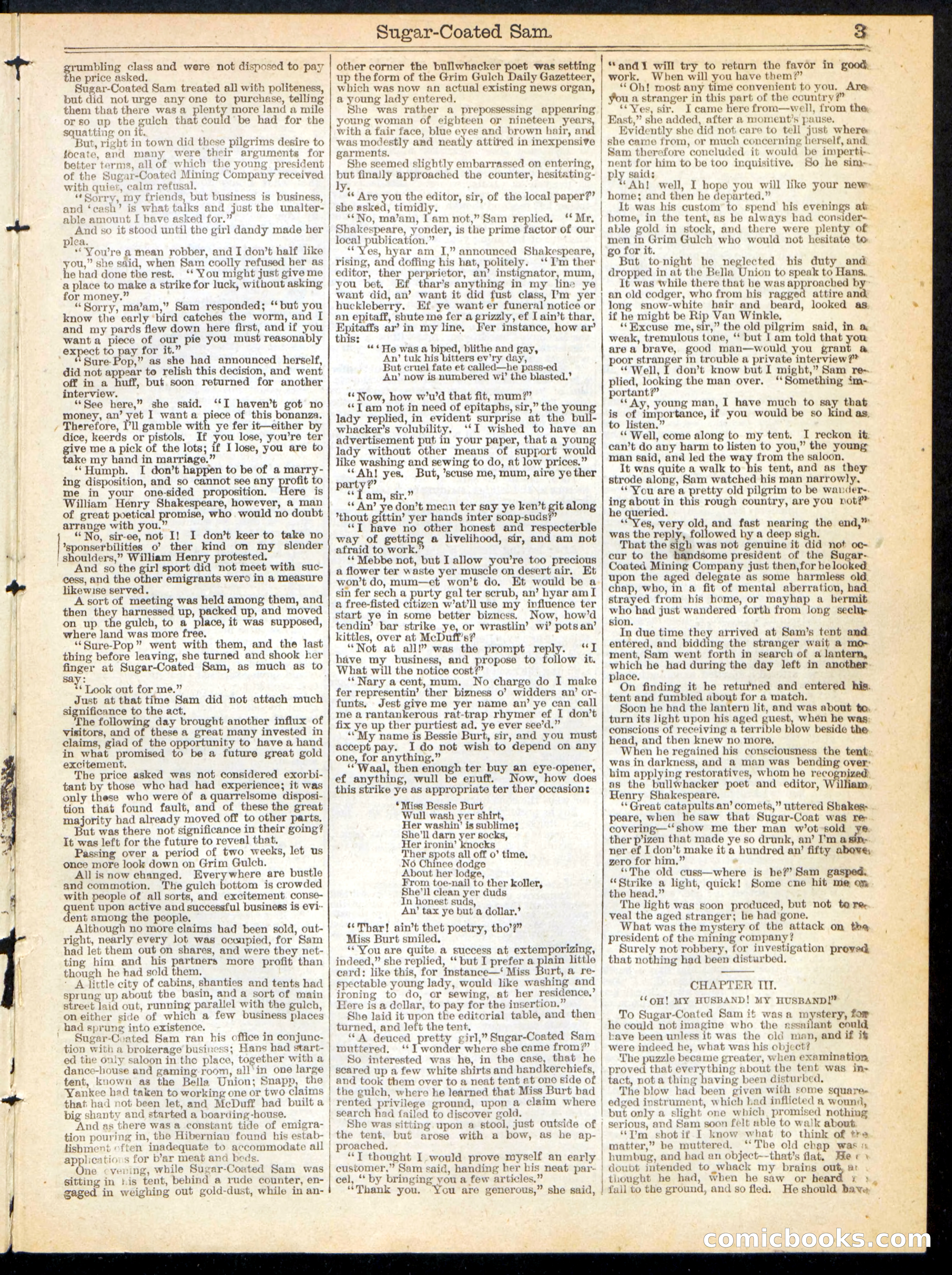
A restored page from Pulp Fiction, 1881. Page through the whole issue in the reader above.
📄 Transcribed text from this page (OCR, searchable)
Machine-transcribed from the original scan — historical spelling and the odd misread are preserved.
Sugar-Coated Sam. rumbling class and were not disposed to pay he price asked. Sugar-Coated Sam treated all with politeness, but did not urge any one to purchase, telling them that there was a plenty more land a mile orso up the guich that could’ be had for the squatting on it. But, right in town did these pilgrims desire to focate, and many were their arguments for better terms, allof which the young president of the Sugar-Coated Mining Company received with quiet, calm refusal. ‘Sorry, my friends, but business is business, and ‘cash’ is what talks and just the unalter- able amount [ have asked for.” And so it stood until the girl dandy made her plea. ‘You’re a mean robber, and I don’t half like you,” she said, when Sam coolly refused her as he had done the rest. ‘* You might just give me a place to make a strike for luck, without asking for money.” “Sorry, ma’am,” Sam responded; ‘but you know the early bird catches the worm, and I and my pards flew down here first, and if you wanta piece of our pie you must reasonably expect to pay for it.” ‘‘Sure-Pop,” as she had announced herself, did not appear to relish this decision, and went off in a huff, but soon returned for another interview. ‘‘See here,” she said. money, an’ yet 1 want a piece of this bonanza. Therefore, ll gamble with ye fer it—either by dice, keerds or pistols. If you lose, you’re ter give me a pick of the lots; if I lose, you are to take my hand in marriage.” ‘‘Humph. I don’t happen to be of a marry- ing disposition, and so cannot see any profit to me in your one-sided proposition. ere is William Henry Shakespeare, however, a man of great poetical promise, who would no doubt arrange with you.” ‘No, sir-ee, not I! I don’t keer to take no 'sponserbilities o’ ther kind on my slender shoulders,” William Henry protested. And so the girl sport did not meet with suc- cess, and the other emigrants wero in a measure likewise served. A sort of meeting was held among them, and then they harnessed up, packed up, and moved on up the gulch, to a place, it was supposed, where land was more free. ‘“Sure-Pop” went with them, and the last thing before leaving, she turned and shook her finger at Sugar-Coated Sam, as much as to say: ‘ Look out for me.” Just at that time Sam did not attach much significance to the act. The following day brought another influx of visitors, and of these a great many invested in claims, glad of the opportunity to have a hand in what promised to be a future great gold excitement, The price asked was not considered exorbi- tant by those who had had experience; it was only these who were of a bp ight ig disposi- tion that found fault, and of these the great majority had already moved off to other parts. But was there not significance in their going? It was left for the future to reveal that. Passing over a period of two weeks, let us once more look down on Grim Gulch. All is now changed. Everywhere are bustle and commotion. The guich bottom is crowded with people of all sorts, and excitement conse- , par upon active and successful business is evi- ent among the people. Although no more claims had been sold, out- right, nearly every lot was oceupied, for Sam had let them out on shares, and were they net- ting him and his partners more profit than though he had sold them. A little city of cabins, shanties and tents had sprung up about the basin, and a sort of main street laid out, running parallel with the gulch, oneither side of which a few business places had sprung into existence. Sugar-Coated Sam ran his office in conjunc- tion with a brokerage business; Hans had start- ed the Only saloon in tho place, together with a dance-house and gaming room, all‘in one large tent, kuown as the Bella Union; Snapp, the Yankee had taken to working one or two claims that had not been let, and McDuff had built a big shanty and started a boarding-house. And as there was a constant tide of emigra- tion pouring in, the Hibernian found his estab- lishment often inadequate to accommodate all applications for b’ar meat and beds. One cveving, while Sugar-Coated Sam was sitting in }.is tent, behind a rude counter, en- gaged in weighing out gold-dust, while in an- “*T haven’t got no other corner the bullwhacker poet was setting up the form of the Grim Gulch Daily Gazetteer, which was now an actual existing news organ, a young lady entered. She was rather a prepossessing appearing young woman of eighteen or nineteen years, with a fair face, blue eyes and brown hair, and was modestly and neatly attired in inexpensive garments. She seemed slightly embarrassed on entering, but finally approached the counter, hesitating- ly. ‘* Are you the editor, sir, of the local paper?’ she asked, timidly. ‘*No, ma’am, lam not,” Sam replied, ‘* Mr, Shakespeare, yonder, is the prime factor of our local publication.” ‘* Yes, hyar am I,” announced Shakespeare, rising, and doffing his hat, politely. ‘‘ I’m ther editor, ther perprietor, an’ instignator, mum, you bet. Ef thar’s anything in my line ye want did, an’ want it did fust class, ’m yer huckleberry. Ef ye want er funeral notice or an epitaff, shute me fer a grizzly, ef [ ain’t thar. Epitaffs ar’ in my line. Fer instance, how ar’ this: ““* He was a papee blithe and gay, An’ tuk his bitters ev’ry day, But cruel fate et called—he pass-ed An’ now is numbered wi’ the blasted.’ ‘Now, how w’u’d that fit, mum?” ‘‘T am not in need of epitaphs, sir,” the young lady replied, in evident surprise at the bull- whacker’s volubility. ‘‘I wished to have an advertisement put in your paper, that a young lady without other means of support would like washing and sewing to do, at low prices.” ‘Ah! yes. But, ’scuse me, mum, aire ye ther sar if 2 am, sir.” ‘* An’ ye don’t mean ter say ye ken’t git along ’thout gittin’ yer hands inter soap-suds?” ‘‘T have no other honest and respecterble way of getting a livelihood, sir, and am not afraid to work. ‘* Mebbe not, but I allow you’re too precious a flower ter waste yer muscle on desert air, Et won’t do, mum—et won’t do. Et would be a sin fer sech a purty gal ter scrub, an’ hyar am [ a free-fisted citizen w’at’ll use my influence ter start ye in some better bizness. Now, how’d tendin’ bar strike ye, or wrastlin’ wi’ pots an’ kittles, over at McDuff's? “Not at all!” was the prompt reply. ‘“I have my business, and propose to tollow it. What will the notice cost?’ ‘‘Nary acent, mum. No charge do I make fer representin’ ther bizness o’ widders an’ or- funts. Jest give me yer name an’ ye can call me a rantankerous rat-trap rhymer ef [ don’t fix ye up ther purtiest ad. ye ever see’d.” ‘‘ My name is Bessie Burt, sir, and you must accept pay. I do not wish to depend on any one, for anything.” ‘* Waal, then enough ter buy an eye-opener, ef anything, wull be enuff. Now, how does this strike ye as appropriate ter ther occasion: *Miss Bessie Burt Wull wash yer shirt, Her washin’ is sublime; She'll darn yer socks, Her ironin’ knocks Ther spots all off o’ time, No Chinee dodge About her lodge, From toe-nail to ther koller, She'll clean yer duds In honest suds, An’ tax ye but a dollar.’ ‘“Thar! ain’t thet poetry, tho’?” Miss Burt smiled. ‘You are quite a success at extemporizing, indeed,” she replied, ‘‘ but I prefer a plain little card: like this, for instance—‘ Miss Burt, a re- spectable young lady, would like washing and ironing to do, or sewing, at her residence,’ Here is a dollar, to pay for the insertion.” She laid it upon the editorial table, and then turned, and left the tent. “A deuced pretty girl,” Sugar-Coated Sam muttered. ‘* I wonder where she came from?” So interested was he, in the case, that he scared up a few white shirts and handkerchiefs, and took them over to a neat tent at ono side of the gulch, where he learned that Miss Burt had rented privilege ground, upon a claim where search had failed to discover gold. She was sitting upon a stool, just outside of the tent, but arose with a bow, as he ap- | proached. “T thought I would prove myself an early customer,” Sam said, handing her bis neat par- cel, ‘* by bringing you a few articles.” “Thank you. “andi will to return the favor in good. work. When will you have them?” ‘“Oh! most any time convenient to you. Are You a stranger in this part of the country” ‘Ves, sir. I came here from—well, from the East,” she added, after a moment’s pause. Evidently she did not care to tell just where she came from, or much concerning herself, and, Sam therefore concluded it would be imperti-. nent for him to be too inquisitive. So he sim-. ply said; ‘Ah! well, I hope you will like your new home; and then he departed.” It was his custom to spend his evenings at home, in the tent, as he always had consider- able gold in stock, and there were plenty of men in Grim Gulch who would not hesitate toe go for it. But tonight he neglected his duty and dropped in at the Bella Union to speak to Hans. It was while there that he was approached by” an old codger, who from his ragged attire and long snow-white hair and beard, looked as. if he might be Rip Van Winkle, ‘‘Excuse me, sir,” the old pilgrim said, in a weak, tremulous tone, ** but | am told that you area brave, good man—would you yah a poor stranger in trouble a private interview?” ‘‘ Well, I don’t know but 1 might,” Sam re-. plied, looking the man over. ‘‘ Something im- portant?’ ‘‘Ay, young man, I have much to say that is of importance, if you would be so kind as, to listen.” ‘Well, come along to my tent. I reckon it can’t do any harm to listen to you,” the young man said, and led the i from the saloon. It was quite a walk to his tent, and as they strode along, Sam watched his man narrowly, ‘*-You are a pretty old pilgrim to be wander-. ing about in this rough country, are you not?” he queried. ‘Yes, very old, and fast nearing the end,” was the reply, followed hy a deep sigh. That the sigh was not genuine it did not oc- cur to the handsome president of the Sugar- Coated Mining Company just then,for be looked. upon the aged delegate as some harmless old. chap, who, in a fit of mental aberration, had strayed from his home, or mayhap a hermit who had just wandered forth from long seelu- sion. In due time they arrived at Sam’s tent and. entered, and bidding the stranger wait a mo ment, Sam went forth in search of a lantern, wa wp he had during the day left in another rlace. On finding it he retuned and entered his. tent and fumbled about for a match. Soon he had the lantern lit, and was about to, turn its light upon his aged guest, when he was; conscious of receiving a terrible blow beside the head, and then knew no more, When he regained his consciousness the tent»: was in darkness, and a man was bending over: him applying restoratives, whom he recognized as the bullwhacker poet and editor, Wilham. Henry Shakespeare. ‘Great catapults an’ comets,” uttered Shakes - peare, when he saw that Sugar-Coat was re. covering—‘‘show me ther man w’ot sold y¥@, ther p’izen that made ye so drunk, an’ I’m asi. ner ef I don’t make it a hundred an’ fifty abowe, zero for him,” . ‘The old cuss—where is he?’ Sam gasped, “Strike a light, quick! Some cne hit me on. the head.” The light was soon produced, but not to re. veal the aged stranger; be had gone. What was the mystery of the attack on the president of the mining company? Surely not robbery, for investigation proved that nothing had been disturbed. CHAPTER ITI. ‘‘on! MY HUSBAND! MY HUSBAND!” To Sugar-Coated Sam it was a mystery, for he could not imagine who the rassailant could have been unless it was the old man, and if ig were indeed he, what was his object? The puzzle became greater, when examination proved that everything about the tent was in- tact, nota thing having been disturbed, The blow had been given with some square. edged instrument, which had inflicled a wound, but only a slight one which promised nothing serious, and Sam soon felt able to walk about. ‘I’m shotit I know what to think of trea matter,” be muttered. ‘“‘Tbe old chap was ‘1 humbug, and bad an object--that’s flat, He « » doubt intended to whack my brains out, a thought he had, when he saw or he er} You are generous,” she said, | fall to the ground, and so fled. He should bave eom (E Si 200k