
Pulp Fiction, 1877 · page 2 of 16
Beadle's Half Dime Library, No. 22 — page 2: what you’re looking at
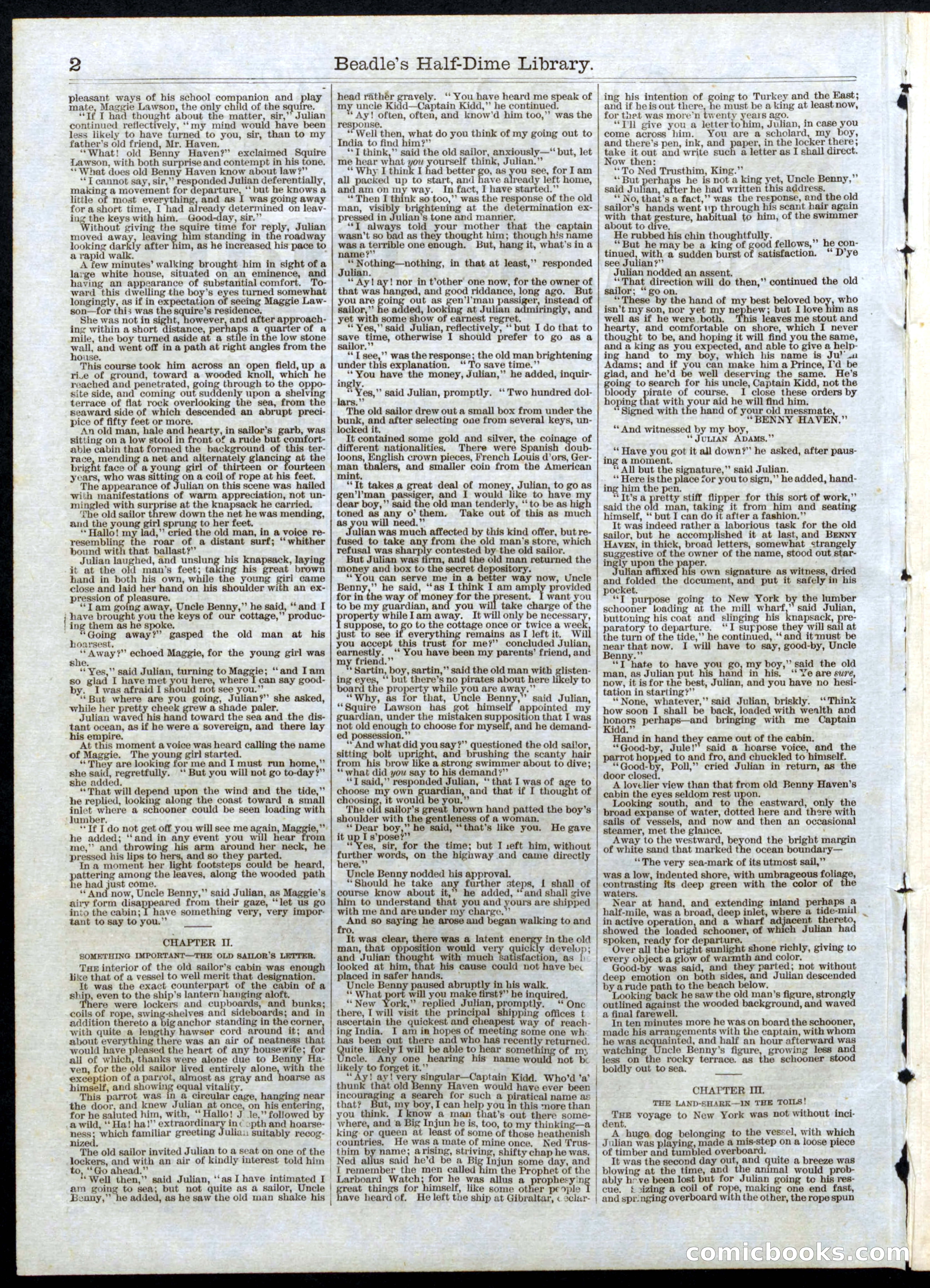
A restored page from Pulp Fiction, 1877. Page through the whole issue in the reader above.
📄 Transcribed text from this page (OCR, searchable)
Machine-transcribed from the original scan — historical spelling and the odd misread are preserved.
i. 2 ee eed iC _ pleasant ways of his school companion and play mate, Maggie Lawson, the only child of the squire. “Tf I had thought about the matter, sir,’’ Julian continued reflectively, ‘‘my mind would have been less likely to have turned to you, sir, than to my father’s old friend, Mr. Haven. “What! old Benny Haven?” exclaimed Squire Lawson, with both surprise and contempt in his tone. ‘** What does old Benny Haven know about law?” ‘*T cannot say, sir,” responded Julian deferentially, making a movement for departure, ‘* but he knows a little of most everything, and as I was going away for ashort time, I had already determined on leav- ing the keys with him. Good-day, sir.” Without giving the squire time for reply, Julian moved ioe: leaving him standing in the roadway looking darkly after him, as he increased his pace to a rapid walk. A few minutes’ walking brought him in sight of a large white house, situated on an eminence, and having an appearance of substantial comfort. To- ward this dwelling the boy’s eyes turned somewhat longingly, as if in expectation of seeing Maggie Law- son—for this was the squire’s residence, She was not in sight, however, and after approach- ing within a short distance, perhaps a quarter of a mile, the boy turned aside at a stile in the low stone wae and went off in a path at right angles from the ouse. This course took him across an open field, up a ri.e of ground, toward a wooded knoll, which he reached and penetrated, going through to the op site side, and coming out suddenly upon a shelving terrace of flat rock overlooking the sea, from the seaward side of which descended an abrupt preci- pice of fifty feet or more. An old man, hale and hearty, in sailor’s garb, was sitting on a low stool in front of a rude but comfort- able cabin that formed the background of this ter- race, mending a net and alternately eeneny at the bright face of a young girl of thirteen or fourteen years, who was sitting on a coil of rope at his feet. The appearance of Julian on this scene was hailed with manifestations of warm appreciation, not un- mingled with surprise at the knapsack he carried. The old sailor threw down the net he was mending, and the young girl sprung to her feet. ‘** Hallo! my lad,”’ cried the old man, in a voice re- resembli he roar of a distant surf; “whither bound with that ballast?” Julian laughed, and unslung his knapsack, laying it at the old man’s feet; taking his great brown hand in both his own, while the young girl came close and laid her hand on his shoulder with an ex- pression of pleasure. ‘*T am going away, Uncle Benny,” he said, *‘ and I have brought you the keys of our cottage,’’ produc- ing them as he spoke. ‘Going away?’ gasped the old man at his hoarsest. ‘*A way?’ echoed Maggie, for the young girl was 1e. ‘* Yes,” said Julian, turning to Maggie; ‘‘and Iam so glad I have met te here, where I can say good- by. I was afraid I should not see you.” ‘‘But where are you going, Julian?’ she asked, while her pretty cheek grew a shade paler. Julian waved his hand toward the sea and the dis- tant ocean, as if he were a sovereign, and there lay his empire. At this moment a voice was heard calling the name of Maggie. The young girl started. “They are looking for me and I must run home,” she said, regretfully. ‘* But you will not go to-day ye she added. ; “That will depend upon the wind and the tide,” he replied, looking along the coast toward a small inlet where a schooner could be seen loading with Jumber. ; ‘If I do not get off you will see me again, he added; ‘‘and in any event you will hear m me,’ and throwing his arm around her neck, he pressed his lips to hers, and so they parted. In a moment her light footsteps could be heard, yattering among the leaves, along the wooded path he had just come. ** And now, Uncle Benny,” said Julian, as Maggie's airy form Sieenppenned from their gaze, “let us go into the cabin; I have something very, very impor- tant to say to you.”’ CHAPTER II. SOMETHING IMPORTANT—THE OLD SAILOR’S LETTER, Tar interior of the old sailor’s cabin was enough like that of a vessel to well merit that designati si on. It was the exact counterpart of the cabin of a ship, even to the ship’s lantern hanging aloft. ere were lockers and cupboards, and bunks; coils of rope, swing-shelves and sideboards; and in addition thereto a big anchor standing in the corner with quite a lengthy hawser cord around it; and about ever here was an air of neatness that would have pleased the heart of any housewife; for all of which, thanks were alone due to Benny Ha- ven, for the old sailor lived entirely alone, with the ex on of a parrot, almost as gray and hoarse as himself, and paws ene vitality. This ot was a ci cage, hanging meer the door, and knew J ulian at once, on his entering, for he saluted him, with, “ Hallo! J Je,” followed by a wild, ‘‘ Ha! ha!” extraordinary inc opth and hoarse- ness; which familiar greeting Julia: suitably recog- nz * The old sailor invited Julian to a seat on one of the lockers, and with an air of kindly interest told him to, “Go ahead.”’ = ‘Well then,” said Julian, ‘‘as I have intimated I am going to sea; but not quite as a sailor, Uncle Benny,” he added, as he saw the old man shake his e,”” | thim by name; arising, striving, shifty chap he was. 'J remember the men called Beadle’s Half-Dime Library. head rathér gravely. ‘‘ You have heard me speak of my uncle Kidd—Captain Kidd,’ he continued. ‘Ay! often, often, and know’'d him too,”’ was the response, ** Well then, what do you think of my going out to India to find him?” ‘**T think,” said the old sailor, anxiously—*“ but, let me hear what you her think, Julian.”’ ‘* Why I think I had better go, as you see, for I am all packed up to start, and have already left home, and am on my way. In fact, I have started.” “Then I think so too,”’ was the response of the old man, visibly brightening at the determination ex- pressed in Julian’s tone and manner, “IT always told your mother that the captain wasn't so bad as they thought him; though his name was a terrible one enough. But, hang it, what's ina name?" 7 aaa nai in that at least,’’ responded ulian. ‘““Ayl ay! nor in t’other one now, for the owner of that was hanged, and good riddance, long ago. But you are going out as gen’l’man passiger, instead of sailor,’’ he added, looking at Julian niringly, and yet with some show of earnest regret. “Yes,” said Julian, reflectively, ‘*‘ but I do that to par time, otherwise I should prefer to go as a or.”’ **T see,’’ was the response; the old man brightening under this explanation. ‘“‘ To save time.”’ ‘You have the money, Julian,’’ he added, inquir- ingly. a Yes,” said Julian, promptly. ‘‘ Two hundred dol- re.” lars. The old sailor drew out a small box from under the bunk, and after selecting one from several keys, un- locked it. It contained some gold and silver, the coinage of different nationalities. There were Spanish doub- loons, English crown pieces, French Louis d’ors, Ger- = thalers, and smaller coin from the American n . ‘*TIt takes a great deal of money, Julian, to go as a passiger, and I would like to have m ear boy,’’ said the old man tenderly, ‘‘ to be as high toned as any o’ them. Take out of this as much as you will need.” ulian was much affected by this kind offer, but re- fused to take ane from the old man’s store, which refusal was sharply contested by the old sailor. But Julian was firm, and the old man returned the money and box to the secret depository. “You can serve mv in a better way now, Uncle Benny,’’ he said, ‘“‘as I think I am wr provided for in the way of money for the present. I want you to be my guardian, and you will take charge of the gh cf while lam away. It will only be mSCeneney suppose, to go to the cottage once or twice a wee just to see if everything remains asI leftit. Wi you accept this trust for me?’’ concluded Julian erst was A “You have been my parents’ friend, and m end.”’ ‘Sartin, boy, sartin,”’ said the old man with glisten- ing eyes, ‘‘ but there’s no pirates about here likely to board the —s, while you are away.”” ‘““Why, as for that, Uncle af * said Julian, “Squire Lawson has got himself appointed my guardian, under the mistaken supposition that I was not old enough to choose for myself, and he demand- ed possession.” ‘** And what did you say?”’ questioned the old sailor, sitting bolt upright, and brushing the scanty hair from his brow like a strong swimmer about to dive; ‘*what did you say to his demand?” “T said,’ responded Julian, ‘ that I was of to choose my own Ape and that if I tho t of t would be “as ig ang The old sailor's brown hand patted the boy’s shoulder with the gentleness of a woman. am Dear boy, he said, “that's like you. He gave up I s’pose “Yes, sir, for the time; but I :eft him, without —— words, on the highway and came directly ere, Uncle Benny nodded his approval. “Should he take any further steps, { shall of course know about it,”’ he added, “and shall give him to understand that you and yours are shipped with me and are under my charge.” 9 Ane EE Se eee eaing taand It was clear, there was a latent energy in the old man, that opposition would ver aoe develop; and Julian thought with much action, as t looked at him, that his cause could not have bec placed in safer hands. — Uncle Benny paused abruptly in his walk. * What will you make first?” he inquired. ‘‘New York,” replied Julian, promptly. “ Onc there, I will visit the princi shipping offices t ascertain the quickest and chea way of reach- ing India. I am in hopes of meeting some one wh has been out there and who has recently returned. uite likely I will be able to hear some of my ncle. Any one hearing his name wo not bc likely to forget it."’ “Ay! ay! very singular—Captain Kidd. Who'd ’a’ thunk that old Haven would have ever been inco a search for such a piratical name as that? t, my boy, I can help you in this nore than you think. I know a man that’s out there some- where, and a Big Injun he is, too, to my thinking—a king or queen at least of some of those heatheni countries. He was a mate of mine once. Ned Trus- Ned allus said he’d be a Bi Injun some day, and m the Prophet of the Larboard Watch; for he was allus a prophesyin at things for himself, like some other pe ple ave heard of. He left the ship at Gibraltar, « oclar- , a . . — — ————————— —— ee ing his intention of going to Turkey and the East; and if heis out there, he must be a king at least now, for thet was more’n twenty yearsago. | “Tl give you a letter to him, Julian, In case you come across him. You are a scholard, my _ boy, and there’s pen, ink, and paper, in the locker there; take it out and write such a letter as I shall direct. Now then: “To Ned Trusthim, King.”’ - ‘“‘But perhaps he is not a king yet, Uncle Benny, said Julian, after he had written this address. ** No, that’s a fact,’’ was the response, and the old sailor’s hands went up through his scant hair again with that gesture, habitual to him, of the swimmer about to dive. He rubbed his chin thoughtfully. FA “But he may be a king of good fellows,” he con- tinued, with a sudden burst of satisfaction. “ D’ye see Julian ?”’ Julian nodded an assent. “That direction will do then,’ continued the old sailor; “‘ go on. “These by the hand of my best beloved boy, who isn’t my son, nor yet my ge? otc but I love him as well as if he were. both. is leaves me stout and hearty, and comfortable on shore, which I never thought to be, and hoping it will find you the same, and a king as you expected, and able to give a help- ing hand to my boy, which his name is Ju’ .u Adams; and if you can make him a Prince, I'd be glad, and he’d be well deserving the same. He's going to search for his uncle, Captain Kidd, not the bloody pirate of course. I close these orders by hoping that with your aid he will find him. ** Signed with the hand of your old messm ate, BENNY HAVEN,” ‘**And witnessed by my boy, ** JULIAN ADAMS.” ‘“* Have you got it all down?” he asked, after paus- ing a moment. ‘All but the signature,” said Julian. ‘* Here is the place for you to sign,’’ he added, hand- ing him the pen. “Tt’s a pretty stiff flipper for this sort of work,”’ said the old man, taking it from him and seating himself, ** but I can do it after a fashion.” It was indeed rather a laborious task for the old sailor, but he accomplished it at last, and BENNY HAVEN, in thick, broad Jetters, somewhat strangely suggestive of the owner of the name, stood out star- ingly upon the r. Fulah affixed his own signature as witness, dried soe a the document, and put it safely in his ocket. ‘“T purpose going to New York by the lumber ghnoaes loadiie at the mill wharf,” said Julian, buttoning his coat and slinging his knapsack, pre- paratory to departure. “I suppose they will sail at the turn of the tide,’’ he continued, ‘‘ and itmust be near that now. I will have to say, good-by, Uncle Benny. re “hate to have you go, my boy,” said the old man, as Julian put h hand in his. “Ye are sure, now, it is for the best, Julian, and you have no hesi- tation in starting?”’ ' “None, whatever,” said Julian, briskly. ‘‘Thinx how soon I shall be back, loaded with wealth and ag perhaps—and bringing with me Captain Hand in hand they came out of the cabin. “*Good-by, Jule!” said a hoarse voice, and the parrot — to and fro, and chuckled to himself. **Good- Ys Poll,” cried Julian in return, as the door closed. A lovelier view than that from old Benny Haven’s cabin the eyes seldom rest upon. Looking south, and to the eastward, only the broad expanse of water, dotted here and there with sails of vessels, and now and then an occasional steamer, met the glance. Away to the westward, beyond the bright margin of white sand that marked the ocean boundary— “The very sea-mark of its utmost sail,” was a low, indented shore, with umbrageous a ag its deep green with the color of the waters. Near at hand, and extending inland perhaps 4 — ile, was . cape wri inlet, where . — ve operation, and a wharf showed the loaded schooner, of wien Julian had spoken, or departure. : Over all the bright sunlight shone richly, giving to every object a glow of warmth and color. Good-by was and they parted; not without deep emotion on both sides, and Julian descended by arude path to the beach below. Looking back he saw the old man’s figure, strongly _ outlined against the wooded background, and waved a final farewell. d sh In ten minutes more he was on board the schooner, made his arrangements with the captain, with whom he was acquainted, and half an hour afterward was watching Uncle Benny’s figure, growing less and less on the rocky terrace. as the schooner stood boldly out to sea. CHAPTER OL THE LAND-SHARK—IN THE TOILS! — voyage to New York was not without inci- ent, A huge dog belonging to the vessel, with which Julian was pisying, piss a mis-step on a loose piece of timber and tumbled overboard. — It was the second day out, and quite a breeze was blowing at the time, and the animal would prob- ably heve been lost but for Julian going to his res- cue. { sizing a coil of poe (1 making one end fast, and spr-nging overboard with the other, the rope spun ,OO cS <eom (E ‘ (E()