
Pulp Fiction, 1877 · page 6 of 16
Beadle's Half Dime Library, Vol. 1, No. 2 — page 6: what you’re looking at
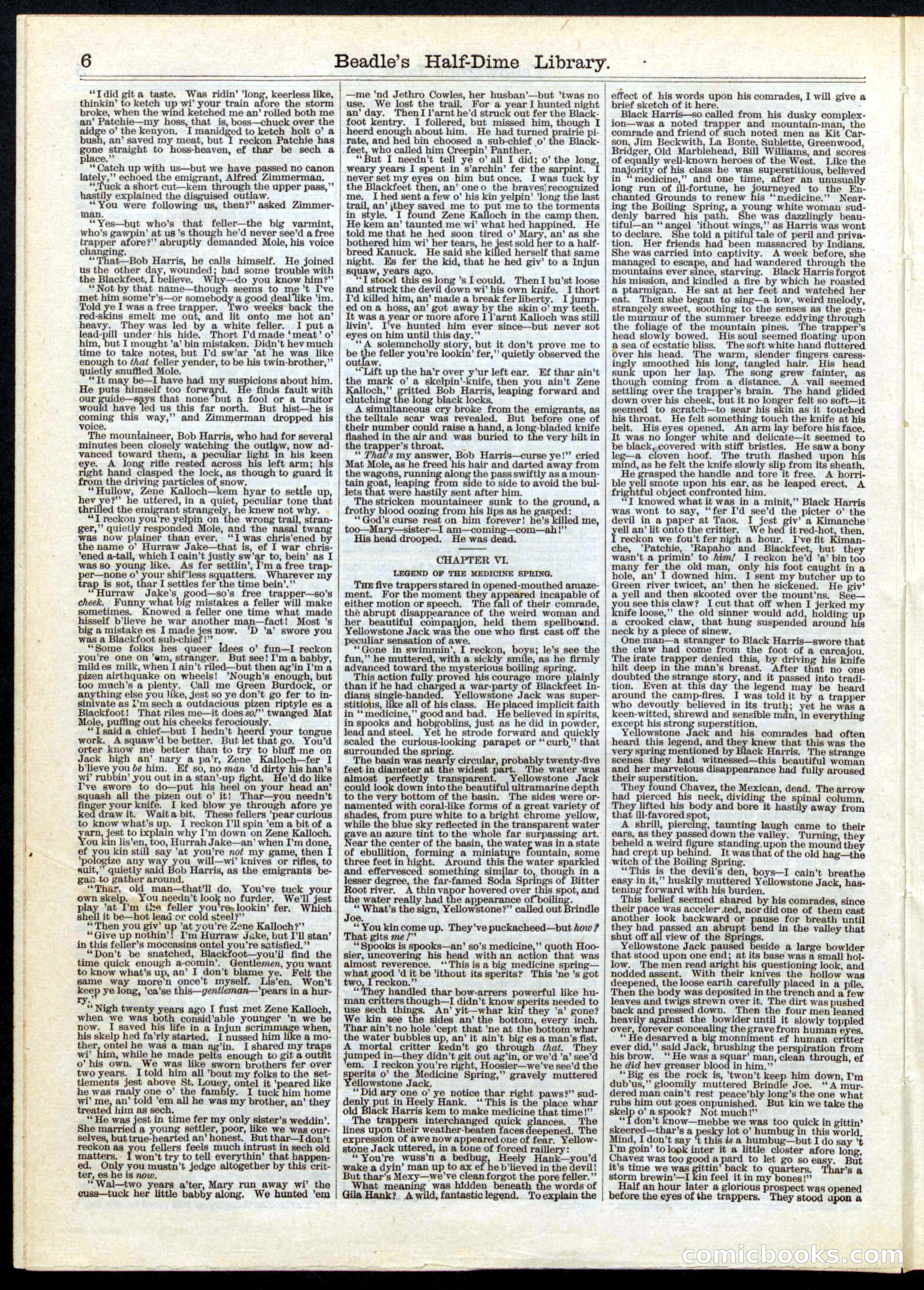
A restored page from Pulp Fiction, 1877. Page through the whole issue in the reader above.
📄 Transcribed text from this page (OCR, searchable)
Machine-transcribed from the original scan — historical spelling and the odd misread are preserved.
| —-— oo —_ . ~~ —— a ee ““T did git a taste. Was ridin’ ‘long, keerless like, thinkin’ to ketch up wi’ your train afore the storm broke, when the wind ketched me an’ rolled both me an’ Patchie—my hoss, that is, boss—chuck over the — o’ the kenyon, I manidged to ketch holt o’ a bush, an’ saved my meat, but I reckon Patchie has gone straight to hoss-heaven, ef thar be sech a place. “Catch up with us—but we pare. pemee no canon we fd echoed the emigrant, Zimmerman. “Tuck a short cut—kem through the upper pass,”’ hastily explained the disguised outlaw. “You were following us, then?’ asked Zimmer- man. *“Yes—but who’s that feller—the big varmint, who’s gawpin’ at us ’s though he’d never see’d a free trapper afore?’ abruptly demanded Mole, his voice changing. ol hhat~-Bob Harris, he calls himself. He joined us the other oy wounded; had some trouble with the Blackfeet, I believe. Why—do you know him?’ “Not by that name—though seems to me’t I’ve met him some’r’s—or somebody a good deal like ‘im. Told ye I was a free i ge o weeks back the red-skins smelt me out, and lit onto me hot an’ heavy. They was led by a white feller. I puta lead-pill under his hide. Thort I’d made ‘meat’ o’ him, but I mought ’a’ bin mistaken. Didn't hey much time to take notes, but I'd sw’ar ’at he was like a to that feller yender, to be his twin-brother,”’ quietly snuffled Mole. “It may be—I have had my suspicions about him. He puts himself too forward. He finds fault with ) pe ears that none but a fool or a traitor would have led us this far north. But hist—he is coming this way,’ and Zimmerman dropped his voice. The mountaineer, Bob Harris, who had for several minutes been closely watching the outlaw, now ad- vanced toward them, om ee iar light in his keen eye. A lo rifle res across his left arm; ht hand clasped the lock, as though to guard it from the driving particles of snow. “Hullow, Zene Kalloch—kem hyar to settle up hev ma he uttered, in a quiet, peculiar tone that t ed the emigrant strangely he knew not why. “T reckon you're yelpin on the wrong trail, stran- ger,” ape mee gh Mole, and the nasal twang was now plainer than ever. “I was chris’ened by the name o’ Hurraw Jake—that is, ef I war chris- ened a-tall, which I cain’t justly sw’ar to, bein’ as I was so young like. As fer settlin’, I’m a free trap- r—none o’ your shif’less squatters. Wharever my p_is sot, thar I settles fer the time bein’.”’ ““Hurraw Jake’s. good—so’s free trapper—so’s cheek. Funny what big mistakes a feller will make sometimes. Knowed a feller one time what made hisself b’lieve he war another man—fact! Most 's big a mistake es I made jes now. ‘D ’a’ swore you was a Blackfoot sub-chief!” “Some folks hes queer idees o’ fun—I reckon you're one on ’em, stranger. But see! I’m a babby, mildes milk, when I ain’t riled—but then ag’in I'm a ng airthquake on wheels! ’Nough’s enough, but much’s a plenty. Call me Green Burdock, or anything else you like, jest so ye don't go fer to in- sinivate as i’m sech a outdacious pizen riptyle es a Blackfoot! That riles me—it does so/’’ twanged Mat Mole, puffing out his cheeks ty oe “IT said a chief—but I hedn’t heerd your tongue work. A squaw’d be better. But let that go. You'd orter know me better than to try to bluff me on Jack high an’ ery a pa’r, Zene Kalloch—fer I b'lieve you be him. Ef so, no man ’d dirty his han’s wi’ rubbin’ you out in a stan’-up fight. He'd do like I've swore to do—put his heel on your h an’ squash all the pizen out o’ it! Thar—you needn't finger your knife. I ked blow ye through afore ye ked draw it. Waita bit. These fellers pear curious to know what’s up. I reckon I'll spin ’em a bit of a Senin gg to ixplain why I’m down on Zene Kalloch, ou lis’en, too, Hurrah Jake—an’ when I’m done ef bee kin still say ’at you’re not my game, then ‘pologize any way you will—wi’ knives or rifles, to suit,’’ quietly said Bob Harris, as the emigrants be- to gather around. “Thar, old man—that’ll do. You've tuck your own skelp. You needn't look no furder. We'll jest play ‘at I’m the feller you're, lookin’ fer. Which shell it be—hot lead or cold steel?”’ “Then you giv’ up ’at you're Zene Kalloch?”’ “Give up nothin’! I’m Hurraw Jake, but I'll stan’ in this feller’s moccasins ontel you’re satisfied.” “Don’t be snatched, B oot—you’l find the time quick enough a-comin’. Gentlemen, you want to know what’s up, an’ I don’t blame ye. Felt the same way more’n once’t myself. ‘en. Won't keep ye long, ’ca'se this—gentleman—'pears in a hur- ‘ Nigh twenty years ago I fust met Zene Kalloch, when we was both consid’able younger 'n we be now. I saved his life in a Injun se when, his skelp hed fa’rly started. I nussed him like a mo- ther, ontel he was a man ag’in. I shared my traps wi’ him, while he made pelts enough to git a outfit o’ his own. We was like sworn brothers fer over two years. I told him all bout my folks to the set- tlements jest above St. Louey, ontel it ‘peared like he was may one 0’ the fam ly. I tuck him home wi’ me, an’ told ’em all he was my brother, an’ they treated him as sech. ‘* He was jest in time fer my only sister’s weddin’. She married a young settler, poor, like we was our- selves, but true-h an’ honest, But thar—I don’t reckon as you fellers feels much intrust in sech old matters. t won't try to tell everythin’ that happen- ed. Only you mustn’t jedge altogether by this crit- ter Mary run away wi’ the 7 OS he is now, ‘*Wal—two years a’ter, cuss—tuck her little babby along. We hunted ’em a —me ‘nd Jethro Cowles, her husban’—but *twas no | effect of his words upon his comrades, I will give a use. We lost the trail. For a pom: I hunted night brief sketch of it here. an’ day. ThenIl’arnt he'd struc heerd enough about him. He had turned prairie pi- rate, and hed bin choosed a sub-chief o’ the Black- feet, who called him Creepin’ Panther. “But I needn’t tell ye o’ all I did; o’ the long weary years I spent in s’archin’ fer the int. I never set my eyes on him but once. I was tuck by the Blackfeet then, an’ oneo the braves’ recognized me. I hed sent a few o’ his kin yelpin’ ‘long the last oe an’ per saved me to put me to the torments in style. I found Zene och in the camp then. He kem an’ taunted me wi’ what hed happined. He told me that he hed soon tired o’ Mary, an’ as she bothered him wi’ her tears, he jest sold her to a half- breed Kanuck. He said she killed herself that same night. Es fer the kid, that he hed giv’ to a Injun squaw, years ago. ‘“*I stood this es long ’s Icould. ThenI bu’st loose and struck the devil down wi’ his own knife. I thort I'd killed him, an’ made a break fer liberty. I ep ed on a hoss, an’ got away by the skin o’ my teeth. It was a year or more afore I arnt Kalloch was still livin’. I’ve hunted him ever since—but never sot eyes on him until this day.”’ ‘*A solemncholly story, but it don’t prove me to be the feller you’re lookin’ fer,” quietly observed the outlaw. ‘Lift up the ha’r over y’ur left ear. Ef thar ain't the mark o’ a skelpin’-knife, then you ain’t Zene Kalloch,”’ apes Bob Harris, leaping forward and clutching the long black locks. A simultaneous cry broke from the emigrants, as the telltale scar was revealed. But before one of their number could raise a hand, a long-bladed knife flashed in the air and was buried to the very hilt in the trapper’s throat. __ ** That's my answer, Bob Harris—curse ye!”’ cried Mat Mole, as he freed his hair and darted away from the wagons, running along the pass swiftly as a moun- tain goat, leaping from side to side to avoid the bul- lets that were hastily sent after him. The stricken mountaineer sunk to the ground, a frothy blood oozing from his lips as he gasped: ‘**God’s curse rest on him forever! he’s killed me, too—Mary—sister—I am—coming—com—ah!”’ His head drooped. He was dead. CHAPTER VI. LEGEND OF THE MEDICINE SPRING. THE five trappers stared in opened-mouthed amaze- ment. For the moment they a incapable of either motion or speech. The fall of their comrade the abrupt disappearance of the weird woman and her beautiful com on, held them spellbound. Yellowstone Jack was the one who first cast off the uliar sensation of awe. *“Gone in swimmin’, I reckon, boys; le’s see the fun,’ he muttered, with a sickly smile, as he firmly advanced toward the mysterious boiling spring. This action fully proved his courage more plainly than if he had charged a war-party of Blackfeet In- dia ye Yellowstone Jack was super- stitious, like all of his class. He placed implicit faith in ** medicine,” goodand bad. He believed in spirits, in spooks and hobgoblins, just as he did in powder, ] and steel. Yet he strode forward and quickly scaled the curious-looking parapet or ‘‘curb,”’ that surrounded the spring. The basin was nearly circular, probably twenty-five feet in diameter at the widest part. The water was almost rfectly transparent. Yellowstone Jack could look down into the beautiful ultramarine depth to the very bottom of the basin. The sides were or- namented with coral-like forms of a great variety of shades, from pure white to a bright chrome yellow, while the blue sky reflected in the transparent water ve an azure tint to the whole far surpassing art. ear the center of the basin, the water was in a state of ebullition, forming a oe ountain, some three feet in hight. Around this the water sparkled and efferv something =i to, though in a lesser degree, the far-famed Spring of Bitter Root river. A thin vapor hovered over this spot, and the water really had the appearance of boiling. ; “What's the sign, Yellowstone?” called out Brindle oe. “You kin come up. They’ve puckacheed—but how ? That gits me /”’ “Spooks is spooks—an’ so’s medicine,’’ quoth Hoo- sier, uncovering his head with an action that was almost reverence. ‘This is a big medicine spring— moee ‘d it be ‘ithout its sperits? This ‘ne ’s got oO on.” ~ They handled thar bow-arrers powerful like hu- man critters though—I didn’t know sperits needed to use sech thin An’ yit—whar kin they ‘a’ gone? We kin see the sides an’ the bottom, every inch, Thar ain’t no hole ‘cept that ‘ne at the bottom whar the water bubbles up, an’ it ain’t big es a man’s fist. A mortal critter kedn’t go through (that. They jumped in—they didn’t git out ag’in, or we’d ’a’ see’d em. Ireckon you're right, Hoosier—we've see’d the = o’ the Medicine Spring,’ gravely muttered éllowstone Jack. ‘Did ary one o’ ye notice thar right paws?’’ sud- denly put in Heely Hank. ‘This is the place whar old Black Harris kem to make medicine t time!” The trappers interchanged quick glances. The lines upon their weather-beaten faces deepened. The expression of awe now aap 9 one of fear. Yellow- stone Jack uttered, in a tone of forced raillery: *You’re wuss’n a ——- Heely Hank—you’d wake a dyin’ man up to axe he b’lieved in the devil! But thar’s Mexy—we’ve clean forgot the pore feller.”’ What meaning was hidden beneath the words of Gila Hank? A wild, fantasticlegend. Toexplain the out fer the Black- | foot kentry. I follered, but missed him, though I | Black Harris—so called from his dusky complex- ion—was a noted er pee and mountain-man, the comrade and friend of such noted men as Kit Car- son, Jim Beckwith, La Bonte, Sublette, Greenwood, Bridger, Old Marblehead, Bill Williams, and scores of equally well-known heroes of the West. Like the majority of his class he was superstitious, believed in “‘medicine,” and one time, after an unusually long run of ill-fortune, he j chanted Grounds to renew ing the Boiling Spring, a young white woman sud- denly barred his path. She was dazzlingly beau- tiful—an “angel ‘ithout wings,’’ as Harris was wont to declare. She told a pitiful tale of peril and priva- tion. Her friends had been massacred by Indians. She was carried into captivity. A week before, she manages to escape, and had wandered through the mountains ever since, starving. Black Harris forgot his mission, and kindled a fire by which he fégated a ptarmigan. He sat at her feet and watched her eat. Then she began to sing—a low, weird melody, strangely sweet, soothing to the senses as the gen- tle murmur of the summer breeze Weer through the foliage of the mountain pines. The trapper’s head slowly bowed. His soul seemed floating upon a sea of ecstatic bliss. The soft white hand fluttered over his head. The warm, slender fingers caress- ingly smoothed his long, tangled hair. His head sunk upon her lap. e song grew fainter, as though coming from a distance. A vail seemed settling over the trapper’s brain. The hand glided down over his cheek, but it no longer felt so soft—it seemed to scratch—to sear his skin as it touehed his throat. He felt something touch the knife at his belt. His eyes opened. An arm lay before his face, It was no longer white and delicate—it seemed to be black, covered with stiff bristles. He sawa bon leg—a cloven hoof. The truth flashed upon h mind, as he felt the knife slowly slip from its sheath, He sped the handle and tore it free. A horri- ble yell smote upon his ear, as he leaped erect. A frig tful object confronted him. “I knowed what it was in a minit,’’ Black Harris was wont to say, “fer I'd see’d the picter o’ the devil in a paper at Taos. I jest giv’ a Kimanche ell an’ lit onto the critter. We hed it red-hot, then. reckon we fou’t fer nigh a hour. I've fit an- che, ‘Patchie, "Rapaho and Blackfeet, but they wasn’t a primin’ to him/ I reckon he'd ‘a’ bin too many fer the old man, only his foot caught in a hole, an’ I downed him. I sent my butcher up to Green river twicet, an’ then he sickened. He giv’ a yell and then skooted over the mount’ns. See— — see this claw? I cut that off when I jerked my nife loose,’’ the old sinner would add, holding u a crooked claw, that hung suspende his neck by a piece of sinew. One man—a stranger to Black Harris—swore that the claw had come from the foot of a carcajou. The irate trapper denied this, by driving his knife hilt deep in the man’s breast. After that no one doubted the strange story, and it passed into tradi- tion. Even at this day the legend may be heard around the camp-fires. I was told it by a trapper who devoutly believed in its truth; yet he was a keen-witted, shrewd and sensible man, in everything except his strong superstition. Yellowstone Jack and his comrades had often heard this legend, and they knew that this was the very spring mentioned by k Harris. The strange scenes they had witnessed—this beautiful woman and her marvelous disappearance had fully aroused their superstition. They found Chavez, the Mexican, dead. The arrow had pierced his neck, dividing the spinal column. They lifted his body and bore it hast a gp t, POSE AM 2 shrill, piercing, taunting laugh came to their ears, as they pasted down the valley. Turning, they beheld a weird figure pp peg the mound they had ae up behind. It was that of the old hag—the witch of the Boiling Spring. Sago sania oes cain’t breathe easy in it,’’ huskily mutter ellowstone Jack, has- tening forward with his burden. * This belief seemed shared by his comrades, since their pace was acceler’ ted, nor did one of them cast another look backward or wey for breath until they had an abrupt bend in the valley that shut off all view of the Springs. Yellowstone Jack paused beside a large bowlder that stood upon one end; at its base was a small hol- low. The men read aright his ome og look, and nodded assent. With their knives the hollow was deepened, the loose earth carefully placed in a pile. Then the body was deposited in the trench and a few leaves and twigs strewn over it. The dirt was pushed back and pressed down. Then the four men leaned heavily against the bowlder until it slowly toppled over, forever concealing the _we from human eyes, “He desarved a big monniment ef human orftter ever did,’’ said Jack, brushing the perspiration from his brow. ‘ He was a squar’ man, clean through, ef he did hev greaser blood in him.” “ Big es the rock is, ‘twon’t keep him down, I’m dub’us,”’ gloomily muttered Brindle Joe. “A mur- dered man cain’t rest peace’bly long’s the one what rubs him out goes onpunished. But kin we take the skelp o’ a spook? Not much!” “I don’t know—mebbe we was too quick in gittin’ skeered—thar’s a pesky lot o’ humbug in this world, Mind, I don’t say ‘t this is a humbug—but I do say 't I'm goin’ to lopk inter it a little closter afore long. Chavez was too good apard to let go so . But it’s time we was gittin’ back to quarters. ‘sa os? yA tn 29 re — it in my bones!” an hour later a glorious prospect was opened before the eyes of the trappers. They stood upon a ourneyed to the En- is “‘medicine.”’ Near- aroun away from “S -- ee SOMME DOCS Eo) _————-