
Pulp Fiction, 1880 · page 3 of 16
Beadle's Half Dime Library No. 168 — page 3: what you’re looking at
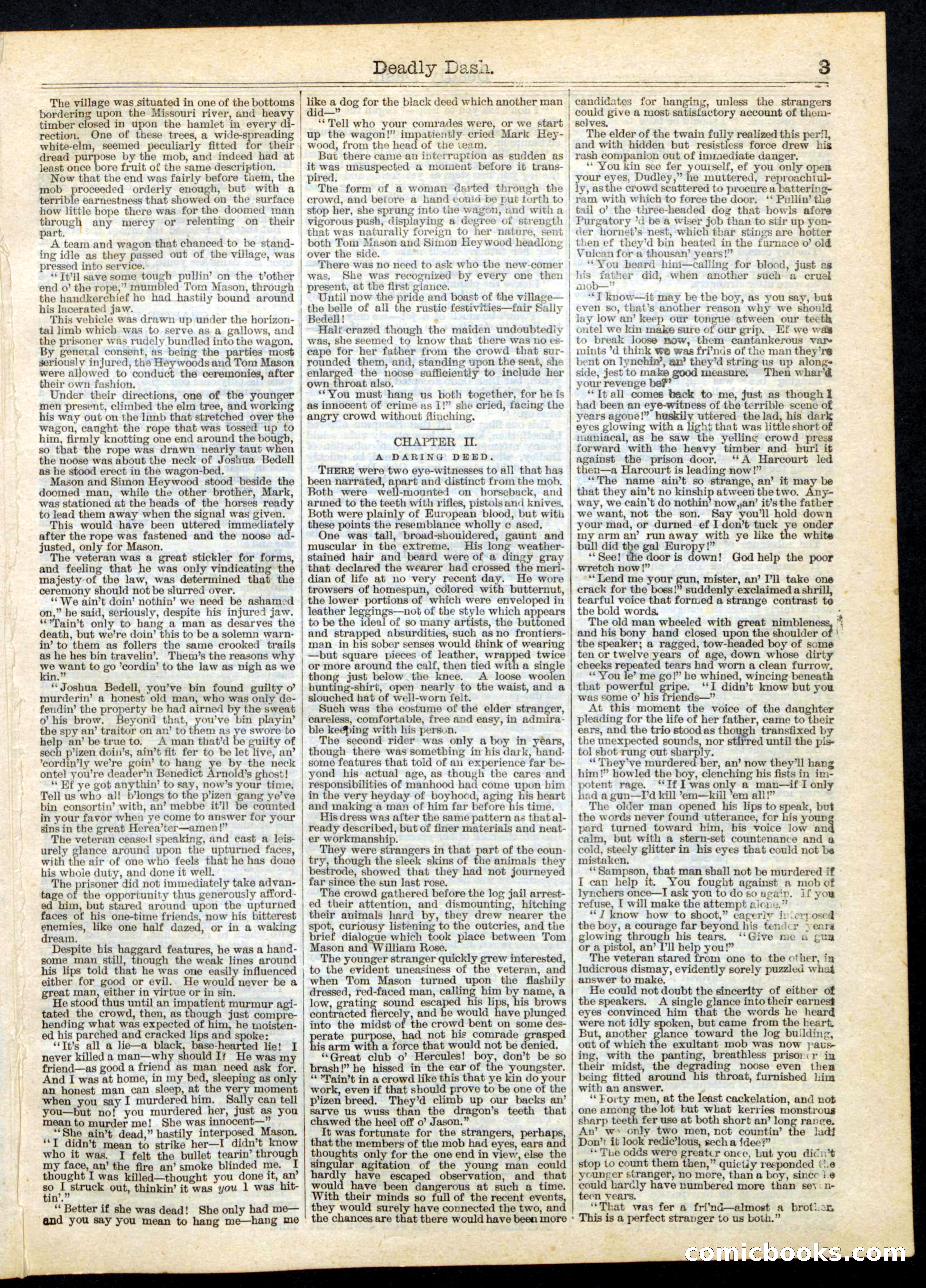
A restored page from Pulp Fiction, 1880. Page through the whole issue in the reader above.
📄 Transcribed text from this page (OCR, searchable)
Machine-transcribed from the original scan — historical spelling and the odd misread are preserved.
The village was situated in one of the bottoms bordering upon the Missouri river, and hea timber closed in upon the hamlet in every di- rection. One of these trees, a wide-spreading white-elm, seemed peculiarly fitted for their dread x te by the mob, and indeed had at least once bore fruit of the same description. Now that the end was fairly before them, the mob proceeded orderly enough, but with a terrible earnestness that showed on the surface how little hope there was for the doomed man through any merey or relenting part. A team and wagon that chanced to be stand- ing idle as they passed out of the village, was pressed into service. ‘‘Tt’'ll save some tough pullin’ on the t’other end o’ the rope,” mumbled Tom Mason, through his lacerated jaw. This vehicle was drawn up under the horizon- tal limb which was to serve as a gallows, and | the prisoner was rudely bundled into the wagon. By general consent, as being the parties most seriously injured, tha Heywoods and Tom Mason were allowed to conduct the ceremonies, after their own fashion. Under their directions, one of the younger men present, climbed the elm tree, and working his way out on the limb that stretched over the wagon, caught the rope that was tossed up to him, firmly knotting one end around the bough, so that the rope was drawn nearly taut when the noose was about the neck of Joshua Bedell as he stood erect in the wagon-bed. Mason and Simon Heywood stood beside the doomed man, while the other brother, Mark, was stationed at the heads of the horses ready to lead them away when the signal was given. This would have been uttered immediatel after the rope was fastened and the noose ad- justed, only for Mason. The veteran was a great stickler for forms, and feeling that he was only vindicating the majesty of the law, was determined that the ceremony should not be slurred over. ‘* We ain’t doin’ nothin’ we need be ashamed on,” he said, seriously, despite his injured jaw. ‘°Tain’t only to hang a man as desarves the death, but we’re doin’ this to be a solemn warn- in’ to them as follers the same crooked trails as he hes bin travelin’. Them’s the reasons why we want to go ’cordin’ to the law as nigh as we in ‘Joshua Bedell, you’ve bin found guilty o’ murderin’ a honest old man, who was only de- fendin’ the property he had airned by the sweat 0’ his brow. Beyond that, you’ve bin playin’ the spy an’ traitor on an’ to them as ye swore to help an’ be true to. A man that’d be guilty of sech p’izen doin’s, ain’t fit fer to be let live, an’ ’cordin’ly we’re goin’ to hang ye by the neck ontel you’re deader’n Benedict Arnoild’s ghost! “ Ef ye got anythin’ to say, now’s your time. Tell us who al! b’longs to the p’izen gang ye’ve bin consortin’ with, an’ mebbe it'll be counted in your favor when ye come to answer for your sins in the great Herea’ter—amen!” The veteran ceased speaking, and cast a leis- urely glance around upon the upturned faces, with the air of one who feels that he has done his whole duty, and done it well. The prisoner did not immediately take advan- tage of the opportunity thus generously afford- ) , but stared around upon the upturned faces of his one-time friends, now his bitterest enemies, like one half dazed, or in a waking dream. | vy | Deadly Dasa. a a dog for the black deed which another man a ‘**Tell who your comrades were, or we start up the wagon!” impatiently cried Mark Hey- | } on their | wood, from the head of the team. But there came an interruption as sudden as it was unsuspected a moment before it trans- pired. The form of a woman darted through the crowd, and betore a hand could be put torth to a ee | | | | stop her, she sprung into the wagon, and with a | vigorous push, displaying a degree of strength that was naturally foreign to her nature, sent | both Tom Mason and Simon Hey wood headlong over the side. 3 —— ——- — - ——_ —.-- ~-* a ee candidates for hanging, unless the strangers could give a most satisfactory account of them- sel] ves, The elder of the twain fully realized this peril, and with hidden but resistless force drew his rash companion out of imraediate danger. ‘* You kin see fer yourself, ef you only oper your eyes, Dudley,” he muttered, reproachtul- ly, asthe crowd scattered to procure a battering- ram with which to force the door. ‘‘ Pullin’ the tail o’ the three-headed dog that howls afore Purgatory ’d be a wiser job than to stir up yon- der hornet’s nest, which thar stings are hotter | then ef they’d bin heated in the furnace o’ old There was no need to ask who the new-comer | was, She was recognized by every one then | present, at the first giance. the handkerchief he had hastily bound around | Until now the pride and boast of the vilaze— the belle of all the rustic festivities—fair Sally Bedell! Halt crazed though the maiden undoubtedly was, she seemed to know that there was no es- cape for her father from the crowd that sur- rounded them, and, standing wpon the seat, she enlarged the noose sufficiently to include her own throat also. ‘You must hang us both together, for he is | as innocent of crime as 1!” she cried, facing the | ; es en — Despite his haggard features, he was a hand- | some man still, though the weak lines around | his lips told that he was one easily influenced either for good or evil.. He woul reat man, either in virtue or in sin. He stood thus until an impatient murmur agi- tated the crowd, then, as though just compre- hending what was expected of him, he moisten- ed his parched and cracked lips and spoke: ‘‘Tt’s all a Jie—a black, base-hearted lie! I never killed a man—why should I? He was my friend—as good a friend as man need ask for, And I was at home, in my bed, sleeping as only an honest man can sleep, at the very moment when you say I murdered him. Sally can tell you—but no! you murdered her, just as you mean to murder me! She was innocent—” “She ain’t dead,” hastily interposed Mason. *T didn’t mean to strike her—I didn’t know who it was. I felt the bullet tearin’ through my face, an’ the fire an’ smoke blinded me. thought I was killed—thought you done it, an’ s0 J struck out, thinkin’ it was you 1 was hit- “Better if she was dead! She only had me— and you say you mean to hang me—hang me never be a | | | | angry crowd without flinching, CHAPTER IL A DARING DEED. THERE were two eye-witnesses to all that has been narrated, apart and distinct from the mob. Both were well-mounted on horseback, and armed to the teeth with rifles, pistols and knives. Both were plainly of European blood, but with these points the resemblance wholly ¢ ased, One was tall, broad-shouldered, gaunt and muscular in the extreme. His long weather- stained hair and beard were of a dingy gray that declared the wearer had crossed the meri- dian of life at no very recent day. He wore trowsers of homespun, colored with butternut, the lower portions of which were enveloped in leather leggings—not of the style which appears to be the ideal of so many artists, the buttoned and strapped absurdities, such as no frontiers- man in his sober senses would think of wearing —but square pieces of leather, Mp twice or more around the calf, then tied with a single thong just below the knee. A loose woolen bunting-shirt, open nearly to the waist, and a slouched hat of well-worn felt. Such was the costume of the elder stranger, careless, comfortable, free and easy, in admira- ble ke@ping with his person. The second rider was only a boy in yéars, though there was sometbing in his dark, hand- some features that told of au experience far be- yond his actual age, as though the cares and responsibilities of manhood had come upon him in the very heyday of boyhood, aging his heart and making a man of him far before his time. His dress was after the same pattern as that al- ready described, but of finer materials and neat- er workmansbip. They were strangers in that part of the coun- try, though the sleek skins of the animals they bestrode, showed that they had not journeyed far since the sun last rose. The crowd gathered before the log jail arrest- ed their attention, and dismounting, hitching their animals hard by, they drew nearer the spot, curiousy listening to the outcries, and the brief dialogue which took place between Tom Mason and William Rose. The younger stranger quickly grew interested to the evident uneasiness of the veteran, an when Tom Mason turned upon the flashily dressed, red-faced man, calling him by name, a low, grating sound — his lips, his brows contracted fiercely, and he would have plunged into the midst of the crowd bent on some des- rate pu , had not his comrade gra his arm with a force that would not be denied. ‘‘Great club o’ Hercules! boy, don’t be so brash!” he hissed in the ear of the youngster. “ *Tain’t in a crowd like this that ye kin do your work, even if that should prove to be one of the p’izen breed. They’d climb up our backs an’ sarve us wuss than the dragon’s teeth that chawed the heel off o’ Jason.” It was fortunate for the strangers, perhaps that the members of the mob had eyes, ears and thoughts only for the one end in view, else the singular agitation of the young man could assy | have escaped observation, and that would have been dangerous at such a time. With their minds so full of the recent events, they would surely have connected the two, and Vulcan for a thousan’ years!” ‘You heard hini—calling for blood, just as iis father did, when another such a cruel mob—” ‘*T know—it may be the boy, as you say, but even so, that’s another reason why we should | lay low an’ keep our tongue atween our teeth _ ontel we kin make sure of our grip. et ai LL LLL LL LL LLL LL Ef we was to break loose now, them cantankerous vare iwints ’d think We was fri’nds of the man they’re bent on lynchin’, an’ they’d string us up alongs side, jest to make good measure. Then whar’¢ your revenge bef? “It all comes back to me, just as though I had been an eye-witness of the terrible scene of years agone!” huskily uttered the lad, his dark eyes glowing with a light that was little short of maniacal, as he saw the yelling crowd press forward with the heavy timber and burl it against the prison door. ‘‘A Harcourt led then—a Harcourt is leading now!” “The name ain’t so strange, an’ it may be that they ain’t no kinship atween the two. y- way, we cain’t do nothin’ now,,an’ it’s the father we want, not the son. Say you'll hold down your mad, or durned ef I don’t tuck ye onder my arm an’ run away with ye like the white bull did the gal Europy!” ‘See! the door is down! God help the poor wretch now!” ‘Lend me your gun, mister, an’ I'll take one crack for the boss!” suddenly exclaimed a shrill, tearful voice that formed a strange contrast te the bold words, The old man wheeled with great nimbleness, * and his bony hand closed upon the shoulder of | the speaker; a ragged, tow-headed boy of some ten or twelve years of age, down whose dirty cheeks repeated tears had worn a clean furrow. ‘* ‘You le’ me go!” he whined, wincing beneath that powerful gripe. ‘I didn’t know but you was some 0’ his friends—” At this moment the voice of the daughter pleading for the life of her father, came to their ears, and the trio stoodas though transfixed by the unexpected sounds, nor stirred until the pis- tol shot rung out sharply. “ 'They’ve murdered her, an’ now they'll hang him!” howled the boy, clenching his fists in im- otent rage. “If I was only a man—if I only had a gun—I’d kill °em—kill ’em all!” The older man opened his lips to speak, but the words never found utterance, for his youn pard turned toward him, his voice low an calm, but with a stern-set countenance and a cold, steely glitter in his eyes that could not be mistaken, ‘‘Sampson, that man shall not be murdered if I can help it. You fought against a mob of lynchers once—I ask you to do s0 ugair. if you refuse, [ will make the attempt alone.” **7 know how to shoot,” eagerly in erposed the boy, a courage far beyond his tendcr \enré glowing through his tears. ‘‘Give me a guy or a pistol, an’ l’ll help you!” The veteran stared foe one to the other, in ludicrous dismay, evidently sorely puzzled what answer to make. He could not doubt the sincerity of either of the speakers. <A single glance into their earnest eyes convinced him that the words he heard were not idly spoken, but came from the heart. But, another Me toward the log building, out of which the exultant mob was now jpaus- ing, with the panting, breathless prison: r in their midst, the degrading noose even then being fitted around his throat, furnished him with an answer. ; ‘* Forty men, at the least cackelation, and not one among the lot but what kerries monstroug sharp teeth fer use at both short an’ long range. An’ w only two men, not countin’ the ladf Don’t it look redic’lous, sech a idee?” ‘** The odds were greatcr once, but you dici’t stop to count them then,” quictiy responded (!.e younger stranger, no more, than a boy, since }.¢@ could harcly have numbered more than sev: n- teen vears. ‘That was fer a fri'nd—almost a brott.cn the chances are that there would have been more ‘ This is a perfect stranger to us both.” EOI om