
Pulp Fiction, 1880 · page 14 of 20
Beadle's Half Dime Library No. 167 — page 14: what you’re looking at
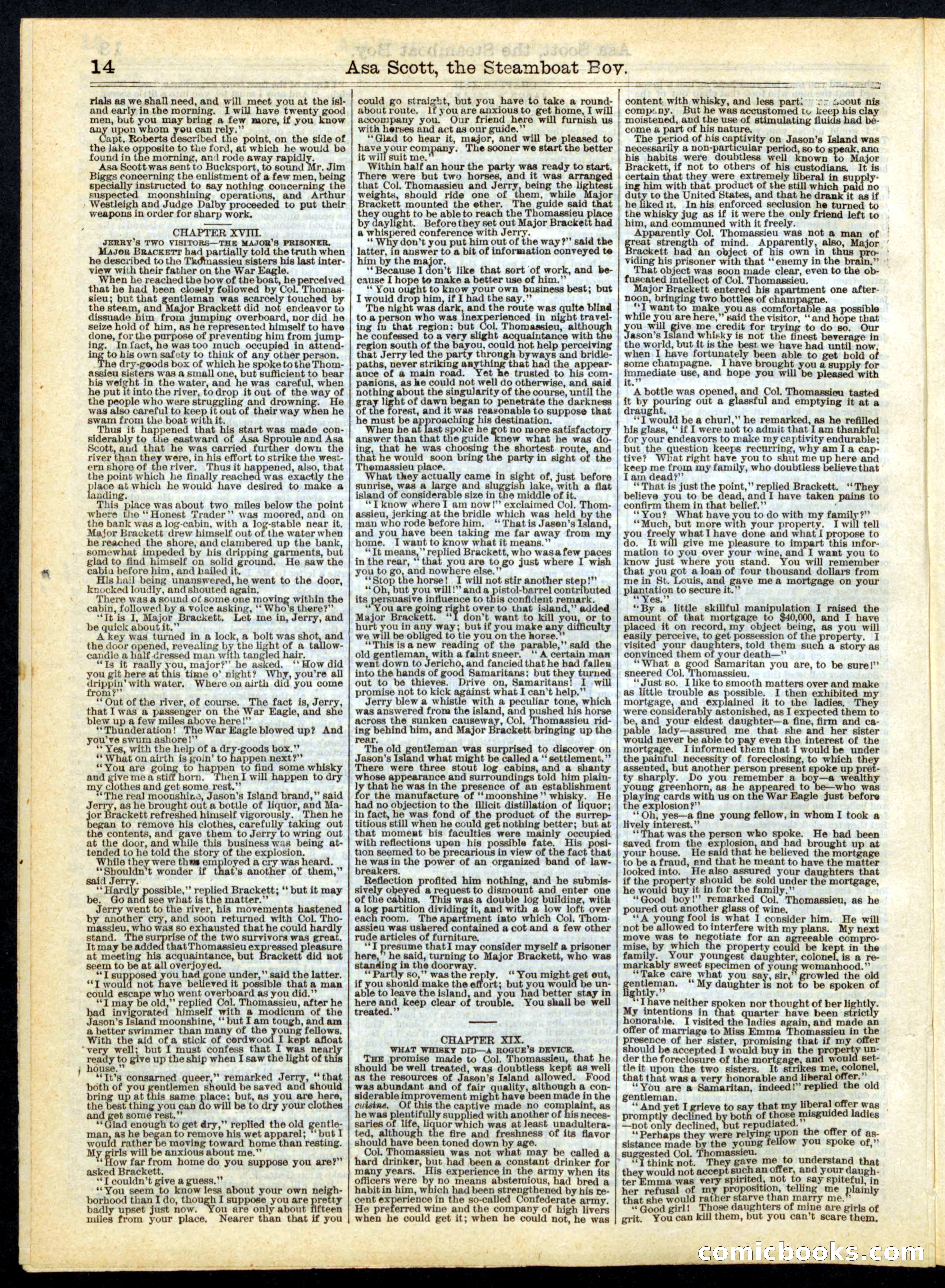
A restored page from Pulp Fiction, 1880. Page through the whole issue in the reader above.
📄 Transcribed text from this page (OCR, searchable)
Machine-transcribed from the original scan — historical spelling and the odd misread are preserved.
A ge ———— ee —_— + — a ee . > - - ae ———— ee ee ee = _--- ' se mem ee ee ee ——— . — , b > t- aoe eae em em a a eee = . . ee me. we ee wee rials as we shall need, and will meet you at the isl- and early in the morning. I will have twenty good men, but you may bring a few more, if you know = upon whom you can rely.” apt. Roberts described the point, on the side of the lake opposite to the ford, at which he would be found in the morning, and rode away wins taw p Asa Scott was sent to Bucksport, to sound Mr, Jim Biggs concerning the enlistment of a few men, being specially instructed to say nothing concerning the s moonshining operations, and Arthur . Westleigh and Judge Dalby proceeded to put their weapons in order for sharp work. CHAPTER XVIII. JERRY'S TWO VISITORS—THE MAJOR’S PRISONER, MaJor Brackett had partially told the truth when he described to the Thdtnassieu sisters his last inter- view with their father on the War Eagle. When he reached the bow of the boat, he perceived that he had been closely followed by Col. Thomas- sieu; but that ceweren was scarcely touched by the steam, and Major Brackett did not endeavor to dissuade him from jumping overboard, nor did he seize hold of him, as he represented himself to have done, for the peTpeee of preventing him from jum ing. Infact, he was too much occupied in attend- to his own safety to think of any other person. The dry-geods box of which he spoke tothe Thom- assieu sisters was a small one, but sufficient to bear his weight in the water, and he was careful, when he put itinto the river, todrop it out of the way of the people who were struggling and CROWDING. He was also careful to keep it out of their way when he swam from the boat with it. Thus it ay fs that his start was made con- siderably to the eastward of Asa Sproule and Asa Scott, aud that he was carried further down the river than they were, in his effort to strike the west- ern shore of the river. Thus it happened, also, that the point which he finally reached was exactly the place at which he would have desired to make a nding. This place was about two miles below the point where the “Honest Trader’’ was moored, and on the bank was a log-cabin, with a log-stable near it. Major Brackett drew himself out of the water when he reached the shore, and clambered up the bank, somewhat impeded by his dripping garments, but glad to find himself on solid ground. He saw the cabiu before him, and hailed it. His hail being unanswered, he went to the door, knocked loudly, and shouted again, There was a sound of some one moving within the cabin, followed by a voice asking, *‘ Who’s there?”’ “Tt is 1, Major Brackett. Let me in, Jerry, and be quick about it.” A key was turned in a lock, a bolt was shot, and the door opened, revealing by the light of a tallow- candle a half.dressed man with tan rled hair. j he asked. ‘* How did “Ts it raally you, major?” you git here at this time o’ night? Why, you're all drippin’ with water, Where on airth did you come m ** Out of the river, of course. The fact is, Jerry, that I was a passenger on the War Eagle, and she blew up a few miles above here!”’ *Thunderation! The War Eagle blowed up? And you've swum ashore!”’ ** Yes, with the help of a dry-goods box.” ** What on airth is goin’ to happen next?”’ “You are going to happen to find some whisky and give mea stiff horn. ThenI will happen to dry my clothes and get some rest.”’ ‘The real moonshine, Jason’s Island brand,” said Jerry, as he brought out a bottle of liquor, and Ma- or Brackett refreshed himself vigorously. Then he to remove his clothes, carefully taking out the contents, and ve them to Jerry to wring out at the door, and while this business was being at- tended to he told the story of the explosion. While they were thes employed a cry was heard. **Shouldn’t wonder if that’s another of them,” said Jerry. “Hardly ssible,’’ replied Brackett; ‘* but it may be. Go and see what is the matter.”’ Jerry went to the river, his movements hastened by another cry, and soon returned with Col. Tho- massieu, who was so exhausted that he could hardly stand. é surprise of the two survivors was great. It may be added that Thomassieu expressed pleasure at meeting his acquaintance, but Brackett did not seem to be at all overjoyed. mg | mappnen you had gone under,” said the latter. “T wo not have believed it possible that a man could escape who went overboard as you did.”’ ““T may be old,” replied Col. Thomassieu, after he d invigorated himself with a modicum of the ason’s Island moonshine, ‘‘ but I am tough, and am oung fellows. a better swimmer than many of the I kept afloat With the aid ofa stick of cordwo ‘very well; but I must confess that_I was near ready to give up the ship when I saw the light of t house.”’ “Tt’s consarned queer,’’ remarked Jerry, ‘‘ that both of you gentlemen should be saved and should bring up at same place; but, as you are here, the best thing you can do will be to dry your clothes and Vy some rest,”’ **Glad enough to get dry,” replied the old gentle- man, as he began to remove his wet apparel; “but I would rather be moving toward home than resting. My girls will be anxious about me.” ‘How far from home do you suppose you are?” asked Brackett. “*T couldn’t give a guess.” **You seem to know less about your own neigh- borhood than I do, monge I suppose you are pretty badly upset just now. You are only about fifteen miles from your place, Nearer than that if you P ” C ee aye —— Asa Scott, the Steamboat Boy. wen em eee ee ee could go straight, but you have to take a round- about route, lf youare anxious to get home, I will accompany you. Our friend here will furnish us with herses and act as our guide.”’ **Glad to hear it, major, and will be pleased to have your company. The sooner we start the better it will suit me,’ Within half an hour the party was ready to start. There were but two horses, and it was arranged that Col. Thomassieu and Jerry, being the lightest weights, should ride one of them, while Major Brackett mounted the ether. The guide said that they ong to be able to reach the Thomassieu place by daylight. Beforethey set out Major Brackett had a whispered conference with Jerry. ‘* Why don’t you put him out of the way?” said the latter, in answer to a bit of information conveyed te him by the major. ‘* Because I don’t like that sort of work, and be- cause I hope to make a better use of him.”’ ‘You ought to know your own business best; but I would drop him, if I had the say.” The night was dark, and the route was quite blind to a person who was inexperienced in night travel- n that region: but Col. Thomassieu, ae mgs he confessed to a very slight acquaintance with the region south of the bayou, could not help perceiving ore Se erry led bee y rs bs 2 and bridle- ths, never s ng anything tha @ appear- inae of a main road. Vet he trusted to his al panions, as he could not well do otherwise, and said nothing about the singularity of the course, until the gray! ht of dawn began to penetrate the darkness of the forest, and it was reasonable to suppose that he must be approaching his destination. When hea t spoke he got no more satisfactory answer than that the guide knew what he was do- ing, that he was choosing the shortest route, and that he would soon bring the party in sight of the Themassieu place. What they actually came in - gy of, just before sunrise, was a nee and sluggish lake, with a flat island of considerable size in the middle of it. “*T know where I am now!” exclaimed Col. Thom- assieu, jerking at the bridle which was held by the man who rode before him, “ Thatis Jasen’s Island, and you have been taking me far away from my home. I want to know what it means.” “Tt means,” replied Brackett, who wasafew paces in the rear, ‘that you are to go just where I wish you to go, and nowhere else.” ** Stop the horse! I will not stir another step!” “Oh, but you will!” anda pistol-barrel contributed its persuasive influence to this confident remark. “You are going right over to that island,’’ added Major Brackett. ‘“‘l don’t want to kill you, or to hurt A in any way; but if you make any difficulty we will be obliged to tie you on the horse.” “This isa new reading of the parable,’’ said the old gentleman, with a faint sneer. ‘A certain man went down to Jericho, and fancied that he had fallen into the hands of good Samaritans; but they turned out to be thieves. Drive on, Samaritans! I will promise not to kick against what I can’t help.” Jerry blew a whistle with a peculiar tone, which was answered from the island, and pushed his horse across the sunken causeway, Col, Thomassieu rid- ing behind him, and Major Brackett bringing up the rear. The old gentleman was surprised to discover on Jason's Island what might be called a “ settlement.”’ There were three stout log cabins, and a shanty whose appearance and surroundings told him plain- py, that he was in the presence of an establishment or the manufacture of ‘‘moonshine”’ ig BF He had no objection to the illicit distillation of liquor; in fact, he was fond of the prods of the surrep- titious still when he could get nothing better; but at that momert bis faculties were mainly occupied with reflections upen his possible fate. His posi- tion seemed to be precarious in view of the fact that he wasin the power of an o band of law- breakers. | Reflection profited him nothing, and he submis- sively obe a request to dismount and enter one of the cabins. This was a double log building, with a log partition dividing it, and with a low loft over each room. Thea ment into which Col. Thom- assieu was ushered contained a cot and a few other rude articles of furniture, “T presume thatI may consider myself a prisoner here,’ he said, turning to Major Brackett, who was standing in the doorway. “* Partly so,"’ was the reply. “You might get out, if you should make the effort; but you would be un- able to leave the island, and you had better stay in here Frys keep clear of trouble. You shall be well treated.’ CHAPTER XIX. WHAT WHISKY DID—A ROGUE’S DEVICE. THE pecans? made to Col. Thomassieu, that he should be well treated, was doubtless kept as well as the resources of Jason’s Island allowed. Food was abundant and of fair quality, although a con- siderable improvement might have been made in the cuisine, the captive made no complaint, as he was plentifully supp! ied with another of his neces- saries of life, liquor which was at least unadultera- ted, although the fire and freshness of its flavor should have been toned down by age. Col, Thomassieu was not what may be called a hard drinker, but had been a constant drinker for |’ many years. His experience in the army when its officers were by no means abstemious, had bred a habitin him, which had been strengthened by his re- cent experience in the so-called Confederate army. He preferred wine and the company of high livers when he could get it; when he could not, he was A -- = - . Sn) eee a eee ee eee ‘ content with whisky, and less parti o> acout nis compsny. But he was accustomed tu keep his clay moistened, and the use of stimulating fluids had be- come a part of his nature. The period of his captivity on Jason’s Island was necessarily a non-particular period, so to ee ana bis habits were doubtless well known Major Brackett, if not to others of his custodians. It is certain that they were extremely liberal in su ply: ing him with that product of the still which vali no duty to the United States, and that he drank it as if he liked it, In his enforced seclusion he turned to the whisky jug as if it were the only friend left to him, and communed with it freely. Apparently Col. Thomassieu was not a man of | » Major ° rackett had an object of his own in wipe ne ; t strength of mind. Apparently, viding his prisoner with that ‘‘enemy in the That object was soon made clear, even to the ob- fuscated intellect of Col. Thomassieu. Major Brackett entered his apartment one after- noon, bringing two bottles of champagne. ‘I want to make you as comfortable as possible while you are here,” said the visitor, ‘‘and hope that 09 will give me credit for ing to do so. Our ason’s Island whisky is not the finest beverage in the world, but it is the best we have had until now when I have fortunately been able to get bold of some champagne. I have brought you a supply for aneperaake use, and hope you will be pleased with 2 A bottle was opened, and Col. Thomassieu tasted it by pouring out a glassful and emptying it at a raught. ‘*] would be a chur!,”’ he remarked, as he refilled his glass, ‘if I were not to admit that I am thankful for your endeavors to make my captivity endurable; but the question keeps recurring, why am I a cap- tive? What right have you to shut me up here and keep me from my family, who doubtless believe that I am dead?”’ ‘That is just the point,” replied Brackett. ‘‘ They believe you to be dead, and I have taken pains to confirm them in that belief.” ’ ‘You? What have you to do with my family?” **Much, but more with your property. I will tell you freely what I have done and what I propose to do. It will give me pleasure to impart this infor- mation to you over your wine, and I want you to know just where you stand. You will remember that you got a loan of four thousand dollars from mein St. Louis, and gave mea mortgage on your plantation to secure it.”’ *By a little skillful manipulation I raised the amount of that mortgage to $40,000, and I have placed it on record, my object being, as you will easily perceive, to get possession of the property. I visited your daughters, told them cask a story as convinced them of your death—”’ “What a good Samaritan you are, to be sure!”’ sneered Col. Thomassieu. “Just so. Llike to smooth matters over and make as little trouble as possible. I then exhibited my mortgage, and explained it to the ladies. They were considerably astonished, as I expected them to be, and your eldest daughter—a fine, firm and ca- pable lady—assured me that she and her sister would never be able to pay even the interest of the mortgage. linformed them that I would be under the painful necessity of foreclosing, to which the assented, but another person present spoke up pret- ty sharply. Do you remember a boy—a wealthy young greenhorn, as he appeared to who was playing cards with us on the War Eagle just before the explosion?”’ ‘*Oh, yes—a fine young fellow, in whom I took a live Forges og ™ ‘*That was the person who ke. He had been saved from the explosion, and had brought up at your house. He said that he believed the mortgage to be a fraud, and that he meant to have the matter looked into. He also assured your daughters that if the property should be sold under the mortgage, he would buy it in for the family.” “Good boy!’ remarked Col. Thomassieu, as he ured out another glass of wine. ‘*A young fool is what I consider him. He will not be allowed tointerfere with my plans. My next move was te negotiate for an agreeable compro- mise, by which the property could be kept in the family. Your youngest daughter, colonel, is a re- markably sweet specinen of young womanhood.” ‘Take care. what you say, sir, wled the old aes a My daughter is not to be spoken of aT have neither ken nor thought of her lightly. My intentions in that arter have been strictly honorable. I visited the ladies again, and made an offer of marriage to Miss Emma Thomassieu in the presence of her sister, promising that if my offer should be accepted I would buy in the propery un- der the foreclosure of the mortgage, and would set- tle it upon the two sisters. It es me, colonel, that that was a very honorable and liberal offer. sed are a Samaritan, indeed!” replied the old gentleman. “And yet I grieve to say that my liberal offer was promptly declined mo of those ™ —not only declined, but repudiated. ‘Perhaps they were relyin — the offer of as- sistance made by the young ow you spoke of,” su te . shom “J think not. They gave me to understand that they would not accept such an offer, and your daugh- ter Emma was very spirited, not to say spiteful, in her refusal of my proposition, telling me plainly that she would rather starve than marry me,” “Good girl! Those daughters of mine are girls of grit. You can kill them, but you can’t scare them, I00 “COmMmIc ladies — 1€O