
Pulp Fiction, 1880 · page 3 of 24
Beadle's Half Dime Library No. 163 — page 3: what you’re looking at
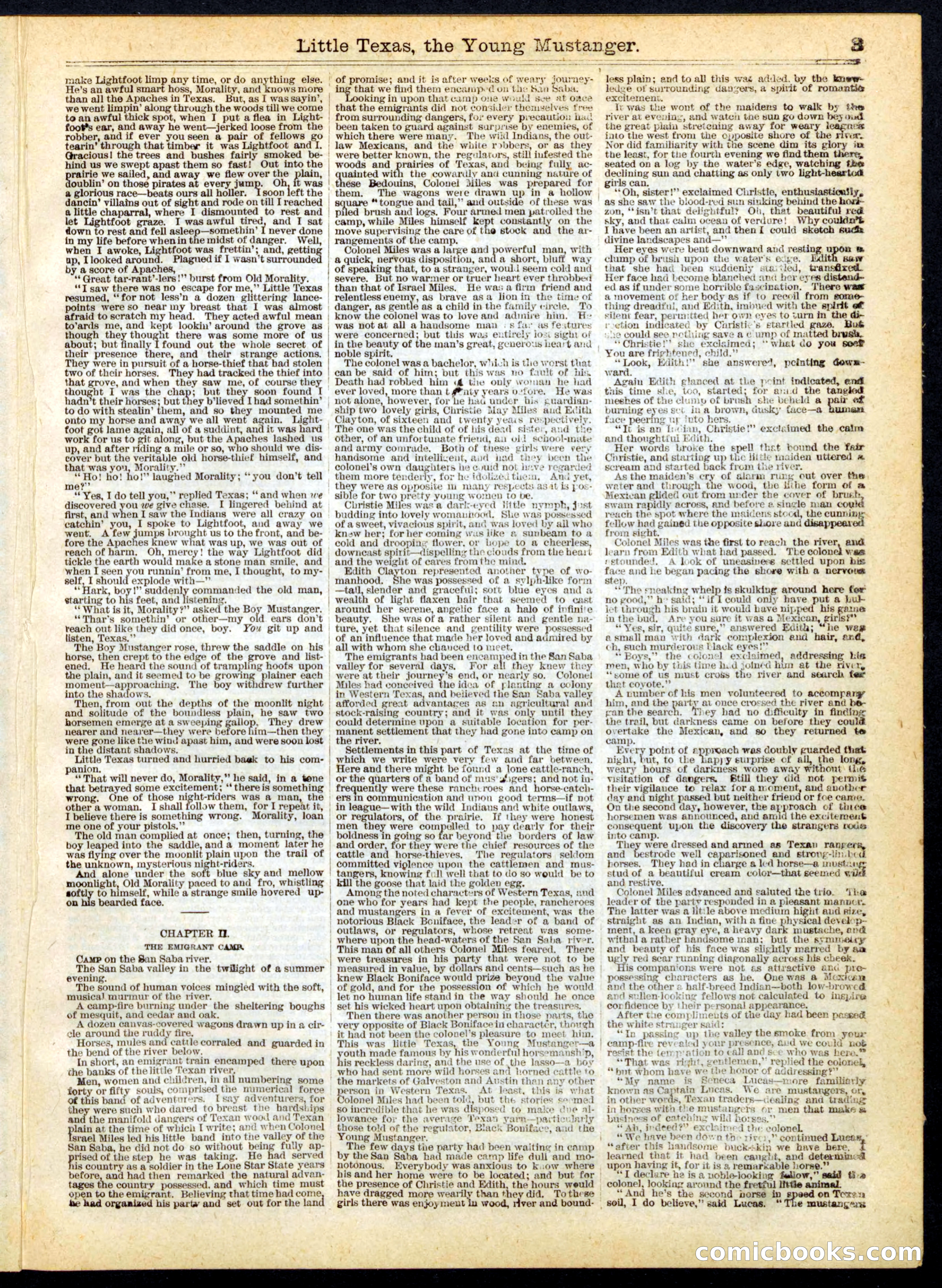
A restored page from Pulp Fiction, 1880. Page through the whole issue in the reader above.
📄 Transcribed text from this page (OCR, searchable)
Machine-transcribed from the original scan — historical spelling and the odd misread are preserved.
~~ <.--— ; make Lightfoot limp any time, or do anything else. | of promise; and jt is after weeks of weary Journey- He’s an awful s hoss, Morality, and knows more than a]l the Apaches in Texas. But, as I wassayin’, we went limpin’ along through the woods till we come to an awful thick spot, when I put a flea in Light- foot’s ear, and away he went—jerked loose from the — robber, and if ever you seen a pair of fellows go tearin’ through that timber it was Lightfoot and I. | Gracious! the trees and bushes fairly smoked be- | hind us we swept apast them so fast! Out into the rairie we sailed, and away we flew over the plain, oublin’ on those pirates at every 69 Oh, it was a glorious race—beats ours all holler. Isoon left the dancin’ villains out of sight and rode on till I reached a little chaparral, where I dismounted to rest and let Lightfoot graze. I was awful tired, and I sat down to rest and fell asleep—somethin’ I in my life before whenin the midst of danger. Well, when I awoke, Lightfoot was frettin’; and, gettin up, [looked around. Plagued if 1 wasn’t surround by a score of Apaches, ‘Great tar-rant’-lers!"’ burst from Old Morality. ‘*T saw there was no escape for me,” Little Texas resumed, “for not less’n a dozen glittering lance- points were so near ny breast that I was almost never done | — 2 ee een oh nee ee - te- C- that we find them encamped on the San Saba, king in upon that camp one would sce at once that the emigrants did not consider themselves tree from surrounding dangers, for every precaution lac been taken to guard against surprise by enemies, of which there were many. The will Indians, the out- law Mexicans, and the white r>bbers, or as they were better known, the regulaturs, still infested the woods and prairies of Texas, and being fully ac- uainted with the cowardly and cunning nature of these Bedouins, Colonel Miles was prepared for them. The wagons were drawn up in a hollow uare “tongue and tail,’’ and outside of these was piled brush and logs. Four armed men patrolled the camp, while Miles himself kept constantly on the move supervising the care of the stock and the ar- 'rangements of the camp. afraid to scratch my head. They acted awful mean | to’ards me, and kept lookin’ around the grove as though they thought there was some more of us about; but finally [found out the whole secret of their presence there, and their strange actions. They were in pursuit of a horse-thief that had stolen two of their horses. They had tracked the thief into that grove, and when they saw me, of course they | thought I was the chap; but they soon found I hadn’t their horses; but they b’lieved I had somethin’ to do with stealin’ them, and so they mounted me onto my horse and away we all went again. Light- foot got lame again, all of a suddint, and it was hard work for us to git along, but the Apaches lashed us up, and after riding a mile or so, who should we dis- cover but the veritable old horse-thief himself, and that was you, Morality.” ‘* Ho! ho! ho!’ laughed Morality; “you don’t tell e?”” ‘* Yes, I do tell you,” replied Texas; “‘ and when wwe discovered you we give chase. I lingered behind at first, and when I saw the Indians were all crazy on catchin’ you, I spoke to Lightfoot, and away we went. A few jumps brought us to the front, and be- fore the Apaches knew what was up, we was out of reach of harm, Oh, mercy! the way Lightfoot did tickle the earth would make a stone man smile, and when I seen you runnin’ from me, I thought, to my- self, I should explode with—”’ ‘Hark, boy!” rege in commanded the old man, starting to his feet, and listening. “What is it, Morality?” asked the nor, Mustanger. “Thar’s somethin’ or other—my old ears don’t reach out like they did once, boy. You git up and listen, Texas.”’ The Boy Mustanger rose, threw the saddle on his horse, then crept to the edge of the grove and list- ened. He heard the sound of trampling hoofs upon the plain, and it seemed to be growi ylainer each moment—approaching. The boy withdrew further into the shadows. horsemen emerge at a sweeping gallop, They drew nearer and nearer—they were before him—then they were gone like the wind apast him, and were soon lost in the distant shadows. Little Texas turned and hurried baek to his com- panion. “That will never do, Morality,” he said, in a tone that betrayed some excitement; “‘ there is something wrong. One of those night-riders was a man, the other a woman. I shall follow them, for 1 repeat it, I believe there is something wrong. Morality, loan me one of your pistols.”’ The old man complied at once; then, turning, the boy leaped into the saddle, and a moment later he was flying over the moonlit plain upon the trail of the unknown, mysterious night-riders. And alone under the soft blue sky and mellow moonlight, Old Morality paced to and fro, whistling page f to himself, while a strange smile hovered up- on bearded face. CHAPTER I. THE EMIGRANT CAMP. Camp on the San Saba river. The San Saba valley in the twilight of a summer evening. The sound of human voices mingled with the soft, musical murmur of the river. A camp-fire burning under the sheltering boughs of mesquit, and cedar and oak. A dozen canvas-covered wagons drawn up in a cir- ele around the ruddy fire, Horses, mules and cattle corraled and guarded in the bend of the river below. In short, an emigrant train encamped there upon the banks of the little Texan river, Men, women and children, in all numbering some forty or fifty souls, comprised the numerical force of this band of adventurers. [say adventurers, for they were such who dared to breast the hardships and the manifold dangers of Texan wood and Texan lain at the time of which I write; and when Colonel srael Miles led his little band into the valley of the San Saba, he did not do so without being fully ap- i Sgt of the step he was taking. He had served 1is country as a soldier in the Lone Star State years before, and had then remarked the natural adven- tages the country possessed, and which time must open to the emigrant. Believing that time had come be organized his parta and set out for the land Colonel Miles was a large and rorecn man, with a quick, nervous disposition, and a short, bluff way of speaking that, to a stranger, would seem cold and severe. But no warmer or truer heart ever throbbed than that of Israel Miles. He was a firm friend and relentless enemy, as brave asa lionin the time of danger, as gentle as a child in the family circle. To know the colonel was to love and adinire him. He was not at all a handsome mian ; s far as fextures were concerned; but this was entirely los: sight of in the beauty of the man’s great, generous heart and noble spirit. The colonel was a bachelor, Wich is Uie worst that can be said of him; but this was no fault of his. Death had robbed him «@ the only wornan he had ever loved, more than t Manty years v-fore. He was not alone, however, for Le haa under bis guardian- ship two lovely girls, Christie May Miles aud Edith Clayton, of sixteen and twenty yeais respectively. The one was the child of of his dead sister, and the other, of an unfortunate friend, au oll scbool-mute and army comrade. Both of these girls were very handsome and intellicent, aud had they been the colonel’s own daughters he cvuid nol heve regarded them more tenderly, for he idolized tie:n, And yet, rd Were as Opposite 1m many respects as at is pos- sible for two pretty young women to be. Christie Miles was a darlr-cyed little nymph, just budding into lovely womanhood, She was possessed of a sweet, vivacious spirit, and was loved by all who knew her: for her coming wus like a sunbeam to a cold and drooping flower, or Lope to a cheerless, downcast spirit—lispelling the clouds from the heart and the weight of cares fromthe mind, Edith Clayton represented another type of wo- manhood, She was possessed of a svlph-like form —tail, slender and graceful; sort blue eyes and a wealth of light flaxen hair that seemed to cast around her serene, angelic face a halo of infini'e beauty. She was of a rather silent and gentle na- ture, yet that silence and gentility were possessed of an influence that made her loved and aumired by all with whom she chanced to meet. The emigrants had been encamped in the San Saba valley for several days. For all they knew they were at their journey’s end, or nearly so. Colonel Miles had conceived the idea of planting a colony in Western Texas, and believed the San Saba valley Then, from out the depths of the moonlit night | and solitude of the boundless plain, he saw two. afforded great advantages as cn agricultural and stock-raising country; and it was only until they could determine upon a suitable location for per- manent settlement that they had gone into camp on the river. Settlements in this part of Texas at the time of which we write were very few and far between. Here and there might be found a lone cattle-ranch, or the quarters of a band of mus’ sfigers; and not in- poke awe | were these ranchvroes and horse-catch- ers in communication and upon good terms—if not in league— with the wild Indians and white outlaws, or regulators, of the prairie. If they were honest men they were compelled to pay dearly for their boldness in going so far beyond the borders of Jaw and order, for they were the chief resources of the cattle and horse-thieves. The regulators seldom committed viglence upon the cattlemen and mus- tangers, knowing full well that to do so would be to kill the goose that laid the golden egg. Among the noted characters of Western Texas, and _ one who for years had kept the people, rancheroes and mustangers in a fever of excitement, was the notorious Black Boniface, the leader of a band of outlaws, or regulators, whose retreat was some- _ where upon the head-waters of the San Saba river. This man of all others Colonel Miles feared. There were treasures in his party that were not to be measured in value, by dollars and cents—such as he knew Black Boniface would prize beyond the value of gold, and for the possession of which he would let no human life stand in the way should he once set his wicked heart upon obtaining the treasures. Then there was another person in those parts, the very opposite of Black Boniface in character, though it had not been the colonel’s pleasure to meet him. This was little Texas, the Young Mustanger—a youth made famous by his wonderful hors ‘mansh’ip, nis reckless daring, and the use of the lasso—a boy who had sent more wild horses and horned cattle to the markets of Galveston and Austin then any other erson in Western Texas. At least, this is what olonel Miles had been tole, but the stories se med so incredible that he was disposed to make dpe al- lowance for the average Texan yarn—paiticularly those told of the regulator, Black Boniface, and the Young Mustanger. The few days tie party had been waiting in camp by the San Saba had made camp life duli and mo- notonous. Everybody was anxious to kiow where his and her home were to the presence of Christie and Edith, the hours weuld have dragged more wearily than they did. Tothese A soil, I do believe,” said Lucas. girls there was enjoy meut in wood, river and bound- ‘ e t he kh a = Fe — ana — ee is des af a oe he Little Texas, the Young Mustanger. oe ’ ~~, >: we _ ; - . el 7 "*< —o ‘ ee + ewe es eee - = less plain; end to al this was added. by the kxiww- ledee of surrounding dancers, a spirit of romanties excitement. | Iv was the wont of the maidens to walk by the river at evenine, and watch the sup go down bey mal the great plain stretcning away for weary lcagnes into the west from the oj posite shore of the river. Nor did familiarity with the scene dim its glory im the least, for the fourth evening we find them there, seated on a log by the water’s edge, watching the gectning sun and chatting as only two light-heartcd irls can. : ‘*Oh, sister!’’ exclaimed Christie, enthusiastically, as she saw the blood-red sun sinking behind the hom zon, “isn’t that delightfuly Ol, that beautiful red sky, and that calm ocean of verdure! Why coulkin’&’ I have been an artist, and then [I could sketch such: divine landscapes and—"’ Her eyes were bent downward and reting See ud clump of brush upon the water's ecye. Ldith saw that she had been suddenly staitled, transfixedL Her face had become blanched and ber eyes distend- ed as if under some horrible fascination. There wast a movement of her body as if to recoil from some- thing dreadful, and Edith, imbued with the spirit ef silent fear, permitted ber own eyes to turn in the di- t-etion indicated by Christic’s startled gaze, But he could see pething save a ¢ ump of matted brug, ‘Christie!’ she exclaimed; “whet do you soe? You are frightened, child.” “Look, Edith! she answered, peinting dowm- ward. Again Edith glanced at the point indicated, end. this time she, too, started; for anid the tangled meshes of the cluniv of brush she beheld a ir of burning eyes set ina brown, dusky face—a Dummer face peering uy ‘uto hers. “Ti is an I: cian, Christie!” exclaimed the calm and thoughtiul Edith. Her words broke the spell thst bound the fair Christie, and starting up the liltte maiden uttered « scream and started back from the river. As the maiden’s cry of alarm rung out over the, water and through the wood, the ihe form of a Mexivan glidefl out from under the cover of brush swain rapidly across, and before e single man courd reach the spot where the maidens stocad, the cunning. fellow had gained the opposite slove and disappear from sight. Colonel Miles was the first to reach the river, and learn from Edith what had passed. The coloned vas rstounde’d. A look of uneasivess settled upon his face and he began pacing the shore with a nervous ster. ‘The sneaking whelp fs skulking around here for no good,” h» said; “if Icould only have put a hub ict through his brain it would have nipped his game in the bud, Are you sure it was a Mexican, giris?* “ Yes, sir, quite sure,” answered Edith; “he weg asmall man with dark complexion end hair, and, ch, such murderous Llack eyes!” ** Boys,” the colonel exclaimed, addressing his men, who by this time hud joined hum at the river, ‘‘some of us must cross the river and search fer that covote.”’ A number of his men volunteered to accompary him, and the party av once crossed the river and be- gan the search. They had no dfficulty in find! the trail, but darkness came on before they cou overtake the Mexican, and so they returned te camp. Every point of a Ronech was doubly guarded that night, but, to the hapjyy surprise of all, the lo weary hours of darkness wore away withont> th: visitation of dangers. Still they did not permit their vigilance to relax for a moment, and another cay and night passed but neither friend or foe came. On the second day, however, the approach of thice horsemen was announced, and amid the excitement consequent upon the discovery the strangers rode into camp. They were dressed and armed as Texan ranpe and bestrode well caparisoned and strong-lin.be horses. They had in charge a led horse—a invustan stud of a beautiful cream color—that seemed ¥% and restive. Colonel Miles advanced and saluted the trio. ‘ihe leader of the party responded in a pleasant manncr. The latter was a little above medium hight aud rize, straight as an Indian, with a fine physical develop- ment, a keen gray eye, a heavy dane mustache, ond withal a rather handsome man: but the symmeicy and beauty of his face was slightly marred by aa ugly red scar running diagonally acrogs his cheek. His companions were not as attractive ana pre- possessing characters as he. One was a Mcxicen and the other a half-breed Indian—both low-browed and sulien-looking fellows not calculated to inspire cor fidence by their personal appearance. After the complimeuts of the day had been passed the white stranger said: . “In passing up the valley the smoke from your | camp-fire revealed your presence, dud we could nob’ be located; and but for | resist the temp ation to call and sce who was here.” “That was right, gentlemen,” replied the colonel, “bnt whom have we the honor of addressing?” “My name is Seneca Lucas—more familiarly known as Captain Lucas. We are mustangers, or in other words, Texan traders—cdéaling and trading in horses with the mustangers or men that make business of eatching wil horses.” “Ah, indeed?” exclaimed the colonel “We have been down the rirc.,” continued Lucas,’ ‘“‘after this handsome buck-skin we bave here, learned that it had been canght, and detexrminc’l upon having it, for it is a, remarkable horse.” “TI declare he is a noble-looking faliow,” said ti-a colonel, looking around the fretful little animal. “And he's the second porse in s on Tere “The mustangs —- comicbhoo = cS —_ ; wa — —sa