
Pulp Fiction, 1880 · page 4 of 16
Beadle's Half Dime Library No. 162 — page 4: what you’re looking at
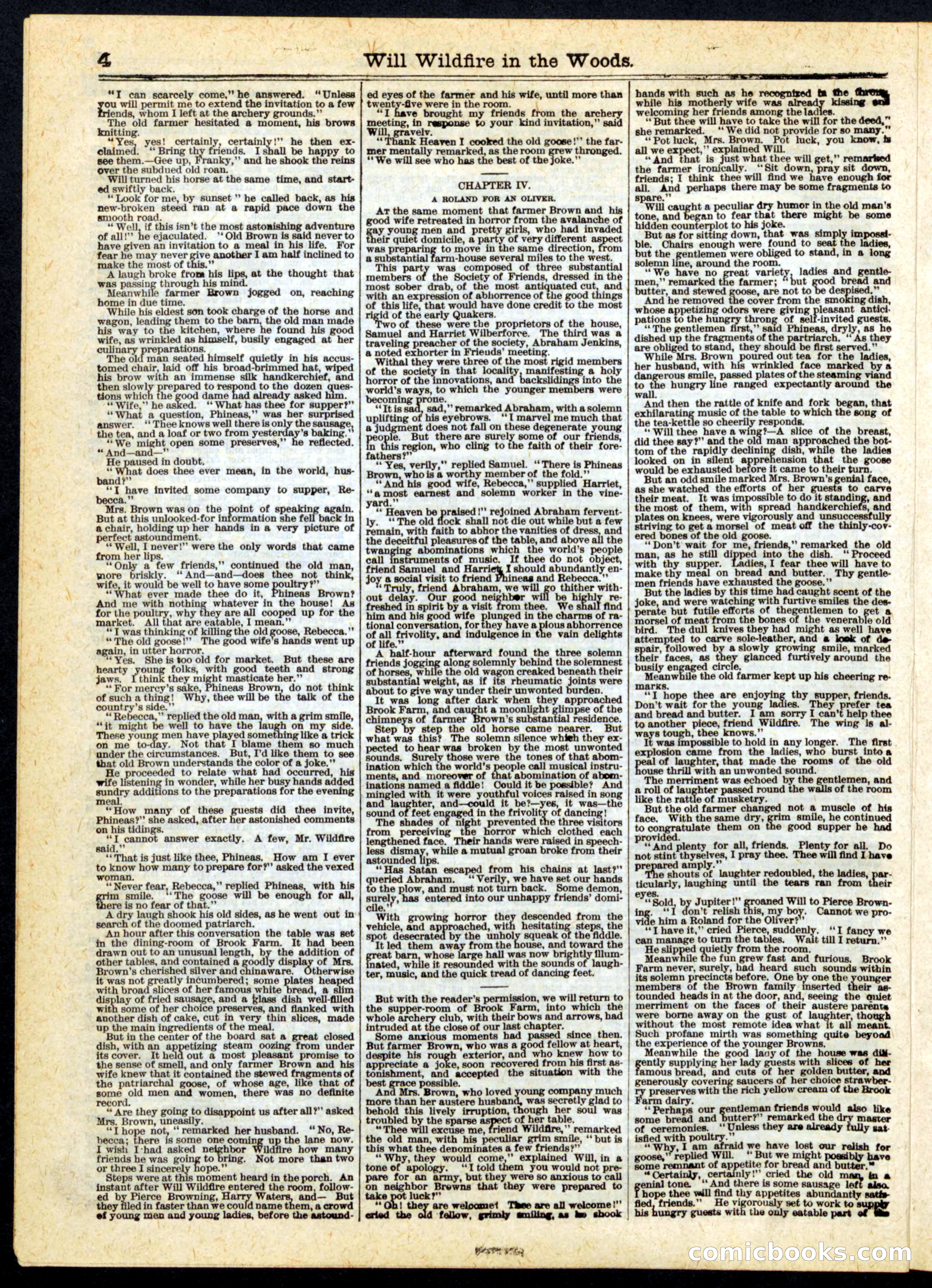
A restored page from Pulp Fiction, 1880. Page through the whole issue in the reader above.
📄 Transcribed text from this page (OCR, searchable)
Machine-transcribed from the original scan — historical spelling and the odd misread are preserved.
~ - 4 ; Re | Will Wildfire in the Woods. _— under the circumstances. “TI can scarcely come,” he answered. ‘ Unless you will permit me to extend the invitation to a few ends, whom I left at the archery grounds.”’ aoe old farmer hesitated a moment, his brows ng. “Yes, yes! certainly, certainly!’ he then ex- claimed. “ Bring thy friends. I shall be happy to see them.—Gee up, Franky,’’ and he shook the reins over the subdued old roan. Will turned his horse at the same time, and start- ed swiftly back. * Look for me, by sunset’ he called back, as his new-broken steed ran at a rapid pace down the smooth road. “ Well, if this isn’t the most astonishing adventure of all!” he ejaculated. *‘Old Brown is said never to have given an invitation to a meal in his life. For fear he may never give another I am half inclined to make the most of this.”’ A laugh broke from his lips, at the thought that was mee | through his mind. Meanwhile farmer Brown jogged on, reaching home in due time. While his eldest son took charge of the horse and wagon, leading them to the barn, the old man made his way to the kitchen, where he found his good wife, as wrinkled as himself, busily engaged at her culinary phe eepweeway The old man seated himself — in his accus- tomed chair, laid off his broad-brimmed hat, wiped his brow with an immense silk handkerchief, and then mony Seti to nd to the dozen ques- tions which the good dame had already asked hn. ‘Wife,’ he asked. ‘‘ What has thee for supper?’ ““What a question, Phineas,’’ was her surprised answer. ‘‘ Thee knows well there is oe then sausage, the tea, and a loaf or two from yesterday’s baking.’ ‘“‘We might open some preserves,’’ he reflected. “ And—and—” He paused in doubt. ¥* hat does thee ever mean, in the world, hus- **T have invited some company to supper, Re- becca.” Mrs. Brown was on the point of speaking again. But at this unlooked-for information she fell back in a chair, holding up her hands in a very picture of perfect astoundment. ‘* Well, I never!’’ were the only words that came from her lips. “Only a few friends,’’ continued the old man, wore briskly. ‘‘And—and—does thee not think, wife, it would be well to have some poultry?” “What ever made thee do it, Phineas Brown? And me with nothing whatever in the house! As for the poultry, why they are all cooped up for the market. All that are eatable, I mean.”’ “T was thinking of killing the old goose, Rebecca.”’ “The old goose!" The good wife's hands went up again, in utter horror. “Yes. She is too old for market. But these are hearty young folks, with good teeth and strong jaws. I think they might masticate her.” “For mercy’s sake, Phineas Brown, do not think of such a thing! Why, thee will be the talk of the country’s side.’’ “Rebecca,” replied the old man, with a grim smile, “it might be well to have the laugh on my side. These young men have played something like a trick on me to-day. Not that I blame them so much But, I'd like them to see that old Brown understands the color of a joke.”’ wie roceeded to relate what had occurred, his e listening in wonder, while her busy hands added ony additions to the preparations for the evening meal. “How many of these guests did thee invite, Phineas?”’ she asked, after her astonished comments on his tidings. Le cannot answer exactly. A few, Mr. Wildfire sa — ‘That is just like thee, Phineas. How am I ever to know how many to prepare for?’’ asked the vexed woman. “ Never fear, Rebecca,” replied Phineas, with his grim smile. ‘‘The goose will be enough for all, ere is no fear of that.” A dry laugh shook his old sides, as he went out in search of the doomed patriarch. An hour after this conversation the table was set in the dining-room of Brook Farm. It had been drawn out to an unusual length, by the addition of other tables, and contained a goodly display of Mrs. Brown's cherished silver and chinaware. Otherwise it was not greatly incumbered; some plates hea with broad slices of her famous white bread, a slim gs of fried sausage, and a glass dish well-filled with some of her choice preserves, and flanked with another dish of cake, cut in very thin slices, made up the main ingredients of the meal. But in the center of the board sat a great closed dish, with an appetizing steam oozing from under its cover. It held out a most pleasant promise to the sense of smell, and only farmer Brown and his wife knew that it contained the stewed fragments of the patriarchal goose, of whose age, like that of some Ney men and women, there was no definite record. “ Are they going to disappoint us after all?" asked . Brown, uneasily. ss hope net ‘remarked her husband. “ No, Re- becca; there is some one co up the lane now. I wish I-had asked n bor Wildfire how many friends he was going to bring. Not more than two or three I sincerely hope.” Steps were at this moment heard in the porch. An instant after Will Wildfire entered the room, follow- ed by Pierce Browning, os! W. and— But they in faster than we could name them, a crowd ef young men and young before the astound- ' ed eyes of the farmer and his wife, until more than twenty-five were in the room. “I have brought my friends ftom the archery meeting, =" response to your kind invitation,” said gravelv. < Heaven I cooked the old goose!’’ the far- mer mentally remarked, as the room grew thronged. ** We will see who has the best of the joke.” CHAPTER IV. A ROLAND FOR AN OLIVER. At the same moment that farmer Brown and his good wife retreated in horror from the avalanche of y young men and pretty girls, who had invaded eir quiet domicile, a pay, very different aspect was ae to move in the same direction, from a substantial farm-house several miles to the west. This party was composed of three substantial members of the Society of Friends, dressed in the most sober drab, of the most antiquated cut, and with an expression of abhorrence of the good things of this life, that would have done credit to the most = ‘= of the early Quakers. o of these were the proprietors of the house, Samuel and Harriet Wilberforce. The third was a traveling preacher of the society, Abraham Jenkins, a noted exhorter in Frieuds’ meeting. Withal they were three of the most rigid members of the society in that locality, manifesting a holy horror of the innovations, and backslidings into the world’s ways, to which the younger members were becoming prone. “Ttis sad,"’ remarked Abraham, with a solemn uplifting of his eyebrows. ‘I marvel me much that a susgmens does not fall on these degenerate young ~~ e. But there are surely some of our friends, n this region, who cling to the faith of their fore- fathers?” “Yes, verily,"’ replied Samuel. “There is Phineas Brown, whois a worthy member of the fold.”’ ‘*And his good wife, Rebecca,’’ supplied Harriet, ‘‘a most earnest and solemn worker in the vine- yard.” ‘* Heaven be praised !’’ rejoined Abraham fervent- ly. ‘* The old flock shall not die out while but a few remain, with faith to abhor the vanities of d and the deceitful pleasures of the table, and above all the pe ve abominations which the world’s people call instruments of music. If thee do not object, friend Samuel and Harri joy a social visit to friend Vhineag and Rebecca.” ‘Truly, friend Abraham, we will go thither with- out delay. Our good ty ey be vo! re- freshed in spirit by a visit from thee. We shall find him and his good wife — ed in the charms of ra- tional conversation, for they have a pious abhorrence be a frivolity, and indulgence in the vain delights of life.” A half-hour afterward found the three solemn friends jogging along solemnly behind the solemnest of horses, while the old wagon creaked beneath their substantial weight, as if its rheumatic joints were about to give way under their unwonted burden. It was long after dark when they approached Brook Farm, and — a moonlight glimpse of the chimneys of farmer Brown's substantial residence. Step by step the old horse came nearer. But what was this? The solemn silence whieh they ex- to hear was broken by the most unwonted sounds. Surely those were the tones of that abom- ination which the world's ple call musical instru- ments, and moreover of that abomination of abom- inations named a fiddle! Could it be possible? And mingled with it were youthful voices raised in song and laughter, and—could it be?—yes, it was—the sound of feet engaged in the frivolity of dancing! The shades of night prevented the three visitors from perceiving the horror which clothed each lengthened face. Their hands were raised in speech- less dismay, while a mutual groan broke from their I should abundantly en- astounded lips. ‘Has Satan escaped from his chains at last?” queried Abraham. “ Verily, we have set our hands to the plow, and must not turn back. Some demon, ny has entered into our unhappy friends’ domi- cile.’ With growing horror they descended from the vehicle, and approached, with hesitating steps, the spot desecrated by the unholy squeak of the fiddle. It led them away from the house, and toward the ee barn, whose hall was now brightly fllum- nated, while it resounded with the sounds of laugh- ter, music, and the quick tread of dancing feet. ———— But with the reader’s permission, we will return to the supper-room of Brook Farm, into which the whole archery club, with their bows and arrows, had intruded at the close of our last chapter. Some anxious moments passed since then. But farmer Brown, who was a good fellow at heart, despite his rough exterior, and who knew how to appreciate a joke, soon recovered from his first as- tonishment, and accepted the situation with the bl best possible. And Mrs. Brown, who loved roo company much more than her austere husband, was secretly glad to behold this lively irruption, though her soul was | troubled Ey ote sparse t of her table. “ Thee excuse me, friend Wildfire,’’ remarked the old man, with his grim smile, ** but is this what thee denominates a few friends?” “Why, they would come,” exp tone of apology. “I told them you would not pre- pare for an Giay, but they were so anxious to call on neighbor Brewns that ges ay re “Oh! are weloamet Thee are all welcome!"’ eried the fellow, grimly emiling, as be shook preserves with | a isfied with poultry.”’ “ Why, I am atrai lained Will, in a | goose,’ replied Will. rtainly, they were prepared to — tone. ‘And there is some sausage ie es hands with such as he recognized t the while his motherly wife was Ae spon. welcoming her friends among the ladies. “* But thee will have to take the will for the deed,” she remarked. ‘‘ We did not provide for so many.” ‘Pot luck, Mrs. Brown. Pot luck, you know, ts all we ,”’ explained Will. “And that is just what thee will get,”’ remartsed the farmer ironically. ‘Sit down, pray sit down, friends; I think thee will find we have enough for all. And perhaps there may be some fragments to spare.”’ PWili caught a peculiar dry humor in the old man's tone, and began to fear that there might be some hidden counterplot to his joke. But as for sitting down, that was simply imposat- ble. irs enough were found to the ladies, but the gentlemen were obliged to stand, in a long solemn line, around the room. “We have no t variety ladies and gentle- men,’’ remarked the farmer; ‘but bread and butter, and stewed goose, are not to be despised,” And he removed the cover from the smoking dish, whose appetizing odors were giving pleasant antici. pations to the hungry throng of self-invited guests. ‘‘The gentlemen first,’ said Phineas, dryly, as he dished up the fragments of the partriarch. ‘‘ As they are obliged to stand, they should be first served.” While Mrs. Brown poured out tea for the ladies, her husband, with his wrinkled face marked by a a smile, passed plates of the steaming viand vos e hungry line ranged expectantly around the wall. And then the rattle of knife and fork began, that aeeeresne music of the table to which the song of the tea-kettle so cheerily responds. ‘* Will thee have a wing?—A slice of the breast, did thee say?’’ and the old man approached the bot- tom of the rapidly declining dish, while the ladies looked on in silent —— ension that the goose would be exhausted before it came to their turn. But an odd smile marked Mrs. ve ppelet geo y face, as she watched the efforts of her guests to carve their meat. It was impossible to do it standing, and the most of them, with spread handkerchiefs, and plates on knees, were vigorously and unsuccessfully striving to get a morsel of meat off the thinly-cov- ered bones of the old goose. ‘*Don't wait for me, friends,’’ remarked the old man, as he still dipped into the dish. ‘“ Proceed with thy supper. Tadiee, I fear thee will have to make thy meal on bread and butter. Thy gentle- men friends have exhausted the goose.”’ But the ladies by this time had caught scent of the joke, and were watching with furtive smiles the des- perate but futile efforts of thegentlemen to get a morsel of meat from the bones of the venerable old bird. The dull knives they had might as well have attempted to carve sole-leather, and a loek of de — followed by a oe smile, marked their faces, as they glan furtively around the busily engaged circle, Meanwhile the old farmer kept up his cheering re- marks. “TI hope thee are enjoying thy supper, friends. Don’t wait for the young ladies. They prefer tea and bread and butter. I am sorry I can’t help thee to another piece, friend Wildfire. The wing is al- Mkt tough, thee knows.” It was impossible to hold in any longer. The first explosion came from the ladies, who burst intoa = of laughter, that made the rooms of the old ouse thrill with an unwonted sound. The merriment was echoed by the ne, and a roll of os mwery passed round the walls of the room like the rattle of musketry. But the old farmer changed not a muscle of his face. With the same dry, _— smile, he continued to —— them on the good supper he had rov : 7 ‘And plenty for all, friends. Plenty for all. Do not stint thyselves, I pray thee. Thee will find I have prepared amply." e shouts of laughter redoubled, the ladies, " ticularly, laughing until the tears ran from their eyes. “Sold, by Jupiter!” ance Will to Pierce Brown- _ “] don’t relish t is, m boy. Cannot we pro- vide him a Roland for the Oliver?”’ ‘*T have it,” cried Pierce, suddenly. ‘I fancy we can manage to turn the tables. Wait till I return.” He slip eg from the room. Meanwhile the fun grew fast and furious. Brook Farm never, surely, had heard such sounds within its solemn precincts before. One by one the younger members of the Brown family inserted their as- tounded heads in at the door, and, seeing the oniet merriment on the faces of their austere parents were borne away on the gust of laughter, though without the most remote idea what it all meant. Such profane mirth was something quite beyoad the experience of the younger Browns. Meanwhile the good lacy of the house was dil- eed supplying her lady guests with slices of her | famous bread, and cuts of her golden butter, and saucers of her choice strawber- e rich yellow cream of the Brook ntleman friends would utter?’ remarked the ‘*Uniess they are already d we have lost our relish for * But we ht possibly have some remnant of awe for b and butter,” “Ce certainly!’ cried the old ma also. hope thee will find thy appetites abundantly saté- fled Priends,” He vigorously set to work to supply his hungry guests with the only eatable part ICO ———— | generously coveri rm dairy. “Perhaps our -gome bread and also like master of ceremonies. sat- COlmille “S - / Eom