
Pulp Fiction, 1880 · page 2 of 16
Beadle's Half Dime Library, No. 154 — page 2: what you’re looking at
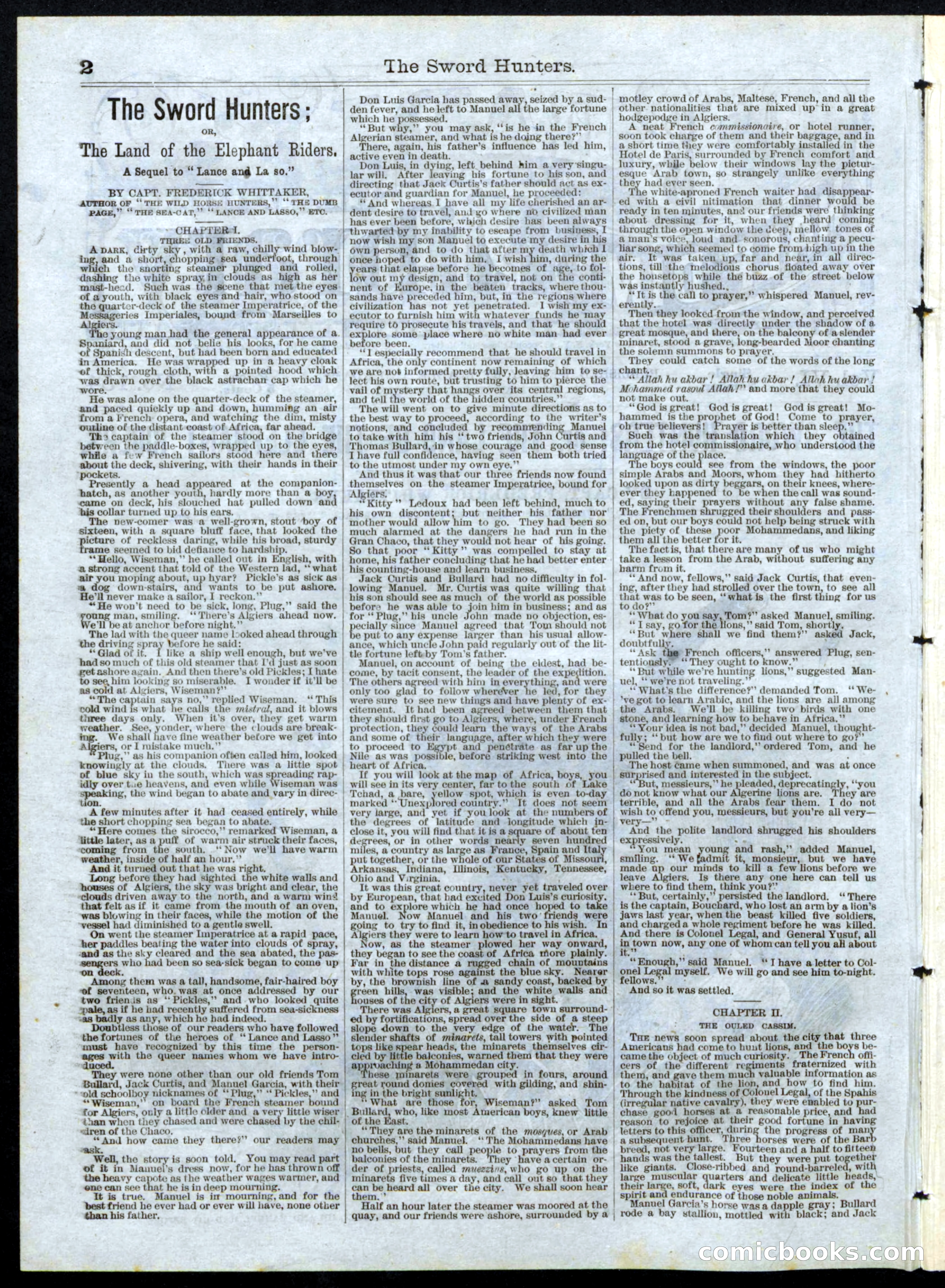
A restored page from Pulp Fiction, 1880. Page through the whole issue in the reader above.
📄 Transcribed text from this page (OCR, searchable)
Machine-transcribed from the original scan — historical spelling and the odd misread are preserved.
2 — ee === ===> ' The Sword Hunters ; The Land of the Elephant Riders, A Sequel to “ Lance ang La so.” BY CAPT. FREDERICK WHITTAKER, AUTHOR OF “THE WILD HORSE HUNTERS,” “ THE DUMB PAGE,” “ THE SEA-CAT,”’ “‘ LANCE AND LASSO,” ETO. » CHAPTRRA. THREE OLD FRIENDS. A DARK, dirty sky , with a raw, chilly wind blow- ing, and a short, chopping sea underfoot, through which the snorting steamer plunged and rolled, dashing the white spray,in clouds as h as her mast-hecad. Sueh was the scene that met the eyes of a youth, with black eyes and hair, who stood on the quarter-deck of the steamer Imperatrice, of the ee Imperiales, bound from Marseilles to ers. e young man had the general appearance of a Spaniard, and did not belie his looks, for he came of Spanish descent, but had been born and educated in America. He was wrapped up in a heavy cloak of thick, rough cloth, with a pointed hood which was drawn over the black astrachan cap which he wore. He was alone on the quarter-deck of the steamer, and paced quickly up and down, humming an air from a l'rench opera, and watching the dim, misty outline of the distant coast of Africa, far ahead. Ths captain of the steamer stood on the bridge between the paddle-boxes, wrapped up to the eyes, while a few French sailors stood here and there about the deck, shivering, with their hands in their ets. Presently a head appeared at the companion- hatch, as another youth, hardly more than a boy came on deck, his slouched hat pulled down and his collar turned up to his ears. The new-comer was a well-grown, stout hoy of sixteen, with a square bluff face, that looked the icture of reckless daring, while his broad, sturdy rame seemed to bid defiance to hardship. *“*Hello, Wiseman,"’ he called out in English, with a strong accent that told of the Western lad, *“* what air you moping about, = hyar? Pickle’s as sick as ma dog down-stairs, and wants to be put ashore, He'll never make a sailor, I reckon.” “He won't need to be sick, long, Plug,” said the a man, smiling. ‘* There’s Algiers ahead now. ell be at anchor before night.” The lad with the queer name looked ahead through the driving spray before he said: ** Glad of it. like a ship well enough, but we've had so much of this old steamer that I'd just as soon get ashore again. And then there's old Pickles; I hate to him looking so miserable. I wonder if it’ll be as cold at Alciers, Wiseman?”’ “The captain says no,”’ replied Wiseman. “ This cold wind is what he calls the mistral, and it blows three days only. weather. See, yonder, where the clouds are break- . We shall have fine weather before we get into Algiers, or I mistake much.” Plug,” as his companion often called him, looked knowingly at the clouds. There was a little spot of blue sky in the south, which was spreading rap- idly over tue heavens, and even while Wiseman was . ing, the wind began to abate and vary in direc- on. A few minutes after it had ceased entirely, while the short chopping sea began to abate. _ “Here comes the sirocco,’’ remarked Wiseman, a little later, as a puff of warm air struck their faces, coming from the south. ‘ Now we'll have warm weather, inside of half an hour.” And it turned out that he was right. Long before they had sighted the white walls and houses of Algiers, the sky was bright and clear, the ‘clouds driven away to the north, and a warm wind that felt asif it came from the mouth of an oven, was blowing in their faces, while the motion of the vessel had diminished to a gentle swell. On went the steamer Imperatrice at a rapid pace, her paddles beating the water into clouds of spray, ‘and as the sky cleared and the sea abated, the pas- ers who been so sea-sick began to come up on , Among them was a tall, handsome, fair-haired boy ef seventeen, who. was at once addressed by our two frienis as ‘ Pickles,” and who looked quite pale, as if he had recently suffered from sea-sickness as as any, which he had indeed. Doubtless those of our readers who have followed the fortunes of the heroes of ‘“ Lance and Lasso” must have recognized by this time the person- ages with the queer names whom we have intro- They were none other than our old friends Tom Ballard, Jack Curtis, and Manuel Garcia, with their ‘old schoolboy nicknames of “* Plug,” “* Pickles,’’ and “Wiseman, on board the French steamer bound for Algiers, only a little older and a very little wiser than when they chased and were ch by the chil- dren of the Chaco. “And how came they there?’ our readers may Well, the story is soon told, You may read part of it in Manuel's dress now, for he has thrown off the heavy capote as the weather wages warmer, and ene can see that he is in deep mourning. It is true. Manuel is im mourning, and for the best friend he ever had or ever will have, none other than his father. <i imamate tet LE RA LLL LLL LLL LLL LLL LLL Se When it’s over, they get warm | to proceed to | de of the East. The Sword Hunters. Don Luis Garcia has passed away, seized by a sud- | den fever, and he left to Manuel all the large fortune | which he possessed, “But why,”’ you may ask, ‘‘is he in the French | Algerian steamer, and what is he doing there?” There, again, his father’s influence has led him, active even in death. Don Luis, in dying, left_ behind him a very ’singu- lar will. After leaving his fortune to his son, and directing that Jack Curtis's father should act as ex- ecutor and guardian for Manuel, he proceeded: ** And whereas. I have all my life cherished an ar- dent desire to travel, and go where nbd civilized man has ever been before, which Cesire has been always thwarted by my inability to eseape from business, I now wish my son Manuel to execute my desire in his own person, and to do that after my death which 1 once hoped to do with him. I wish him, during the ears that elapse before he becomes of age, to fol- ow out my design, and to travel, not on the conti- nent of Kurope,in the beaten tracks, where thou- sands have preceded him, but, in the regions where civilization has not yet penetrated. 1 wish my ex- ecutor to furnish him with whatever funds he may require tO prosecute his travels, and that he should | explore some place where no white man had ever | before been. ‘*]l especially recommend that he should travel in Africa, the only continent now remaining of which we are not informed pretty fully, Jeaving him to se- lect his own route, but trusting to him to pierce the vail of mystery that hangs over its central regions, and tell the world of the hidden countries.” The will went on to give minute directions as to | the best way to proceed, according to the writer’s notions, and concluded by recommending Manuel to take with him his ‘‘ two friends, John Curtis and Thomas Bullard,:in whose courage and good sense I have full confidence, having seen them both tried to the utmost under my own eye.” And thus it was that our three friends now found Saeed on the steamer Imperatrice, bound for Algiers. “Kitty * Ledoux had been left behind, much to his own discontent; but neither his father nor mother would allow him to go. They had been so much alarmed at the dangers he had run in the Gran Chaco, that they would not hear of his going. ——E—EE the piety of these —$ —$——______ ———_— ee eee motley crowd of Arabs, Maltese, French, and all the other. nationalities that are mixed up’ in a great hodgepodge in Algiers. A neat French commissionaire, or hotel runner, soon took charge of them and their baggage, and in a short time they were comfortably installed in the Hotel de Paris, surrounded by French comfort and luxury, while below their windows lay the pictur- esque Arab town, so strangely unlike everything they had ever seen. The white-aproned French waiter had disappear- ed with a civil nitimation that dinner would be ready in ten minutes, anc our friends were thinking about dressing for it, when they heard coming through the open window the deep, mellow. tones of a man’s voice, loud and. sonorous, chanting a pecu- liar song, which seemed to come from digh up in the air. It was taken up, far and near,in all direc- tions, till the melodious chorus floated away over the honsetops while thé buzz of the street below was instantly hushed., **Tt is the call to prayer,” whispered Manuel, rev- erently. Then they looked from the window, and perceived that the hotel was directly under the shadow of a great mosque, and there, on the balcony of a slender minaret, stood a grave, long-bearded Moor chanting the solemn summons to prayer. iad could catch some of the words of the long chant, ** Allah hu akbar ! Allah hu akbar! Allah hu akbar! Mohammed rasod Allah!” and more that they could not make out. “God is great! Godis great! Godis great! Mo- hammed is the prophet of God! Come to prayer, oh true believers! Prayer is better than sleep.” Such was the translation which they obtained from the hotel commissionaire, who understood the language of the place. The boys could see from the windows, the poor simple Arabs and Moors, whom they had hitherto looked upon as dirty beggars, on their knees, where- ever they happened to be when the call was sound- ed, saying their prayers without any false shame. The Frenchmen shrugged their shoulders and pass- ed on, but our boys could not help being struck with oor Mohammedans, and liking them all the better for it. So that poor “ Kitty’ was compelled to stay at | home, his father concluding that he had better enter his counting-house and learn business. Jack Curtis and Bullard had no difficulty in fol- lowing Manuel. Mr. Curtis was quite willing that his son should see as much of the world as possible before he was able to join him in business; and as for ‘“* Plug,” his uncle John made bo objection, es- genre since Manuel agreed that Tom should not : put to any expense larger than his usual allow- ance, which uncle John paid regularly out of the lit- tle fortune leftby Tom's father. Manuel, on account of being the eidest, had be- come, by tacit consent, the leader of the expedition. The others agreed with him in everything, and were only too glad to follow wherever he led, for they were sure to see new things and have plenty of ex- citement. It had been agreed between them that they should first go to Algiers, where, under French protection, they could learn the ways of the Arabs and some of their language, after which they were Keypt and pen¢trate as far up the Nile as was possible, before striking west into the heart of Africa, If you will look at the map of Africa, boys, you will see in its very center, far tothe south of Lake | Tchad, a_bare, ag spot, which is even to-day marked ** Unexplored country.” It does not seem very large, and yet if youlook at the numbers of the degrees of latitude and longitude which in- close it, you will find that it is a square of about ten ees, or in other words neariy seven hundred miles, a country as large as France, Spain and Ital put together, or the whole of our States of Missouri, Arkansas, Indiana, Llinois, Kentucky, Tennessee, Ohio and Virginia. Se It was this great country, never yet traveled over by European, that had excited Don Luis’s curiosity. and to mies which he had once gue to take Manuel. Now Manuel and his two’ friends were going to try to find it, inobedience to his wish. Algiers they were to learn howto travel in Africa. Now, as the steamer plowed her way onward, they began to see the of Africa more plainly. Far in the distance a chain of mountains with white tops rose st the blue sky. Nearer by, the brownish line of sandy coast, backed by eo hills, was visible; and the white walls and ouses of the city of Algiers were in sight. There was Algiers, a great square town surround- ed by fortifications, spread over the side of a steep slope down to the very edge of the water. The slender shafts of minarets, tall towers with pointed tops like pzaeer heads, the minarets themselves cir- cled by balconies, warned them that they were a en ee Mohammedan city. hese minarets were exoupes in fours, around reat round donies covered with gilding, and shin- ing in the bright sunlight, 6 | ‘What are those for, Wiseman?” asked Tom Bullard, who, like most American boys, knew little “ They are the minarets of the mosques, or Arab churches,” said Manuel. ‘The Mohammedans have no bells, but they call — to prayers from the balconies of the minarets. ey have acertain or- der of priests, called muezzins, who go up on the minarets five times a day, and call out so that they re be heard all over the city. We shall soon hear em.’ Half an hour later the steamer was moored at the quay, and our friends were ashore, surrounded by a a made a | The factis, that there are many of us who might take a lesson from the Arab, without suffering any barm from it. **And now, fellows,” said Jack Curtis, that even- ing, after they had strolled over the town, to see all a was to be seen, “‘“whatis the first thing for us o do?” ‘** What do you say, Tom?” asked Manuel, smiling. “TI say, go for the lions,” said Tom, shortly. ‘But where shall we find them?’ asked Jack, doubtfully. “Ask © French officers,’’ answered Plug, sen- tentionsly” ‘“* They ought to know.” ‘ But while we're hunting lions,”’ suggested Man- uel, “ we're not traveling.’ ‘What's the difference?’ demanded Tom. ‘ We- *ve got to learn Arabic, and the lions are all among the Arabs. We'll be ~ two birds with one stone, and learning how to behave in Africa.” ** Your idea is not bad,” decided Manuel, thought- fully; ‘‘ but how are we to find out where to go?” “Send for the landlord,"’ ordered Tom, and he ulled the bell. 3 The host Game when summoned, and was at once Ky me and interested in the subject. “But, messieurs,’’ he pleaded, deprecatingly, ‘‘you do not know what our erine lions are. 1ey are terrible, and all the Arabs fear them. I do not wish to offend you, messieurs, but you're all very— very And the polite landlord shrugged his shoulders Ron ta and rash,” added Manuel “You mean young an 4 anuel, smiling. ‘* We damit it, monsieur, but we have our minds to kill a few lions before we Is there any one here can tell us where to find them, think you?”’ ‘** But, certainly,’ on gran the landlord. “ There is the captain, Bouchard, who lost an arm by a lion's jaws last year, when the beast killed five soldiers, and charged a whole regiment before he was killed. And there is Colonel Legal, and General Yusuf, all in gown now, any one of whom can tell you ali about “Eno h,”’ said Manuel. “I have a letter to Col- onel self. We will go and him to-night. “Lo ndenaiy alg ill go and see him to-nig And so it was settled. leave Algiers. CHAPTER I. . THE OULED CASSIM. THE news soon spread about the city that three Americans had come to huut lions, and the boys be- came the object of much curiosity. The French offi- cers of the different regiments fraternized with them, and gave them much valuable information as to the habitat of the lion, and_how to find him. Through the kindness of Colouel Legal, of the Spahis (irr native cavalry), they were enabled to pur- chase good horses at a reasonable price, and had reason to rejoice at their good fortune in having _ letters to this officer, <a the progress of many a subsequent hunt. Three horses were of the Bar breed, not very large. Fourteen and a half to fitteen hands was the tallest. But they were put together like giants. Close-ribbed and round-barreled, with large muscular quarters and delicate little heads, their large, soft, dark eyes were the index of the spirit and endurance of those noble . Manuel Garcia’s horse was a dapple gray; Bullard rode a bay stallion, mottled with black; and Jack (E| 90 o) eom cS (E(0) —_ ill i tn, da at alll, lt -. —-—e --—- tt, daa