
Pulp Fiction, 1880 · page 7 of 16
Beadle's Half Dime Library, No. 152 — page 7: what you’re looking at
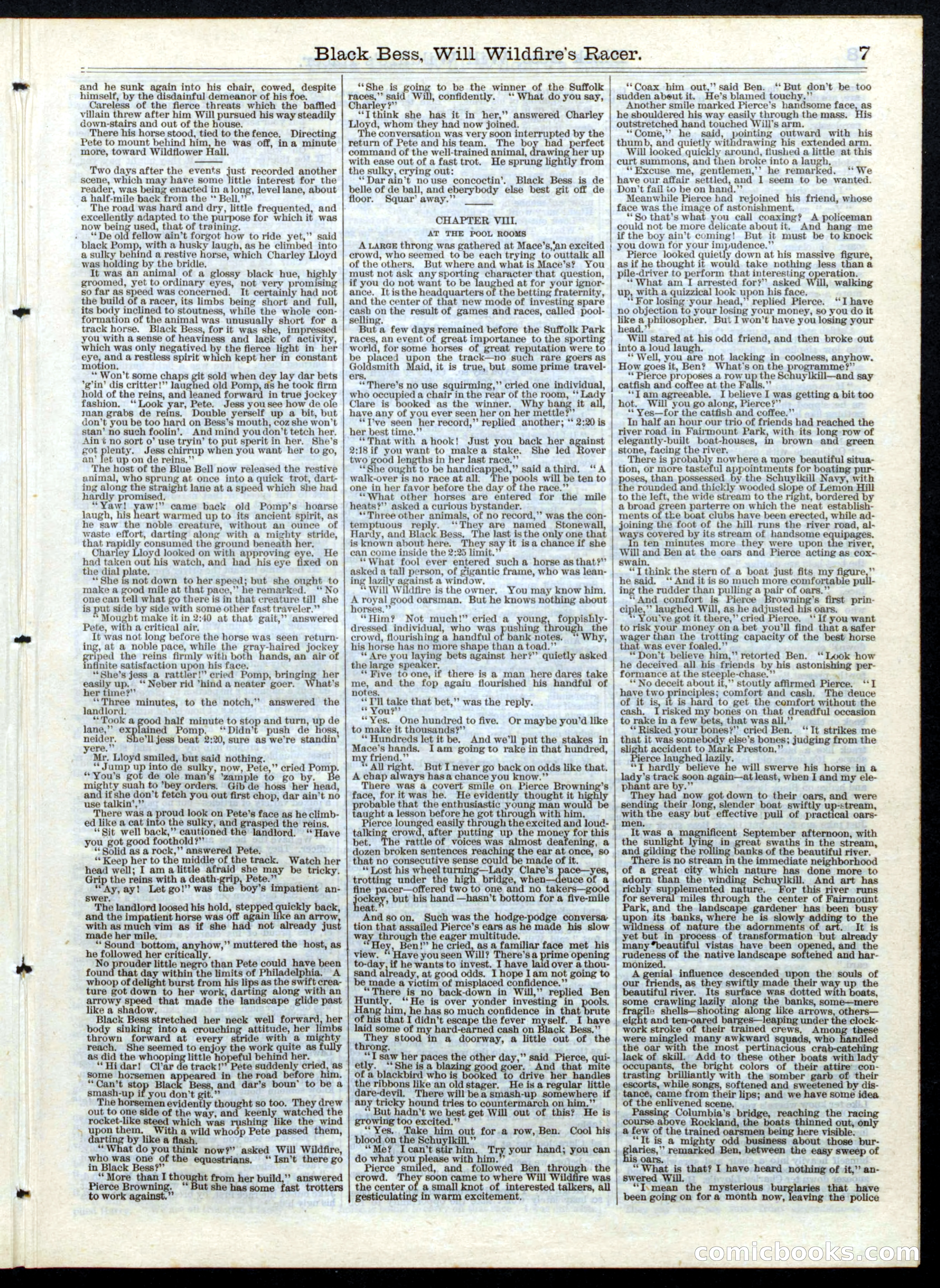
A restored page from Pulp Fiction, 1880. Page through the whole issue in the reader above.
📄 Transcribed text from this page (OCR, searchable)
Machine-transcribed from the original scan — historical spelling and the odd misread are preserved.
/ and he sunk again into his chair, cowed, despite himself, by the disdainful demeanor of his foe. Careless of the fierce threats which the baffled villain threw after him Will pursued his way steadily down-stairs and out of the house. There his horse stood, tied to the fence. Directing Pete to mount behind him, he was off, ina minute more, toward Wildflower Hall. Two days after the events _— recorded another scene, which may have some little interest for the reader, was being enacted in along, level lane, about a half-mile back from the * Bell.”’ The road was hard and dry, little frequented, and excellently adapted to the purpose for which it was now being used, that of training. ‘“* De old fellow ain’t forgot how to ride yet,” said black Pomp, with a husky laugh, as he climbed into a sulky behind a restive horse, which Charley Lloyd was holding by the bridle. It was an animal of a glossy black hue, highly groomed, yet to ordinary eyes, not very promising so far as speed was concerned. It certainly had not the build of a racer, its limbs being short and full, its body inclined to stoutness, while the whole con- formation of the animal was unusually short for a track horse. Black Bess, for it was she, impressed you with a sense of heaviness and lack of activity, which was only negatived by the fierce light in her eye, and a restless spirit which kept her in constant motion. “Won't some chaps git sold when dey lay dar bets ‘gin’ dis critter!’’ laughed old Pomp, ds he took firm hold of the reins, and leaned forward in true jockey fashion. ‘Look yar, Pete. Jess you see how de ole man grabs de reins. Double yerself up a bit, but don't you be too hard on Bess’s mouth, coz she won't stan’ no such foolin’. And mind you don’t tetch her. Ain ¢ no sort 0’ use tryin’ to put speritin her. She's got plenty. Jess chirrup when you want her to go, an’ let up on de reins.”’ The host of the Blue Bell now released the restive animal, who sprung at once into a quick trot, dart- ing along the straight lane at a speed which she had hardly promised. “Yaw! yaw!” came back old Pomp’s hoarse laugh, his heart warmed up to its ancient spirit, as he saw the noble creature, without an ounce of waste effort, darting along with a mighty stride, that rapidly consumed the ground beneath her. Charley Lloyd looked on with approving eye. He had taken out his watch, and h his eye fixed on the dial plate, ‘**She is not down to her speed; but she ought to make a good mile at that pace,"’ he remarked. ‘No one can tell what go there is in that creature till she is put side by side with some other fast traveler.” “* Mougbt make it in 2:40 at that gait,’’ answered Pete, with a critical air. It was not long before the horse was seen return- ing, at a noble pace, while the gray-haired jockey riped the reins firmly with both hands, an air of infinite satisfaction upon his face. **“She’s jess a rattler!’ cried Pomp, bringing her easily up. ‘“‘ Neber rid “hind a neater goer. What's her time?” ‘Three minutes, to the notch,”’ answered the landlord. . “Took a good half minute to stop and turn, up de lane,” explained Pomp. ‘Didn't push de hoss, neider. e’ll jess beat 2:20, sure as we're standin yere. Mr. Lloyd smiled, but said nothing. * Jump up into de sulky, now, Pete,” cried Pomp. *“You’s got de ole man’s ‘zample to go by. e me suah to *bey orders. Gib de hoss her head, and if she don’t fetch you out first chop, dar ain’t no use talkin’,”’ There was a proud look on Pete’s face as he climb- ed like a cat into the sulky, and grasped the reins. ‘Sit well back,” cautioned the landlord. “Have you got good foothold?” ‘Solid as a rock,” answered Pete. “Keep her to the middle of the track. Watch her head well; I am alittle afraid she may be tricky. Grip the reins with a death-grip, Pete.” *“Ay, ay! Let go!’’ was the boy’s impatient an- swer. The landlord loosed his hold, stepped quickly back, and the impatient horse was off again like an arrow with as much vim as if she had not already just made her mile. ‘“*Sound bottom, anyhow,” muttered the host, as he followed her critically. No prouder little negro than Pete could have been found that day within the limits of elphia, A whoop of delight burst from his lips as the swift crea- ture got down to her work, darting along with an arrowy 8 that made the landscape glide past like a shadow. Black Bess stretched her neck well forward, her body sinking intoa crouching attitude, her limbs thrown forward at every de with a mighty reach. She seemed to enjoy the work quite as fully as did the whooping little hopeful behind her. ““Hidar! Cl’ar de track!’ Pete suddenly cried, as Some horsemen appeared in the road before him. ** Can’t 5k Black Bess, and dar’s boun’ to be a smash-up if you don’t git.” The horsemen evidently thought so too. They drew out to one side of the way, and keenly watched the rocket-like steed which was hing like the wind upon them. With a wild whoop Pete passed them, Ee by like a flash. si at do pe > ap now?” asked cant bss who was one of the estrians. “ ' ere go in Black Bess?” _— 4 ‘**More than I as sn from her build,’’ answered Pierce Browning. ‘ But she has some fast trotters to work against.” “She is going to be the winner of the Suffolk races,’’ said Will, confidently. ‘* What do you say, Charley?” “‘Ithink she has it in her,’ answered Charley = whom they had now joined. e conversation was very soon interrupted by the return of Pete and his team. The boy had rfect command of the well-trained animal, pees er up with ease out of a fast trot. He sprung lightly from the sulky, crying out: ‘Dar ain’t nouse concoctin’. Black Bess is de belle of de ball, and eberybody else best git off de floor. Squar’ away.”’ CHAPTER VIIL. AT THE POOL ROOMS A LARGE throng was gathered at Mace’s,‘an excited crowd, who seemed to be each trying to outtalk all of the others. But where and what is Mace’s? You must not ask any sporting character that question, if you do not want to be Fe hed at for your ignor- ance. It isthe headquarters of the betting fraternity, and the center of that new mode of investing spare ee on the result of games and races, called pool- selling. But a few days remained before the Suffolk Park races, an event of great importance to the sporting world, for some horses of great reputation were to be placed upon the track—no such rare goers as Goldsmith Maid, it is true, but some prime travel- ers, “There’s no use squirming,’ cried one individual, who occupied a chair in the rear of the room, ‘* Lad Clare is booked as the winner. Why hang it all, have any of you ever seen her on her mettle?” “I've seen her record,’’ replied another; ** 2:20 is her best time.”’ “That with a hook! Just you back her against 2:18if you want to makea stake. She led Rover two good lengths in her last race.”’ ‘*She ought to be handicapped,” said athird, “A walk-over is no race atall. The Is will be ten to one in her favor before the day of the race.”’ “What other horses are entered for the mile heats?’’ asked a curious bystander. ‘Three other animals, of no record,’’ was the con- temptuous reply. “They are named Stonewall, Hardy, and Black Bess. The last is the only one that is known about here. They say it isa chance if she can come inside the 2:25 limit.’ “What fool ever entered such a horse as that?” asked a tall person, of gigantic frame, who was lean- ing lazily against a window. “Will Wildfire is the owner. You may know him. A royal good oarsman. But he knows nothing about horses.”’ “Him? Not much!” cried a young foppishly- dressed individual, who was pushing throu the crowd, flourishing a handful of bank notes. ‘“* Why, his horse has no more shape than a toad.” * Are you laying bets against her?’ quietly asked the large speaker, ‘* Five to one, if there is a man here dares take me, and the fop again flourished his handful of notes. **T'll take that bet,’’ was the reply. ‘e You?’ “Yes. One hundred to five. Or maybe you'd like to make it thousands?” ‘Hundreds let it be. And we'll put the stakes in Mace’s hands. Lam going to rake in that hundred, my friend.” ‘Allright. But I never go back on odds like that. A chap always has a chance you know.” There was a covert smile on Pierce Browning’s face, for it was he. He evidently thought it highly probable that the enthusiastic young man would be taught a lesson before he got through with him. Pierce loun easily through the excited and loud- talking crowd, after putting up the money for this bet. e rattle of voices was almost deafening, a dozen broken sentences reac the ear at once, so that no consecutive sense could be made of it. ‘** Lost his wheel —Lady ’s yes, trotting under the high bridge, whan. daake of a fine pacer—offered two to one and no takers—good jockey, but his hand —hasn’t bottom for a five-mile eat. And soon. Such was the hodge-podge conversa tion that assailed Pierce’s ears as he made his slow way through the eager multitude. ; Hey Ben!” he cried, as a familiar face met his view. *‘ Have you seen Will? There’sa prime opening to-day, if he wants to invest. I have laid over a thou- sand already, at good odds. I hope Iam not going to be made a victim of misplaced confidence.” “There is no back-down in Will,” replied Ben Huntly. “He is over yonder inves in ls. Hang him, he has so much po ies that brute self. I have k Bess.” of his that I didn’t escape the fever m laid some of my hard-earned cash on They stood in a doorway, a little out of the ng. ‘I saw her paces the other day,” said etly. ‘‘She is a blazing good avd tat’ ae , a oer. m of a blackbird who is booked drive her handles the ribbons like an old stager. He isa little dare-devil. There will bea smash-up somewhere if any tricky hound tries to countermarch on ~ But hadn't we best get Will out of this? He is growing too excited.” “Yes... Take him out for.a row, Ben. Cool his blood on the Schuylkill.” “Me? I can't stir him. Try your hand; you can do what you please with him. Pierce smiled, and followed Ben through the crowd. They soon came to where Will Wil was the center of a small knot of interested talkers, all gesti in warm excitement, — Cee ee Ts a a i i lll ‘Coax him out,” said Ben. ‘‘ But don’t be too sudden abeut it. He’s blamed touchy.’”’ Another smile marked Pierce’s handsome face, as he shouldered his way easily through the mass. His outstretched hand touched Will's arm. “Come,” he said, pointing outward with his thumb, and quietly wiltirawing his extended arm. Will looked quickly around, flushed a little at this curt summons, and then broke into a laugh, ‘Excuse me, gentlemen,’ he remarked. ‘‘ We have our affair settled, and 1 seem to be wanted. Don’t fail to be on hand.” Meanwhile Pierce had rejoined his friend, whose face was the image of astonishment. **So that’s what you call coaxing? A policeman could not be more delicate about it. And hang me if the boy ain’t coming! But it must be to knock you down for your impudence.”’ Pierce looked quietly down at his massive figure, as if he thought it would take nothing less thana pile-driver to perform that interesting operation. ‘* What am I arrested for?” asked Will, walking up, with a quizzical look upon his face. ‘For losing your head,” replied Pierce. “I have no objection to your losing your money, so you do it wes philosopher. But I won’t have you losing your e 9 Will stared at his odd friend, and then broke out into a loud laugh. ‘** Well, you are not lacking in coolness, anyhow. How goes it, Ben? What's on the programme?”’ “Pierce proposes a row up the Schuylkill—and say — and co $e at me “4 ¥ pave ‘*‘l am agreeable. elieve I was gett a bit too hot. Will you go along, Pierce?” ‘** Yes—for the catfish and coffee.” In half an hour our trio of friends had reached the river road in Fairmount Park, with its long row of elegantly-built boat-houses, in brown and green stone, facing the river. There is probably nowhere a more beautiful situa- tion, or more tasteful appointments for boating pur- ses, than possessed by the Schuylkill Navy, with he rounded and thickly wooded slope of Lemon Hill to the left, the wide stream to the right, bordered by a broad green parterre on which the neat establish- ments of the boat clubs have been erected, while ad- joining the foot of the hill runs the river road, al- ways covered by its stream of handsome equipages. In ten minutes more they were upon the river, Will and Ben at the oars and Pierce acting as cox- wain. “I think the stern of a boat just fits my figure,” he said. ‘‘ And it is so much more comfortable pull- ing the rudder than pulling a pair of oars.” ‘‘And comfort is Pierce Browning's first prin- ciple ** laughed Will, as he adjusted his oars. ‘You've got it there,” cried Pierce. ‘‘ lf you want to risk your money on a bet you'll find that a safer ae than the trotting capacity of the best horse that was ever foaled.”’ “Don’t believe him,” retorted Ben. ‘“ Look how he deceived all his friends by his astonishing per- formance at the steeple-chase.”’ . **No deceit about it,” stoutly affirmed Pierce. ‘I have two yee comfort and cash, The deuce of it is, it is hard to get the comfort without the cash. I risked my bones on that dreadful occasion to rake in a few bets, that was all.”’ “*Risked your bones?” cried Ben. ‘It strikes me that it was somebody else’s bones; judging from the slight accident to Mark Preston,”’ Pierce laughed Y. “T hardly believe he will swerve his horse in a lady’s track soon again—at least, when I and my ele- phant are by.” They had now got down to their oars, and were sending their long, slender boat swiftly up-stream, with the easy but effective pull of poastionl oars- che Sanit lng in great ete in tne secre es y great swaths es and gilding the ro banks of the beautiful river. There is no stream in the immediate neighborhood of a great city which nature has done more to adorn than the vending gam nog And art has richly supplemented nature. or this river runs for seve miles through the center of Fairmount Park, and the landscape gardener has been busy upon its ba where he is slowly ad to the ess of na the adornments of «. It) is yet but in peooese of transformation but already many “beau vistas have been opened, and the rudeness of the native landscape softehed and har- monized. A ial influence descended upon the souls of our nds, as they swiftly made their way up the beautiful river. Its surface was dotted with boats, some crawling lazily along the some—mere e shells—shooting along like arrows, others— t and ten-oared barges—leaping under the clock- work stroke of their trained crews, Among these were ed many awkward squads, who dled the oar with the most pertinacious crab-catching lack of skill. Add to these other boats with lady nen a the bright colors of their attire’ con- trasting brilliantly with the somber garb of their escorts, while songs, softened and sweetened by dis- tance, came from their lips; and we have some idea of the enlivened scene ridge, saenng Columbia’s b reaching the racing course above Rockland, the boats thinned out, only a few of the trained oarsmen being here visible “Tt is a mighty odd business about those bur- prarics, ? remarked Ben, between the easy sweep of oars. ro Mi FY that? I have heard nothing of it,” an- men, It was a m swered “T. mean the mysterious burglaries that have been going on fora month now, teaving the police JOO e€om (E (S)a(GO)