
Pulp Fiction, 1880 · page 10 of 16
Beadle's Half Dime Library, No. 152 — page 10: what you’re looking at
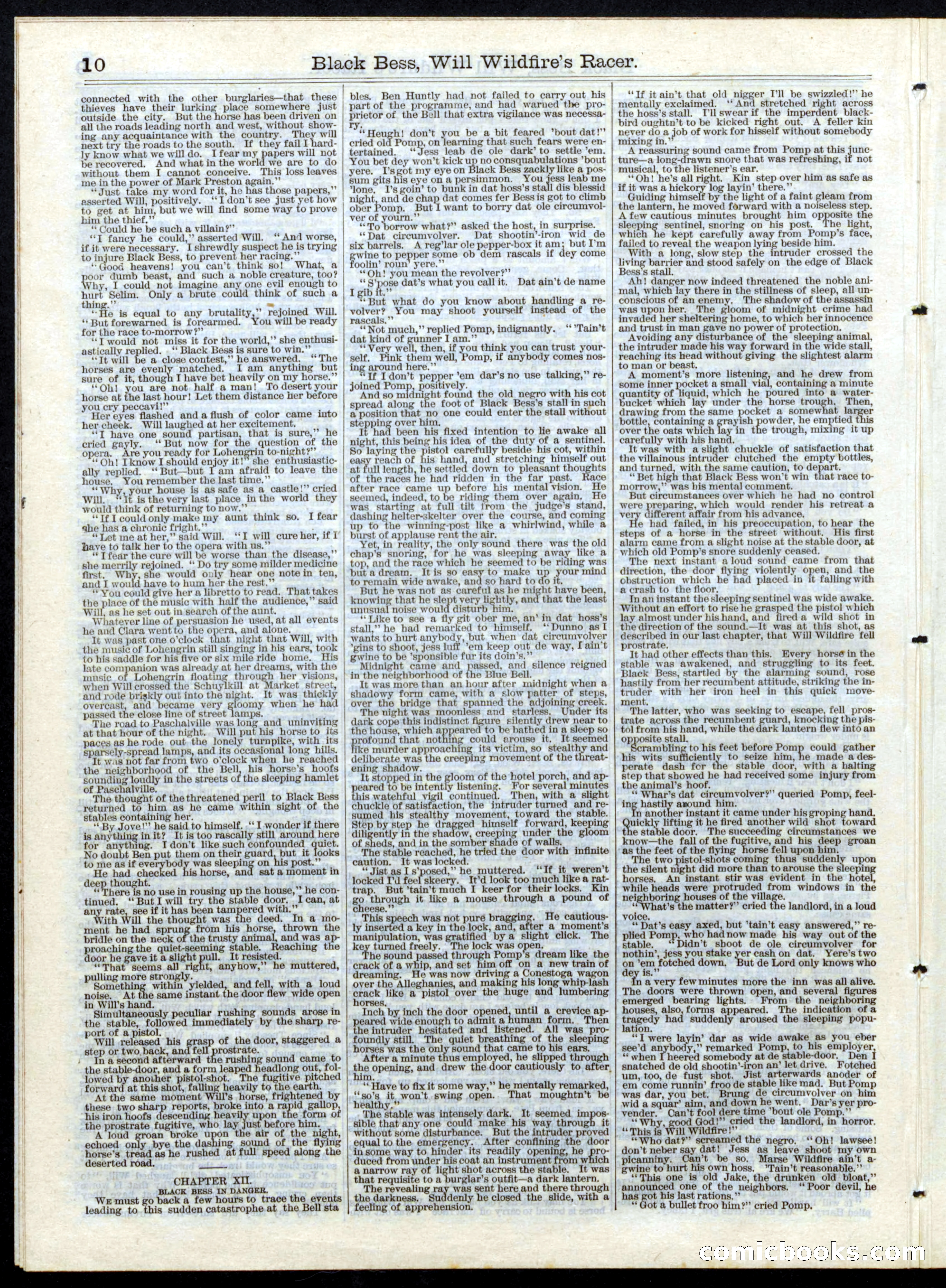
A restored page from Pulp Fiction, 1880. Page through the whole issue in the reader above.
📄 Transcribed text from this page (OCR, searchable)
Machine-transcribed from the original scan — historical spelling and the odd misread are preserved.
a _—_— ——= — ed — — << — _ rm -- SS —- == — - = —- += _ 10 connected with the other burglaries—that these thieves have their lurking place somewhere just outside the city. But the horse has been driven on all the roads leading north and west, without show- ing any acquaintance with the country. They will next try the roads to the south. If they fail I hard- ly know what we will do. I fear my pores will not be recovered. And whatin the world we are to do without them I cannot conceive. This loss leaves me in the power of Mark Preston again.” “Just take my word for it, he has those papers,” asserted Will, positively. ‘‘I don’t see just yet how to get at him, but we will find some way to prove him the thief,”’ * Could he be such a villain?” “T fancy he could,” asserted Will. ‘And worse, if it were necessary. I gece | suspect he is trying to ere Black Bess, to prevent her racing.”’ ‘Good heavens! you can’t think so! What, a oor dumb beast, and such a noble creature, too? Vhy, I could not imagine any one evil enough to = Selim. Only a brute could think of such a thing.’’ - ‘He is equal to any brutality,’ rejoined Will. ‘‘ But forewarned is forearmed. You will be ready for the race to-morrow?” ‘*T would not miss it for the world,’’ she enthusi- astically replied. . ‘‘ Black Bess is sure to win.” “Tt will a close contest,” he answered. “The horses are evenly matched. I am anything but sure of it, though I have bet heavily on my horse.” ‘Oh! you are not half a man! To desert your horse at the last hour! Let them distance her before you cry peccavil”’ Her eyes flashed and a flush of color came into her cheek. Will laughed at her excitement. “T have one sound partisan, that is sure,’ he cried gayly. “But now for the question of the opera. Are you ready for Lohengrin to-night?’’ ‘‘Oh! [know I should enjoy it!” she enthusiastic- ally replied. ‘‘But—but I am afraid to leave the house, You remember the last time.” "\ Why your house is as safe as a castle!” cried Will. "tt is the very last place inthe world they would think of returning to now.” “Te I could only make my aunt think so. I fear ahe has a chronic fright.” “ Let me at her,” said Will. have to talk her to the opera with us.’ ‘* T fear the cure will be worse than the disease,”’ she merrily rejoined. “ Do try some milder medicine first. date f she would only hear one notein ten, and I would have to hum her the rest.” “You could give her a libretto to read. That takes the place of the music with half the audience,” said Will, as he set out in search of the aunt. Whatever line of persuasion he used, at all events he and Clara went to the opera, and alone. It was past one o'clock that night that Will, with the music of Lohengrin still singing in his ears, took to his saddle for his five or six mile ride home. His nion was already at her dreams, with the music 0 onengrip floating through her visions, when Will crossed the Schuylkill at Market street, and rode briskly out into the night. It was thickly overcast, and became very gloomy when he had passed the close line of street lamps. The road to Paschalville was po and uninviting at that hour of the night. Will put his horse to its paces as he rode out the lonely turnpike, with its sparsely-spread lamps, and its occasional long hills. It was not far from two o'clock when he reached the neighborhood of the Bell, his horse’s hoofs sounding loudly in the streets of the sleeping hamlet of Paschalville. The thought of the threatened peril to Black Bess returned to him as he came within sight of the stables containing her. , “By Jove!” he said to himself. .‘‘ 1 wonder if there is any in it? It is too rascally still around here for anything. I don’t like such confounded quiet. No doubt Ben put them on their guard, but it looks to me as if eve reg 4 was —— on his post.” He had chec is horse, and sat a moment in deep thought. “There is no use in rousing up the house,”’ he con- tinued. ‘“ But I will try the stable door, I can, at any rate, see if it has been ea with.” ith Will the thought was the deed. ment he had sprung from his horse bridle on the neck of the trusty animal, and was ap- “J will cure her, if I , late com proaching the quiet-seeming stable. hing the door he gave it a slight cong It resisted. “That seems all right, anyhow,” he muttered, pulling more oe ENN Some wit yielded, and fell, with a loud noise. At the same instant the door flew wide open in Will's hand. Simultaneously peculiar rushing sounds arose in the stable, followed immediately by the sharp re- port of a pistol. Will released his grasp of the door, staggered a step or two. back, f rostrate. In a second afterward the rushing sound came to the stable-door, and a form leaped headlong out, fol- lowed by anovher pistol-shot. The tive pitched forw at this shot, falling heavily to the earth. At the same moment s horse, frightened by these two —? reports, broke into a rapid_gallop his iron hoofs descen hea upon the form o the prostrate fugitive, who lay just before him. A loud oe broke upon the air of the night, echoed only bye the d ng sound of the flying horse’s tread as he rushed at full speed along the deserted road. CHAPTER XII. BLACK BESS IN DANGER, We must go back a few hours to trace the events leading to this sudden catastrophe at the Bell sta | Black Bess, Will Wildfire’s Rac bles. Ben Huntly had not failed to carry out his part of the programme, and had warned the pro- prietor of the Bell that extra vigilance was necessa- ry. ‘“‘Heugh! don't you be a bit feared *bout dat!” cried old Pomp, on learning that such fears were en- tertained. “Jess leab de ole dark’ to settle ’em. You bet dey won’t kick me no consquabulations ’bout yere. I’sgot my eye on Black Bess zackly like a pos- sum gits his eye ona persimmon. You jess leab me ‘lone, I’s goin’ to bunk in dat hoss’s stall dis blessid night, and de chap dat comes fer Bess is got to climb ober Pomp. But I want to borry dat ole circumvol- ver of yourn.”’ “To borrow what?” asked the host, in surprise. “Dat circumvolver. Dat shootin’-iron wid de six barrels. A reg’lar ole pepper-box it am; but ’m wine to pepper some ob dem rascals if dey come oolin’ roun’ yere.”’ “Oh! you mean the revolver?”’ ~ a dat’s what you call it. I gib o ‘But what do you know about handling a re- volver? You may shoot yourself instead of the rascals.” j ‘*Not much,” replied Pomp, indignantly. “‘ *Tain’t dat kind of gunner I am.” “Very well, then, if you think you can trust your- self. Pink them well, Pomp, if anybody comes nos- ing around here.”’ ‘If I don’t pepper ’em dar’s no use talking,” re- joined = np positively. And so midni rht found the old_negro with his cot spread along the foot of Black Bess’s stall in such a position that no one could enter the stall without wa over him. It had been his fixed intention to lie awake all night, this being his idea of the duty of a sentinel. So laying the pistol carefully beside his cot, within easy reach of his hand, and stretching himself out at full length, he settled down to pleasant thoughts of the races he had ridden in the far past. ace after race came up before his mental vision. He seemed, indeed, to be riding them over again, He was starting at full tilt from the judge's stand, dashing helter-skelter over the course, and coming up to the winning-post like a whirlwind, while a burst of applause rent the air. Yet, in reality, the only sound there was the old chap's snoring, for he was sleeping away like a top, and the race which he seemed to be riding was but adream. Itis so easy to make u oa mind to remain wide awake, and so hard to do it. But he was not as careful as he might have been, knowing that he slept very lightly, and that the least unusual noise would disturb him. ‘‘ Like to see a fly git ober me, an’ in dat hoss’s stall,” he had remarked to himself, ‘‘Dunno asI wants to hurt anybody, but. when dat_circumvolver ‘gins to shoot, jess luff ‘em keep out de way, [ain't gwine to be ‘sponsible fur its doin’s.”’ Midnight came and passed, and silence reigned in the neighborhood of the Blue Bell. It was more than an hour after midnight when a shadowy form came, with a slow patter of steps, over the bridge that spanned the adjoining creek. The night was moonless and starless. Under its dark cope this indistinct figure silently drew near to the house, which ap ared to be bathed in a sleep so hear that nothing could erouse it, It seemed ike murder approaching its victim, so stealthy and deliberate was the creeping movement of the threat- ening shadow. It stopped in the gloom of the hotel porch, and ap- ared to be intently listening. For several minutes his watehful vigil continued. Then, with a slight chuckle of satisfaction, the intruder turned and re- sumed his stealthy movement, toward the stable. Step by step he dragged himself forward, keeping diligently in the shadow, creeping under the gloom of sheds, and in the somber shade of walls. The stable reached, he tried the door with infinite caution. It was locked. : “ Jist_as Is’ .’ he muttered. “If it weren't locked I'd feel skeery. It'd look too much like a rat- trap. But ’tain't mach I keer for their locks. Kin go through it like a mouse through a pound of eese This was not puré braggin . He cautious- ly meer a} key in the tot, and, r a moment’s manipulation, was gratified by a slight click. The key turned freely. The lock was open, he sound passed through Pomp’s dream like the crack of a whip, and set off on a new train of dreaming. He was now driving a Conestoga wagon over the Alleghanies, and making his long whip-lash crack like a pistol over the huge and lumbering Dat ain’t de name horses. Inch by inch the door opened, until a crevice ap- peared wide enough to admit a human form. Then : e tye en a bgp ‘ a wan pro- oun e et brea of the slee east eer aan end h “ih se ae raminu us employed, he slip oe opening, and drew the de m. ‘* Have to fix it some way,” he mentally remarked, ot, era swing open. That moughtn’t be e The stable was intensely dark. It seemed im sible that any one could make his way throurb it without some disturbance. But the intruder proved equal to the emergency. After confining the door in some way to hinder its readily opening, he pro- duced from under his coat an instrument from which a narrow ray of light shot across the stable. It was that requisite to a burglar’s outfit—a dark lantern. The revealing ray was sent here and there through the darkness. Suddenly he closed the slide, with a feeling of apprehension. as the feet of the flying oor cautiously to after, er. ee “Tf it ain’t that old nigger I'll be swizzled!’’ he mentally exclaimed. ‘And stretched right across the hoss’s stall. Tll swearif the imperdent black- bird oughtn’t to be kicked right out. A feller kin never do a job of work for hisself without somebody mixing in.’ A reassuring sound came from Pomp at this junc- ture—a long-drawn snore that was refreshing, if not musical, to the listener's ear. ‘‘Oh! he’s all right. Kin step over him as safe as if it was a hickory log layin’ there.”’ Guiding himself by the light of a faint gleam from the lantern, he moved forward with a noiseless step. A few cautious minutes brought him a ny the sleeping sentinel, snoring on his post. The light, which he kept carefully away from Pomp’s face, failed to reveal the weapon lying beside him. _ With a long, slow step the intruder crossed the living barrier and stood safely on the edge of Black Bess’s stall. Ah! danger now indeed threatened the noble ani- mal, which lay there in the stillness of sleep, all un- conscious of an enemy, The shadow of the assassin was upon her. The gloom of midnight crime had invaded her sheltering home, to which her innocence and trust in man gave no power of protection, Avoiding any disturbance of the sleeping animal, the intruder made his way forward in the wide stall, reaching its head without giving the slightest alarm to man or beast, A moment’s more listening, and he drew from some inner ey a small vial, containing a minute quantity of liquid, which he poured into a water- bucket which lay under the horse trough, Then, drawing from the same pocket a somewhat <¢ x7 bottle, containing a grayish hel he emptied this over the oats which y in the trough, mixing it up carefully with his hand. It was with a a chuckle of satisfaction that the villainous intruder clutched the empty bottles, and turned, with the same caution, to depart. ** Bet high that Black Bess won’t win that race to- morrow,”’ was his mental comment. But circumstances over which he had no control were preparing: which would render his retreat a be? different affair from his advance, e had failed, in his preoccupation, to hear the steps of a horse in the street without. His first alarm came from a slight noise at the stable door, at which old Pomp’s snore suddenly ceased, The next instant aloud sound came from that direction, the door flying violently open, and the obstruction which he had placed in it falling with a crash to the floor. Tn an instant the sleeping sentinel was wide awake. Without an effort to rise he grasped the pistol which lay almost under his hand, and fired a wild shot in the direction of the sound.—It was at this shot, as described in our last chapter, that Will Wildfire fell prostrate. It had other effects than this. Every horsé in the stable was awakened, and struggling to its feet. Black Bess, startled by the alarming sound, rose hastily from her recumbent attitude, striking the in- truder with her iron heel in this quick move- ment, The latter, who was seeking to escape, fell pros- trate across the recumbent guard, knocking the pis- tol from his hand, while the dark lantern flew into an opposite stall. mbling to his feet before Nome | could gather his wits sufficiently to seize him, he made a des- perate dash for the stable door, with a halting step that showed he had received some injury from the animal’s hoof, ‘* Whar’s dat circumvolver?”’ queried Pomp, feel- ing hastily avound him. n another instant it came under his groping hand. ickly lifting it he fired another wild shot toward the stable door. The succeeding circumstances we know—the fall of the fugitive, and his deep groan orse fell upon him. The two pistol-shots coming thus suddenly upon the silent night did more than to arouse the sleepi horses, An instant stir was evident in the hote while heads were protruded from windows in the neighboring houses of the May. ri t’s the matter?” cried the landlord, in a loud yoice, *“ Dat’s easy axed, but ‘tain’t easy answered,” re- plied Pomp who had now made his way out of the stable. “Didn't shoot de ole cireumvolver for nothin’, jess you stake yer cash on dat. Yere’s two on be fotched down, But de Lord only knows who my In a very few minutes more the inn was all alive. The doors were thrown open, and several figures emerged bearing lights. From the we nei houses, also, forms appeared. The indication ofa ie y had suddenly aroused the sleeping popu- on. “TI were layin’ dar as wide awake as you eber see’d an y,” remarked Pomp, to his employer “when I heered somebody at de stable-door. Den snatched de old shootin’-iron an’ let drive. Fotched um, too, de fust shot. Jist_arterwards anoder of em come runnin’ froo de stable like mad. But Pomp was dar, you bet. Brung de circumvolver on him wid a squar’ aim, and down he went. Dar’s yer pro- vender. Can't fool dere time "bout ole Pomp.” “Why, poor God!”’ cried the landlord, in horror. “This is Will Wildfire!"’ “Who dat?” screamed the negro. ‘Oh! lawsee! don’t neber say dat! Jess as leave shoot my own picanniny. Can’t be so, Wildfire ain’t a- gwine to hurt his own hoss. ’Tain't reasonable.”’ anno e ne . oor de e has got his last rations.” “ “Got a bullet froo him?” cried Pomp. GDOOKS (E@) €om