
Pulp Fiction, 1877 · page 14 of 16
Beadle's Half Dime Library, No. 15 — page 14: what you’re looking at
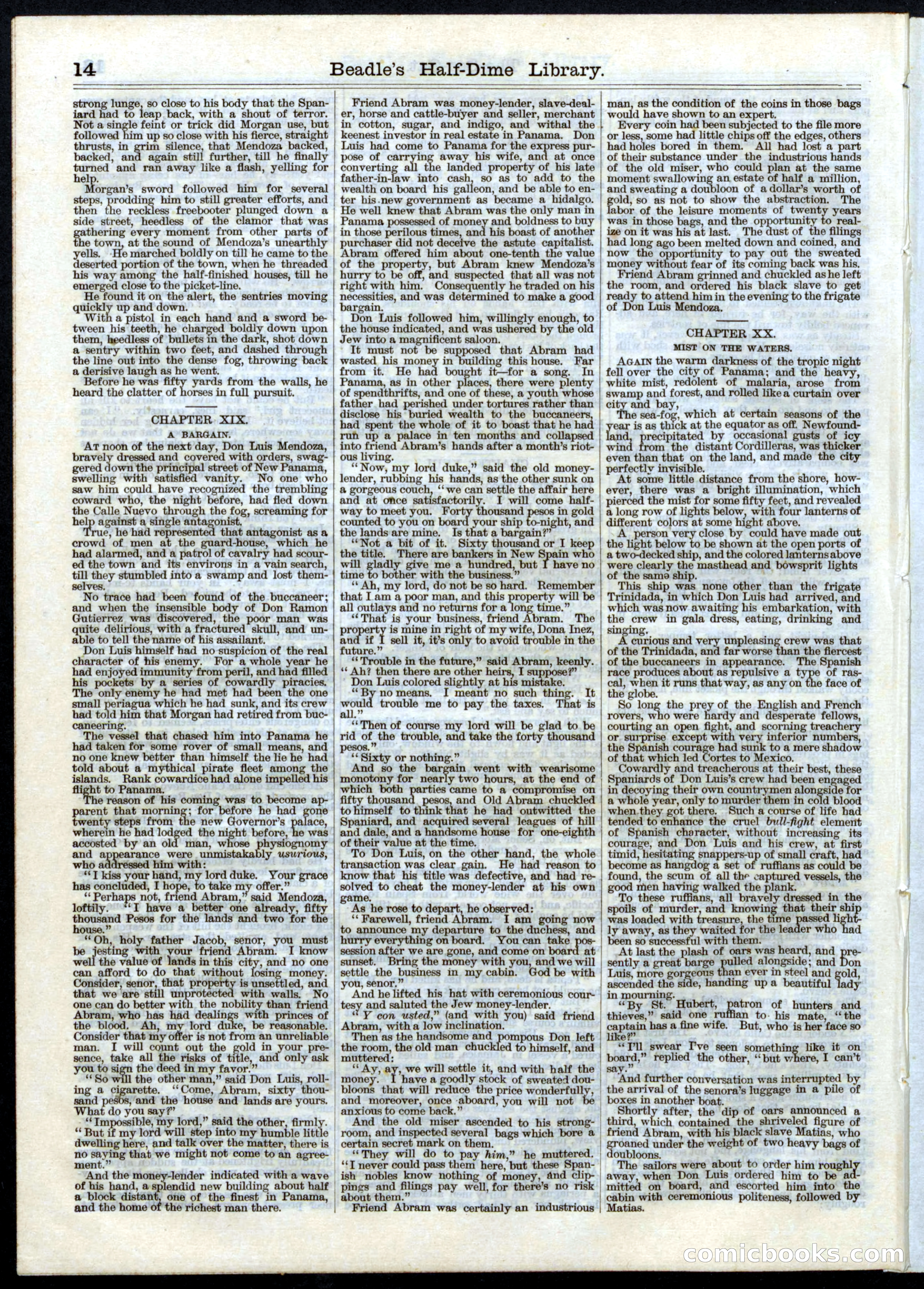
A restored page from Pulp Fiction, 1877. Page through the whole issue in the reader above.
📄 Transcribed text from this page (OCR, searchable)
Machine-transcribed from the original scan — historical spelling and the odd misread are preserved.
14 —— ee strong lunge iard had to leap back, with a shout of terror. Not a a feint or trick did Morgan use, but followed him up so close with his fierce, straight thrusts, in grim silence, that Mendoza backed, backed, and again still further, till he finally turned and ran away like a flash, yelling for help. Worvin’s sword followed him for several steps, prodding him to still greater efforts, and then the reckless freebooter plunged down a side street, heedless of the clamor that was thering every moment from other parts of e town, at the sound of Mendoza’s unearthly yells. He marched boldly on till he came to the deserted portion of the town, when he threaded his way among the half-finished houses, till he emerged close to the picket-line. He found it on the alert, the sentries moving quickly up and down. With a pistol in each hand and a sword be- tween his teeth, he charged boldly down upon them, heedless of bullets in the dark, shot down a sentry within two feet, and dashed through the line out into the dense fog, throwing back a derisive laugh as he went. Before he was yards from the walls, he heard the clatter of horses in full pursuit. CHAPTER. XIX. A BARGAIN. AT noon of the next day, Don Luis Mendoza, bravely dressed and covered with orders, swag- gered down the principal street of New Panama, swelling with satisfied vanity. No one who saw him could have recognized the trembling coward who, the night before, had fled down the Calle Nuevo through the fog, screaming for help against a single antagonist. e, he had represehited that antagonist as a crowd of men at the guard-house, which he had alarmed, and a patrol of cavalry had scour- ed the town and its environs in a vain search, till they stumbled into a swamp and lost them- selves. No trace had been found of the buccaneer; and when the insensible body of Don Ramon Gutierrez was di ered, the poor man was quite delirious, with a fractured skull, and un- able to tell the name of his assailant. Don Luis himself had no suspicion of the real character of his enemy. For a whole year he had enjoyed immunity from peril, and had filled his pockets by a series of cowardly piracies, The only enemy he had met had been the one small periagua which he had sunk, and its crew had told him that Morgan had retired from buc- caneering. The vessel that chased him into Panama he had taken for some rover of small means, and no one knew better than himself the lie he had told about a mythical pirate fleet among the islands. Rank cowardice had alone impelled his ht to Panama. ’ e reason of his coming was to become ap- parent that morning; for before he had gone enty steps from the new Governor’s palace wherein he had lod the night before, he was et by an old man, whose hysiognomy and appearance were unmistakably usurious, who abdréesed him with: **T kiss your hand, my lord duke. Your has concluded, I hope, to take my offer.” a Perhaps not, friend Abram,” said Mendoza, loftily. “‘I have a_ better one already, thousand Pesos for the lands and two for the “Oh, holy father Jacob, senor, you must be jesting with your friend Abram. I know well the value of lands in this city, and no one can afford to do that without pene. money. Consider, senor, that pro is unsettled, and that we are unpro with walls. No one can do better with the nobility than friend Abram, who has had dealin th princes of the blood. Ah, my lord duke, be reasonable. Consider that my offer is not from an unreliable man. I will count out the gold in your pre- sence, take all the risks of title, and only ask you to se the deed in my favor.” ‘* So the other man,” said Don Luis, roll- ing a ec tte. ‘‘Come, Abram, sixty thou- sand , and the house and lands are yours. What do you say?” ‘‘Tmpossible, my lord,” said the other, firmly. “But if my lord will step into my humble little dwelling here, and talk over the matter, there is no saying that we might not come to an agree- ment.” And the woo a indicated with a wave of his hand, a splendid new building about half a block distant, one of the finest in Panama, and the home of the richest man there. so close to his body that the Span- Beadle’s Half-Dime Library. Friend Abram was money-lender, slave-deal- er, horse and cattle-buyer and seller, merchant in cotton, sugar, and indigo, and withal the keenest investor in real estate in Panama. Don Luis had come to Panama for the express pur- pose of carr ing away his wife, and at once convertin the landed property of his late | rr dag, into cash, so as to add to the wealth on board his galleon, and be able to en- _ ter his.new government as became a hidalgo. | He well knew that Abram was the only man in Panama possessed of money and boldness to buy _ in those perilous times, and his boast of another purchaser did not deceive the astute capitalist. Abram offered him about one-tenth the value of the property, but Abram knew Mendoza’s hurry to be off, and suspected that all was not right with him. Consequently he traded on his eee rig and was determined to make a good rgain. Don Luis followed him, willingly enough, to the house indicated, and was ushered by the old Jew into a magnificent saloon. that Abram had It must not be supposed wasted his mone in building this house. Far from it. He bought it—for a song. In Panama, as in other p there were plenty of spendthrifts, and one of these, a youth whose father had perished under tortures rather than disclose his buried wealth to the buccaneers had spent the whole of it to boast that he had ruh up a palace in ten months and collapsed into friend Abram’s hands after a month’s riot- ous living. ‘Now, my lord duke,” said the old money- lender, rubbing his hands, as the other sunk on a gorgeous couch, ‘we can settle the affair here and at once satisfactorily. I will come half- way to meet you. Forty thousand SEry in gold counted to you on our ship to-night, and the lands are mine. Is that a bargain?” ‘Not a bit of it. Sixty thousand or I keep the title. There are bankers in New 8 who will gladly give me a hundred, but I have no time to bother with the business.” ‘* Ah, my lord, do not be so hard. Remember that Iam a poor man, and this property will be all outlays and no returns for a time.” ‘That is your business, friend Abram. The property is mine in right of my wife, Dona Inez, ee if é sell it, it’s only to avoid trouble in the re. ' “Trouble in the future,” said Abram, keenly. ‘‘ Ah? then there are other heirs, I suppose?” Don Luis colored slightly at his e. “By no means. I meant no such a or trouble me to pay the taxes. “Then of course my lord will be glad to be rid of the trouble, and take the forty thousand oS or nothing.” Pag: 4 the g monotony for which both It t is went with wearisome fifty th ~ and Old Ab - kkled ousan an ram chue = himself to think that he ae by peg a paniard, and acqu seve eagues 0 and dale, and a handsome house for one-eighth of their value at the time. To Don Luis, on the other hand, the whole transaction was clear gain. He know that his title was defective, and had re- solved to cheat the money-lender at his own game. As he rose to depart, he observed: ‘** Farewell, friend Abram. I am going now to announce my departure to the duchess, and hurry everything on board. You can take session after we are gone, and come on at sunset. Bring the money with you, and we will settle the business in my cabin. God be with you, senor,” And he lifted his hat with ceremonious cour- tesy and saluted the Jew money-lender. * Y econ usted,” (and with you) said friend Abram, with a low inclination. Then as the handsome and pompous Don left the room, the old man chuckled to himself, and muttered: ‘‘ Ay, ay, we will settle it, and with half the t money. I have a goodly stock of sweated dou- _bloons tha t will reduce the price aT ha and moreover, once a , you will not _ anxious to come back.” And the old miser ascended to his strong- certain secret mark on them. _ “They will do to pay him,” he muttered. ‘tT never could pass them here, but these Span- ish nobles know nothing of money, and clip- pings and filings pay well, for there’s no risk | about them.” Friend Abram was certainly an industrious nearly two hours, at the end of had reason to — — _———e man, as the condition of the coins in those bags would have shown to an expert. Every coin been subjected to the file more or less, some had little chips off the edges, others had holes bored in them. All had lost a part of their substance under the industrious hands of the old miser, who could plan at the same moment swallowing an estate of half a million, and sweating a doubloon of adollar’s worth of old, so as not to show the abstraction. The abor of the leisure moments of twenty years was in those bags, and the ha Soggy ize on it was his at last. The dust of the filings had long ago been melted down and coined, and now the opportunity to pay out the sweated money without fear of its coming back was his. iend Abram grinned and chuckled as he left the room, and ordered his black slave to get ready to attend him in the evening to the frigate of Don Luis Mendoza. CHAPTER XX. MIST ON THE WATERS. AGAIN the warm darkness of the tropic night fell over the city of Panama; and the heavy, white mist, redolent of malaria, arose swamp and forest, and rolled likea curtain over city and bay, _. e sea-fog, which at certain seasons of the ear is as thick =) ye equator as Ychee cr toy d, precipitated by occasiona Oo wind ai tthe distant Cordilleras, was thicker even than that on the land, and made the city perfectly invisible. : At some little distance from the shore, how- ever, there was a bright illumination, which pierced the mist for some fifty feet, and revealed a long row of lights below, with four lanterns of different colors at some hight above. A person Mins eng by could have made out the light below to be shown at the open ports of a two-decked ship, and the colored lanterns above were clearly the masthead and bowsprit lights of the samo ship. : This ship was none other than the frigate Trinidada, in which Don Luis had arrived, and which was now awaiting his embarkation, with the crew in gala dress, eating, drinking and singing. curious and very Mae gms crew was that of the Trinidada, and far worse than the fiercest of the buccaneers in appearance. The §S race produces about as repulsive a t of ras- cal, when it runs that way, as any on the face of the globe. So long the prey of the English and French rovers, who were hardy and desperate fellows, courting an open fight, and scorning treachery or ise except with very inferior numbers, the Spanish cou had sunk to a mere shadow of that which led Cortes to Mexico. Cowardly and treacherous at their best, these Spaniards of Don Luis’s crew had been engaged in decoying their own countrymen ape cy e for a whole year, only to m r them in cold blood when.they got there. Such a course of life had tended to enhance the cruel bull-fight element of Spanish character, without increasing its courage, and Don Luis and his crew, at first timid, hesitating snappers-up of small craft, had become as hangdog a set o ruffians as could be found, the scum of all the captured vessels, the good men having walked the plank. | To these ruffians, all bravely dressed in the spoils of murder, and knowing that ee g was loaded with treasure, the ne Parag. High ly away, as they waited for the leader who had been so successful with them. At last the plash of oars was heard, and pee sently a great barge ed alongside; and Don Luis, more go s than ever in steel and gold, ascended the side, handing up a beautiful lady in mourning. “By St. rere i ‘snake of hunters and thieves,” said one — to: his mate, ‘the copie has a fine wife. But, who is her face so e “Til swear I’ve seen something like it on board,” replied the other, “but where, I can’t say.” And further conversation was interrupted by the arrival of the senora’s luggage in a pile of boxes in another boat. Shortly after, the dip of oars announced a third, which contained the shriveled figure of room, and inspected several bags which bore a friend Abram, with his black slave Matias, who ey Caitied under the weight of two heavy bags of oubloons. The sailors were about to order him a away, when Don Luis ordered him to be ad- mitted on board, and escorted him into the se with ceremonious politeness, followed by tias. COMME DOOKS (c rt Col