
Pulp Fiction, 1877 · page 12 of 16
Beadle's Half Dime Library, No. 15 — page 12: what you’re looking at
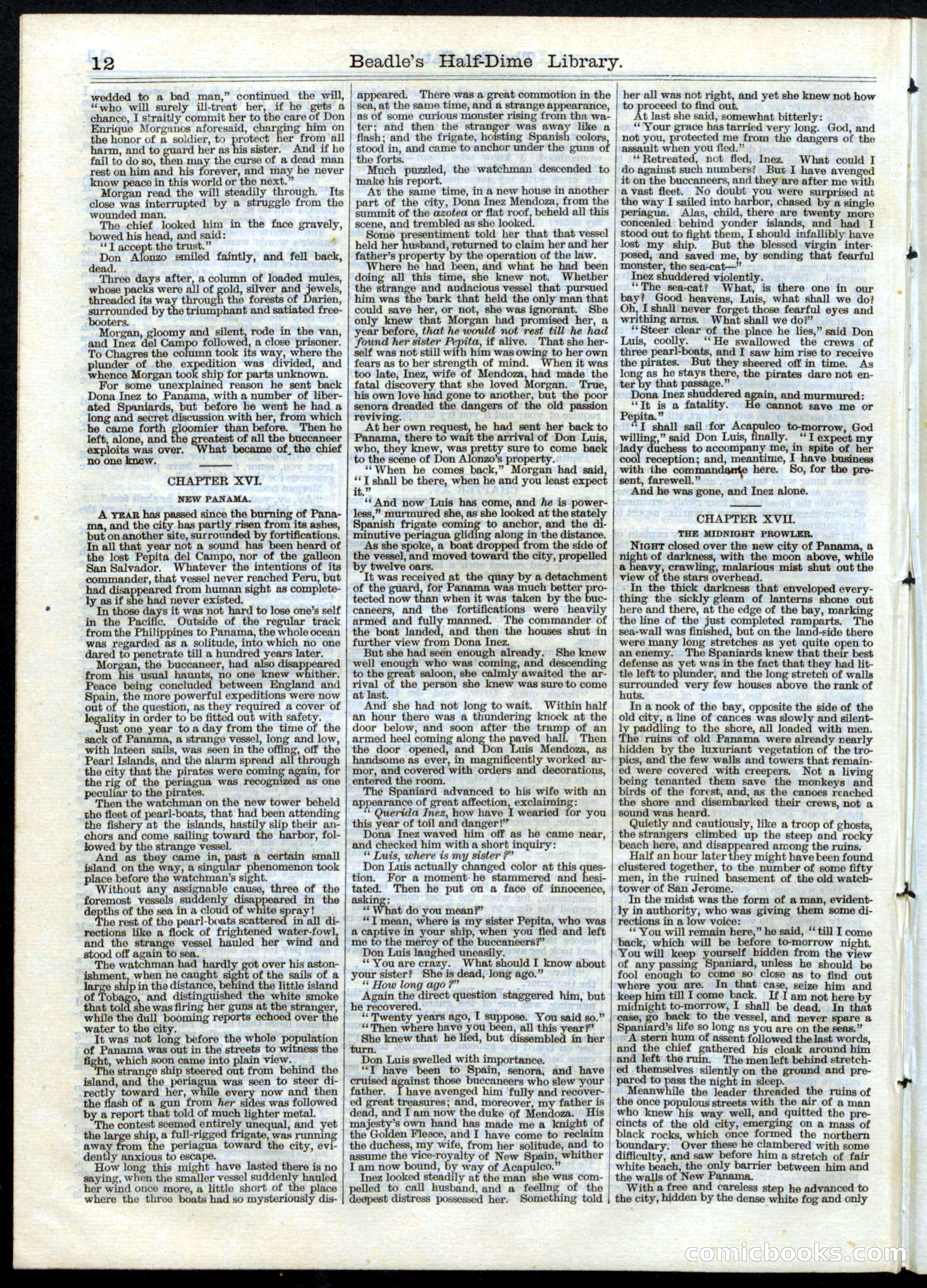
A restored page from Pulp Fiction, 1877. Page through the whole issue in the reader above.
📄 Transcribed text from this page (OCR, searchable)
Machine-transcribed from the original scan — historical spelling and the odd misread are preserved.
——————————— ee 12 wedded to a bad man,” continued the will, “who will surely ill-treat her, if he gets a chance, I straitly commit her to the care of Don Enrique Morganos aforesaid, charging him on es the honor of a soldier, to protect her from all harm, and to rd her as his sister. And if he fail to do so, then may the curse of a dead man rest on him and his forever, and may he never know peace in this world or the next.” Morgan read the will steadily through. Its close was interrupted by a struggle from the wounded man. ; The chief looked him in the face gravely, bowed his head, and said: . ‘““T accept the trust.” Don Alonzo smiled faintly, and fell back, dead Three days after, a column of loaded mules, whose packs were all of old, silver and jewels, threaded its way through the forests of Darien, surrounded by the triumphant and satiated free- Tr onghb, 2 a silent, rode in th or oomy an en e in the van, and toes’ ‘del Cari followed, a close prisoner. To Chagres the column took its way, where the plunder of the expedition was divided, and whence Morgan took ship for parts unknown. For some unexplained reason he sent back Dona Inez to Panama, with a number of liber- ated Spaniards, but before he went he had a long and secret discussion with her, from which he came forth gloomier than before. Then he left, alone, and the of all the buccaneer exploits was over, hat became of_ the chief no one knew. CHAPTER XVI. NEW PANAMA. A YEAR has since the burning of Pana- ma, and the city has partly risen from its ashes, but on another site, surrounded by fortifications. In all that year not a sound has been heard of the lost Pepita del Campo, nor of the galleon San Salvador. Whatever the intentions of its commander, that vessel never reached Peru, but had disa from human sight as complete- ly as if she had never existed. In those days it was not hard to lose one’s self in the Pacific. Outside of the track from the Philippines to Panama, the whole ocean was regarded as a solitude, into which no one dared to penetrate till a hundred years later. rg the buccaneer, had also disap from his usual haunts, no one knew whither. Peace being concluded between England and Spain, the more powerful expeditions were now out of the question, as they required a cover of ity in order to be fitted out with safety. lust one year toa day from the time of the sack of Panama, a strange vessel, long and low, with lateen sails, was seen in the offing, off the Pear! Islands, and the alarm spread through the city that the pirates were comin in, for as one the rig of the periagua was reco iar to the pirates. Then the watchman on the new tower beheld the fleet of pearl-boats, that had been attending the fishery at the islands, hastily slip their an- chors and come sailing toward the harbor, fol- lowed by the strange vessel. | And as they came in, a certain small island on the way, a singular phenomenon took place before the watchman’s sight. Without any assignable cause, three of the foremost vessels suddenly disa in the depths of the sea in a cloud of w wh gk it | The rest of the pearl-boats scatte in all di- rections like a flock of frightened water-fowl and the strange vessel hauled her wind an stood off again to sea. The watchman had hardly got over his aston- ishment, when he caught of the sails of a large ship in the distance, behind the little island of Tobago, and distin ed the white smoke that she was firing her guns at the stranger, while the dull booming reports echoed over the water to the city. It was not long before the whole acts of Panama was out in the streets to wi the fight, which soon came into plain view. e strange ship steered out from behind the island, and the peria was seen to steer di- rectly toward her, w every now and then the flash of a from her sides was followed by a report that told of much lighter metal. The contest seemed entirely unequal, and yet the ee ship, a full-rigged frigate, was running awa m the periagua toward the city, evi- dently anxious to escape. How long this might have lasted there is no saying, when the smaller vessel suddenly hauled her wind once more, a little short of the place where the three boats had so mysteriously dis- Be —— SE — appeared. There was a t commotion in the sea, at the same time, and a strange appearance, as of some curious monster rising from tha wa- ter; and then the stranger was away like a flash; and the frigate, hoisting Spanish colors stood in, and came to anchor under the guns of the forts. Much puzzled, the watchman descended to make his report. At the same time, in a new house in another part of the city, Dona Inez Mendoza, from the summit of the azotea or flat roof, beheld all this scene, and trembled as she looked. Some presentiment told her that that vessel held her husband, returned to claim her and her father’s property by the operation of the law. Where he had been, and what he had been doing all this time, she knew not, Whether the strange and audacious vessel that pursued him was the bark that held the only man that could save her, or not, she was ignorant. She only knew that Morgan had promised her, a year before, that he would not rest till he had found her sister Pepita, if alive. That she her- self was not still with him was owing to her own fears as to her strength of mind. en it was too late, Inez, wife of Mendoza, had made the fatal discovery that she loved Morgan. True, his own love had gone to another, but the poor senora dreaded the dangers of the old passion reviving. At her own request, he had sent her back to there to wait the arrival of Don Luis, who, they knew, was pretty sure to come back to the scene of Don Alonzo’s property. ‘*When he comes back,” Morgan had said + T shall be there, when he and you least expect ‘*And now Luis has come, and he is power- less,” murmured she, as she looked at the stately Spanish frigate coming to anchor, and the di- minutive periagua gliding along in the distance. As she spoke, a boat dropped from the side of the vessel, and moved toward the city, propelled by twelve oars. It was received at the quay by a detachment of the guard, for Panama was much better ot tected now than when it was taken by the buc- caneers, and the fortifications were heavily armed and fully manned. The commander of the boat landed, and then the houses shut in further view from Dona Inez. But she had seen enough already. She knew well enough who was coming, and descending to the great saloon, she calmly awaited the ar- void t the person she knew was sure to come a ; And she had not long to wait. Within half an hour there was a thundering knock at the door below, and soon after the tramp of an armed heel coming along the paved hall. Then the door opened, and Don Luis Mendoza, as me as ever, in magnificently worked ar- mor, and covered with orders and decorations, entered the room. The Spaniard advanced to his wife with an appearance of great affection, exclaiming: ‘ Querida Inez, how have I wearied for you this year of toil and danger!” Dona Inez waved him off as he came near, and checked him with a short inquiry: ** Tuis, where is my sister ?” Don Luis actually changed color at this ques- tion. For a moment he stammered and hesi- tated. Then he put on a face of innocence, asking: - What do you mean?” “I mean, where is my sister Pepita, who was a captive in your ship, when you fled and left me to the mercy of the buccaneers?” Don Luis laughed uneasily. **'You are crazy. What should I know about your sister? She is dead, long ago.” ** How long ago ?” Again the direct question staggered him, but he recovered. “Twenty years ago, [ suppose. You said so.” “Then where have you been, all this year?’ She knew that he lied, but dissembled in her turn. Don Luis swelled with importance. ‘‘T have been to Spain, senora, and have cruised nst those buccaneers who slew ‘your father. I have avenged him fully and recover- ed great treasures; and, moreover, my father is dead, and I am now the duke of tendons His majesty’s own hand has made me a knight of the Golden Fleece, and I have come to reclaim the duchess, my wife, from her solitude, and to assume the vice-royalty of New Spain, whither I am now bound, by way of Acapulco.” Inez looked steadily at the man she was com- lied to call husband, and a feellng of the aespent distress possessed her. Something told adle’s HalfDime Library. ees re oe ee LL SSS —p—~~~-seste-~—n>-~-t = Sees a her all was not right, and yet she knew not how to proceed to find out. t last she said, somewhat bitterly: “Your grace has tarried very long. God, and not you, protected me from the dangers of the assault when you fled.” ‘*Retreated, not fled, Inez. What could I do against such numbers? But I have avenged it on the buccaneers, and they are after me with a vast fleet. No doubt you were surprised at the way I sailed into harbor, chased by a single periagua. Alas, child, there are twenty more concealed behind yonder islands, and had I stood out to fight them, I should infallibly have lost my ship. But the blessed virgin inter. posed, and saved me, by sending that fearful monster, the sea-cat—” Inez shuddered violently. ‘The sea-cat? What, is there one in our bay? Good heavens, Luis, what shall we do? Oh, I shall never forget those fearful eyes and writhing arms. What shall we do?’ ‘Steer clear of the place he lies,” said Don Luis, coolly. ‘‘He swallowed the crews of three pearl-boats, and I saw him rise to receive the pirates. But they sheered off in time. As long as he stays there, the pirates dare not en- ter by that passage. Dona Inez shuddered in, and murmured: “Tt is a fatality. e cannot save me or Pepita.” I shall sail for Acapulco to-morrow, God hn said Don Luis, ly. “IT expect my lady duchess to accompany me, in spite of her cool reception; and, meantime, I have business with the commandante here. So, for the pre- sent, farewell.” And he was gone, and Inez alone. CHAPTER XVIL. THE MIDNIGHT PROWLER. NIGHT closed over the new city of Panama, a night of darkness, with the a above, while a , crawling, malarious mist shut out the view of the stars overhead. In the thick darkness that enveloped every- thing the sickly gleam of lanterns shone out here and there, at the edge of the bay, marking the line of the just completed ramparts. The sea-wall was finished, but on the land-side there were many long stretches as yet quite open to anenemy. The Spaniards knew that their best defense as yet was in the fact that they had lit- tle left to plunder, and the long stretch of walls eager very few houses above the rank of u In a nook of the bay, opposite the side of the old city, a line of cances was slowly and silent- ] paddling to the shore, all loaded with men. e ruins of old Panama were already nearly hidden by the luxuriant vegetation of the tro- pics, and the few walls and towers that remain- ed were covered with creepers. Not a livin being tenanted them save the monkeys and birds of the forest, and, as the canoes reached the shore and disembarked their crews, not a sound was heard. Quietly and cautiously, like a troop of ghosts, the strangers climbed up the steep and rocky beach here, and disappeared among the ruins. Half an hour later they might have been found clustered together, to the number of some fifty men, in the ruined basement of the old watch- tower of San Jerome. In the midst was the form of a man, evident- ly in authority, who was giving some di- ons in a low voice: ‘You will remain here,” he said, “ till I come back, which will be before to-morrow night. You will keep yourself hidden from the view of any ing Spaniard, unless he should be fool enough to come so close as to find out where you are. In _ that case, seize him and keep him till I come back. If I am not here by midnight to-morrow, I shall be dead, In that case, go back to the vessel, and never spare a Spaniard’s life so long as you are on the seas.” A stern hum of assent followed the last words, and the pl ete his cloak around him and left the . The menleft behind stretch- ed themselves silently on the ground and pre- pared to pass the night in sleep. Meanwhile the leader threaded the ruins of the once populous streets with the air of a man who knew his way well, and quitted the pre- cincts of the old city, emerging on a mass of black rocks, which once formed the northern boundary. Over these he clambered with some difficulty, and saw before him a stretch of fair white beach, the only barrier between him and the walls of New Panama. With a free and careless step he advanced to the city, hidden by the dense white fog and only IOOKS COMMIS | 4 Eom)