
Pulp Fiction, 1880 · page 10 of 24
Beadle's Half Dime Library, No. 146 — page 10: what you’re looking at
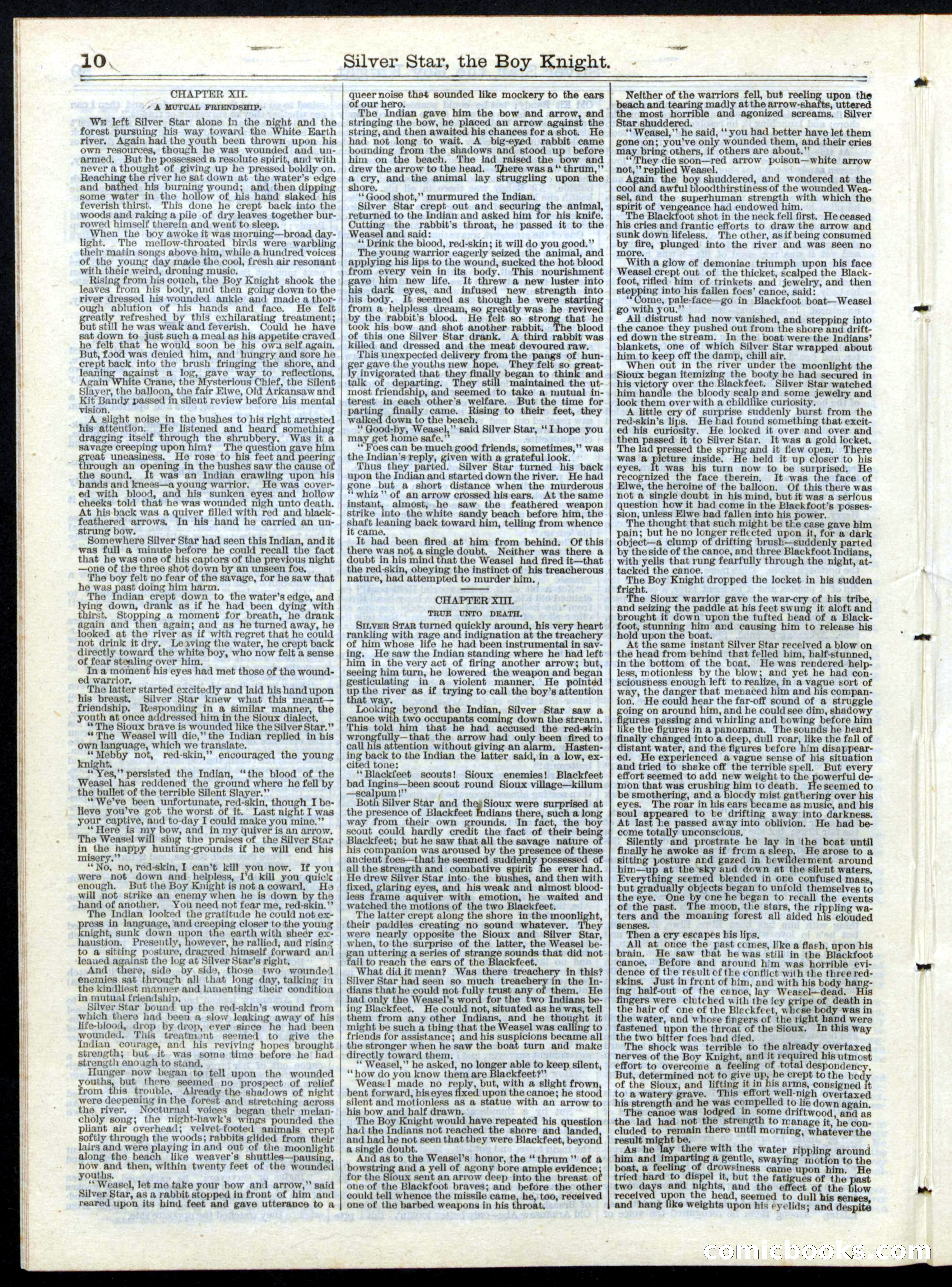
A restored page from Pulp Fiction, 1880. Page through the whole issue in the reader above.
📄 Transcribed text from this page (OCR, searchable)
Machine-transcribed from the original scan — historical spelling and the odd misread are preserved.
az a ae a — * i VE i ee ee ee eee 24 OO ~ a a 10, oe SS ee CHAPTER XII. - A MUTUAL FRIENDSHIP. We left Silver Star alone in the night and the forest pursuing his way toward the White Earth river, Again had the youth been thrown upon his own resources, though he was wounded and un- armed. But he possessed a resolute spirit, and with never a thought of giving up he pressed boldly on. Reaching the river he sat down at the water’s edge and bathed his burning wound; and then dipping some water in the hollow of his hand slaked his feverish thirst. This done he crept back into the woods and raking a pile of dry leaves together bur- rowed himself therein and went to sleep. When the boy awoke it was morning—broad day- light. The mellow-throated birds were warbling their matin songs above him, while a hundred voices of the young day made the cool, fresh air resonant with their weird, droning music. Rising from his couch, the Boy Knight shook the leaves from his body, and then going down to the river dressed his wounded ankle and made a thor- ough ablution of his hands and face. He felt reatly refreshed by this exhilarating treatment; ut still he was weak and feverish. Could he have sat down to just such a meal as his appetite craved he felt that he would soon be his owa self again. But, food was denied him, and hungry and sore he crept back into the brush fringing the shore, and geen a log, gave way to reflections, Again ite Crane, the Mysterious Chief, the Silent Slayer, the balloon, the fair Elwe, Old Arkansaw and Kit Bandy passed in silent review before his mental vision. A slight noise in the bushes to his right arrested his attention. He listened and heard something dragging itself through the shrubbe Was it a savage creeping upon him? The question gave him reat uneasiness. He rose to his feet and peering ugh an Boge in the bushes saw the cause o the sound, It was an Indian crawling upon his hands and knees—a B ine 3 warrior. He was cover- ed with blood, and his sunken eyes and hollow cheeks told that he was wounded nigh unto death. At his back was a quiver filled with red and black- feathered arrows. In his hand he carried an un- strung bow. Somewhere Silver Star had seen this Indian, and it was full a minute before he could recall the fact that he was one of his captors of the previous night —one of the three shot down by an unseen foe, The boy felt no fear of the savage, for he saw that he was past doing him harm. The Indian crept down to the water’s edge, and lying down, drank as if he had been dying with thirst. Stopping a moment for breath, he drank again and then again; and as he turned away, he looked at the river as if with regret that he could not drink it vor Leaving the water, he crept back directly toward the white boy, who now felt a sense of fear stealing over him. In a moment his eyes had met those of the wound- ed warrior, The latter started excitedly and laid his hand upon his breast. Silver Star knew what this meant— friendship. Responding in a similar manner, the youth at once addressed him in the Sioux dialect. “The Sioux brave is wounded like the Silver Star.” “The Weasel will die,’ the Indian replied in his own | ge, which we translate. = ong y not, red-skin,’’ encouraged the young t. * Yes,’ persisted the Indian, “the blood of the Weasel has reddened the ground where he fell by the bullet of the terrible Silent Slayer.” “We've been unfortunate, red-skin, though I be- lieve you’ve got the worst of it. Last night I was your captive, and to-day I could make you mine.” ‘*Here is my bow, and in my quiver is an arrow. The Weasel will sing the praises of the Silver Star — the happy hunting-grounds if he will end his misery.’ ‘* No, no, red-skin, I can’t kill you now. If you were not down and helpless, I'd kill you quick enough. But the Boy Knight is nota coward, Hae will not strike an enemy when he is down by the hand of another. You need not fear me, red-skin.”’ The Indian looked the gratitude he could not ex- ress in language, and creeping closer to the young ight, sunk down upon the earth with sheer ex- haustion. Presently, however, he rallied, and rising to a sitting posture, dragged himself forward an:| leaned against the log at Silver Star’s right. And there, side by side, those two wounded enemies sat through all that long day, talking in the kindliest manner and lamenting their condition in mutual friendship. Silver Star bound up the red-skin’s wound from which there had been a slow leaking away of his life-blood, drop by drop, ever since he had been wounded. This treatment seemed to give the Indian courage, and his reviving hopes brought strength; but it was some time before he had strength enough to stand, Hunger now began to tell upon the wounded ouths, but there seemed no prospect of relief rom this trouble, “rene the shadows of night were deepening in the forest and stretching across the river. Nocturnal voices began their melan- choly song; the night-hawk’s wings pounded the pliant air overhead; velvet-footed animals crept softly through the woods; rabbits glided from their lairs and were playing in and out of the moonlight along the beach like weaver's shuttles—pausing, mw Car agg then, within twenty feet of the wounded youths. ‘* Weasel, let me take your bow and arrow,” said Silver Star, as a rabbit stopped in front of him and reared upon its hind feet and gave utterance to a Si queer noise that sounded like mockery to the ears of our hero, The Indian gave him the bow and arrow, and stringing the bow, he placed an arrow against the string, and then awaited his chances for a shot. He had not long to wait. A big-eyed rabbit came bounding from the shadows and stood _ before him on the beach. The lad raised the bow and drew the arrow to the head. There was a‘ thrum,”’ * cry, and the animal lay struggling upon the shore. ‘** Good shot,’’ murmured the Indian. Silver Star crept out and yer the animal, returned to the Indian and asked him for his knife. Cutting the rabbit's throat, he passed it to the Weasel and said: ** Drink the blood, red-skin; it will do you good.” The young warrior eagerly seized the animal, and applying his lips to the wound, sucked the hot blood from every vein in its body. This nourishment ave him new life. It threw a new luster into dark eyes, and infused new strength into his body. It seemed as though he were startin from a helpless dream, so greatly was he reviv by the rabbit’s blood. He felt so strong that he took his bow and shot another rabbit. e blood of this one Silver Star drank. A third rabbit was killed and dressed and the meat devoured raw. This unexpected deliv from the pa of hun- er gave the youths new hope. They felt so t- y invigorated that m4 ualy began to and talk of departing. They still maintained the ut- most friendship, and seemed to take a mutual in- terest ee pes 2 other's Lema o> oe a parti nally came. Rising e eet, they valet down to the beach, ** Good-by, Weasel,” said Silver Star, ‘‘I hope you may get home safe.’ ‘Foes can be much good friends, sometimes,’’ was the Indian’s reply, ee with a grateful look. Thus they parted. Silver Star turned his back upon the Indian and started down the river. He had gone but a short distance when the murderous ‘whiz’ of an arrow crossed his ears. At the same instant, almost, he saw the feathered weapon strike into the white sandy beach before him, the ones leaning back toward him, telling from whence came. It had been fired at him from behind. Of this there was nota single doubt. Neither was there a doubt in his mind that the Weasel had fired it—that the red-skin, obeying the instinct of his treacherous nature, had attempted to murder him. , CHAPTER XTIL TRUE UNTO DEATH. Srrver StTar turned quickly around, his very heart rankling with e and indignation at the treachery of him whose life he had been instrumental in sav- ing. He saw the Indian standing where he had left him in the very act of firing another arrow; but, seeing him turn, he lowered the weapon and began gesticulating in a violent manner. He pointéd yh ae river as if trying to call the boy’s attention way. nonce beyond the Indian, Silver Star saw a canoe with two occupants coming down the stream. This told him that he had accused the red-skin wron —that the arrow had only been fired to call his attention without giving an alarm. Hasten- ing back to the Indian the latter said, in a low, ex- cited tone: ** Blackfeet scouts! Sioux enemies! Blackfeet bad Ingins—been scout round Sioux village—killum —scalpum !”’ Both Silver Star and theySioux were surprised at the presence of Blackfeet Indians there, such a long way from their own grounds. In fact, the boy scout could hardly credit the fact of their Blackfeet; but he saw that all the savage nature o his companion was aroused by the presence of these ancient foes—that he seemed suddenly possessed of all the strength and combative spirit he He drew Silver Star into. the bu fixed, glaring eyes, and his weak an less frame aquiver with emotion, he waited and watched the motions of the two Blackfeet. The latter crept along the shore in the moonlight, their paddles creating no sound whatever. ey were nearly opposite the Sioux and Silver Star, when, to the surprise of the latter, the Weasel be- an utte a series of str sounds that did not ail to reach the ears of the Blackfeet. What did it mean? Was there treachery in this? Silver Star had seen so much treachery in the In- dians that he could not fully trust any of them. He had only the Weasel’s word for the two Indians be- ing Blackfeet. He could not, situated as he was, tell them from any other Indians, and he thought it might be such a thing that the Weasel was calling to friends for assistance; and his suspicions became all the stronger when he saw the boat turn and make directly toward them. ‘* Weasel,”’ he asked, no longer able to keep silent, ‘‘how do you know them are Blackfeet?” Weasel made no reply, but, with a slight frown bent forward, his eyes fixed upon the canoe; he stood silent and motionless as a statue with an arrow to his bow and half drawn. The Boy Knight would have repeated his question had the Indians not reached the shore and landed and had he not seen that they were Blackfeet, beyond a single doubt. And as to the Weasel’s honor, the “thrum” of a bowstring and a yell of agony bore ample evidence; for the Sioux sent an arrow deep into the breast of one of the Blackfoot braves; and before the other could tell whence the missile came, he, too, received one of the barbed weapons in his throat, lver Star, the Boy Knight. Neither of the warriors fell, but reeling upon the beach and tearing madly at the evedacabetion uttered the most horrible and agonized screams. Silver Star shuddered. ‘*Weasel,’’ he said, ‘‘ you had better have let them gone on; you've only wounded them, and their cries may bring others, if others are about.” __ “They die soon—red arrow pvoison—white arrow not,” replied Weasel. in the boy shuddered, and wondered at the cool and awful bloodthirstiness of the wounded Wea- sel, and the superhuman strength with which the spirit of vengeance had endowed him. The B oot shot in the neck fell first. He ceased his cries and frantic efforts to draw the arrow and sunk down lifeless. The other, asif being consumed by fire, plunged into the river and was seen no more With a glow of demoniae triumph upon his face Weasel crept out of the thicket, scalped the Black- foot, rifled him of trinkets and jewelry, and then step into his fallen foes’ canoe, said: ““Come, pale-face—go in Blackfoot boat—Weasel go with you.” All distrust had now vanished, and stepping into the canoe they pushed out from the shore and drift- ed down the stream. In the boat were the Indians’ blankets, one of which Silver Star wrapped about him to keep off the damp, chill air. When out in the river under the moonlight the Sioux began itemizing the booty he had secured in his victory over the Blackfeet. Silver Star watched him handle the bloody scalp and some jewelry and look them over with a childlike curiosity. A little cry of surprise suddenly burst from the red-skin’s lips. He had found something that excit- ed his curiosity. He looked it over and over and then passed it to Silver Star. It was a gold locket, The lad pressed the spring and it flew open. There was a picture inside. He held it up closer to his eyes. It was his turn now to be surprised. He recognized the face therein. It was the face of Elwe, the heroine of the balloon. Of this there was not a single doubt in his mind, but it was a serious question how it had come in the Blackfoot’s posses- sion, unless Elwe had fallen into his power. The thought that such might be the case gave him pain; but he no longer reflected upon it, for a dark object—a clump of drifting brush—suddenly parted by theside of the canoe, and three Blackfoot Indians, with yells that rung fearfully through the night, at- tacked the canoe. ’ ‘ a Boy Knight dropped the locket in his sudden t. e Sioux warrior gave the war-cry of his tribe it aloft and and seizing the paddle at his feet swun brought it down upon the tufted head of a Black- foot, stunning him and causing him to release his hold upon the boat. At the same instant Silver Star received a blow on the head from behind that felled bim, half-stunned, in the bottom of the boat, He was rendered help- less, motionless by the blow; and yet he had con- sciousness enough left to realize, in a vague sort of way, the danger that menaced him and his compan- ion. He could hear the far-off sound of a struggle going on around him, and he could see dim, shadowy res passing and whirling and bowing before him like the figures in a panorama. The sounds he heard finally changed into a deep, dull roar, like the fall of distant water, and the figures before him disappear- ed. He experienced a vague sense of bis situation and tried to sheke off the terrible spell. But every effort seemed to add new weight to the powerful de- mon that was — him to death. Heseemed to be smothering, and a blocdy mist gathering over his eyes. The roar in his ears became as music, and his soul —— to be drifting away into darkness. At last he passed away into oblivion. He had be- come totally unconscious, Silently and prostrate he lay in the boat until finally he awoke as if fromasleep. He arose to a sitting posture and gazed in bewilderment around him—up at the sky aud down at the silent waters. Everything seemed blended in one confused mass, but gradually objects began to unfold themselves to the eye. One by one he begen to recall the events of the a. The moon, the stars, the rippling wa- ters and the moaning forest all aided his elouded senses. Then a cry escapes his lips. All at_once the past comes, like a flach, upon his brain. He saw that he was still in the Blackfoot canoe, Before and around h'm was horrible evi- dence of the result of the conflict with the three red- skins. Just in front of him, and with his body hang ing half-out of the canoe, lay Weasel—dead. fingers were clutched with the icy gripe of death in the hair of one of the Bleckfeet, whese body was in the water, and whose fingers of the right hand were fastened upon the throat of the Sioux, In this way the two bitter foes had died. The shock was terrible to the already overtaxed nerves of the Boy Knight, and it required his utmost effort to overcome a feeling of total despondency, But, determined not to give ag! he crept to the Sad of the Sioux, and lifting it in his arms, consigned t toa tar grave. This effort well-nigh overtaxed his strength and he was compelled to lie down again. The canoe was lodged in some driftwood, and as the lad had not the agen: to manage it, he con- cluded to remain there until morning, whatever the mallee leis With'tho Water spits d As he ere @ water aroun him and a mabe a a swaying ier on to the boat, a fee ness came upon him. tried hard to dispel it, but the fa Ps of the - two days and nights, and the e of the received upon the head, seemed to dull his and hang like weights upon his eyelids; and despite low IJOO Goim (C <S: