
Pulp Fiction, 1880 · page 4 of 16
Beadle's Half Dime Library No. 144 — page 4: what you’re looking at
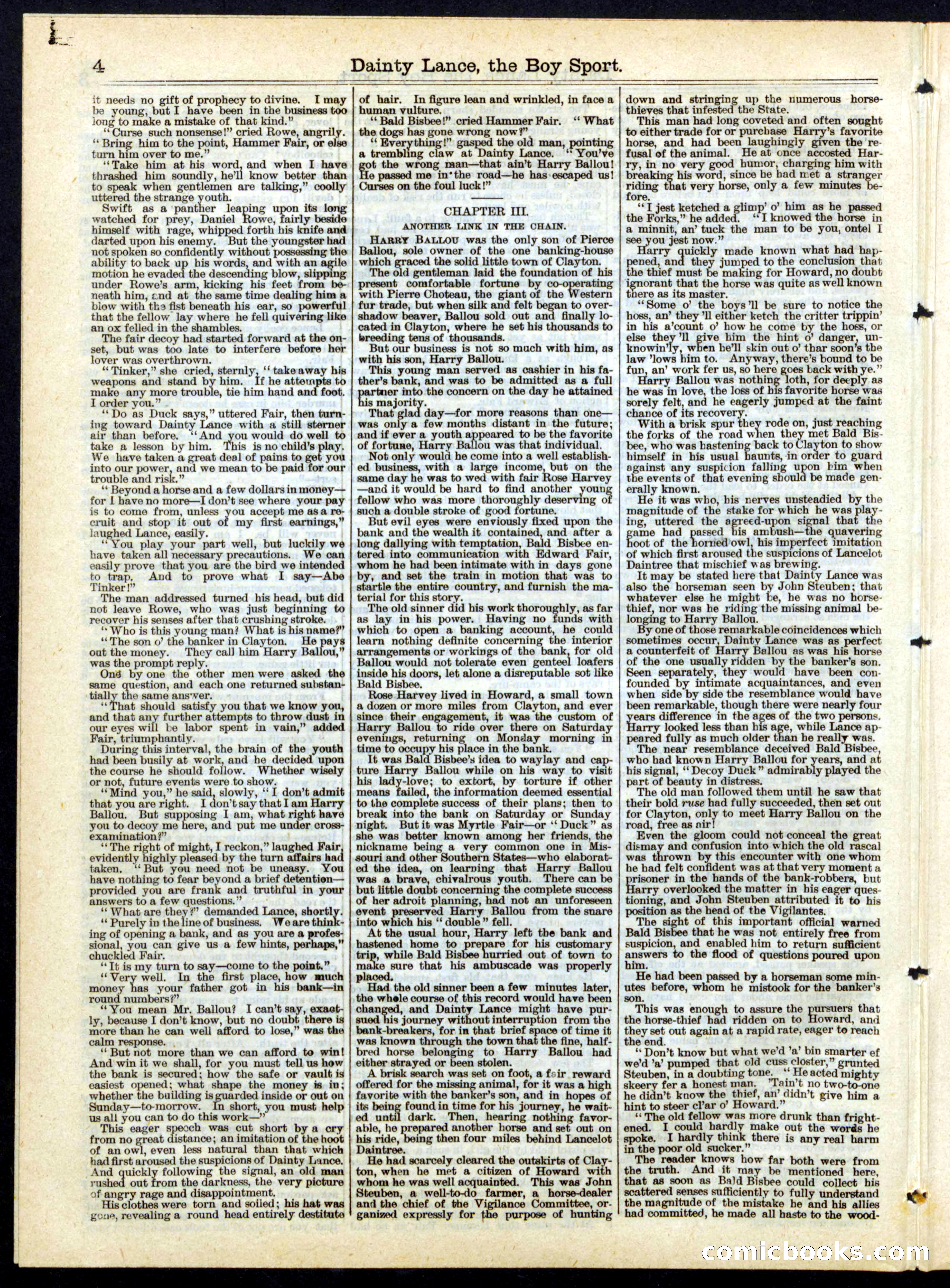
A restored page from Pulp Fiction, 1880. Page through the whole issue in the reader above.
📄 Transcribed text from this page (OCR, searchable)
Machine-transcribed from the original scan — historical spelling and the odd misread are preserved.
ee ee ee ee 4. Dainty Lance, the Boy Sport. _—- it needs no gift of prophecy to divine. I may be young, but I have been in the business too long to make a mistake of that kind.” ‘*Curse such nonsense!” cried Rowe, angrily. ‘Bring him to the point, Hammer Fair, or else turn him over to me.” ‘*‘Take him at his word, and when I have thrashed him soundly, he'll know better than to speak when gentlemen are talking,” coolly uttered the strange youth. Swift as a panther leaping we its long watched for prey, Daniel we, fairly beside himself with rage, whipped forth his knife and darted upon his enemy. But the youngster had not spoken so confidently without possessing the ability to back up his words, and with an agile motion he evaded the descending blow, sliggiue under Rowe’s arm, kicking his feet from be- neath him, cnd at the same time dealing him a blew with the fist beneath his ear, so powerful that the fellow lay where he fell quivering like an ox felled in the shambles. The fair decoy had started forward at the on- set, but was too late to interfere before her lover was overthrown. “Tinker,” she cried, sternly, ‘‘ takeaway his weapons and stand by him. if he attempts to make any more trouble, tie him hand and foot, I order you.” ‘*Do as Duck says,” uttered Fair, then turn- ing toward Dainty Lance with a still sterner air than before. ‘‘And you would do well to take a lesson by him. This is no child’s play. We have taken a great deal of pains to get you into our power, and we mean to be paid for our trouble and risk.” ‘* Beyond a horse and a few dollars in money— for | have no more—I don’t see where your pay is to come from, unless » accept me as a re- eruit and stop it out of my first earnings,” laughed Lance, easily. “You play your part well, but luckily we have taken all necessary precautions. We can easily prove that you are the bird we intended to trap, And to prove what I say—Abe Tinker!” The man addressed turned his head, but did not leave Rowe, who was just beginning to recover his senses after that crushing stroke. ‘Who is this young man? at is his name?” ‘The son 0’ the banker in Clayton. He pays out the money. They cal) him Harry Ballou,” was the prompt reply. y one the other men were asked the same question, and each one returned substan- tially the same ans‘ver, ‘‘That should satisfy you that we know you, and that any further attempts to throw dust in our eyes will be labor spent in vain,” added Fair, triumphantly. During this interval, the brain of the youth had been busily at work, and he decided upon the course he should follow. Whether wisely or not, future events were to show. ‘*Mind you,” he said, slowly, ‘‘ I don’t admit that you are right. I don’t say that Iam Ballou. But supposing I am, what right have you to decoy me here, and put me under cross- examination?” | ‘*The right of might, I reckon,” laughed Fair evidently highly pleased by the turn affairs had taken, ‘‘ But you need not be uneasy. You have nothing to fear beyond a brief detention— provided you are frank and truthful in your answers to a few questions.” | ‘‘ What are they?’ demanded Lance, shortly. ‘Purely in the line of business. Weare - ing of opening a bank, and as you are a profes- sional, you can give us a few hints, per " chuckled Fair. “Tt is my turn to say—come to the point,” ¢¢ ary well. In the first place, how much money as your father got in his bank—in round numbers?” ‘You mean Mr. Ballou? I can’t say, exaet- ly, because I don’t know, but no doubt there is more than he can well afford to lose,” was the calm response. . ‘* But not more than we can afford to win! And win it we shall, for you must tell us how the bank is secured; how the safe or vault is easiest opened; what shape the money is in; whether the building is ed inside or out on Sunday—to-morrow. In short, you must help us ae you can to do —_ ria wage wee is eager § was cut sho a from no great Tehaneine an imitation of he hoot of an owl, even less natural than that which had first aroused the suspicions of Dainty Lance. And < Yuonr following the signal, an old man +p out from Pee mer very picture of an rage an ppointment, His clothes were torn and soiled; his hat was gone, revealing a round head entirely destitute -_----— -= of hair. In figure lean and wrinkled, in face a human vulture. ‘* Bald Bisbee!” cried Hammer Fair. ‘‘ What the dogs has gone wrong now?” “ Kverything!” gasped the old man, pointing a trembling claw at Dainty Lance. ‘ You’ve t the wrong man—that ain’t Harry Ballou! @ passed me in*the road—he has: escaped us! Curses on the foul luck!” CHAPTER UL ANOTHER LINK IN THE CHAIN. HARRY BALLOU was the only son of Pierce Ballou, sole owner of the one banking-house which the solid little town of Clayton. The old gentleman laid the foundation of his present comfortable fortune by ri ete with Pierre Choteau, the giant of the Western fur trade, but when silk and felt began to over- shadow beaver, Ballou sold out and finally lo- cated in Clayton, where he set his thousands to breeding tens of thousands. But our business is not so much with him, as with his son, Harry Ballou. This young man served as cashier in his fa- ther’s bank, and was to be admitted as a full mpeg into the concern on the day he attained m vem § ; That glad day—for more reasons than one— was only a few months distant in the future; and if ever a youth appeared to be the favorite of fortune, Harr ou was that individual. Not only would he come into a well establish- ed business, with a large income, but on the same day he was to wed with fair Rose Harvey —and it would be hard to find another youn fellow who was more thoroughly dese go such a double stroke of good fortune. But evil eyes were enviously fixed upon the bank and the wealth it contained, and after a long dallying with temptation, Bald Bisbee en- red into communication with Edward Fair, whom he had been intimate with in days gone by, and set the train in motion that was to startle the entire country, and furnish the ma- terial for this story. The old sinner did his work thoroughly, as far as lay in his power. Having no funds with which to open a banking account, he could learn nothing definite concerning the interior arrangements or workings of the bank, for old Ballou would not tolerate even genteel loafers inside his doors, let alone a disreputable sot like Bald Bisbee. Rose Harvey lived in Howard, a small town a dozen or more miles from Clayton, and ever since their engagement, it was the custom of Ballou to ride over there on Saturday evenings, returning on Monday morning in time to occupy his place in the bank. It was Bald Bisbee’s idea to waylay and cap- ture Harry Ballou while on his way to visit his lady-love; to extort, by torture if other means failed, the information deemed essential to the complete success of their plans; then to break into the bank on Saturday or Sunday night. Butit was Myrtle Fair—or ‘‘ Duck” as she was better known among her friends, the nickname being a very common one in Mis- souri and other Southern States—who elaborat- ed the idea, on learning that Harry Ballou was a brave, chivalrous youth. There can be but little doubt concerning the complete success of her adroit planning, had not an unforeseen event preserved Harry Ballou from the snare into which his “‘ double ” fell. At the usual hour, Harry left the bank and hastened home to pre for his customary trip, while Bald Bis urried out of town to e sure that his ambuscade was properly placed. Had the old sinner been a few minutes later, the whele course of this record would have been pare amy and regen d Lance might have pur- sued his journey without interruption from the bank-breakers, for in that brief of time it was known through the town that the fine, half- bred horse belonging to Harry Ballou had either strayed or stolen. A brisk search was set on foot, a fsir reward offered for the missing animal, for it was a high favorite with the banker’s son, and in hopes of its being found in time for his journey, he wait- ed until dark. Then, hearing nothing favor- able, he poaeene another horse and set out on poten ing then four miles behind Lancelot ntree. He had scarcely cleared the outskirts of Tr ton, when he met a citizen of Howard with whom he was well acquainted. This was John Steuben, a well-to-do farmer, a horse-dealer and the chief of the V ce Committee, or- ganized expressly for purpose of hunting -———-—- -- = - —— — down and stringing up the numerous horse- thieves that infested the State. This man had long coveted and often sought to either trade for or purebase ’s favorite horse, and had been laughingly given the re- fusal of the animal. hoe at ne were con , in no very good bumor, charging him wit broakin his Sond: since he bad met a stranger —— that very horse, only a few minutes be- ore ‘*T jest ketched a glimp’ o’ him as he passed the Forks,” he added. ‘I knowed the horse in a minnit, an’ tuck the man to be you, ontel I see you jest now.” arry Sone | made known what had hap- pened, and they jumped to the conclusion that the thief must be making for Howard, no doubt ignorant that the horse was quite as well known tnere as its master. *“Some o’ the boys’ll be sure to notice the hoss, an’ they ’ll either ketch the critter trippin’ in his a’count 0’ how he come by the hoss, or else they ll give him the hint o’ danger, un- knowin’ly, when he’ll skin out o’ thar soon’s the law 'lows him to. Anyway, there’s bound to be fun, an’ work fer us, so here goes back with ye.’’ arry Ballou was nothing loth, for deeply as he was in love, the loss of his favorite horse was sorely felt, and he eagerly jumped at the faint chance of its recovery. With a brisk spur as 3 rode on, just reaching the forks of the road when they met Bald Bis- bee, who was bastening back to Clayton to show himself in his usual haunts, in order to guard against any suspicion falling upon bim when the events of that evening should be made gen- erally known. He it was who, his nerves unsteadied by the magnitude of the stake for which he was pe - ing, uttered the ager = — that the ame had passed his ambush—the quavering Foot of the horred’owl, his imperfect imitation of which first aroused the suspicions of Lancelot Daintree that mischief was brewing. It may be stated here that Dainty Lance was also the horseman seen by John Steuben; that whatever else he might be, he was no horse- thief, nor was he riding the missing animal be- longing to Harry Ballou. By one of those remarkable coincidences which sometimes occur, Dainty ce was as perfect a counterfeit of Harry Ballou as was his horse of the one usually ridden by the banker’s son. Seen separately, they would have been con- founded by intimate acquaintances, and even when side by side the resemblance would have been remarkable, though there were nearly four ears difference in the ages of the two persons. arry looked less than h age, while Lance ap- peared fully as much older than be really was. The near resemblance deceived Bald Bisbee, who had known Harry Ballou for years, and at his signal, ‘‘ Decoy Duck” admirably played the part of beauty in distress. The old man followed them until he saw that their bold ruse had fully succeeded, then set out for Clayton, poms to meet Harry Ballou on the road, free as air Even the gloom could not conceal the great dismay and confusion into which the old rascal was thrown by this encounter with one whom he had felt confident was at that very moment a risoner in the hands of the bank-robbers, but Hairy overlooked the matter in his eager ques- tioning, and John Steuben attributed it to his position as the head of the Vigilantes. The sight of this important official warned Bald Bisbee that he was not entirely free from suspicion, and enabled him to return sufficient answers to the flood of questions poured upon him. He had been by a horseman some min- utes before, whom he mistook for the banker’s son. This was enough to assure the pursuers that the horse-thief had ridden on to Howard, and they set out again at a rapid rate, eager to reach the end. ‘* Don’t know but what we'd ’a’ bin smarter ef we'd ’a’ pumped that old cuss closter,” grunted Steuben, in a doubting tone. ‘* He acted mighty skeery fer a honest man. "Tain’t no two-to-one he didn't know the thief, an’ didn’t give him a hint to steer cl’ar 0’ Howard.” ‘The old fellow was more drunk than fright- ened. I could hardly make out the words he spoke. I hardly think there is any real harm in the poor old sucker.” The reader knows how far both were from the truth. And it may be mentioned here, that as soon as Bald Bisbee could collect his scattered senses sufficiently to fully understand the magnitude of the mistake he and his allies had committed, he made all haste to the wood- Eomicbooks.co : ‘