
Pulp Fiction, 1879 · page 2 of 16
Beadle's Half Dime Library, No. 118 — page 2: what you’re looking at
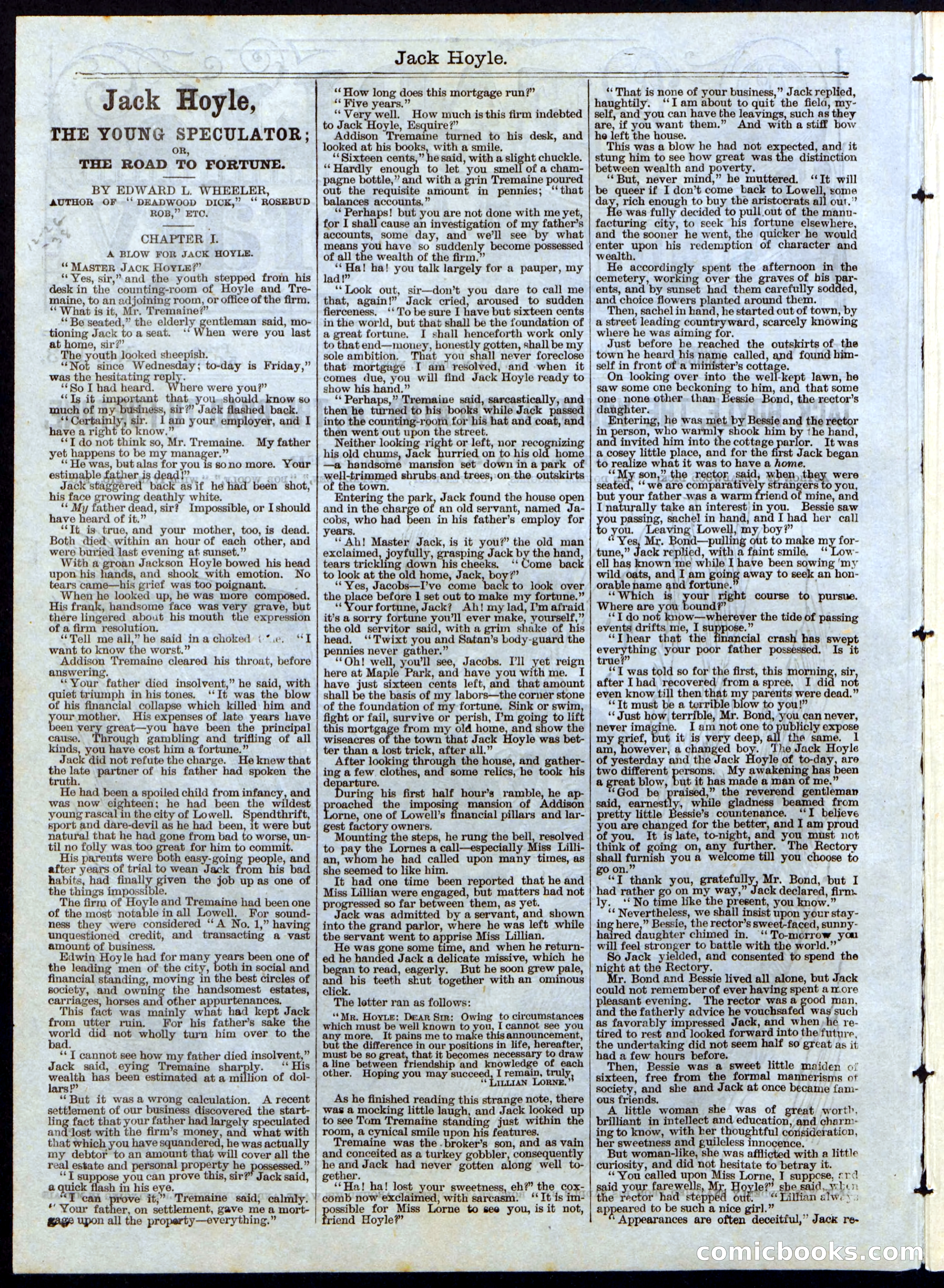
A restored page from Pulp Fiction, 1879. Page through the whole issue in the reader above.
📄 Transcribed text from this page (OCR, searchable)
Machine-transcribed from the original scan — historical spelling and the odd misread are preserved.
0 re ee ne eee ee ee Jack Hoyle, THE YOUNG SPECULATOR; OR, THE ROAD TO FORTUNE. BY EDWARD L. WHEELER, AUTHOR OF ‘‘ DEADWOOD DICK,” ‘‘ ROSEBUD ROB,” ETC. of i CHAPTER I. A BLOW FOR JACK HOYLE. “MASTER JACK HOYLE?” * Yes, sir,” and the youth stepped from his desk in the counting-room of Hoyle and Tre- maine, to an adjoining room, or office of the firm. ‘What is it, Mr. Tremaine?” ‘Be seated,” the elderly gentleman said, mo- tioning Jack toa seat. ‘‘ When were you last at home, sir?” The youth looked sheepish. “Not since Wednesday; to-day is Friday,” was the hesitating reply. ‘So I had heard. here were you?” ‘(Ts it important that you. should.know so much of my business, sir?’ Jack flashed back. ‘¢ Certainly, sir. 1am your employer, and I have a right to know.” **T do not think so, Mr. Tremaine. My father yet happens to be my manager.” 8 ‘He was, but alas for you is sono more. Your estimable father is dead!” Jack staggered back as if he had been shot, his face growing deathly white. ** My father dead, sir? Impossible, or I should have heard of it.” ‘“*Tt is true, and your mother, too, is dead. Both died. within an hour of each other, and were buried last evening at sunset.” With a groan Jackson Hoyle bowed his head upon his hands, and shook with emotion. No tears came—his grief was too poignant. When he looked up, he was more composed. His frank, handsome face was very grave, but there lingered about his mouth the expression of a firm resolution. | “Tell me all,” he said ina choked i’.e. “I want to know the worst.” Addison Tremaine cleared his throat, before answering. *““Your father died insolvent,” he said, with quiet triumph in his tones. ‘It was the blow of his financial collapse which killed him and our mother. His expenses of late years have een very great—you have been the principal cause. Through gambling and trifling of all kinds, you have cost him a fortune.” Jack did not refute the charge. He knew that alg partner of his father had spoken the He had been a spoiled child from infancy, and was now eighteen; he had been the wildest young rascal in the city of Lowell. Spendthrift, sport and vil as he had been, it were but natural that he had gone from bad to worse, un- til no folly was too great for him to commit. His parents were both cany Soing Rene and after years of trial to wean Jack from his bad habits, had finally given the job up as one of the things impossible. The firm of ws he and Tremaine had been one of the most notable in all Lowell. For sound- ness they were considered ‘A No, 1,” havi unquestioned credit, and transacting a v amount of business. Edwin Hoyle had for many years been one of the leading men of the city, both in social and financial standing, moving in the best circles of society, and owning the handsomest estates, carriages, horses and other appurtenances. This fact was mainly what had kept Jack from utter ruin. For his father’s sake the world did not wholly turn him over to the ‘* I cannot see how my father died insolvent,” Jack said, eying Tremaine sha : ae wealth has been estimated ata million of dol- ‘But it was a wrong calculation. A recent settlement of our business discovered the start- ling fact that your father had largely speculated and lost with the firm’s money, and what with that which you have squandered, he was actually ma debtor ie an amount that we cover all the real estate and personal property he possessed. “T suppose on can prove this, sir?’ Jack said, a quick h in his eye. . ‘Tcan prove it,” Tremaine said, calmly. ‘Your father, on settlement, gave me a mort- &AgP upon all the property—everything.” Jack Hoyle. -_—_- -—_ ‘How long does this mortgage run?” ** Five years.” well. How much is this firm indebted oyle, Esquire?” Addison Tremaine turned to his desk, and looked at his books, with a smile. ‘*Sixteen cents,” he said, with a slight chuckle. “Hardly enough to let you smell of a cham- pagne bottle,” and with a grin Tremaine poured out the requisite amount in pennies; “that balances accounts,” ‘Perhaps! but you are not done with me yet, for I shall cause an investigation of my father’s accounts, some day, and we'll see by what means you have so suddenly become possessed of all the wealth of the firm.” oe ha! you talk largely for a pauper, my a ‘* Look out, sir—don’t you dare to call me that, again!” Jack cried, aroused to sudden erceness. ‘‘ To be sure I have but sixteen cents in the world, but that shall be the foundation of a great fortune. I shall henceforth work only to that end—money, honestly gotten, shall be my sole ambition. That you shall never foreclose that mortgage I am resolved, and when it comes due, you will find Jack Hoyle ready to show his hand.” ‘* Perhaps,” Tremaine said, sarcastically, and then he turned to his books while Jack into the counting-room for his hat and coat, and then went out upon the street. Neither looking right or left, nor recognizing his old chums, Jack hurried on to his old home —a handsome mansion set down in a park of well-trimmed shrubs and trees, on the outskirts of the town. Entering the park, Jack found the house open and in the charge of an old servant, named Ja- cobs, who had been in his father’s employ for years. ‘‘ Ab! Master Jack, is it you?’ the old man exclaimed, joyfully, grasping Jack by the hand, tears trickling down his cheeks. ‘‘Come back to look at the old home, Jack, boy?’ ‘‘ Yes, Jacobs—I’ve come back to look over the une before 1 set out to make my fortune.” ‘Your fortune, Jack? Ah! my lad, I’m afraid it’s a sorry fortune you’ll ever make, yourself,” the old servitor said, with a grim shake of his head. ‘‘Twixt you and Satan’s body-guard the pennies never gather.” ‘‘Oh! well, you'll see, Jacobs. Pll yet reign here at Maple Park, and have you with me. have just sixteen cents left, and that amount shall be the basis of my labors—the corner stone of the foundation of my fortune, Sink or swim fight or fail, survive or perish, [m going to litt this mortgage from my old home, and show the wiseacres of the town that Jack Hoyle was bet- ter than a lost trick, after all.” After looking through the house, and gather- ing a few clothes, and some relics, he took his pears. uring his first half hour’s ramble, he ap- roached the imposing mansion of Addison rne, one of Lowell’s ncial pillars and lar- gest factory owners. Mounting the steps, he rung the bell, resolved to pay the Lornes a call—especially Miss Lilli- an, whom he had called upon many times, as she seemed to like him. It had one time been reported that he and Miss Lillian were engaged, but matters had not progressed so far between them, as yet. Jack was admitted by a servant, and shown into the grand parlor, where he was left while the servant went to apprise Miss Lillian. He was gone some time, and when he return- ed he handed Jack a delicate missive, which he n to read, eagerly. But he soon grew pale, — teeth shut gether with an ominous cli The letter ran as follows: ‘*Mr. Hoye: Dear Sm: Owing to circumstances which must be well known to you, [ cannot see you ony more. It pains me to make announcement, but the difference in our positions in life, hereafter, must be so arene, that it becomes necessary to draw a line between friendship and knowledge of each other. Hoping you may succeed, I remain, truly, ‘6 LILLIAN LORNE.,’ As he finished reading this strange note, there was a mocking little laugh, and Jack looked up to see Tom Tremaine standing just within the room, & cynical smile upon his features. Tremaine was the .broker’s son, and as vain and conceited as a turkey gobbler, consequently rote Jack had never gotten along well to- gether. ‘‘Ha! ha! lost your sweetness, eh?” the cox- comb now exclaimed, with sarcasm. ‘‘It is im- ossible for Miss Lorne to see you, isit not, friend Hoyle?’ — : = 7 SESS eae ns a ———— **That is none of your business,” Jack replied, haughtily. ‘‘I am about to quit the fiela, my- self, and you can have the leavings, such as they are, if you want them.” And with a stiff bow he left the house. This was a blow he had not expected, and it stung him to see how great was the distinction between wealth and poverty. ‘But, never mind,” he muttered. “It will be queer if I don’t come back to Lowell, some day, rich enough to buy the aristocrats all out.” e was fully decided to pull out of the manv- facturing city, to seek his fortune elsewhere, and the sooner he went, the quicker he would enter upon his redemption of character and wealth. He accordingly spent the afternoon in the cemetery, working over the graves of bis par- ents, and by sunset had them carefully sodded, and choice flowers planted around them. Then, sachel in hand, he started out of town, by a street leading countryward, scarcely knowing where he was aiming for. Just before he reached the outskirts of. the town he heard his name called, and found him- self in front of a minister’s cottage. On looking over into the well Be t lawn, he saw some one beckoning to him, and that some one none other. than Bessie Bond, the rector’s daughter. te Entering, he was met by Bessie and the rector in person, who warmly shook him by the hand, and invited him into the cottage P ae or. It was a cosey little place, and for the first Jack began to realize what it was to have a home. “My son,7, the rector said, when, they were seated, ‘‘ we are comparatively strangers to you, but your father was a warm friend of mine, and I naturally take an interest in you. Bessie saw ou passing, sachel in hand, and I had her call ou. Leaving Lowell, my boy?” “Yes, Mr. Bond—pulling out to make my for- tune,” Jack replied, with a faint smile. ‘‘ Low- ell has known me while I have been sowing ‘my wild. oats, and I am going away to seek an hon- orable e and fortune. a5 ch is your right course to pursue. Where are you bound?’ ‘‘T do not know—wherever the tide of passing events drifts me, I ener Ope: . 4} “Thear that the cial crash has swept eens your poor father possessed. Is it true?” ‘*T was told so for the first, this morning, sir after [had recovered from aspree, I di not even know till then that my parents were dead.” ‘Tt must be a terrible blow to you!” ‘‘ Just how terrible, Mr. Bond, you can never, never imagine. I am not one to publicly expose my grief, but it is very deep, the same. 1 am, however, a charged boy. The Jack Hoyle of yesterday and the Jack Hoyle of to-day, are two different persons. My awakening has been a great blow, but it has made a man of me.” ‘God be raised,” the reverend gentleman said, earnestly, while gladness beamed from pretty little Bessie’s countenance. ‘‘I believe you are changed for the better, and I am proud of you. It is late, to-night, and you must not think of going on, any further. The Rectory shall furnish you a welcome till you choose to on.” acs thank you, gratefully, Mr. Bond, but I had rather go on my way,” Jack declared, firm. ly. ‘* No time like the present, you know.” ‘¢ Nevertheless, we shail insist upon your stay- ing here,” Bessie, the rector’s sweet-faced, sunny- aughter chimed in. ‘‘ To-morrow you will feel stronger to battle with the world.” So Jack yielded, and consented to spend the night at the Rectory. . Bond and Bessie lived all alone, but Jack could not remember of ever having spent a more pleasant evening. The rector was a good man, and the fatherly advice he vouchsafed was such as favorably impressed Jack, and when he re- tired to rest and looked forward into the future, the undertaking did not seem half so great as it had a few hours before. Then, Bessie was a sweet little maiden o/ sixteen, free from the formal mannerisms ot society, and she and Jack at once became fam- ous friends. A little woman she was of great wort!. brilliant in intellect and education, and charm- ing to know, with her thoughtful consideration, her sweetness and guileless innocence. But woman-like, she was afflicted with a little curiosity, and did not hesitate to betray it. ‘You called a Miss Lorne, I sup erd pose, id your farewe e?” she said, when the Pactor had raes: Boule éTaltian alwes; ap to be such a nice girl.” 3 ‘Appearances are often deceitful,” Jack re- EGomic SS 900 (G0)