
Pulp Fiction, 1902 · page 4 of 16
Beadle's Half Dime Library No. 1126 — page 4: what you’re looking at
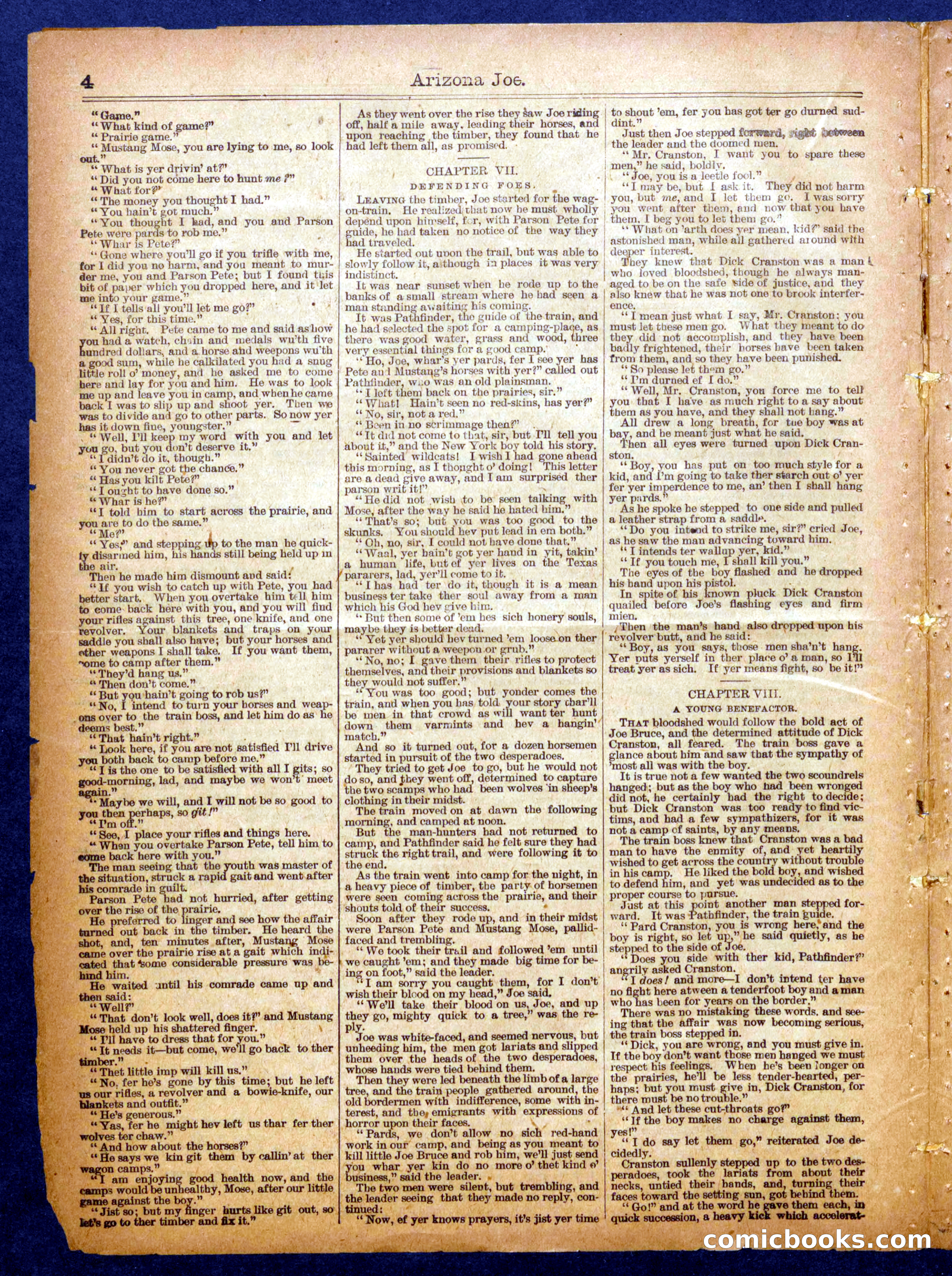
A restored page from Pulp Fiction, 1902. Page through the whole issue in the reader above.
📄 Transcribed text from this page (OCR, searchable)
Machine-transcribed from the original scan — historical spelling and the odd misread are preserved.
4b ac Game.” “What kind of game?” “ Prairie game.” ‘Mustang Mose, you are lying to me, so look out.”’ * What is yer drivin’ at?’ “Did you not come here to hunt me ?” “What for?’ ““The money you thought I had.” * You hain’t got much.” “You thought I had, and you and Parson Pete wére pards to rob me.” ‘Whar is Pete?” ‘* (Gone where you'll go if you trifle with me, for I did you no harm, and you meant to mur- der me, you and Parson Pete; but I found this bit of payer which you dropped here, and it ‘let me into your game.” “Tf J tells ‘all you'll let me go?” “Yes, for this time.” | “Allright. Pete came to me and said as'how ou had a watch, chain and medals wu’th five undred dollars, and a. horse ahd weepons wu'th a good sum, while he calkilated you had a snug little roll o’ money, and he asked me to come here and lay for you and him. He was to look me up and leave you in camp, and when he came back I was to slip up and shoot yer. Then we was to divide and go to other parts. So now yer has it down fine, youngster.” os _ © Well, Pll keep my word with you and let you go, but you di m’t deserve it,” “7 didn’t do it, though.” “You never got the chance,” “ Has you kilt Pete?” ‘“T oucht to have done so.” “Whar is he?” “T told him to start across the prairie, and you are to do the same.” “ Me?” “* Yos”’ and stepping up to the man he quick- disarmed him, his hands still being held up in 6 air. Then he made him dismount and said: *If you wish to catch up with Pete, you had better start. When you overtake him tell him to come: back here with you, and you will find eo. your rifles against this tree, one knife, and one *_vevolver. Your blankets and traps on your /.~ saddle you shall also have; but your horses and "ether weapons I shall take. If you want them, ys *ome to camp after them.” met “ They'd hang us.” “Then don’t come.” “But you’hain’t going to rob us?” “No, t intend to turn your borses and weap- ons over to the train boss, and let him do as he deems best.” “That hain’t right.” . “ Took here, if you are not satisfied Pll drive both back to camp before me,” ‘7 is the one to be satisfied with all I gits; so good-morning, lad, and maybe we won’t’ meet ’ *Maybe we will, and I will not be so good to you ig eee so git / _* See, I place your rifles and things here. _ “When you overtake Parson Pete, tell him to -eome back here with you.” ~ The man seeing that the youth was master of | the situation, struck a rapid gait and went. after his comrade in gut 9 Parson Pete had not hurried, after getting "© over the rise of the praizic, vee He preferred to linger and see how the affair out back in the timber. He heard the - shot, and, ten minutes after, Mustang Mose "came over the prairie rise at a gait which indi- ~ cated that some considerable pressure was be- ~~ He waited antil his comrade came up and > then said: : meee) ss ** Well? ' + “That don’t look well, does it?” and Mustang Mose held up his shattered finger. ‘ _ * Pil have to dress that for you.” '" “Tt needs it—but come, we'll go back to ther .. * Thet little imp will kill us.” ~~ . “WNo, fer he’s gone by this time; but he left eS our rifles, a revolver and a bowie-knife, our blankets and outfit.” _. “He's generous.” "+ “Yas, fer he might hev left us thar fer ther . wolves ter chaw.” it _ And how about the horses?” tay says we kin git them by callin’ at ther camps. | am ng good health now, and the Pattee anhealthy, Mose, after our little - game against the boy.” . | | _ “Jist so; but my r hurts like git out, so “Jets go to ther timber and fix it. Wey Somes a wt ma A 3 ‘ ‘Lwits> ¥ ae rv $)% ” 7 . - att: . %- a 7) * ” =*; ae ed of . ‘ ' ¥ : “a Sit} fie a ae ‘ : ' “a ~.. * Shoe ys “a von te nee * ' sg 48: + all b i BA 3 n : a) ate “4 ‘ "ey yi ’ roy! i, & ts vai |” ’ ReMi oN ke Ae P > ; , i She Mae ; 4 v 45 +A ; es ee ae rs Wal “a. a | | | | rizona Joé. As they went over the rise they Saw Joe riding off, half a mile away, leading their horses, and upon reaching the timber, they found that he had left them all, as promised. CHAPTER DEFENDING LEAVING the timber, Joe started for the wag- on-train. He realizedjthat now be must. wholly depénd upon himself, for, with Parson Pete for geuide, he had taken no notice of the way they had traveled. He started out uvon the trail, but was able to VIL. FOES, | slowly follow it, aithough in places it Was very — ee ee ~ Ar feline ® pl - et * ay i ey ed - “” ; es” ’ . > - 2” * s indistinct. It was near sunset when he rode up to the banks of asmall stream where he bad seen a man standing awaiting his coming. It was Pathfinder, the gnide of the train, and | he had selected the spot for a camping-plage, as | there was good water, grass and wood, three very essential things for a good camp. ; ‘“Ho, Joe, whar’s yer pards, fer I see yer has Pete and Mustang’s horses with yer?” called out Pathfinder, wo was an old plainsman. | ‘* T joft them back on the prairies, sir.” ‘What! Hain’t seen no red-skins, has yer?” ‘¢ No, sir, not a red,” ** Boen in no scrimmage then?” . ‘‘Tt did not come to that, sir, but [ll tell you | about it,” and the New York boy told his story, | ‘‘Sainted wildeats! I wishl had gone ahead this morning, as I thonght o’ doing! This letter are a dead give away, and lam surprised ther parson writ it!” ‘“‘Hedid not wish to be seen talking with Mose, after the way he said he hated him,” ‘‘That’s so; but you was too good to the skunks, You should hev put lead in em both.” ‘‘ Oh, no, sir, I could not have done that,” ‘“Waal, yer bain’t got yer hand in yit, takin’ a human life, butef yer lives on the Texas pararers, lad, yer’ll come to if. ‘‘Thas had ter do it, though it is a mean business ter take ther soul away from a man which his God hev give him. * But then some of ’em hes sich honery souls, maybe they is better dead. ‘* Yet yer should hev turned ’em loose_on ther pararer without a weepon.or grub.” ‘‘No, no; I gave them their rifles to protect themselves, and their provisions and blankets so they would not suffer.” “You was too good; but yonder comes the | train, and when you has told pe story cbar’ll be men in that crowd as will want ter hunt down them varmints and hev a hangin’ match.” And so it turned out, for a dozen horsemen started in pursuit of the two desperadoes. They tried to get Joe to go, but he would not doso, and fhey went off, determined to capture the two scamps who had been wolves ‘in sheep’s clothing in their midst. The train moved on at dawn the following morning, and camped at noon. But the man-hunters bad not returned to cainp, and Pathfinder said he felt sure they had struck the right trail, and were following it to the end. As the train went into camp for the night, in a heavy piece of timber, the party of horsemen were seen coming across the prairie, and their | shouts told of their success. ‘ | Soon after they rode up, and in their midst | were Parson Pete and Mustang Mose, pallid- | faced and trembling. ‘We took their trail and followed ’em until we caught ’em; and they made big time for be- | ing on foot,” said the leader. | ‘I am sorry you caught them, for I don’t | wish their blood on my head,” Joe said, ‘“‘ We'll take their blood on us, Joe, and up they go, mighty quick to a tree,” was the re- | y: | Joe was white-faced, and seemed nervous, but uvheeding him, the men got lariats and slipped | them over the heads of the two desperadoes, | whose hands were tied behind them. Then they were led beneath the limb ofa large tree, and the train people gathered around, the old bordermen with indifference, some with in- terest, and the, emigrants with expressions of | horror upon their faces. ‘Qe : “ Pards, we don’t allow no sich red-hand work in our camp, and being as you meant to you whar yer kin do no more o’ thet kind @’ usiness,” said the leader. . The two men were silent, but trembling, and the leader seeing that they made no reply, con- rae So i ra A : al kill little Joe Bruce and rob him, we'll just send | “Now, ef yer knows prayers, it’s jist yer time quick al ~*~ ‘ ’ : . y Ny “eRe is lay ery i 73 say (ed 2 - ‘, rip.) , ee to shout ’em, fer you has got ter go durned sud- dint.” Just then Joe stepped forward, sight Vebween the leader and the doomed men, ‘‘Mr. Cranston, I want you to spare these | men,” he said, boldly. ‘* Joe, you is a leetle fool.” ‘‘T may be, but I ask it. They did not harm you, but me, and I let them go. I was sorry you went after them, and now tbat you have them, I beg you to let them go.” ‘+ ‘What on ’arth does yer mean, kid? said the astonished man, while all gathered around with deeper interest. They knew that Dick Cranston was a man | who loved bloodshed, though he always man- aged to be on the safe side of justice, and they | also knew that he was not one to brook interfer- ence, ‘‘T mean just what I say, Mr. Cranston: you must let these men go. What they meant to do they did not accomplish, and they have been badly frightened, their borses bave been taken from them, and so they have been punished. ‘* So please let them go.” ‘*?'m durned ef I do.” ‘* Well, Mr. Cranston, you force me to tell you that I have as much right to a say about them as you have, and they shall not hang.” All drew a long breath, for tue boy was at bay, and he meant just what he said, ‘hen all eyes were turned upon Dick Cran- ston. ‘* Boy, you has put on too much style for a kid, and I’m going to take ther starch out o’ yer fer yer imperdence to me, an’ then I shall hang yer purds.” As he spoke he stepped to one side and pulled a leather strap from a saddle. ‘“Do you intend to strike me, sir?’ cried Joe, as he saw the man advancing toward him. ‘* T intends ter wallup yer, kid.” ‘Tf you touch me, I shall kill you.” The eyes of the boy flashed and he dropped his band upon his pistol. In spite of his known pluck Dick Cranston quailed before Joe’s flashing eyes and firm mien, ,Then the man’s hand also dropped upon his revolver butt, and he said: ‘‘ Boy, as you says, those men sha’n’t hang. Yer vuts yerself in ther place o’ a man, so | treat yer as sich. If yer means fight, so be it!” CHAPTER VITi. A YOUNG BENEFACTOR. THAT bloodshed would follow the bold act of Joe Bruce, and the determined attitude of Dick Cranston, all feared. The train boss gave a glance about him and saw that the sympathy of ’most all was with the boy. It is true not a few wanted the two scoundrels hanged; but as the boy who had been wronged did not, he certainly had the right to decide; but Dick Cranston was too ready to find vic- tims, and had a few sympathizers, for it was not a camp of saints, by any means, The train boss knew that Cranston was a bad man to have the enmity of, and yet heartil wished to get across the country without trouble in hiscamp. He liked the bold boy, and wished to defend him, and yet was undecided as to the proper course to pursue. Just at this point another man ste ward. It was Pathfinder, the train guide. ‘‘Pard Cranston, you is wrong here;and the boy is right, so let up,” he said quietly, as he stepped to the side of Joe. ‘Does you side with ther kid, Pathfinder?” for- | angrily asked Cranston. ‘ I does! and more—I don’t intend ter have no fight here atween a tenderfoot boy and aman | who has been for years on the border.” There was no mistaking these words, and see- ing that the affair was now becoming serious, | the train boss stepped in. ‘‘ Dick, you are wrong, and you must give in. If the boy don’t want those men hanged we must respect his feelings. When he’s been longer on the prairies, he'll be less tender-hearted, per- haps; but you must give in, Dick Cranston, for there must be no trouble.” ~* And let these cut-throats go?” “If the boy makes no charge against them, es!” mc I do say let them go,” reiterated Joe cidedly. } Cranston sullenly stepped up to the two des- peradoes, took the lariats from about their necks, untied their bands, and, tu - their faces toward the setting sun, got bebind ‘* Go!” and at yer he gave | ag ts fh is ia ‘< fe! ~ vi uy ue. "Aid ee - + y my eet y 1 Wey’ om ‘as wy: add p | ——~w