
Pulp Fiction, 1879 · page 15 of 24
Beadle's Half Dime Library No. 105 — page 15: what you’re looking at
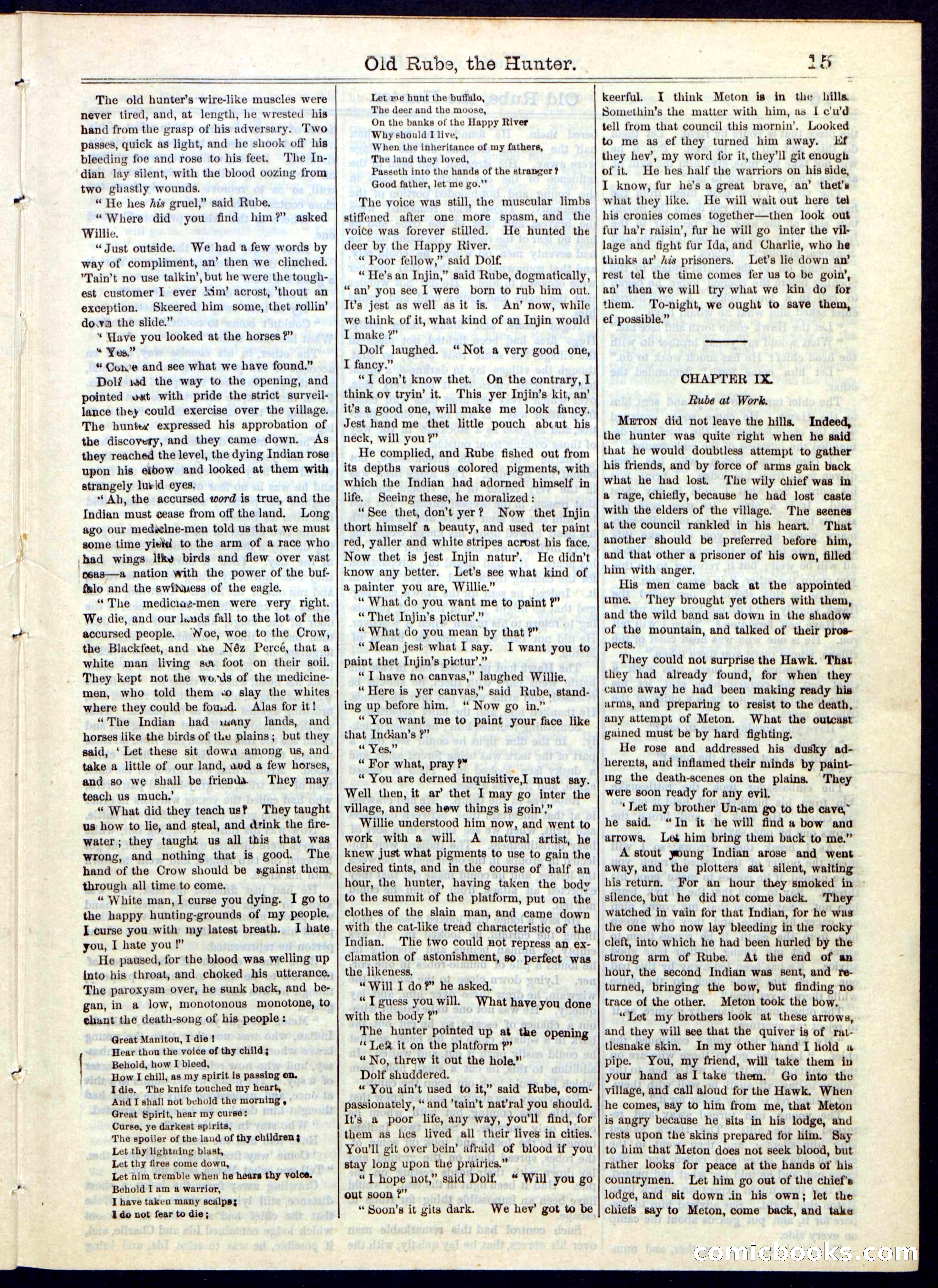
A restored page from Pulp Fiction, 1879. Page through the whole issue in the reader above.
📄 Transcribed text from this page (OCR, searchable)
Machine-transcribed from the original scan — historical spelling and the odd misread are preserved.
rm me a Se ee a ——-— The old hunter’s wire-like muscles were never tired, and, at length, he wrested his hand from the grasp of his adversary. Two passes, quick as light, and he shook off his bleeding foe and rose to his feet. The In- dian lay silent, with the blood oozing from two ghastly wounds. “He hes his gruel,” said Rube. “Where did you find him?” asked Willie. “Just outside. We had a few words by way of compliment, an’ then we clinched. 'Tain’t no use talkin’, but he were the tough- est customer I ever kim’ acrost, ’thout an exception. Skeered him some, thet rollin’ do.va the slide.” “ Have you looked at the horses?” % Yous.” “ Oon'e and see what we have found.” Dolf 1d the way to the opening, and pointed vat with pride the strict surveil- lance they could exercise over the village. The huntey expressed his approbation of the discovery, and they came down. As they reached the level, the dying Indian rose upon his elbow and looked at them with strangely luxld eyes. “Ah, the accursed word is true, and the Indian must cease from off the land, Long ago our medwine-men told us that we must some time yield to the arm of a race who ‘had wings like birds and flew over vast o6as—a nation with the power of the buf- ‘falo and the swinness of the eagle. “The mediciag-men were very right. We die, and our lauds fall to the lot of the accursed people. Woe, woe to the Crow, the Blackfeet, and we Néz Percé, that a white man living sev foot on their soil. They kept not the words of the medicine- men, who told them .o slay the whites where they could be found. Alas for it! “The Indian had sswzany lands, and horses like the birds of the plains; but they said, ‘ Let these sit down among us, and take a little of our land, avd a few horses, and so we shall be friend& They may teach us much,’ “ What did they teach usf They taught us how to lie, and steal, and drink the fire- water; they taught us all this that was wrong, and nothing that is good. The hand of the Crow should be against them, through all time to come. “ White man, I curse you dying. I go to the happy hunting-grounds of my people. I curse you with my latest breath. I hate you, I hate you!” He paused, for the blood was welling up into his throat, and choked his utterance. The paroxysm over, he sunk back, and be- gan, in a low, monotonous monotone, to chant the death-song of his people : Great Manitou, I die! Hear thou the voice of thy child; Behold, how I bleed, How I chill, as my spirit is passing on. Idie. The knife touched my heart, And I shall not behold the morning , Great Spirit, hear my curse: Curse, ye darkest spirits, The spoiler of the land of thy children 3 Let thy lightning blast, Let thy fires come down, Let him tremble when he hears thy voice. Behold I am a warrior, I have taken many scalps; ido not fear to die; ee Old Rube, the Hunter. — eee Let me hunt the buffalo, The deer and the moose, On the banks of the Happy River Why should I live, When the inheritance of my fathers, The land they loved, Passeth into the hands of the stranger? Good father, let me go.”’ The voice was still, the muscular limbs stiffened after one more spasm, and the voice was forever stilled. He hunted the deer by the Happy River. “ Poor fellow,” said Dolf. “ He’s an Injin,” said Rube, dogmatically, “‘an’ you see I were born to rub him out. Tt’s jest as well as it is. An’ now, while we think of it, what kind of an Injin would I make ?” Dolf laughed. I fancy.” “T don’t know thet. On the contrary, I think oy tryin’ it. This yer Injin’s kit, an’ it’s a good one, will make me look fancy. Jest hand me thet little pouch abcut his neck, will you ?” He complied, and Rube fished out from its depths various colored pigments, with which the Indian had adorned himself in life. Seeing these, he moralized : “See thet, don't yer? Now thet Injin thort himself a beauty, and used ter paint red, yaller and white stripes acrost his face. Now thet is jest Injin natur’.. He didn’t know any better. Let’s see what kind of a painter you are, Willie.” “What do you want me to paint ?” “ Thet Injin’s pictur’.” “What do you mean by that ?” “ Mean jest what I say. I want you to paint thet Injin’s pictur’.” “T have no canvas,” laughed Willie. “ Here is yer canvas,” said Rube, stand- ing up before him, “ Now go in.” “ You want me to paint your face like that Indian’s ?” “ Yes,” “For what, pray ?” ; “You are derned inquisitive,I must say. Well then, it ar’ thet I may go inter the village, and see hew things is goin’,” Willie understood him now, and went to work with a will. A natural artist, he knew just what pigments to use to gain the desired tints, and in the course of half an hour, the hunter, haying taken the bodv to the summit of the platform, put on the clothes of the slain man, and came down with the cat-like tread characteristic of the Indian. The two could not repress an ex- clamation of astonishment, so perfect was the likeness. “Will I do?” he asked. “IT guess you will. What have you done with the body ?” The hunter pointed up at the opening “ Le& it on the platform ?” “ No, threw it out the hole.” Dolf shuddered. “ You ain’t used to it,” said Rube, com- passionately, “and ’tain’t nat’ral you should. It’s a poor life, any way, you'll find, for them as hes lived all their lives in cities. You'll git over bein’ afraid of blood if you stay long upon the prairies.” “T hope not,” said Dolf. out soon ?”’ “Soon’s it gits dark. We hev’ got to be “Not a very good one, “Will you go eee oe Le eee eee tee ene ee ee eH _ — eee ~~ keerful. I think Meton is in the hills Somethin’s the matter with him, as | c’u’d tell from that council this mornin’. Looked to me as ef they turned him away. if they hev’, my word for it, they’ll git enough of it. He hes half the warriors on his side, I know, fur he’s a great brave, an’ thet’s what they like. He will wait out here tel his cronies comes together—then look out fur ha’r raisin’, fur he will go inter the vil- lage and fight fur [da, and Charlie, who he thinks ar’ Ais prisoners. Let’s lie down an’ rest tel the time comes fer us to be goin’, an’ then we will try what we kin do for them. To-night, we ought to save them, ef possible.” CHAPTER IX, Rube at Work. Meron did not leave the hills. Indeed, the hunter was quite right when he said that he would doubtless attempt to gather his friends, and by force of arms gain back what he had lost. The wily chief was in a rage, chiefly, because he had lost caste with the elders of the village. The seenes at the council rankled in his heart. That another should be preferred before him, and that other a prisoner of his own, filled him with anger. His men came back at the appointed ume, They brought yet others with them, and the wild band sat down in the shadow of the mountain, and talked of their pros- pects, They could not surprise the Hawk. That they had already found, for when they came away he had been making ready his urms, and preparing to resist to the death, any attempt of Meton. What the outcast gained must be by hard fighting. He rose and addressed his dusky ad- herents, and inflamed their minds by paint- ing the death-scenes on the plains, They were soon ready for any evil. ‘Tet my brother Un-am go to the cave” he said. “In it he will find a bow anda arrows, Leé him bring them back to me.” A stout young Indian arose and went away, and the plotters sat silent, waiting his return. For an hour they smoked in — silence, but he did not come back. They watched in vain for that Indian, for he wag the one who now lay bleeding in the rocky cleft, into which he had been hurled by the strong arm of Rube. At the end of an hour, the second Indian was sent, and re- turned, bringing the bow, but finding no trace of the other. Meton took the bow, “Let my brothers look at these arrows, and they will see that the quiver is of rat- tlesnake skin. In my other hand I hold a pipe. You, my friend, will take them in your hand asI take them. Go into the village, and call aloud for the Hawk. When he comes, say to him from me, that Meton is angry because he sits in his lodge, and rests upon the skins prepared for him. Say to him that Meton does not seek blood, but rather looks for peace at the hands of his countrymen. Let him go out of the chief's lodge, and sit down .in his own; let the chiefs say to Meton, come back, and take EOMIGcDOOKS