
Pulp Fiction, 1897 · page 14 of 17
Beadle's Half Dime Library No. 1020 — page 14: what you’re looking at
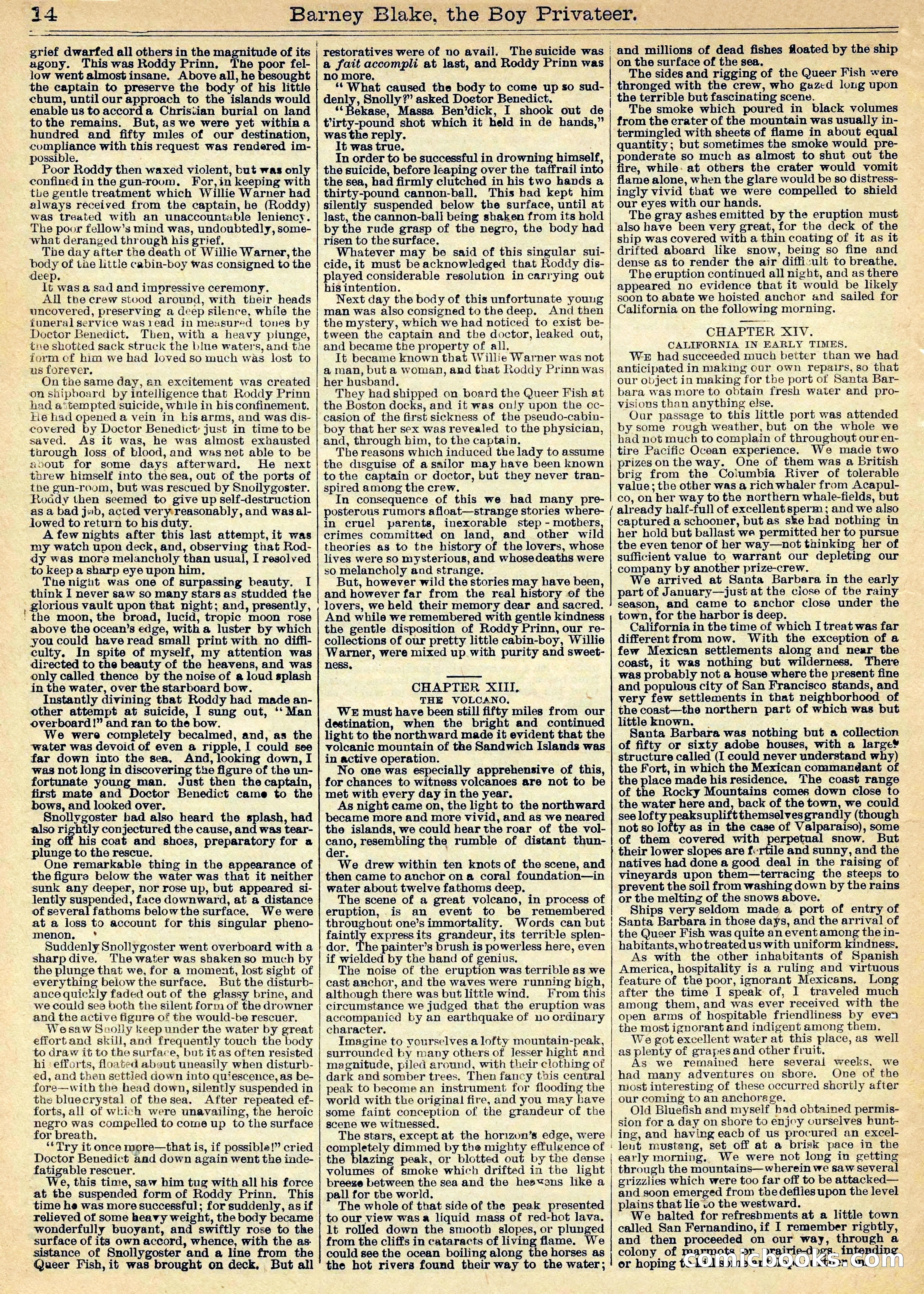
A restored page from Pulp Fiction, 1897. Page through the whole issue in the reader above.
📄 Transcribed text from this page (OCR, searchable)
Machine-transcribed from the original scan — historical spelling and the odd misread are preserved.
_— +: grief dwarfed all others in the magnitude of its agony. This was Roddy Prinn, The poor fel- low went almost insane. Above all, he besought the captain to preserve the body of his little chum, until our eppscess to the islands would enable us to accord a Chrisiian burial on land tothe remains. But, as we were yet within a hundred and fifty miles of our destination, compliance with this request was rendered im- possible. Poor Roddy then waxed violent, but was only confined in the gun-room, For,in keeping with tue gentle treatment which Willie Warner had always received from the captain, he (Roddy) was treated with an unaccountable leniency. The poor fellow’s mind was, undoubtedly, some- what deranged through his grief. _ The day after the death of Willie Warner, the ey of tie little cabin-boy was consigned to the deep, lt was a sad and imovressive ceremony. All the crew stood around, with their heads uncovered, preserving a deep silence, while the iuneral service was zead in measured tones by Doctor Benedict. Then, with a heavy piunge, tie shotted sack struck the blue waters, and the form of him we had loved so much was lost to ns forever, On the same day, an excitement was created on shipboard by intelligence that Roddy Prinn had attempted suicide, while in his confinement. tie had opened a vein in his arms, and was dis- covered by Doctor Benedict: just in time to be saved. As it was, he was almost exnausted tarough loss of blood, and was net able to be avout for some days afterward. He next threw himself into thesea, out of the ports of the gun-room, but was rescued by Snoilygoster. Roady then seemed to give up self-destruction as a bad jwb, acted veryreasonably, and wasal- lowed to return to his duty. A few nights after this last attempt, it was my watch upon deck, and, observing that Rod- dy was mors melancholy than usual, I resolved to keep a sharp eye upon him, The nigit was one of surpassing beauty. I think I never saw so many stars as studded the glorious vault upon that night; and, presently, the moon, the broad, lucid, tropic moon rose above the ocean’s edge, with a luster by which you could have read small print with no diffi- culty. In spite of myself, my attention was directed to the beauty of the heavens, and was only called thence by the noise of a loud splash in the water, over the starboard bow. Instantly divining that Roddy had made an- other attempt at suicide, I sung out, ‘‘ Man overboard!” and ran to the bow. We were completely becalmed, and, as the water was devoid of even a ripple, I could see far down into the sea. And, looking down, I was not long in discovering the figure of the un- fortunate young man. Just then the captain, first mate and Doctor Benedict came to the bows, and looked over. Snollygoster had also heard the splash, had also rightly conjectured the cause, and was tear- ing off his coat and shoes, preparatory for a plunge to the rescue. One remarkabie thing in the appearance of the figure below the water was that it neither sunk any deeper, nor rose up, but appeared si- lently suspended, face downward, at a distance of several fathoms below the surface. We were at a loss to account for this singular pheno- menon, ° Suddenly Snollygoster went overboard with a sharp dive. The water was shakenso much by the plunge that we, for a moment, lost sight of everything below the surface. But the disturb- ance quickly faded out of the glassy brine, and we could ses both the silent form of the drowner and the active figure of the would-be rescuer. Wesaw Snolly keep under the water by great effortand skill, and frequently touch the body to draw it to the surface, but if as often resisted hi ‘efforts, floated about uneasily when disturb- ed, and then settled down into quiescence, as be- fore—with the head down, silently suspended in tie bluecrystal of thesea. After repeated ef- forts, all of wkich were unavailing, the heroic negro was compelied to come up to the surface for breath. “‘Try it once more—that is, if possible!” cried Doctor Benedict and down again went the inde- fatigable rescuer. e, this time, saw him tug with all his force at the suspended form of Roddy Prinn. This time he was more successful; for suddenly, as if Telieved of some heavy weight, the body became wonderfully buoyant, and swiftly rose to the surface of its own accord, whence, with the as- sistance of Snollygoster and a line from the Queer Fish, it was brought on deck, But all Barney Blake, restoratives were of no avail. Thesuicide was a fait accompli at last, and Reddy Prinn was no more, ‘‘ What caused the body to come up so sud- denly, Snolly?” asked Doctor Benedict. ‘*Bekase, Massa Ben’dick, I shook out de t’irty-pound shot which it held in de hands,” was the reply. It was true. . In order to be successful in drowning himself, the suicide, before leaping over the taffrail into the sea, had firmly clutched in his two hands a thirty-pound cannon-ball. This had kept him silently suspended below the surface, until at last, the cannon-ball being shaken from its hold by the rude grasp of the negro, the body had risen to the surface. Whatever may be said of this singular sui- cide, it must be acknowledged that Roddy dis- played considerable resolution in carrying out his intention. Next day the body of this unfortunate young man was also consigned to the deep. And then the mystery, which we had noticed to exist be- tween the captain and the doctor, leaked out, and became the property of all. It became known that Willie Warner was not a man, but a woman, and that Roddy Prinn was her husband. They had shipped on board the Queer Fish at the Boston docks, and it was only upon the oc- casion of the first sickness of the pseudo-cabin- boy that her sex was revealed to the physician, and, through him, to the captain. The reasons which induced the lady to assume the disguise of assilor may have been known tothe captain or doctor, but they never tran- spired among the crew. In consequence of this we had many pre- osterous rumors afloat—strange stories where- in cruel parents, inexorable step - mothers, crimes committed on land, and other wild theories as to the history of the lovers, whose lives were so mysterious, and whosedeaths were so melancholy and strange. But, however wild the stories may have been, and however far from the real history of the lovers, we held their memory dear and sacred. And while we remembered with gentle kindness the gentle disposition of Roddy Prinn, our re- collections of our pretty little cabin-boy, Willie Warner, were mixed up with purity and sweet- ness, CHAPTER XIII, THE VOLCANO, : WE must have been still fifty miles from o destination, when the bright and continued light to the northward made it evident that the volcanic mountain of the Sandwich Islands was in active operation. No one was especially apprehensive of this, for chances to witness volcanoes are not to be met with every day in the year. As night came on, the light to the northward became more and more vivid, and as we neared the islands, we could hear the roar of the vol- ae resembling the rumble of distant thun- er. We drew within ten knots of the scene, and then came to anchor on a coral foundation—in water about twelve fathoms deep. The scene of a great volcano, in process of eruption, is an event to be remembered throughout one’s immortality. Words can but faintly expressits grandeur, its terrible splen- dor. The painter’s brush is powerless here, even if wielded by tne hand of genius. The noise of the eruption was terrible as we cast anchor, and the waves were running high, although there was but little wind. From this circumstance we judged that the eruption was accompanied by an earthquake of no ordinary character. Imagine to yourselves a lofty mountain-peak, surrounded hy many others of lesser hight and magnitude, piled around, with their clothing of dark and somber trees. Then fancy this central peak to become an instrument for flooding the world with the original fire, and you may have some faint conception of the grandeur of the scene we witnessed. The stars, except at the horizon’s edge, were the blazing peak, or blotted out by the dense volumes of smoke which drifted in the light breeze between the sea and the hes<ens like a pall for the world, The whole of that side of the peak presented to our view was a liquid mass of red-hot lava. 1t rolled down the smooth slopes, or plunged from the cliffs in cataracts of living flame. We could see the ocean boiling along the horses as the hot rivera found their way to the water; ; | —————— nel SS NO lard dimmed by the mighty effulgence of + the Boy Privateer. and millions of dead fishes floated by the ship on the surface of the sea. The sides and rigging of the Queer Fish were thronged with the crew, who gazed loug upon the terrible but fascinating scene. The smoke which poured in black volumes from the crater of the mountain was usually in- termingled with sheets of flame in about equal quantity ; but sometimes the smoke would pre- ponderate so much as almost to shut out the fire, while: at others the crater would vomit flame alone, when the glare would be so distress- ingly vivid that we were compelled to shield our eyes with our hands. The gray ashes emitted by the eruption must also have been very great, for the deck of the ship was covered with a thin coating of it as it drifted aboard like snow, being so fine and dense as to render the air difficult to breathe. The eruption continued all night, and as there appeared no evidence that it would be likely soon to abate we hoisted anchor and sailed for California on the following morning. CHAPTER XIV. CALIFORNIA IN EARLY TIMES. W-5 had succeeded much better than we had anticipated in making our own repaurs, so that our object in making for the port of Santa Bar- bara was more to obtain fresh water and pro- visions than anything else. Our passage to this little port was attended by some rough weather, but on the whole we had not much to compiain of throughout our en- tire Pacific Ocean experience. We made two prizeson the way. One of them was a british brig from the Columbia River of tolerable value; the other was a rich whaler from Acapul- co, on her way to the northern whale-fields, but already half-full of excellent sperm; and we also captured a schooner, but as ske kad nothing in her hold but ballast we permitted her to pursue the even tenor of her way—not tninking her of sufficient value to warrant our depleting our company by another prize-crew. We arrived at Santa Barbara in the early part of January—just at the ciose of the rainy season, and came to snchor close under the town, for the harbor is deep. California in the time of which I treat was far different from now. With the exception of a few Mexican settlements along and near the coast, it was nothing but wilderness. There was probably not a house where the present fine and populous city of San Francisco stands, and very few settlements in that neighborhood of the coast—the northern part of which was but little known. - : Santa Barbara was nothing but a collection of fifty or sixty adobe houses, with a large* structure called (I could never understand why) the Fort, in which the Mexican commandant of the place made his residence, The coast range of the Rocky Mountains comes down close to the water here and, back of the town, we could see lofty peaksupliftthemselves grandly (though not so lofty as in the case of Valparaiso), some of them covered with perpetual snow. But their lower slopes are fc rtile and sunny, and the natives had done a good deal in the raising of — vineyards upon them—terracing the steeps to prevent the soil from washing down by the rains or the melting of the snows above. Ships very seldom made a port of entry of Santa Barbara in those days, and the arrival of the Queer Fish was quite an event among the in- habitants, whotreated us with uniform kindness, As with the other inhabitants of Spanish America, hospitality is a ruling and virtuous feature of the poor, ignorant Mexicans. Long after the time I speak of, I traveled much among them, and was ever received with the open erms of hospitable friendliness by even the most ignorant and indigent among them. We got excellent water at this place, as well as plenty of grapes and other fruit. As we remained here several weeks, we had many adventures on shore. One of the most interesting of these occurred shortly after our coming to an anchorage. Old Bluefish and myself had obtained permis- sion for a day on shore to enjcy ourselves hunt- ing, and having each of us procured an excel- lent musteng, set off at a brisk pace in the early morning. We were not long in getting through the mountains— wherein we saw several grizzlies which were too far off to be attacked— and soon emerged from the deflies upon the level plains that lie wo the westward. We halted for refreshments at a little town called San Fernandino, if I remember rightly, and then proceeded on our way, through a or hoping or PBA =k Feomiecbooksicom