
Pulp Fiction, 1866 · page 74 of 97
Beadle's Dime Novels No. 96: Little Moccasin — page 74: what you’re looking at
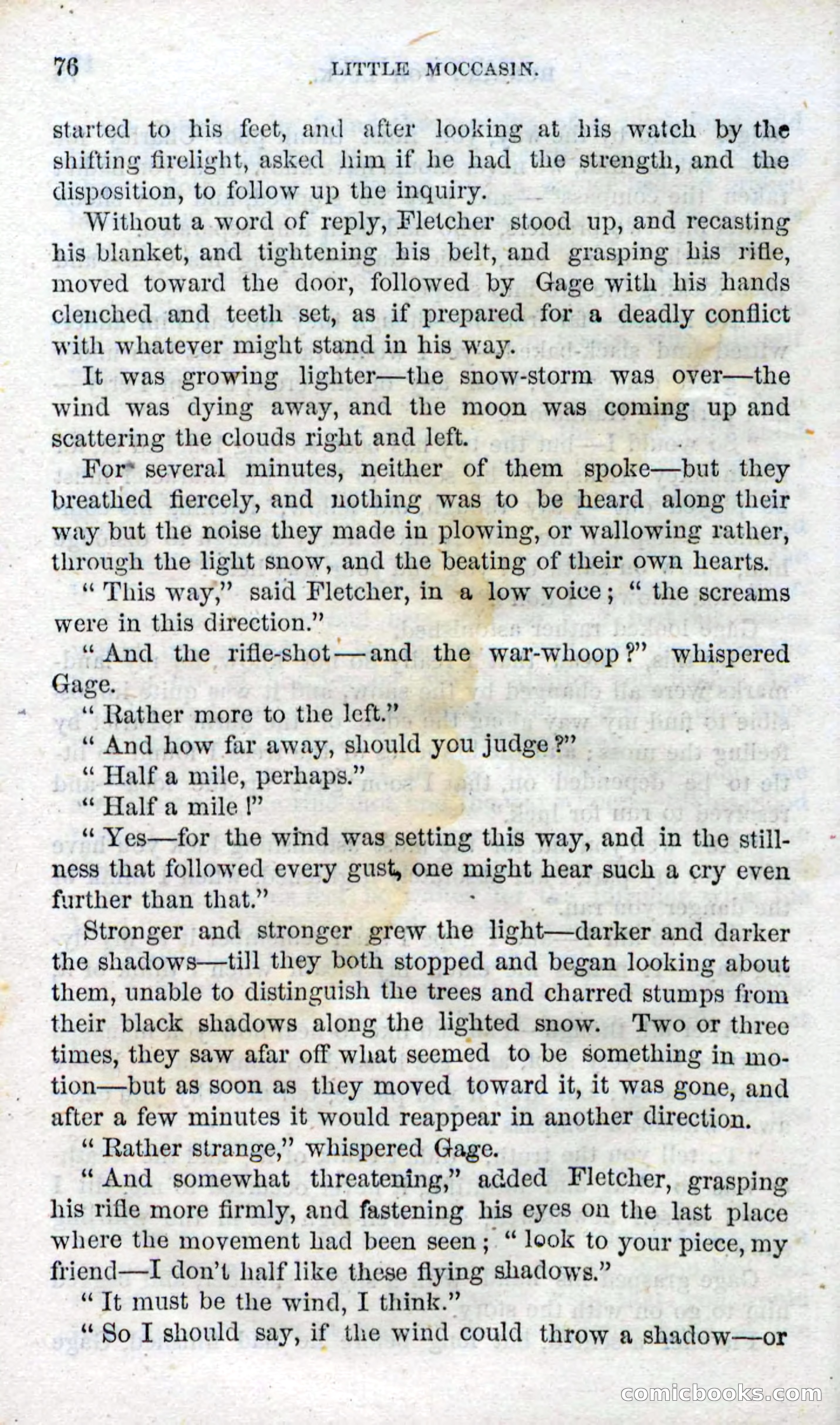
A restored page from Pulp Fiction, 1866. Page through the whole issue in the reader above.
📄 Transcribed text from this page (OCR, searchable)
Machine-transcribed from the original scan — historical spelling and the odd misread are preserved.
76 _ LITTLE MOCCASIN, started to his feet, and after looking at his watch. by the shifting firelight, asked him if he had the strength, and the disposition, to follow up the inquiry. Without a word of reply, Fletcher stood up, and recasting his blanket, and tightening his belt, and grasping his rifle, moved toward the door, followed by Gage with his hands clenched. and teeth set, as if prepared for a deadly conflict with whatever might stand in his way. | 7 It was growing lighter—the snow-storm was over—the wind was dying away, and the moon was coming up and scattering the clouds right and left. For* several minutes, neither of them spoke—but they breathed fiercely, and nothing was to be heard along their way but the noise they made in plowing, or wallowing rather, through the light snow, and the beating of their own hearts. K This way,” said Fletcher, in a low voice; “ the screams were in this direction.” “And. the rifle-shot—and the war-whoop?” whispered Gage. ‘‘ Rather more to the left.” _ “ And how far away, should you judge ?” “ Half a mile, perhaps.” “ Half a mile !” “ Yes—for the wind was setting this way, and in the still- ness that followed every gust, one pig hear such a cry even further than that.” Stronger and stronger grew the light—darker and darker the shadows—till they both stopped and began looking about them, unable to distinguish the trees and charred stumps from their black shadows along the lighted snow. Two or three times, they saw afar off what seemed to be something in mo- tion—but as soon as they moved toward it, it was gone, and after a few minutes it would reappear in another direction. “ Rather strange,’ whispered Gage. “And somewhat threatening,” added Fletcher, grasping his rifle more firmly, and fastening his eyes on the last place where the movement had been seen; “look to your piece, my friend—TI don’t half like these flying shadows.” “Tt must be the wind, I think.” “So I should say, if the wind could throw a shadow—or connicloooks.com